 info@unicomposite.com


Introduction
Corrosion can turn a sound beam into a maintenance liability long before its planned service life ends. In wastewater plants, coastal facilities, substations, and chemical sites, repeated coating and shutdown costs may exceed the original structure’s price.
An FRP H-beam gives engineers and procurement teams a lightweight, corrosion-resistant option for selected structures. This guide explains how it is made, where it fits, how it compares with metals, and what buyers should verify before ordering.
What Is an FRP H-Beam?
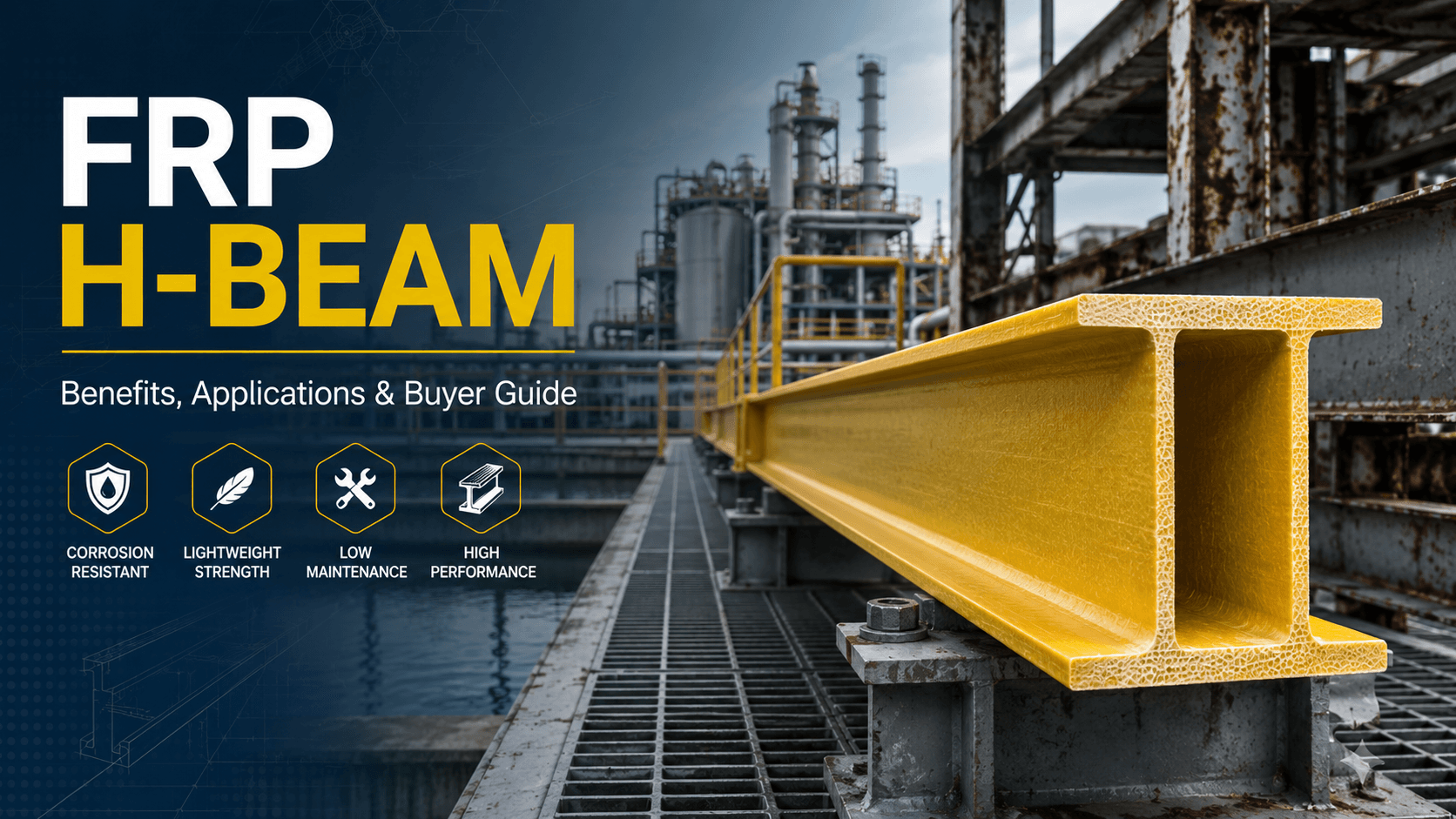
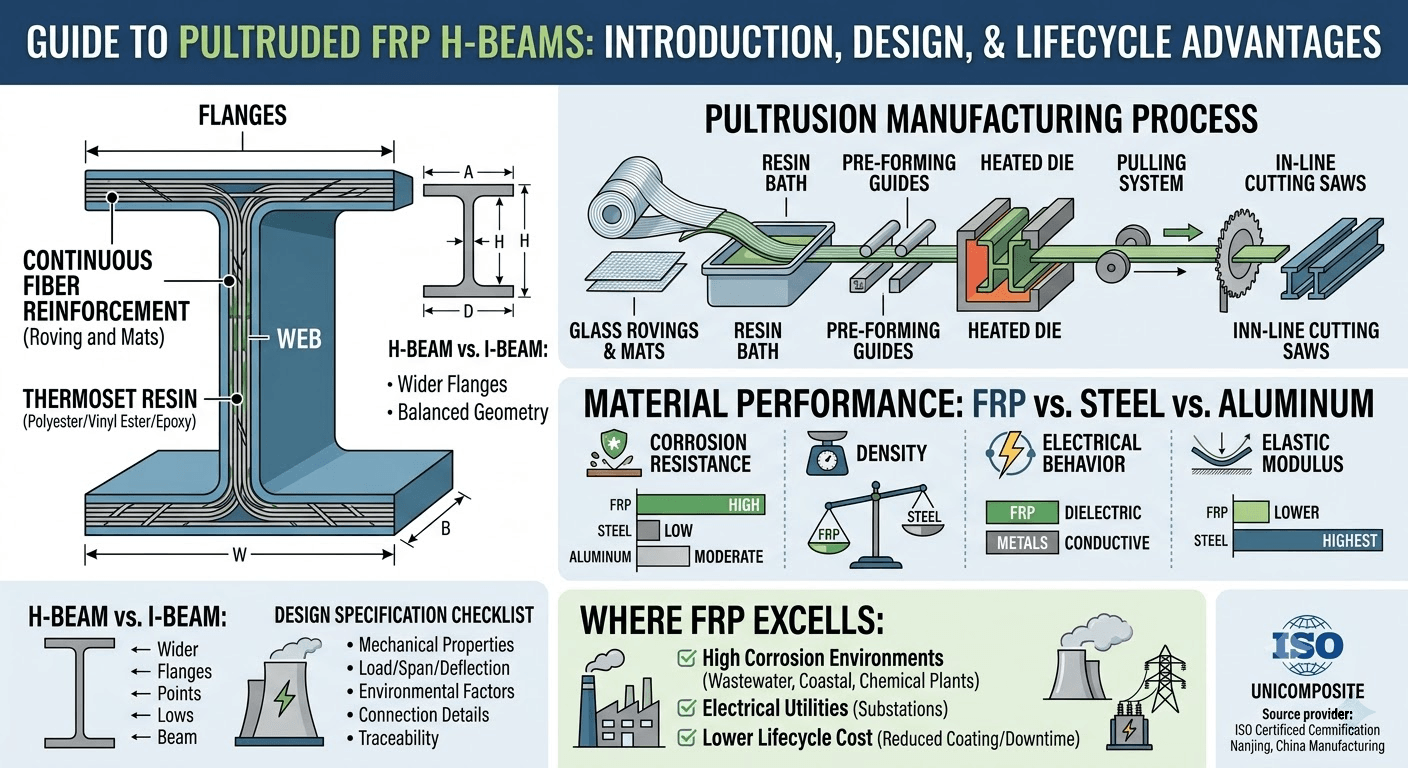
An FRP H-beam is a fiber-reinforced polymer profile with two flanges connected by a central web. Most structural versions use continuous glass fibers embedded in a thermoset resin to resist bending, shear, corrosion, and electrical exposure.
frp h beam
How FRP H-Beams Are Manufactured
Most profiles are pultruded. Glass rovings and mats pass through resin, enter a heated die, cure into a constant cross-section, and are cut to length.
Pultrusion places most continuous fibers along the beam, supporting longitudinal strength. Mats and surface veils improve transverse performance and surface protection. Fiber placement, resin content, cure temperature, and pulling speed all influence consistency.
What Materials Are Used in an FRP H-Beam?
Common resins include polyester, vinyl ester, and epoxy. Polyester suits many general industrial uses, while vinyl ester often provides stronger chemical and moisture resistance. Epoxy supports selected mechanical, thermal, or bonding requirements.
Reinforcement may include E-glass rovings, strand mat, surface veil, fillers, pigments, ultraviolet inhibitors, and fire-retardant additives.
How Is an FRP H-Beam Different From an I-Beam?
Naming varies among manufacturers. H-beams often have wider flanges or more balanced flange-to-web proportions, while I-beams may have narrower flanges. Buyers should compare dimensioned drawings, section modulus, moment of inertia, tolerances, and connection geometry rather than relying on the profile name.
How Does FRP H-Beam Compare With Steel and Aluminum?
FRP provides substantial weight savings, although its elastic modulus is much lower than steel. The following values support preliminary comparison only.
| Property | Pultruded FRP | Carbon Steel | Aluminum |
|---|---|---|---|
| Density | 1.7 to 2.0 g/cm³ | About 7.85 g/cm³ | About 2.7 g/cm³ |
| Elastic modulus | 17 to 35 GPa | About 200 GPa | About 69 GPa |
| Corrosion resistance | High with suitable resin | Usually needs protection | Moderate to high |
| Electrical behavior | Laminate-dependent dielectric performance | Conductive | Conductive |
| Routine coating | Usually low | Often required | Usually low |
Source note: These are representative industry ranges. Final design must use manufacturer-specific test results, design allowables, environmental reduction factors, and project safety factors.
Structural and Physical Property Comparison
Pultruded profiles may report tensile properties under ASTM D638, flexural properties under ASTM D790, and short-beam shear under ASTM D2344. Test direction matters because FRP is anisotropic.
Deflection often controls selection. A profile may pass an ultimate-strength check yet exceed the allowable movement under service loads, requiring a deeper section, shorter span, or intermediate support.
Where FRP Offers the Strongest Lifecycle Advantage
FRP often performs best where corrosion protection is difficult or shutdowns are expensive. Consider an anonymized wastewater platform exposed to humidity, chemical splash, and washdown. Steel supports required recoating every four years.
During a 20-year comparison, the owner included three future coating cycles, scaffold access, surface preparation, and downtime. Engineers selected vinyl ester FRP, shortened support spans, used oversized washers, and completed drilling before delivery.
Where Metal May Still Be the Better Choice
Steel may remain preferable for long spans, high stiffness, severe impact, elevated temperatures, or welded structures. Aluminum may suit lightweight applications where conductivity and galvanic interaction are manageable.
FRP must be designed as a composite material. Copying steel dimensions or connection details can create deflection and bearing problems.
When Should Engineers Use FRP H-Beam?
FRP H-beams offer the clearest value when corrosion resistance, dielectric behavior, low maintenance, or reduced handling weight solves a defined project problem.
Corrosive Industrial and Infrastructure Environments
Applications include wastewater plants, cooling towers, marine walkways, chemical facilities, bridges, platforms, and equipment frames. Chemical resistance must be checked against concentration, temperature, exposure duration, stress, and cleaning methods.
Supplier compatibility charts support screening, while written confirmation should cover the actual environment. Sealed cut edges and controlled fabrication can also limit exposed reinforcement.
Electrical and Utility Applications
Glass-fiber FRP can provide useful dielectric performance in substations, cable supports, and access platforms. Actual behavior depends on resin formulation, moisture, contamination, additives, surface condition, frequency, and test method.
Buyers should request verified electrical data and still follow site grounding, clearance, and local code requirements.
Agricultural and OEM Applications
Greenhouses, aquaculture systems, washdown areas, equipment frames, and repeat-production assemblies can benefit from corrosion resistance and consistent dimensions. Prefabricated holes, labeled parts, and repeatable cut lengths also reduce OEM assembly time.
When Should an FRP H-Beam Not Be Used?
FRP may be unsuitable where a project requires very high stiffness, unsupported long spans, continuous high temperature, severe impact resistance, or unverified structural performance. Engineers should also pause when creep, fire, connections, or environmental exposure have not been reviewed with manufacturer-specific data.
Hybrid structures can combine metal stiffness with FRP corrosion or electrical advantages.
guide to pultruded frp h beams
How Should an FRP H-Beam Be Designed and Specified?
A sound specification begins with loads, spans, supports, environment, service life, and applicable requirements.
Mechanical Properties and Section Geometry
Engineers should review tensile, compressive, flexural, and shear properties, plus elastic modulus, section modulus, moment of inertia, and weight. Reports should state the test method, fiber direction, conditioning, and whether values are averages, minimums, or design allowables.
Load, Span, and Deflection Requirements
Design inputs should include dead, live, concentrated, impact, and vibration loads; support conditions; creep; load duration; safety factors; and allowable deflection. A useful supplier request includes the clear span, load positions, operating temperature, and exposure.
Environmental, Fire, and Temperature Requirements
Specifications should define chemicals, concentration, ultraviolet exposure, moisture, temperature, flame spread, smoke development, and cleaning procedures. ASTM E84 may apply to fire testing, although local codes can require other methods.
Buyers should request the report for the proposed resin system and profile family because fire-retardant additives can affect smoke, finish, strength, and cost.
Connection and Fabrication Details
Bolted joints require checks for bearing stress, net-section strength, hole spacing, edge distance, washer size, gussets, and torque. Installers can crush laminate around holes by overtightening bolts. Large washers, controlled torque, accurate drilling, and clear instructions help distribute load.
Which FRP H-Beam Specifications Should Buyers Request?
A complete request for quotation should define geometry, material, performance, fabrication, and evidence.
| Item | Information to request | Why it matters | Evidence |
|---|---|---|---|
| Geometry | Full profile dimensions and tolerances | Confirms fit | Dimensioned drawing |
| Section properties | Weight, inertia, section modulus | Supports design | Engineering data sheet |
| Resin and reinforcement | Resin type, additives, fiber layout | Matches exposure and loads | Material declaration |
| Mechanical properties | Strength, shear, and modulus | Supports evaluation | Test report |
| Fire and surface system | Test results, veil, UV protection | Supports durability and compliance | Applicable reports |
| Fabrication and traceability | Cuts, holes, labels, batch ID | Reduces field risk | Approved drawing and batch record |
Product Specification Checklist
Buyers should distinguish representative test data from guaranteed design values. Substituting another resin, reinforcement layout, or thickness may change performance even when outside dimensions match.
Testing and Quality Documentation
Useful records include dimensional inspections, resin certificates, mechanical tests, fire reports, chemical-resistance guidance, and batch traceability. Reports should apply to the proposed material system and relevant profile family.
Customization and Manufacturing Capability
Custom work may require new dies, added reinforcement, special resins, machined holes, cut lengths, or assemblies. Unicomposite is an ISO 9001-certified FRP manufacturer in Nanjing, China, with an 18,000-square-meter facility and capabilities in pultrusion, pulwinding, molding, hand lay-up, and vacuum infusion. Pultrusion supports continuous longitudinal reinforcement, while pulwinding can improve transverse performance in selected geometries. In-house fabrication can also reduce connection errors.
How Can Buyers Evaluate Suppliers and Total Project Cost?
Supplier evaluation should cover technical support, production control, logistics, and lifecycle cost.
Compare Lifecycle Cost Instead of Unit Price
A credible model includes material, freight, fabrication, lifting, installation, coatings, inspections, access equipment, shutdowns, and replacement. It should state the evaluation period, coating frequency, and excluded costs so buyers can audit the result.
Review Engineering Support and Production Controls
Buyers should assess drawings, section data, tolerances, traceability, prototype support, and fabrication guidance. A capable supplier should explain which values are tested, guaranteed, or dependent on project engineering approval.
Confirm Packaging, Logistics, and Field Readiness
Long profiles need protective nesting, lifting points, bundle labels, container planning, and cut schedules. For bulk orders, buyers should request bundle weights, unloading instructions, and labels linked to fabrication drawings.
Conclusion
FRP H-beams can deliver strong value in corrosive, electrically sensitive, and maintenance-intensive environments.
- Verify strength and deflection using profile-specific data.
- Match the resin to chemicals, temperature, moisture, and fire requirements.
- Design connections for composite bearing behavior and controlled torque.
- Compare lifecycle cost, testing evidence, fabrication, and logistics alongside price.
Buyers should provide spans, loads, supports, exposure, dimensions, fabrication needs, and compliance requirements before requesting a final quotation.
[Contact Unicomposite for an FRP H-beam specification review and custom quote →]


