 info@unicomposite.com


Introduction
Tomato plants rarely fail because they are difficult to grow. They fail when the support system does not match the variety, row spacing, labor plan, harvest schedule, or field conditions.
For farms, greenhouses, nurseries, and market gardens, staking affects airflow, fruit quality, spray access, harvest speed, storage, and reuse cycles. This guide compares methods for growers who need repeatable support.
Why Tomato Plants Need Proper Support
Before choosing a stake or frame, growers need to define the job the support system must do. Tomatoes become heavy, dense, and difficult to handle once fruit sets begin.
tomato staking methods for growers
Preventing Stem Breakage and Fruit Loss
Unsupported tomato plants can bend, sprawl, or collapse under fruit weight. That increases fruit contact with soil and slows harvesting. In field use, growers often underestimate support needs until the crop enters heavy fruiting.
A basic specification should include mature plant height, fruit load, row spacing, wind exposure, and anchoring depth. Total stake length should include above-ground support height plus below-ground insertion.
Improving Airflow, Spray Coverage, and Harvest Access
Vertical support improves airflow around the canopy and keeps foliage and fruit away from the ground. It also improves access for scouting, spraying, pruning, tying, and picking.
Labor efficiency matters at scale. A method that saves a few seconds per plant can become meaningful across thousands of plants.
Who needs tomato staking methods at scale?
Tomato staking methods matter most for farms, greenhouses, nurseries, market gardens, and distributors managing multiple rows or repeat seasonal planting. At scale, the best method depends on labor, row spacing, plant variety, support material, reuse cycles, storage, and harvest access.
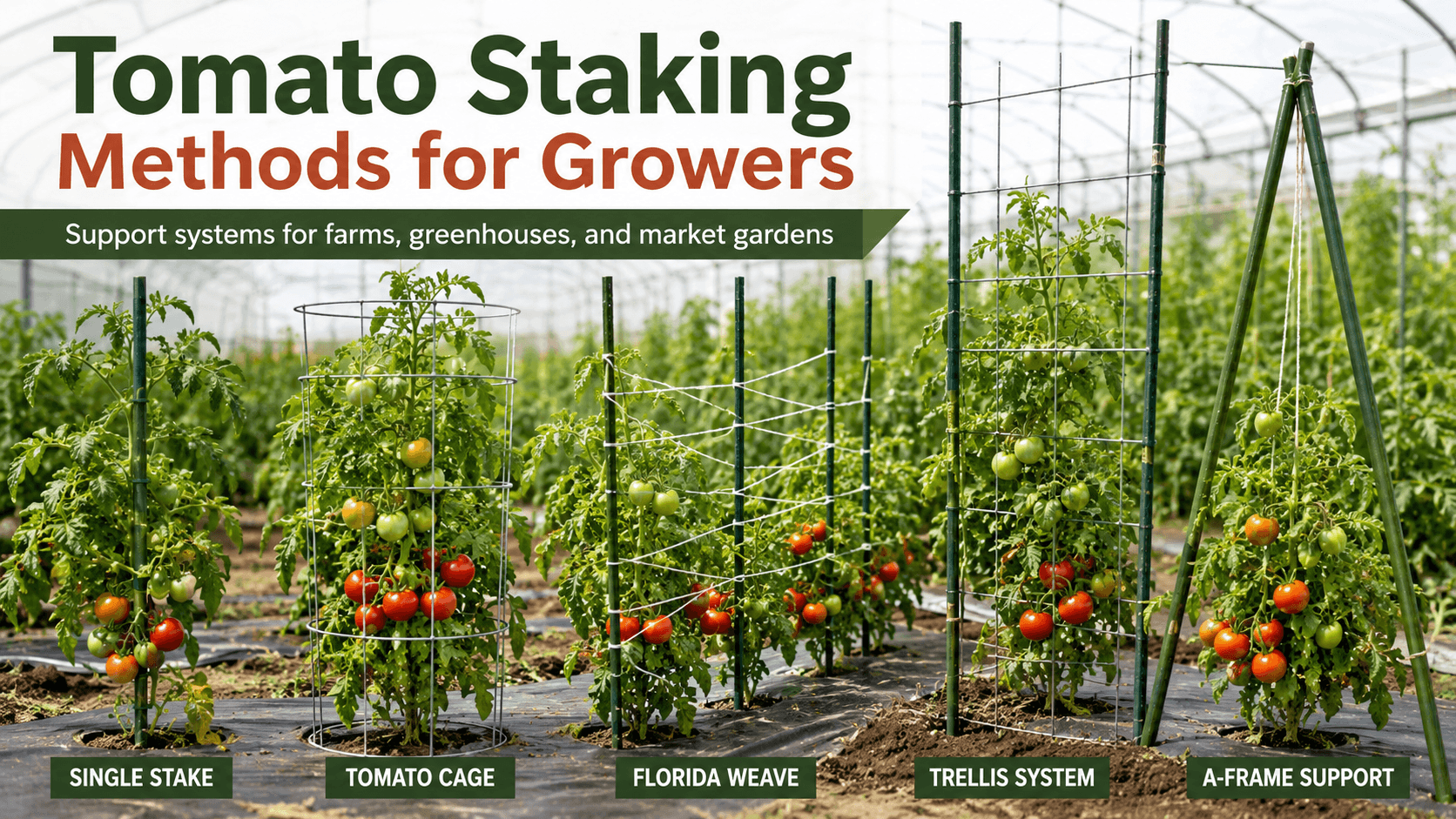
5 Common Tomato Staking Methods
Once the purpose is clear, growers can compare support methods by crop type and operating model. No single method fits every farm.
Single Stake Method
The single stake method supports each plant with one vertical stake tied to the main stem. It is simple, flexible, and easy to adjust as the plant grows.
Growers may use fiberglass, wood, bamboo, steel, or plastic-coated stakes. Tall indeterminate tomatoes usually need taller supports than compact determinate varieties because part of the stake stays below ground.
Tomato Cages
Tomato cages support branches and fruit clusters from multiple sides. They can reduce tying labor and work well for determinate varieties or smaller production systems.
The trade-off is storage. Cages are bulkier than straight stakes, which can create problems for farms that handle large volumes each season.
Florida Weave
The Florida weave uses stakes and twine to support a row of tomato plants. It fits market gardens and row-based operations because it balances material efficiency with structured support.
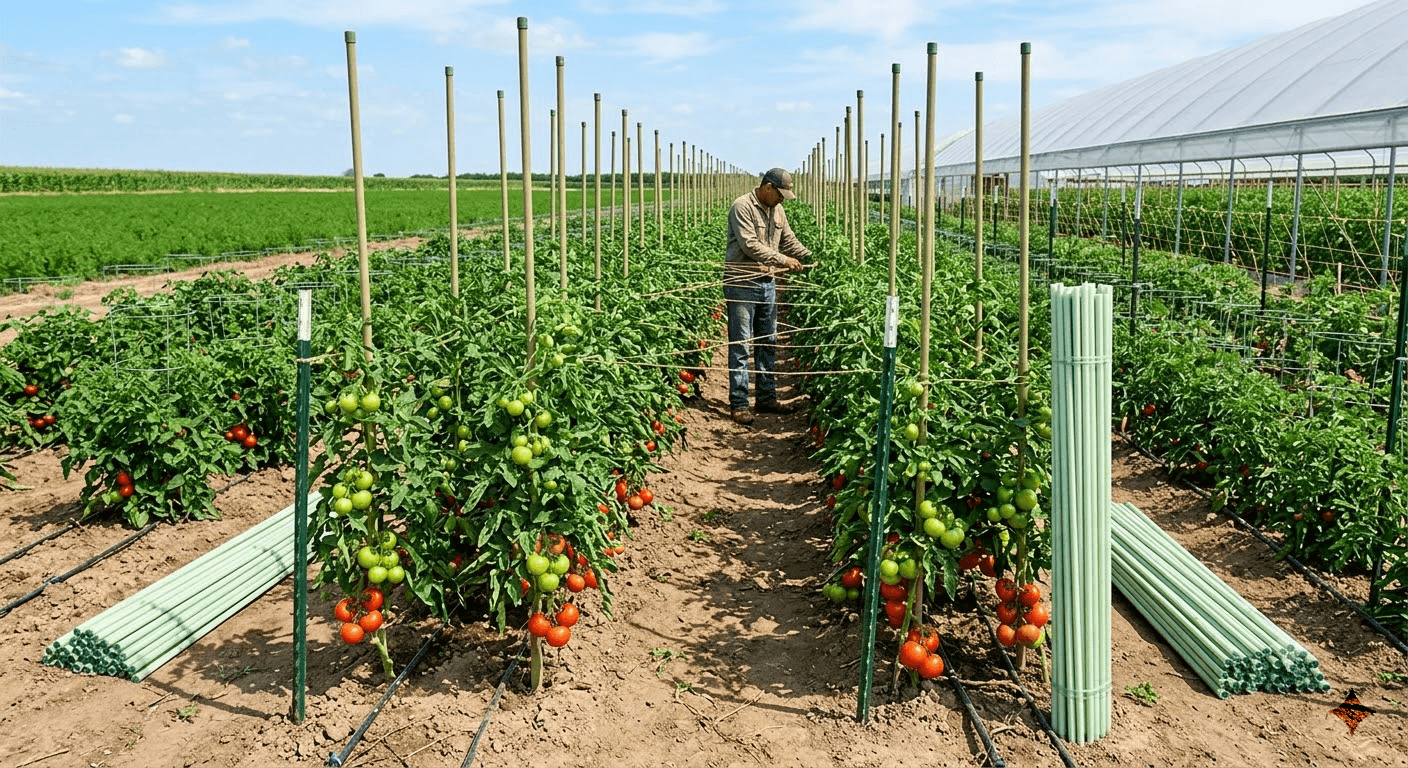
In an anonymized market-garden setup, the grower moved from mixed wood stakes to consistent fiberglass stakes in row ends and intervals, reducing sorting time before installation.
Trellis Systems
Trellis systems guide plants vertically using posts, wire, string, or overhead support. They are common in greenhouses, high tunnels, and higher-density systems.
Trellising works well for indeterminate tomatoes and controlled crop training. It requires more setup planning than basic staking, but it can improve canopy control and harvest access.
A-Frame Support
A-frame support creates a stronger angled structure for heavy plants or taller systems. It may use stakes, poles, or cross supports.
This method adds stability where fruit load is high, but it requires more material and labor. It usually fits targeted rows rather than every row in a large field.
Tomato staking method comparison
The table below compares common tomato support methods for growers evaluating labor, storage, and field fit:
| Method | Best For | Material | Labor | Buyer Note |
|---|---|---|---|---|
| Single stake | Individual plants | Fiberglass, wood, bamboo | Low-medium | Simple and flexible |
| Tomato cage | Determinate plants | Steel, coated wire | Medium | Bulky storage |
| Florida weave | Field rows | Stakes + twine | Medium | Efficient for rows |
| Trellis system | Greenhouses | Posts, wire, string | Higher | Strong canopy control |
| A-frame support | Heavy plants | Poles or stakes | Higher | Stable but more setup |
Method fit should come before material choice. A low-cost stake can become expensive if it increases tying labor, breaks during removal, or creates storage problems.
Why Fiberglass Stakes Work for Tomato Plants
After the support method is selected, material choice becomes the next major decision. Stakes must handle soil contact, moisture, handling, seasonal reuse, and storage.
Fiberglass vs Wood vs Metal Stakes
The table below compares common stake materials used in tomato support systems:
| Material | Durability | Moisture Resistance | Reuse | Buyer Note |
|---|---|---|---|---|
| Fiberglass | High when correctly sized | High | High | Lightweight repeat-use option |
| Wood | Medium | Low-medium | Medium | Can split or absorb moisture |
| Bamboo | Medium | Medium | Medium | Low-cost seasonal option |
| Steel | High | Coating-dependent | High | Strong but heavier |
| Plastic-coated | Medium | Medium-high | Medium | Check coating wear |
Fiberglass stakes are useful when growers need lightweight, moisture-resistant, corrosion-resistant supports that can be reused across seasons. Performance still depends on correct diameter, installation depth, handling, storage, and the chosen staking method.
When should growers choose fiberglass stakes for tomato plants?
Growers should consider fiberglass stakes when they need reusable, lightweight, moisture-resistant, corrosion-resistant supports for repeated field or greenhouse use. Fiberglass stakes are especially useful for bulk planting systems where consistent size, easy handling, long service life, and reliable seasonal reuse matter.
Consistency can be as valuable as strength. Wood and bamboo may vary in straightness, diameter, and surface quality, while fiberglass plant stakes can be produced with repeatable dimensions.
Where Fiberglass Stakes May Not Be the First Choice
Fiberglass is not always the first choice. Hobby gardens, short-term test plots, low-budget seasonal plantings, or permanent trellis systems may use bamboo, wood, cages, or fixed posts instead.
How to Choose Stakes for Tomato Plants in Bulk
Bulk purchasing changes the decision. A stake that works for 20 plants may not work for 20,000 plants if it creates sorting, storage, or installation problems.
Length, Diameter, and Spacing
Stake length should match tomato variety, mature plant height, soil depth, and support method. Total stake length should include above-ground support height plus insertion depth. Indeterminate tomatoes usually need taller supports, while compact determinate plants may use shorter stakes or cages.
Diameter affects stiffness and handling. Larger fruit load, windy fields, looser soil, or wider spacing may require thicker stakes or closer placement.
Field vs Greenhouse Requirements
Field rows face wind, rain, uneven soil, weather exposure, and seasonal storage needs. Field growers often care about anchoring, fast installation, visibility, and easy removal after harvest.
Greenhouse and high-tunnel systems usually prioritize repeatable layout, sanitation, crop training, aisle access, and compatibility with trellis or row systems.
What information should buyers send for a plant stake quote?
Buyers should send crop type, plant height, staking method, row spacing, required stake length and diameter, color, quantity, packaging, destination, and delivery schedule. For bulk orders, photos, drawings, or previous specifications help suppliers recommend a suitable plant stake configuration.
A clear RFQ reduces back-and-forth and prevents quotes based on wrong assumptions.
Bulk Plant Stake RFQ Checklist
The table below shows the basic information buyers should prepare before requesting a plant stake quote:
| RFQ Item | What to Provide | Why It Matters |
|---|---|---|
| Crop and system | Variety, field, greenhouse, nursery | Defines support needs |
| Size | Length, diameter, insertion depth | Affects stability |
| Color | Standard or custom | Helps row identification |
| Quantity | Pieces, bundles, container volume | Affects production |
| Packaging | Bundle, label, pallet needs | Supports handling |
| Destination and timing | Port, warehouse, deadline | Supports freight planning |
Bulk buyers should compare durability, handling, storage efficiency, packaging, and repeat-order consistency together with unit price.
Source Fiberglass Plant Stakes from Unicomposite
After growers define the method and specification, supplier capability becomes part of the purchasing decision. A reliable supplier should help buyers match the stake to the crop system.
ways to stake tomato plants
Product Fit
Unicomposite Technology Co., Ltd. is an ISO 9001 certified FRP and GRP composite manufacturer based in Nanjing, China, with an 18,000-square-meter facility. Its fiberglass plant stakes can support tomatoes, tree seedlings, nursery crops, greenhouse rows, agricultural supports, and landscape applications.
For growers and distributors, manufacturing consistency supports field planning. Repeatable diameter helps crews install stakes with the same handling process. Consistent length, color, and packaging make seasonal reorders easier.
Custom Options for Growers and Distributors
Custom options may include length, diameter, color, surface, tip style, packaging, bundle labels, and bulk order planning. Color options can help identify rows or product lines, while bundle labeling helps warehouse teams sort shipments faster.
How to Request a Quote
Buyers should send crop type, growing environment, stake size, quantity, packaging preference, destination, and timeline. Existing product photos, previous specifications, or target use cases can speed up review.
Conclusion
Tomato staking methods should match plant variety, row system, labor capacity, and harvest needs. Single stakes, cages, Florida weave, trellis systems, and A-frame supports each fit different growing conditions.
Fiberglass stakes can support repeat-use field and greenhouse systems when buyers need lightweight, moisture-resistant, corrosion-resistant plant support. Their value depends on correct sizing, installation depth, handling, storage, and application fit.
Bulk buyers should compare durability, storage, handling, reuse cycles, packaging, delivery, and unit price together. A complete RFQ helps suppliers recommend the right stake length, diameter, color, quantity, and packaging.
[Contact Unicomposite for a custom fiberglass plant stake quote →]


