 info@unicomposite.com


Introduction
A low square-foot price can look good on a quote sheet and still become expensive on a wet plant floor. For engineers and procurement teams, the real question is which material delivers the lowest installed and lifecycle cost for the environment.
What Affects FRP Grating Cost per Square Foot?
Before comparing FRP with steel, buyers need to define the FRP specification. Two panels can both be called fiberglass grating while using different structures, resin systems, surfaces, and fabrication steps.
frp grating cost per square foot vs steel grating
Panel Type and Manufacturing Method
FRP grating includes molded grating, pultruded grating, I-bar grating, covered grating, stair treads, trench covers, and cut-to-size panels. Each format uses a different mix of glass reinforcement, resin volume, profile geometry, and production method.
Molded FRP grating is often selected for corrosive environments and multi-directional support needs. Pultruded FRP grating is often selected for higher directional strength, longer spans, and predictable bar alignment.
Resin System and Corrosion Resistance
Resin selection affects both cost and service life. Polyester, vinyl ester, flame-retardant resin, and specialty resin systems may all change the quote.
A wastewater plant, marine dock, food washdown zone, and power utility platform may need different resin choices. Buyers should base resin selection on chemical concentration, temperature, cleaning agents, UV exposure, moisture, and safety requirements.
Size, Thickness, Span, and Load Requirement
Thickness, support spacing, span, pedestrian load, equipment load, rolling load, and deflection limits all affect final cost. Custom cutting, cutouts, edge finishing, clips, stair nosings, bundle labels, color, and export packaging can change the quote.
Why is FRP grating cost per square foot different by project?
FRP grating cost per square foot changes by grating type, resin system, thickness, span, load requirement, surface finish, cutting, color, packaging, quantity, and delivery destination. A reliable quote should reflect the actual application and operating environment, not a generic square-foot number.
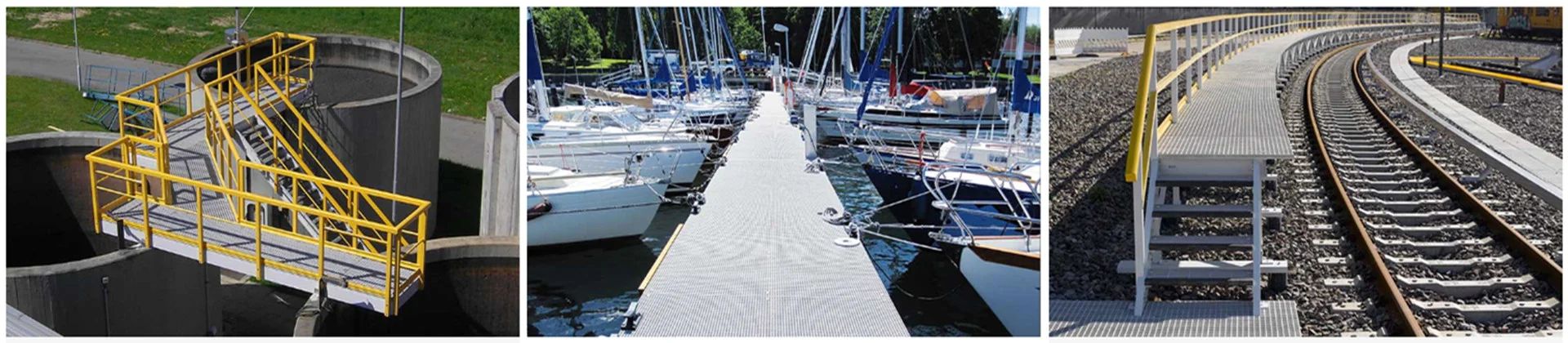
A marine dock, substation platform, wastewater walkway, trench cover, and stair tread may all use FRP grating, but they can require different resin systems, depths, surfaces, clips, and fabrication.
FRP Grating vs Steel Grating Cost Comparison
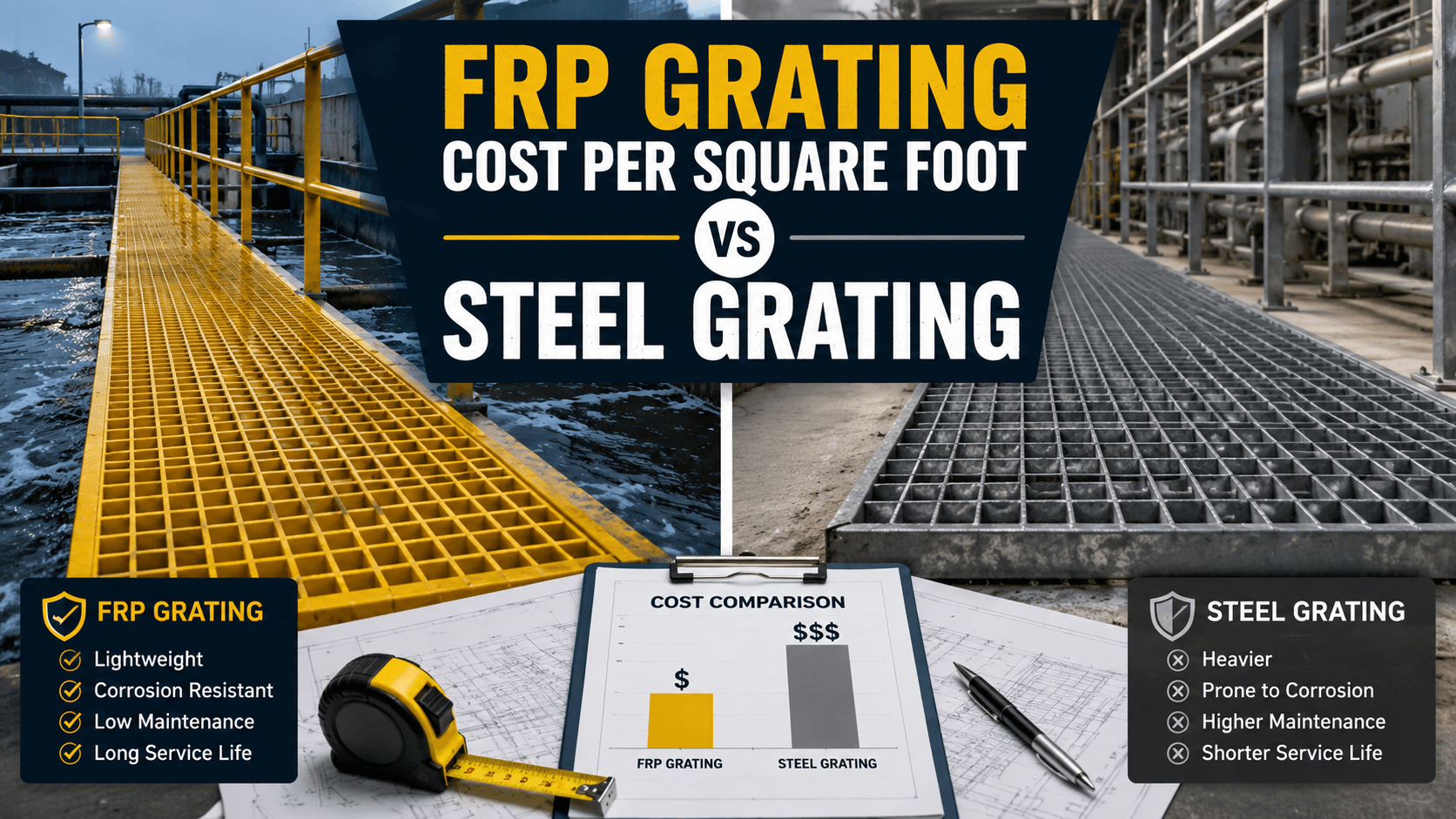
Once the specification is clear, buyers can compare FRP and steel more fairly. Initial panel price is only one part of the decision.
Direct Cost vs Lifecycle Cost
The table below compares common cost factors that affect FRP and steel grating decisions:
| Cost Factor | FRP Grating | Steel Grating | Buyer Note |
|---|---|---|---|
| Initial cost | May be higher in some specs | Often lower for standard stock | Compare equivalent specs |
| Freight and handling | Lighter in many layouts | Heavier to move and install | Affects labor and lifting |
| Corrosion maintenance | Lower when resin matches exposure | May need coating or galvanizing | Depends on environment |
| Electrical safety | Non-conductive option | Conductive | Relevant for utility areas |
| Replacement planning | Depends on resin and use | Depends on corrosion and coating life | Compare lifecycle cost |
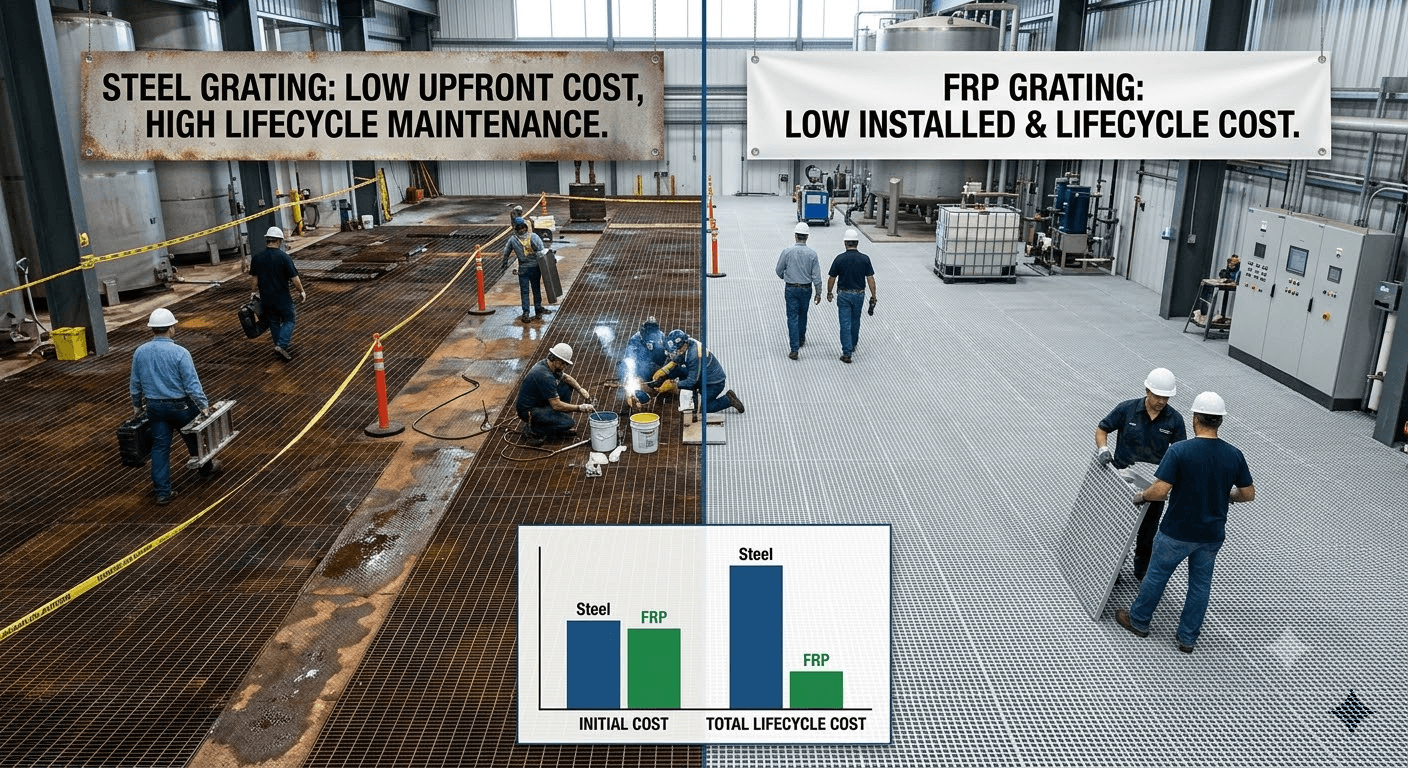
Steel may look attractive for standard, dry, local stock. FRP may become more competitive where corrosion, non-conductivity, weight, and maintenance access create long-term cost pressure.
Weight, Handling, and Installation Impact
FRP grating is generally lighter than steel grating, which can influence freight, lifting, installation, and retrofit planning. In field installations, crews often evaluate panel weight together with site access, support framing, cutting requirements, and safe handling.
For elevated walkways or restricted-access platforms, lighter panels can simplify installation.
Maintenance and Replacement Planning
Steel grating may require coating, galvanizing, repainting, corrosion inspection, or replacement in aggressive environments. FRP can reduce those tasks when the resin system matches the exposure and the panels are installed correctly.
FRP needs inspection for impact damage, worn grit, loose clips, unsupported edges, and unusual deflection.
When FRP Grating Is More Cost-Effective
The comparison often shifts when the site is wet, corrosive, electrically sensitive, or difficult to access. FRP does not fit every project, but it can reduce lifecycle cost in the right conditions.
Corrosive or Wet Environments
Wastewater plants, chemical processing areas, marine facilities, cooling towers, drainage platforms, and washdown zones can expose grating to moisture, salt, chemicals, or cleaning agents. Corrosion resistance can reduce coating-related maintenance and replacement planning.
In an anonymized wastewater access walkway project, the buyer compared standard steel with FRP after repeated coating repairs required shutdown coordination. Because the walkway crossed wet process areas, each maintenance cycle created access control, safety planning, and lost operating time.
Electrical or Non-Conductive Requirements
FRP grating can support non-conductive requirements in substations, utility platforms, telecom sites, and equipment access zones. This matters where walking surfaces sit near electrical systems.
Buyers should still follow project electrical safety requirements, grounding plans, lockout procedures, and site standards.
Lightweight Installation and Retrofit Projects
FRP can fit retrofit platforms, elevated walkways, trench covers, and maintenance access systems where weight affects installation planning. Reduced panel weight may help when crane access is limited or existing supports have load restrictions.
Installation teams should verify support spacing, span, clip type, panel orientation, and cutout locations before final approval.
When does FRP grating save money over steel?
FRP grating can save money over steel when corrosion, moisture, electrical conductivity, coating maintenance, weight, or downtime creates higher long-term costs. It is most valuable where steel needs repeated protection, frequent inspection, difficult-access maintenance, or earlier replacement.
Procurement teams should compare initial material cost, freight, installation labor, coating work, maintenance access, shutdown risk, service conditions, and replacement planning.
When Steel Grating May Still Fit
A credible comparison should also show where steel remains reasonable. Some projects need steel’s stiffness, heat tolerance, availability, or short-term cost advantage.
High Heat or High Point-Load Conditions
Steel grating may fit high-heat areas, heavy point-load zones, forklift routes, impact-prone locations, and certain heavy industrial applications. Its stiffness and temperature tolerance can support demanding mechanical conditions.
FRP selection should still consider span tables, support spacing, temperature exposure, resin system, traffic type, and loading conditions.
Standard Stock and Urgent Replacement
Standard steel grating may be locally available in some markets. That can help facilities dealing with urgent replacement work or standard panel repairs.
Local availability should be weighed against corrosion exposure, coating needs, handling weight, and long-term maintenance goals.
Budget-Driven Short-Term Projects
Steel may be practical for short-term, dry, non-corrosive, non-electrical projects where initial budget controls the decision. Temporary access platforms and low-exposure stock replacements may not justify a custom FRP specification.
frp grating vs steel grating
How to Request an Accurate FRP Grating Quote
Price confusion usually comes from mismatched assumptions. One supplier may quote full standard panels, while another includes cutting, clips, special resin, surface grit, and labeled packaging.
RFQ Checklist for FRP Grating
The table below shows the information buyers should prepare before requesting an FRP grating quote:
| RFQ Item | What to Provide | Why It Matters |
|---|---|---|
| Application | Walkway, platform, cover, stair tread | Defines grating type |
| Environment | Chemical, wastewater, marine, electrical | Defines resin system |
| Load/span | Pedestrian, equipment, rolling load | Defines depth and support |
| Surface and fabrication | Grit, cutouts, clips, labels | Affects safety and packing |
| Destination | Country, port, or site | Affects freight planning |
What information helps compare FRP and steel fairly?
Buyers should compare initial material price, freight, installation, maintenance, corrosion exposure, coating needs, downtime risk, electrical safety, expected service conditions, and replacement planning. Square-foot price alone does not show the full cost difference between FRP and steel grating.
Cost Factors Buyers Often Miss
Commonly missed cost factors include cutting waste, clip and hardware selection, special resin, anti-slip surface, export packing, freight class, urgent lead time, and site labor. Two quotes may differ because suppliers assumed different support spans, resin systems, panel sizes, or fabrication details.
Source Custom FRP Grating from Unicomposite
Once buyers understand the cost drivers, supplier capability becomes part of the price comparison. A clear quote depends on engineering support, manufacturing control, and export experience.
Product Fit
Unicomposite Technology Co., Ltd. is an ISO 9001 certified FRP and GRP composite manufacturer. Its FRP grating products support industrial platforms, walkways, stair treads, trench covers, drainage covers, chemical plants, wastewater facilities, utility areas, and marine environments.
Custom Manufacturing Support
Unicomposite supports molded and pultruded FRP grating, resin selection, color, surface finish, custom cutting, size matching, edge treatment, clips, packaging, and bulk supply.
These capabilities produce practical buyer outcomes. Resin selection supports chemical matching. Factory cutting reduces field labor and cutting waste. Surface options support slip resistance. Packaging control helps repeat orders arrive with consistent labeling and protection.
How to Request a Quote
Buyers can send drawings, photos, previous specifications, load requirements, environmental conditions, preferred grating type, quantity, destination, and delivery schedule. Procurement teams should also ask suppliers to list quote assumptions, including resin system, surface, clips, fabrication, packaging, and freight terms.
Conclusion
FRP grating cost per square foot depends on resin, grating type, thickness, span, load, surface finish, fabrication, quantity, packaging, and delivery. Steel grating may cost less upfront in standard dry applications, especially when local stock is available.
FRP grating can become more cost-effective in corrosive, wet, electrical, lightweight, or maintenance-sensitive environments, but only when the resin, support design, installation, and maintenance plan fit the site conditions.
Buyers should compare lifecycle cost, not only initial square-foot price. A complete RFQ helps suppliers quote the correct specification and reduces price confusion.


