 info@unicomposite.com


Introduction
A low-cost structural angle can become expensive after corrosion, repainting, shutdowns, or replacement. Selecting fiberglass angle iron requires more than copying an existing steel section.
“Fiberglass angle iron” is a common commercial search term for a nonmetallic fiber-reinforced polymer, or FRP, angle profile. It contains no iron. This guide shows you how to define loads, select materials, evaluate suppliers, and calculate lifecycle value.
What Is Fiberglass Angle Iron?
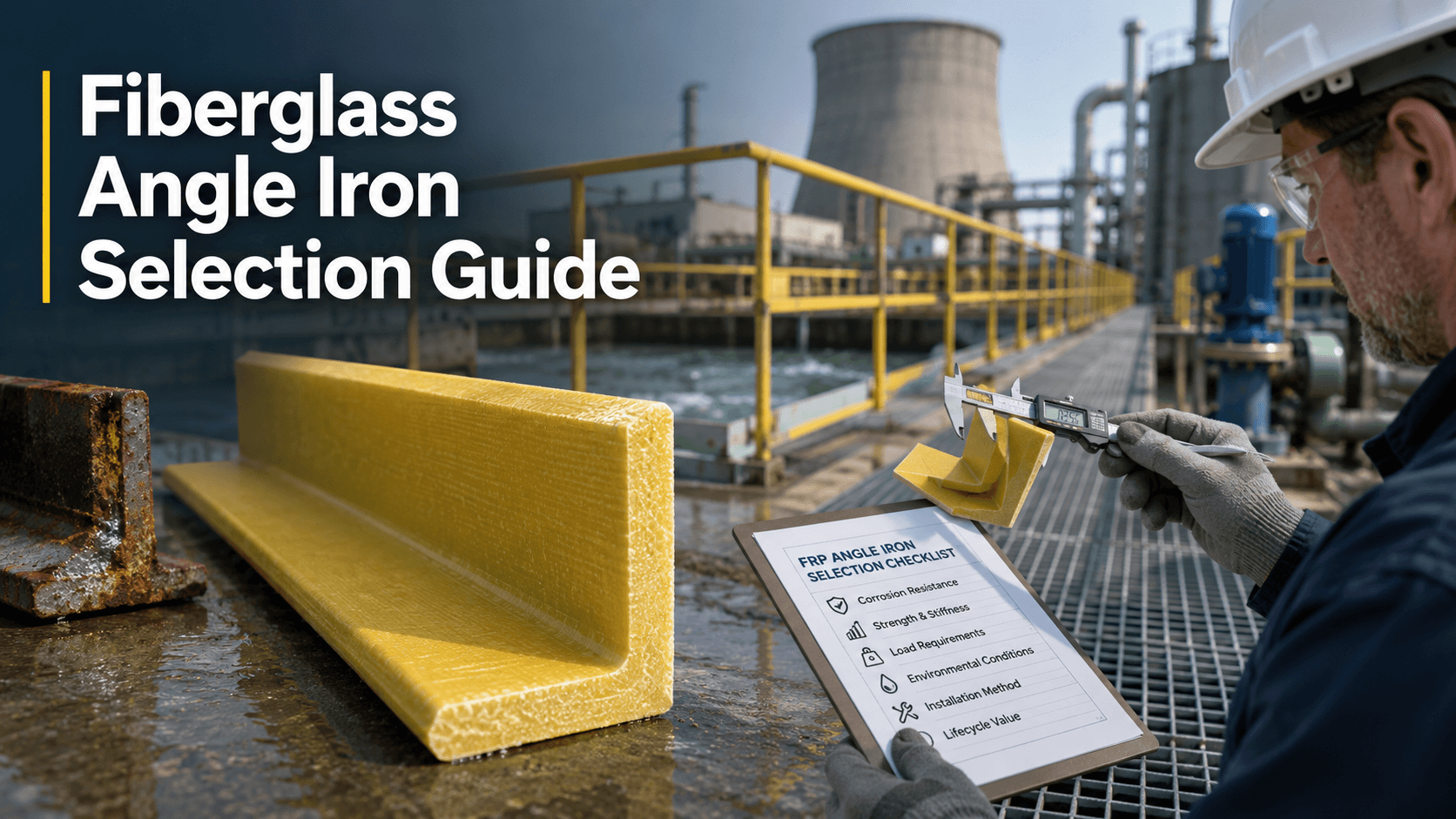
Fiberglass angle iron is a pultruded FRP profile with two perpendicular legs. Continuous glass fibers provide most of the longitudinal strength, while a thermoset resin binds the reinforcement and protects it from moisture and chemicals.
fiberglass angle lronselection guide
Profile Geometry and Manufacturing Method
Equal-leg angles suit general framing and bracing. Unequal-leg angles provide more attachment area on one face or additional support in a preferred direction.
During pultrusion, reinforcement passes through resin and a heated die to create a constant cross-section. Surface veils and UV additives can improve durability.
How Does Fiberglass Angle Iron Carry Structural Loads?
Fiberglass angle iron carries bending, bracing, edge, and connection loads through its two legs. Performance depends on orientation, span, load direction, hole location, and reinforcement design. Use current manufacturer data and project-specific calculations because FRP properties differ by direction.
Representative pultruded profiles may show longitudinal tensile strength above 200 MPa and an elastic modulus around 17 to 25 GPa. These values vary by resin, reinforcement, fiber content, and test method, so verify them on the supplier’s current technical data sheet.
Where Is Fiberglass Angle Iron Commonly Used?
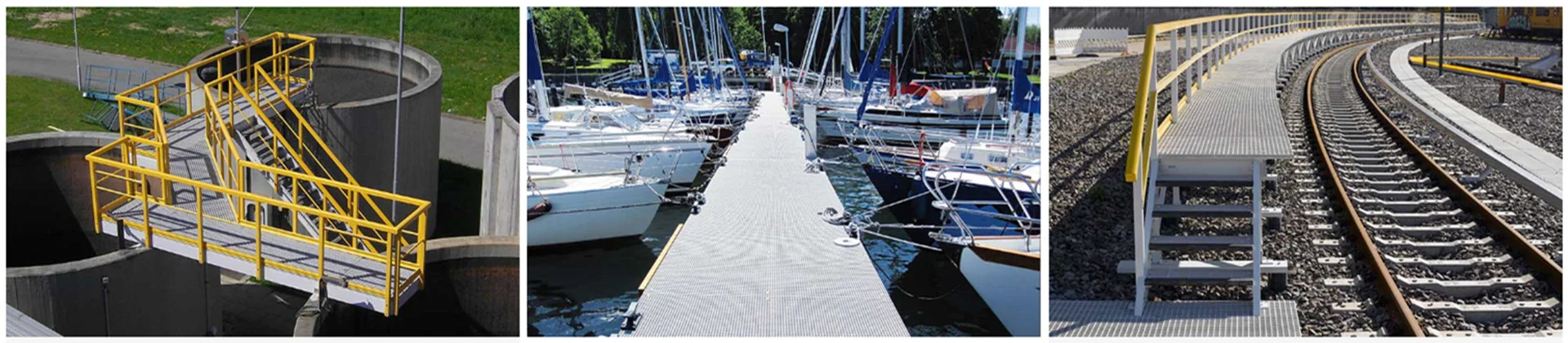
Typical applications include wastewater walkways, cooling towers, utility supports, coastal platforms, cable supports, and OEM assemblies.
In one anonymized washdown area, coating failure caused corrosion around steel fasteners and cut edges. Engineers specified a vinyl ester FRP angle, predrilled connections, broad washers, and compatible hardware. The revised assembly reduced coating work and eased handling.
Your service environment should guide material selection before profile size does.
Compare Fiberglass Angle Iron With Metal Alternatives
Once you understand the profile, compare FRP with steel and aluminum.
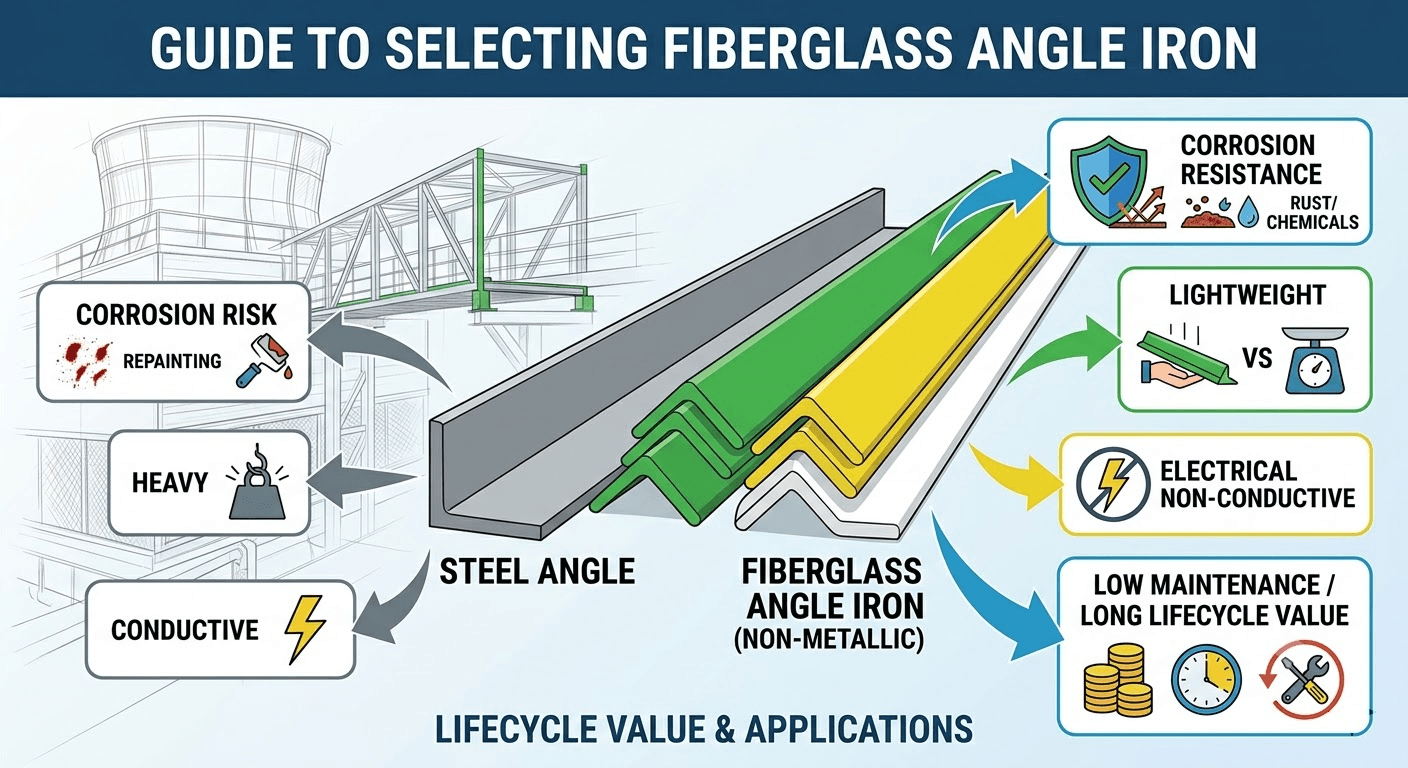
Fiberglass Angle Iron vs Steel and Aluminum
The table below summarizes the main selection factors.
| Factor | Fiberglass Angle Iron | Steel Angle | Aluminum Angle |
|---|---|---|---|
| Corrosion | Resists rust and many chemicals | Often needs coating or galvanizing | Good in many atmospheres, with chloride and galvanic limits |
| Weight | Much lighter than steel | Highest | Lightweight |
| Electrical behavior | Non-conductive grades available | Conductive | Conductive |
| Stiffness | Lower modulus, so deflection may govern | Highest | Moderate |
| Directional behavior | Strongest along the fiber direction | More uniform | More uniform |
| Temperature capability | Resin-dependent | Strong at higher temperatures | Alloy-dependent |
| Maintenance | Usually low in compatible service | Coating repair may be needed | Environment-dependent |
| Best fit | Wet, corrosive, dielectric areas | High stiffness, impact, or heat | Lightweight general structures |
Steel may remain preferable when stiffness, welding, impact, or temperature controls the design.
When Does FRP Deliver Better Lifecycle Value?
FRP often creates stronger lifecycle value when corrosion, repainting, difficult access, and shutdowns dominate operating cost. Compare actual quotations with this framework:
Lifecycle cost = material + freight + installation + coatings + inspection + maintenance + downtime + replacement
Use local labor rates, access costs, coating intervals, and expected service life.
Define the Required Size and Structural Performance
After choosing the material family, define the profile around the real load case.
Choose Equal-Leg or Unequal-Leg Geometry
Use equal-leg profiles for symmetric framing. Choose unequal legs for more bolt space, a wider attachment face, or directional support.
Specify leg width, thickness, length, inside radius, and tolerances. An FRP angle with the same dimensions as a steel angle will not provide equal stiffness.
What Load Information Should You Give the Supplier?
Provide point and distributed loads, span, support conditions, load direction, connection loads, safety factors, and allowable deflection. This helps the supplier check strength, local bearing, and stiffness.
Limits such as L/180 or L/240 are only examples. The final criterion should come from the project specification, governing code, or engineer of record.
Specification Overview for Supplier Discussions
| Input | Information to Provide | Why It Matters |
|---|---|---|
| Leg dimensions | Equal or unequal legs, width, radius | Controls fit and attachment area |
| Thickness | Nominal and minimum value | Affects strength and local bearing |
| Span | Clear support distance | Drives bending and deflection |
| Design load | Point, distributed, static, cyclic | Determines capacity |
| Deflection limit | Project-specific requirement | Controls serviceability |
| Connection | Bolts, plates, adhesive, clips | Influences local stress |
| Environment | Chemicals, temperature, UV, immersion | Guides resin selection |
A complete brief reduces oversizing, redesign, and quotation revisions.
Select the Right Resin System and Surface Protection
Geometry alone cannot protect a profile in an aggressive environment.
Polyester, Vinyl Ester, and Specialty Resins
Polyester often suits general service. Vinyl ester typically provides stronger chemical resistance. Specialty formulations may target fire, UV, or dielectric requirements.
Request the exact grade and supporting report instead of accepting broad labels such as “chemical resistant.”
How Do You Match the Resin to the Chemical Environment?
Provide the chemical name, concentration, operating temperature, exposure duration, immersion or splash conditions, and cleaning method. Resistance charts support initial screening, but critical applications still need manufacturer review.
Heat, mixed chemicals, and repeated washdowns can change suitability.
Surface Veil, UV Protection, Color, and Fire Performance
A synthetic veil can create a resin-rich exterior. UV inhibitors and pigments support outdoor durability, while flame-retardant formulations may require project-specific flame-spread and smoke-development evidence.
Ask which test method appears on the actual report. Depending on the property, suppliers may reference ASTM D638, ASTM D3039, or ASTM D790. The method must match the reported property and tested product.
Evaluate Manufacturing Quality and Supplier Capability
With the resin defined, evaluate whether the supplier can reproduce the profile consistently.
Confirm the Pultrusion Process and Quality Controls
Consistent pultrusion depends on fiber placement, resin wet-out, cure control, and dimensional inspection. Check samples for cracks, voids, exposed fibers, and inconsistent dimensions.
Unicomposite is an ISO 9001-certified FRP manufacturer in Nanjing, China, with an 18,000-square-meter facility. Its capabilities include pultrusion, pulwinding, SMC/BMC molding, hand lay-up, and vacuum infusion. Pultrusion supports repeatable constant sections, while custom tooling can support nonstandard geometry and repeat-order programs.
What Documents Should a Qualified Supplier Provide?
Request technical data sheets, dimensional drawings, resin information, mechanical test data, inspection records, certificates of conformity, and traceability documents. Safety-critical projects may require third-party testing.
A certificate without a product grade, batch reference, test method, or acceptance criteria provides limited assurance.
Standard Profiles or Custom Tooling?
Standard dies reduce cost and lead time. Custom tooling suits justified volume, geometry, reinforcement, or tolerance needs.
Confirm tooling ownership, minimum order quantity, sample approval, revision limits, and repeat-order controls before approval.
Plan Connections, Fabrication, and Installation
Connection details can govern the performance of an otherwise suitable profile.
Cutting, Drilling, and Fastener Selection
Cut and drill FRP with carbide or diamond-grit tools and dust extraction. Seal cut surfaces when specified.
Use corrosion-compatible hardware, broad washers, backing plates, and controlled torque. Excessive clamping pressure can damage the laminate.
guide to selecting fiberglass angle iron
How Can You Prevent Connection Failures?
Provide adequate edge distance, load-spreading washers or plates, controlled bolt torque, and uncrowded hole patterns. These details reduce local bearing, shear-out, and splitting stresses around drilled holes.
In an anonymized equipment-frame test, backing plates improved load distribution without increasing profile size.
Installation and Handling Checklist
- Store profiles level and protect edges.
- Support long lengths at several points.
- Control dust during machining.
- Verify hole spacing and washer size.
- Inspect joints before loading.
Connection design often determines whether the installed system performs as intended.
Compare Quotations and Lifecycle Cost
After technical review, compare commercial offers using the same specification.
Look Beyond the Price per Meter
Identical dimensions can hide different resin grades, reinforcement content, tolerances, and quality controls. Compare testing, machining, freight, tooling, and documentation.
What Should a Complete RFQ Include?
Include dimensions, quantity, cut lengths, loads, spans, environment, resin preference, standards, fabrication, destination, packaging, and documentation. Drawings should show holes, edge distances, tolerances, and interfaces.
For custom sections, add forecast volume, tooling expectations, sample quantity, and approval criteria.
Build a Total-Cost Comparison
Create a worksheet covering purchase, freight, installation, coatings, inspection, maintenance, downtime, and replacement. Label every assumption and test several service-life scenarios.
This gives procurement and engineering teams a shared basis for approval.
Final Selection Checklist
Before ordering, confirm that every document describes the same approved product.
Technical Requirements
Verify geometry, load, span, deflection, connection design, chemical exposure, temperature, resin, UV resistance, fire performance, and dielectric requirements.
Commercial and Quality Requirements
Confirm quantity, lead time, tooling ownership, inspection criteria, traceability, packaging, shipping terms, warranty conditions, and repeat-order controls.
When Should You Request Engineering Support?
Request engineering support for long spans, cyclic loads, chemical immersion, elevated temperatures, regulated structures, safety-critical assemblies, and custom profiles. Review is especially valuable when replacing steel because equal dimensions do not provide equal stiffness or connection behavior.
Conclusion
Use these four rules when selecting fiberglass angle iron:
- Start with the operating environment and design load.
- Match the resin and surface protection to measurable exposure conditions.
- Design connections around FRP’s directional and local bearing behavior.
- Compare suppliers using verified data, quality controls, and lifecycle cost.
[Contact Unicomposite for a custom fiberglass angle iron quote →]


