 info@unicomposite.com


Introduction
A low quotation can become expensive after installation. In corrosive or remote infrastructure, material selection affects lifting, shutdowns, maintenance, coating work, and replacement risk.
This comparison shows where fiberglass L beam performs better than steel, where steel keeps the advantage, and which checks matter before approval.
fiberglass l beam vs steel
What Is a Fiberglass L Beam?
A fiberglass L beam is a pultruded fiber-reinforced polymer profile with an L-shaped cross-section. Engineers use it for brackets, platform edges, cable supports, equipment frames, and secondary structures.
How Pultruded Fiberglass L Beams Are Manufactured
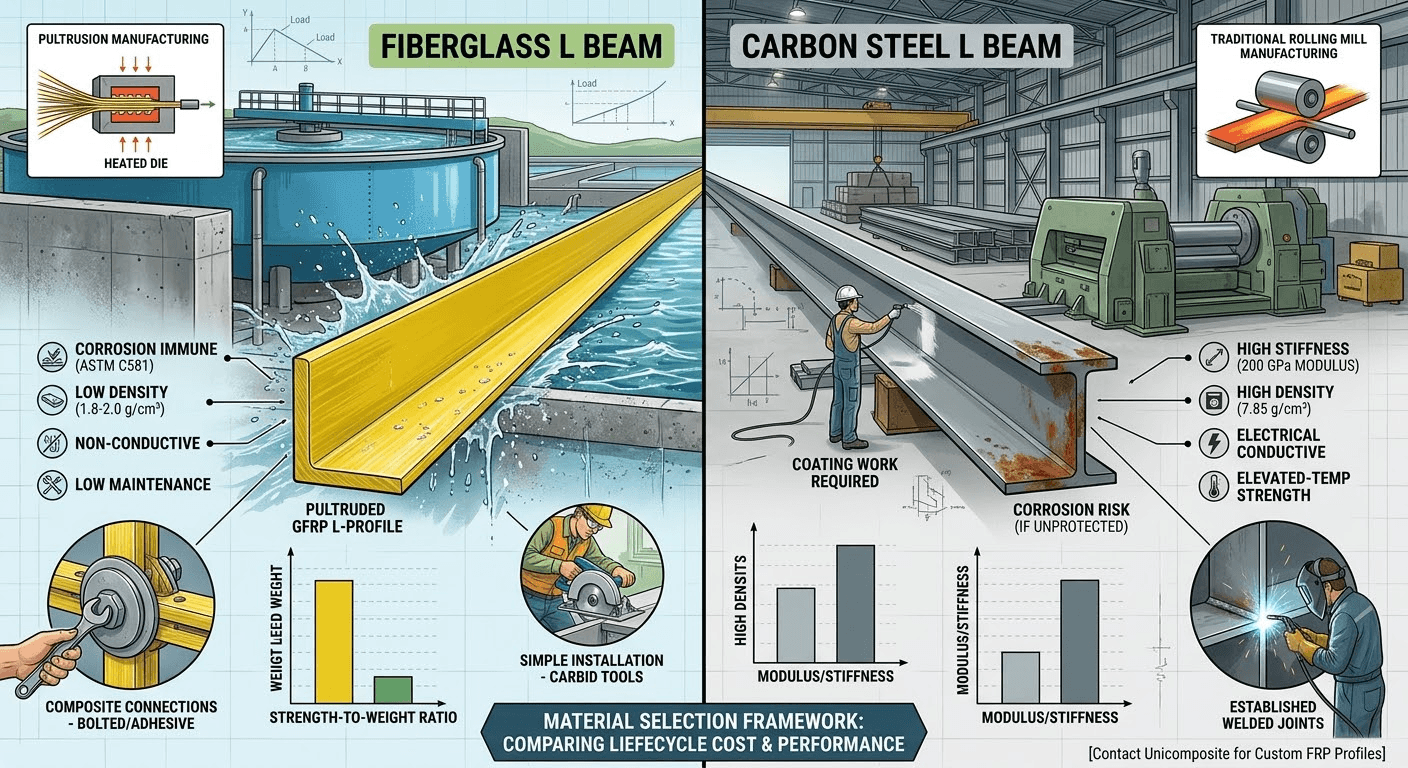
Pultrusion pulls continuous glass reinforcement through resin and a heated die. Longitudinal rovings carry primary loads, while mats and surface veils improve durability.
Glass content, resin ratio, die temperature, and pull speed influence consistency.
What Properties Define Fiberglass L Beam Performance?
Engineers review strength, modulus, density, bearing capacity, dielectric behavior, flame spread, and chemical resistance under methods such as ASTM D638, ASTM D790, ASTM E84, and ASTM C581.
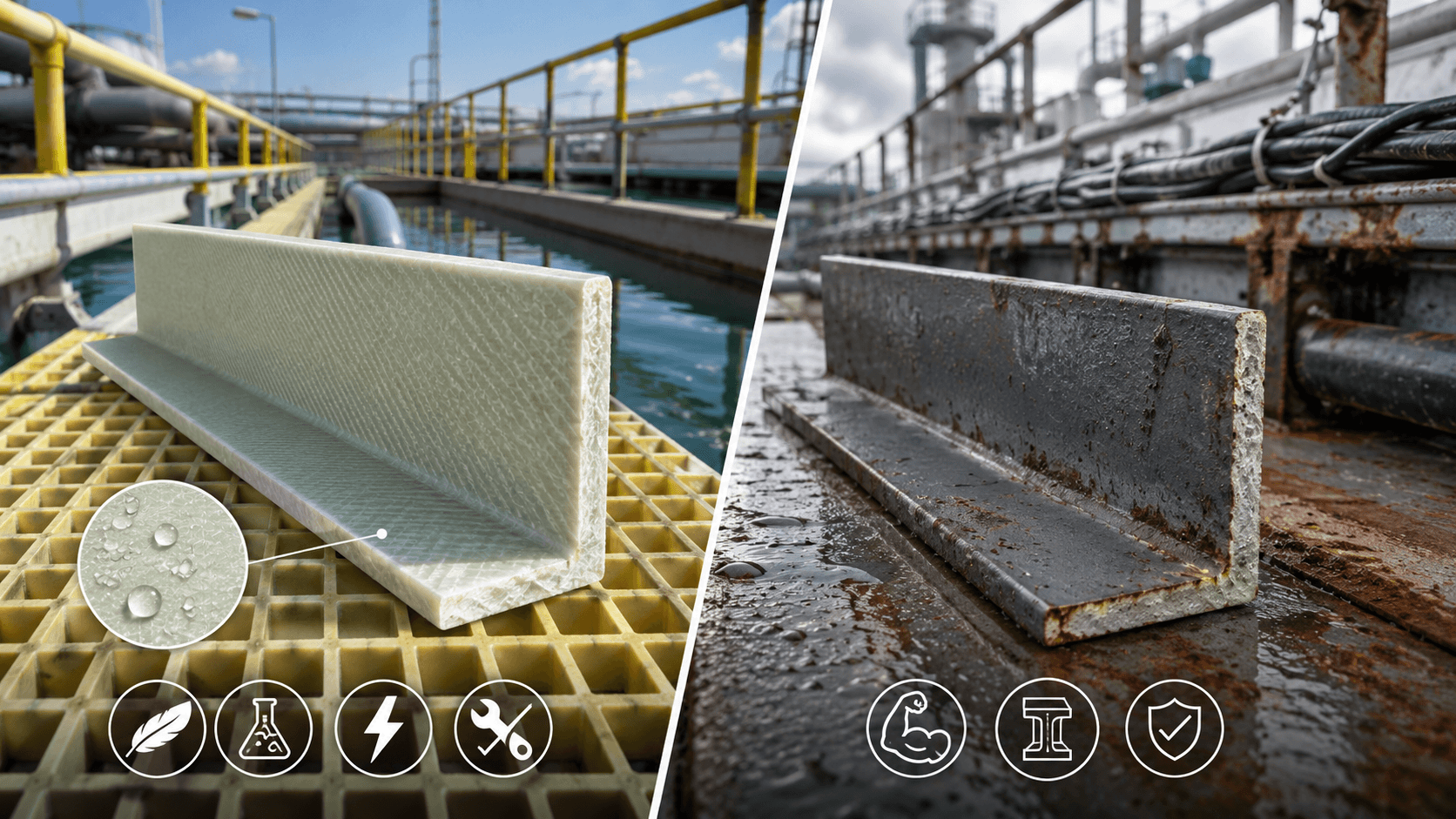
Pultruded FRP density is often 1.8 to 2.0 g/cm³, compared with about 7.85 g/cm³ for carbon steel. Exact values vary by resin, geometry, reinforcement, test direction, and temperature.
Where Are Fiberglass L Beams Commonly Used?
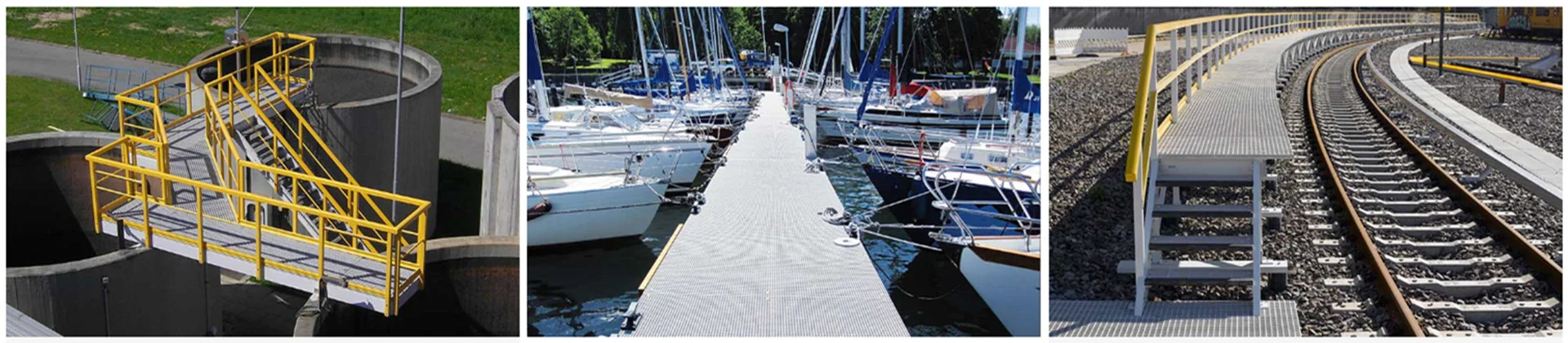
Applications include wastewater platforms, cooling towers, substations, marine structures, agricultural equipment, and OEM assemblies.
Fiberglass L Beam vs Steel: Key Property Comparison
The table below summarizes the differences that most affect engineering and procurement decisions:
| Factor | Fiberglass L beam | Carbon steel | Procurement implication |
|---|---|---|---|
| Density | About 1.8–2.0 g/cm³ | About 7.85 g/cm³ | FRP reduces handling weight |
| Elastic modulus | Commonly 17–28 GPa | About 200 GPa | Steel controls deflection better |
| Corrosion | Does not rust | Needs protection | FRP may reduce maintenance |
| Electrical behavior | Non-conductive when clean and dry | Conductive | FRP may suit electrical areas |
| High-temperature behavior | Resin-dependent | Generally stronger | Fire exposure may favor steel |
How Do Fiberglass L Beam and Steel Compare?
Steel provides high stiffness and stronger elevated-temperature performance. Fiberglass offers lower weight, corrosion resistance, dielectric behavior, and less repainting.
Which Material Provides the Better Strength-to-Weight Ratio?
Fiberglass L beam often provides the stronger strength-to-weight advantage because continuous glass reinforcement delivers useful structural capacity at roughly one-quarter the density of steel. Lower weight can reduce freight, manual handling, lifting equipment, and dead load, although steel remains much stiffer and often permits smaller sections.
Lighter members can also simplify installation in restricted areas.
Why Does Modulus Matter as Much as Strength?
A member can remain below its ultimate strength and still deflect too far. Steel has an elastic modulus near 200 GPa, while many pultruded profiles fall near 17 to 28 GPa.
FRP designs may need deeper sections, shorter spans, closer supports, or tighter serviceability checks.
Performance in Corrosive and Electrically Sensitive Environments
Environmental exposure often controls long-term reliability.
How Does Fiberglass L Beam Perform in Corrosive Conditions?
Properly specified fiberglass L beam performs well in many wet, saline, wastewater, and chemical environments because it does not rust. Performance still depends on resin chemistry, temperature, concentration, exposure duration, and stress level, so engineers should confirm compatibility through product-specific data, ASTM C581 results, or project testing.
Polyester may suit general service, while vinyl ester often offers broader chemical resistance. Cut edges and joints also need suitable detailing.
What Happens to Steel in the Same Environment?
Steel usually depends on paint, galvanizing, stainless grades, or corrosion allowance. Damaged protection can lead to rust, seized fasteners, section loss, and repeat maintenance.
Coating life varies with preparation, exposure, inspection, and repair access.
Why Are Dielectric Properties Important?
FRP can add value around substations, cable routes, and electrical maintenance areas because the base material does not readily conduct electricity. Moisture, contamination, conductive fasteners, surface tracking, and geometry still affect assembly-level performance.
Electrical suitability requires project-specific verification.
Structural Capacity, Deflection, and Connection Design
After confirming material compatibility, engineers must verify the selected profile and connection layout.
How Should Engineers Evaluate Load Capacity?
A complete review covers bending, shear, local buckling, bearing, lateral stability, and allowable deflection. Buyers should request section properties, load tables, test methods, safety factors, and temperature derating data.
Creep, moisture, temperature, and fiber direction can reduce allowable capacity.
How Do Fiberglass and Steel Connections Differ?
FRP connections commonly use bolts, large washers, backing plates, adhesives, or hybrid systems. Because pultruded composites are anisotropic, edge distance, bearing stress, clamp pressure, and load distribution need careful review.
Wide bearing surfaces and controlled torque help reduce crushing and delamination.
What Design Mistakes Most Often Cause FRP Problems?
The most common problems are excessive deflection, poor connection detailing, incorrect resin selection, and reliance on unverified load tables. Engineers should also review local bearing, support spacing, fire exposure, fabrication tolerances, creep, and temperature effects before approving the profile.
A practical review should confirm load path, serviceability, connection bearing, environmental compatibility, and verified product data.
Installation, Maintenance, and Lifecycle Cost
How Do Installation Requirements Compare?
FRP can usually be cut and drilled with carbide or diamond tools and often avoids welding or hot-work permits. Crews still need dust extraction, eye protection, gloves, respiratory controls, and cut-edge treatment where specified.
Steel may require heavier lifting, welding permits, and coating touch-up.
Which Material Has the Lower Lifecycle Cost?
Fiberglass often delivers lower lifecycle cost in corrosive or difficult-access locations because it can reduce coating, repainting, lifting, and replacement work. Steel may remain more economical in dry, high-temperature, or stiffness-controlled applications where corrosion protection is simple and local fabrication is readily available.
The following table identifies the cost categories buyers should compare:
| Cost category | Fiberglass L beam | Steel |
|---|---|---|
| Initial material | Often higher | Often lower |
| Freight and lifting | Lower weight | Higher weight |
| Coatings | Usually unnecessary | Often required |
| Maintenance | Inspect damage and connections | Inspect coating and corrosion |
| Shutdown exposure | Often lower | Can rise with hot work |
Anonymized Case Study: Corrosive Access Platform
A wastewater facility needed a replacement platform in a narrow treatment area with constant moisture, chemical splash, limited crane access, and strict hot-work controls.
Steel offered smaller sections and lower initial cost. FRP reduced weight, avoided field welding, and removed the coating system. Engineers shortened spans and increased connection bearing areas to control deflection and local crushing.
The decision came from access, shutdown risk, and maintenance exposure.
fiberglass l beam
When Steel Performs Better
Where Does Steel Retain a Clear Advantage?
Steel usually performs better where high stiffness, compact geometry, severe impact, elevated temperature, fire exposure, or established code pathways control the design. Its modulus near 200 GPa supports longer spans and slimmer members.
Can Fiberglass L Beam Replace Steel Directly?
Fiberglass L beam should not replace steel dimension for dimension because the materials differ greatly in stiffness, connection behavior, thermal response, creep, and failure mode. Engineers must recheck spans, support spacing, local bearing, fastener design, fire requirements, and safety factors using product-specific FRP data.
Direct substitution can create excessive deflection even when strength appears adequate.
How Should Buyers Avoid Over-Specifying FRP?
FRP adds limited value where corrosion, electrical isolation, or weight reduction do not matter. A dry warehouse frame with high stiffness demands may gain more from steel.
Every requested feature should address a defined project risk.
How to Specify Fiberglass L Beam for a Project
A complete RFQ makes supplier quotations easier to compare.
What Information Should Be Included in an RFQ?
The RFQ should state dimensions, tolerances, spans, loads, support conditions, resin system, chemical exposure, temperature, UV requirements, flame-spread limits, surface veil, hole patterns, fabrication needs, quantity, schedule, and documentation requirements.
Which Test Reports and Quality Documents Should Buyers Request?
Useful documents include dimensional records, mechanical-property reports, resin certification, flame-spread data, chemical-resistance information, and batch traceability. Reports should identify the test method, specimen orientation, conditioning, temperature, and production lot.
How Can Manufacturing Capability Affect Product Consistency?
Unicomposite operates an ISO 9001-certified, 18,000-square-meter facility and uses pultrusion, pulwinding, molding, hand lay-up, and vacuum infusion.
Consistency depends on material checks, fiber placement, cure control, dimensional inspection, testing, and batch traceability.
A Practical Material Selection Framework
Which Conditions Favor Fiberglass L Beam?
FRP is a strong candidate where corrosion, electrical isolation, low weight, restricted lifting access, low thermal conductivity, or reduced maintenance are major priorities.
Which Conditions Favor Steel?
Steel often wins where stiffness, fire resistance, high temperature, heavy impact, compact geometry, code familiarity, or local fabrication capability dominate.
What Should Engineers Review Before Final Approval?
Before approval, engineers should verify design loads, deflection limits, environmental exposure, resin compatibility, connections, fire requirements, test data, fabrication tolerances, creep, temperature derating, and lifecycle cost. Procurement teams should also confirm traceability, inspection points, quality records, and engineering support for custom profiles.
The final review should identify which material controls the project’s largest technical and commercial risks.
Conclusion
Four takeaways guide the decision:
- Fiberglass L beam performs especially well in corrosive, electrically sensitive, and weight-restricted environments.
- Steel usually provides greater stiffness, compact geometry, and stronger high-temperature performance.
- FRP requires profile-specific calculations, composite-aware connections, and verified environmental data.
- Lifecycle cost should include lifting, coatings, shutdowns, inspections, maintenance, and replacement risk.


