 info@unicomposite.com


Introduction
For industrial buyers, tent pole sets are not simple accessories. They are structural parts that affect service life, maintenance frequency, and field reliability. A pole system that works for light consumer use may underperform in agriculture, marine-adjacent sites, utility work, or OEM shelter systems, where moisture, UV exposure, chemical contact, and repeated assembly cycles matter more than sticker price. Corrosion alone is a major economic burden globally, estimated at about US$2.5 trillion, or 3.4% of world GDP, which is a useful reminder that material decisions have long-term cost consequences.
For B2B procurement teams, the better question is not “What is the cheapest pole set?” but “Which material and design will hold up in our actual environment?” That is where fiberglass-reinforced composites often enter the conversation. They are widely chosen in industrial settings for corrosion resistance, electrical insulation, and low-maintenance performance.
Unicomposite fits naturally into that discussion because it presents itself as an ISO-certified pultrusion manufacturer with its own factory for FRP profiles and custom composite parts, serving sectors such as power, wastewater, agriculture, marine, and infrastructure. For buyers sourcing in bulk or developing custom assemblies, that kind of manufacturing capability matters because tent pole sets are often closer to engineered components than off-the-shelf hardware.
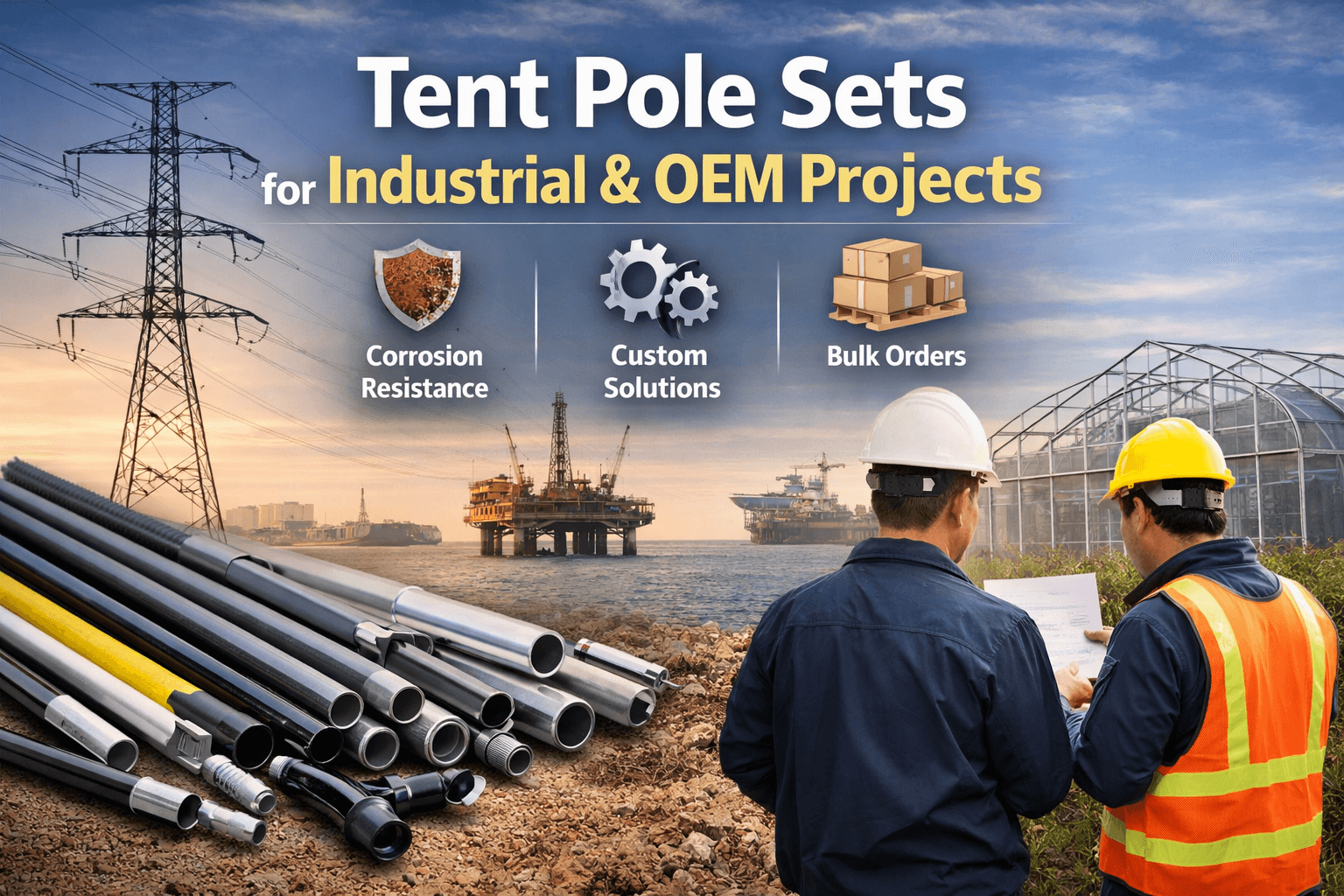
tent pole sets
What B2B Buyers Need to Know About Tent Pole Sets
Who typically buys tent pole sets in bulk
Bulk demand for tent pole sets usually comes from buyers who need repeatable structural performance, not consumer branding. Common examples include:
- OEM shelter and enclosure manufacturers
- Agricultural and aquaculture equipment suppliers
- Utility and field-service contractors
- Industrial distributors sourcing replacement components
- Fabric structure builders serving commercial or civil projects
These buyers usually care most about consistency, lead times, fit with existing assemblies, and resistance to real-world operating conditions.
Why material selection affects long-term performance
Material choice shapes nearly every downstream outcome. A buyer selecting tent pole sets for coastal use, for example, has very different priorities than one sourcing for dry, short-term installations. Fiberglass composites are commonly used where corrosion resistance and dielectric properties matter, while metal may still make sense for some higher-load or tightly budgeted applications.
A practical sourcing lesson is that unit cost rarely tells the full story. The better calculation includes:
- Expected service life
- Replacement frequency
- Maintenance labor
- Downtime risk
- Exposure to moisture, salt, chemicals, or electricity
That lifecycle view is often what separates a smart procurement decision from a recurring field problem.
How Tent Pole Sets Are Built for Strength and Reliability
Core components that matter
A tent pole set may look simple, but performance depends on several linked parts:
- Pole segments
- Ferrules or connectors
- Shock cord or joining system
- End tips and reinforced connection points
In B2B applications, failure often happens at the interface, not the tube alone. A strong composite segment can still disappoint if tolerances vary, connector fit is inconsistent, or the wall thickness is wrong for the flex pattern the structure sees in use.
Why pultrusion matters for consistency
Pultrusion is especially relevant for composite tent pole sets because it is a continuous manufacturing process used to produce fiber-reinforced profiles with a constant cross-section. That makes it well suited to repeatable production, dimensional consistency, and scale.
For buyers ordering in volume, consistency is not a minor detail. It affects assembly speed, connector fit, scrap rates, and warranty exposure. Unicomposite’s published capabilities also extend beyond standard pultrusion into other composite forming methods and custom fabrication, which is useful when the project needs non-standard lengths, fittings, or property targets rather than a basic stock tube.
Fiberglass vs. Metal Tent Pole Sets for Industrial Use
Where fiberglass tent pole sets perform well
Fiberglass tent pole sets are often a strong fit when the application requires:
- Corrosion resistance in wet or chemical-prone environments
- Electrical insulation near power equipment
- Lower maintenance over time
- A favorable strength-to-weight balance
- Customization of profile and resin system
That is why FRP materials appear so often in infrastructure, process, marine, and electrical applications. Their value is not only that they are lightweight, but that they can keep performing in environments that quickly punish untreated or damaged metal surfaces.
When metal may still be the better choice
Fiberglass is not always the right answer. Aluminum or steel can still be appropriate when:
- The structure sees unusually high point loads
- Extreme stiffness is the top priority
- The use case is short-term and highly price-driven
- Existing hardware is already standardized around metal poles
This balance is important for trust. A credible buying guide should acknowledge that material choice depends on the application, not on a one-size-fits-all claim.
A realistic buyer-side scenario
Consider an anonymized shelter-system buyer serving utility crews. The team needs pole sets that can be deployed repeatedly in wet environments, transported often, and used near electrical infrastructure. A low-cost metal option may look attractive on the RFQ sheet, but repeated exposure to moisture and coating damage increases maintenance and replacement risk. In that case, fiberglass becomes easier to justify because corrosion resistance and dielectric performance reduce field headaches, even if the upfront cost is higher.
That type of decision is common in B2B sourcing: the “best” option is often the one that reduces replacement cycles and operating friction, not the one with the lowest first invoice.
How to Choose the Right Tent Pole Sets for Your Project
Start with the application
Match the pole set to the working environment before comparing prices. Ask:
- Is this for temporary shelter, agriculture, marine use, or utility work?
- Will the poles be exposed to salt, chemicals, or constant moisture?
- Does the application require electrical insulation?
- How often will the structure be assembled and disassembled?
- Are custom connectors or lengths required?
This approach helps prevent overspecifying where it is unnecessary and underspecifying where it becomes costly.
Key buying criteria for procurement teams
A practical B2B checklist should include:
- Diameter and wall thickness for strength and flex performance
- Connector design for fit, speed of assembly, and replacement ease
- Resin and reinforcement choice for environmental resistance
- UV and weather exposure over the expected service life
- MOQ and lead time for supply planning
- Engineering support for custom or integrated systems
- Quality documentation such as ISO-backed process control
For buyers managing recurring orders, the last point is especially important. Process discipline and documentation often matter as much as raw material selection.
Custom Tent Pole Sets for OEM and Bulk Orders
When custom design is worth it
Custom tent pole sets make sense when a standard profile does not align with the final product. That often happens when buyers need:
- Non-standard lengths or diameters
- Specialized end fittings
- Better fit with existing OEM hardware
- More demanding corrosion or dielectric performance
- A profile tuned for a specific flex behavior
In those cases, a supplier with both pultrusion and custom fabrication capability can solve specification problems earlier, before they become production or field issues.
What a strong manufacturing partner should provide
A capable supplier should offer more than extrusion capacity. Look for:
- Design and application review
- Prototype support
- Scalable production
- Stable tolerances across batches
- Quality system documentation
- Openness about process and material choices
Unicomposite’s published profile supports that kind of positioning: ISO 9001-certified facilities, in-house FRP production, and experience across power, wastewater, marine, and agriculture all suggest a supplier oriented toward industrial use cases rather than commodity-only selling.
Common Mistakes Buyers Make When Sourcing Tent Pole Sets
Choosing on unit price alone
This is the most common sourcing mistake. A lower-cost pole set can become more expensive once breakage, corrosion, replacement labor, and downtime are considered. That is exactly why lifecycle thinking matters in materials procurement.
Ignoring the actual environment
Buyers sometimes evaluate tent pole sets as if all outdoor exposure is the same. It is not. UV, moisture, salt spray, chemicals, and electrical conditions can all change the best material choice.
Skipping fit and connection details
Even when the pole material is correct, poor ferrule fit or inconsistent segment tolerances can create avoidable failures. In many B2B systems, assembly quality is part of performance.
Conclusion
The best tent pole sets for industrial buyers are the ones matched to the real job: load conditions, environment, service life, and assembly demands. Fiberglass-based systems often offer a strong advantage where corrosion resistance, dielectric performance, and low maintenance matter most, while metal can still make sense in selected high-load or cost-driven scenarios.
For OEM and bulk buyers, supplier capability is just as important as material selection. A manufacturer with repeatable pultrusion, custom fabrication support, and documented quality systems can help reduce procurement risk and improve long-term performance. If you are comparing options for a new or replacement project, start with the environment and performance target, then work backward to the pole design and manufacturing approach that best fits.
Frequently Asked Questions
Not in every situation. Metal can outperform fiberglass in some high-load designs, but fiberglass often delivers better corrosion resistance, electrical insulation, and lower maintenance in demanding environments.
Custom sets are useful when standard sizes do not match your assembly, when you need special fittings, or when the environment requires more specific performance targets such as dielectric behavior or chemical resistance.
Often, yes. Engineering input helps confirm wall thickness, connector design, flex behavior, and material suitability before large-volume production begins.
Pultrusion supports consistent cross-sections and repeatable manufacturing, which helps with fit, scalability, and quality across bulk orders.
Ask about material options, tolerances, lead times, prototype support, QA documentation, and whether the supplier can handle custom dimensions or connection details at production scale.


