 info@unicomposite.com


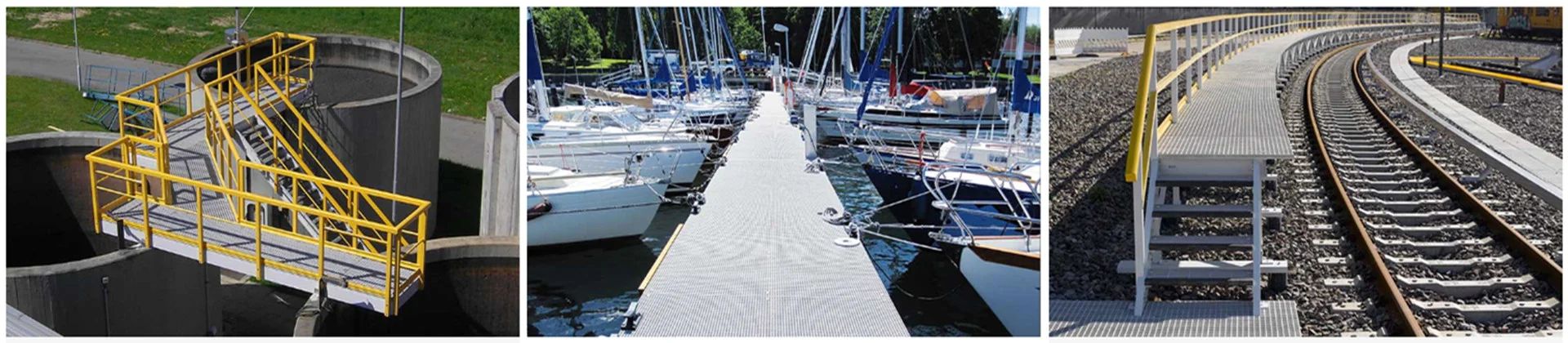
Introduction
In underground support design, material choice affects much more than strength on a datasheet. It influences installation speed, worker handling, corrosion risk, excavation continuity, and long-term maintenance. For contractors, engineers, and procurement teams, that makes the GFRP rock bolt a practical option worth close attention.
A GFRP rock bolt is often selected when projects need corrosion resistance, low weight, and the ability to cut through reinforcement during later excavation. These advantages make it especially relevant in tunneling, mining, slope stabilization, and other civil works where steel can create downstream challenges.
For industrial buyers, the value is not just in the product itself. It also comes from working with suppliers that understand composite production at scale. Unicomposite, for example, is an ISO-certificated pultrusion manufacturer in China producing standard FRP profiles and custom composite parts for industries including electricity, wastewater treatment, marine, agriculture, and infrastructure. That kind of manufacturing background reflects the broader expertise many buyers seek when specifying composite reinforcement for demanding environments.
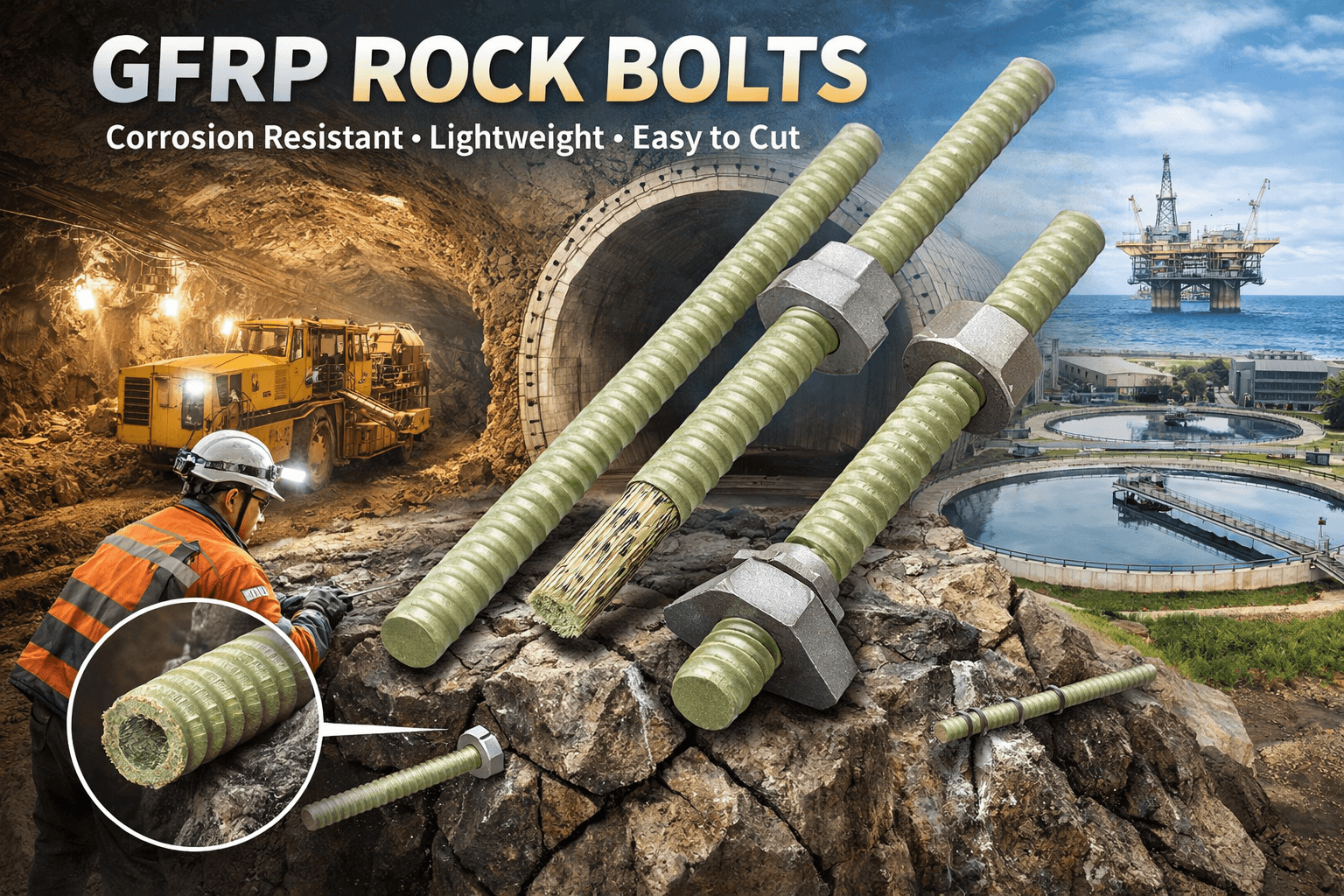
gfrp rock bolt
What Is a GFRP Rock Bolt and How Does It Work?
Material composition and structural role
A GFRP rock bolt is made from glass fibers embedded in a polymer resin matrix. This structure differs from steel because it combines reinforcement fibers with a corrosion-resistant binding material rather than relying on a single metal body. The result is a bolt that is lightweight, non-conductive, and resistant to rust in wet or chemically aggressive environments.
Its role in ground support is similar to that of other reinforcement systems: it helps stabilize rock or soil by transferring load away from unstable zones. When properly designed and installed, it works with the surrounding ground and bonding medium to limit deformation and improve excavation stability.
From a project engineering perspective, the appeal is clear. In environments where corrosion, stray current, or later excavation are major concerns, GFRP solves problems that traditional steel may leave behind.
How load transfer works in ground support
The bolt is installed into a drilled hole and bonded with grout or resin. Once the bond cures, tensile forces can be transferred from the surrounding rock mass into the bolt and redistributed into more stable ground.
In practice, installation quality matters as much as material selection. On ground support jobs, teams often find that poor hole preparation, unsuitable bonding media, or inconsistent embedment length can reduce performance well before the material itself reaches its limit. That is why experienced buyers review not only the nominal properties of a GFRP rock bolt, but also how it will behave with the intended installation method.
A useful rule for specifiers is simple:
- Match the bolt to the ground condition.
- Match the bond system to the installation method.
- Confirm that field crews can install the system consistently.
Why Buyers Choose GFRP Rock Bolt Instead of Steel
Corrosion resistance and service life
Corrosion resistance is one of the strongest reasons to specify a GFRP rock bolt. In wet tunnels, marine-adjacent projects, wastewater facilities, and chemically exposed ground, steel can require extra protection or more frequent replacement over time. GFRP avoids rust-related deterioration, which can make lifecycle planning more predictable.
For B2B buyers, that matters because material cost is only one part of the real equation. A lower-priced steel option may look attractive at the purchase stage, but maintenance, downtime, and replacement risk can change the total value picture later. In aggressive environments, corrosion resistance is not a minor feature. It is often the factor that protects long-term project performance.
Lightweight handling and safety benefits
Compared with steel, GFRP bolts are lighter and easier to move onsite. That helps in confined excavation zones, remote locations, and projects where crews must handle reinforcement manually.
In one anonymized tunnel support scenario, a site team using composite reinforcement found that daily face preparation became smoother because workers could transport and position the bolts with less effort in a narrow access zone. The time savings per bolt were modest, but across repeated installation cycles, the workflow became more efficient and less physically demanding.
Another operational benefit is that GFRP is non-conductive. This can be useful in electrically sensitive environments or projects near power infrastructure, where dielectric performance adds value beyond structural support alone.
Cuttability in excavation and tunneling
Cuttability is a major advantage in projects where future excavation must pass through the supported zone. Steel bolts can slow excavation, interfere with cutting equipment, or require removal. A GFRP rock bolt, by contrast, is often chosen as a sacrificial reinforcement element because it can usually be cut more easily during later works.
This is particularly important in tunnel face support, sequential excavation, and selected mining applications. Buyers evaluating excavation continuity often find that the cost of interruptions, equipment wear, or removal work matters as much as the upfront cost of the bolt itself.
Where GFRP Rock Bolt Performs Best
Tunneling and underground excavation
Tunneling is one of the most suitable applications for GFRP bolts. They are often used in temporary face support and other reinforcement zones that may later be intersected by excavation. In these cases, corrosion resistance and cuttability combine to create a practical advantage.
Project teams in underground works are rarely choosing only the strongest material in theory. They are choosing the material that creates the fewest problems during installation, service, and excavation progression.
Mining and slope stabilization
Mining projects may also benefit from GFRP in situations where support needs to be cut through later or where corrosion is a concern. In selected slope stabilization or shaft-related works, non-metallic reinforcement can also support project goals tied to durability and handling.
That said, use should always depend on the design case. A GFRP rock bolt is not a one-for-one replacement for steel in every application. Suitability depends on geology, load demand, support strategy, and project requirements.
Infrastructure and corrosive environments
Infrastructure exposed to marine conditions, wastewater, chemicals, or electrical sensitivity can also be a strong fit for composite materials. Buyers already familiar with FRP in gratings, profiles, and structural components often see the logic in extending similar material benefits to reinforcement systems where conditions justify it.
This broader composite background matters when choosing a supplier. Unicomposite serves industries ranging from cooling tower construction and aquaculture to electricity and wastewater treatment, and it supports both standard pultruded fiberglass profiles and custom composite fabrication. For buyers, that kind of experience can be useful when a project needs more than an off-the-shelf solution.
How to Evaluate the Right GFRP Rock Bolt for Your Project
Mechanical properties and design requirements
Not all products are equal. Buyers should review key technical factors such as:
- Tensile strength
- Diameter and profile geometry
- Elastic modulus
- Bonding compatibility with grout or resin
- Design life and safety factors
The correct specification should start with project conditions, not supplier inventory. A competent engineering review should consider the rock mass, load case, excavation method, and support sequence before selecting the bolt.
Manufacturing quality and customization options
In composite products, manufacturing control directly affects field performance. Fiber alignment, resin quality, curing consistency, and dimensional tolerance all influence how a bolt behaves during installation and service.
That is why procurement teams often ask suppliers for:
- Product test data
- Quality assurance documentation
- Dimensional tolerance information
- Customization capability
- Technical communication support
For large-volume or engineered orders, customization may be important. Length, diameter, surface treatment, and packaging may all need adjustment. Suppliers with established pultrusion experience and broader composite manufacturing capability are often better positioned to support these requirements. Unicomposite is one example of the kind of supplier platform that can handle both standard and custom composite production for industrial buyers.
Installation method and onsite compatibility
A technically suitable product can still underperform if it does not fit site practice. Before procurement, teams should verify hole size, bonding material, tool compatibility, handling procedures, and crew familiarity.
One of the most common mistakes is treating the bolt as a standalone purchase rather than part of a full installation system. In reality, a GFRP rock bolt performs best when the material, bond medium, installation method, and ground conditions are evaluated together.
Design and Safety Considerations
Specification should always be validated by qualified engineering review. Ground conditions, loading demands, installation variables, and local project requirements can all affect suitability. Buyers should avoid assuming that corrosion resistance or cuttability alone makes a product appropriate for every ground support design.
A balanced procurement process should include material testing data, installation planning, and confirmation that the selected system meets the project’s structural and operational needs. This improves both performance and trust in the final specification.
Common Buyer Questions Before Specifying GFRP Rock Bolt
Is GFRP strong enough for demanding ground support?
It can be, provided the selected product matches the design requirements. The key question is not whether GFRP is strong in general, but whether the specific bolt, bonding system, and installation method satisfy the actual load and service conditions of the project.
What are the trade-offs versus steel bolts?
Steel may still be preferred where higher stiffness, familiar field practice, or certain long-term support strategies are the priority. GFRP, however, offers clear advantages in corrosion resistance, lighter handling, non-conductivity, and cut-through excavation zones.
How do procurement teams assess total value?
The best approach is to evaluate total value rather than unit price alone. Buyers should consider service environment, handling efficiency, excavation continuity, supplier support, quality documentation, and the need for customization before making a decision.
Conclusion
The GFRP rock bolt is most valuable when projects need more than basic reinforcement. In corrosive environments, excavation-through support zones, and access-limited jobsites, it offers a combination of durability, lighter handling, and operational convenience that steel often cannot match.
For B2B buyers, the smartest specification starts with the real project demands: geology, installation method, excavation sequence, service conditions, and supplier capability. When those factors align, GFRP can deliver both technical and commercial value.
Teams evaluating reinforcement options should work with qualified engineers and experienced composite manufacturers to review product data, installation compatibility, and customization needs before final selection. That approach reduces risk and leads to a more reliable ground support solution.
Frequently Asked Questions
It is often a better fit when corrosion resistance, lighter handling, or future cut-through excavation are important. These conditions are common in tunneling, mining development, and chemically aggressive environments.
Yes. Industrial buyers often request custom lengths, diameters, or surface configurations to suit installation methods and design needs. Suppliers with strong pultrusion and fabrication capability are usually better equipped to support these requests.
That depends on the design criteria, environmental conditions, and engineering requirements of the project. Permanent applications require careful technical review, material verification, and compliance with relevant specifications.
They should request mechanical test data, QA documentation, production tolerance information, lead time details, and technical support for installation compatibility. These details help reduce procurement risk and improve project fit.
They can, especially in confined or difficult-access areas where repeated manual handling is required. The benefit is often seen in smoother workflow, easier transport, and reduced physical strain rather than in one dramatic productivity jump.


