 info@unicomposite.com


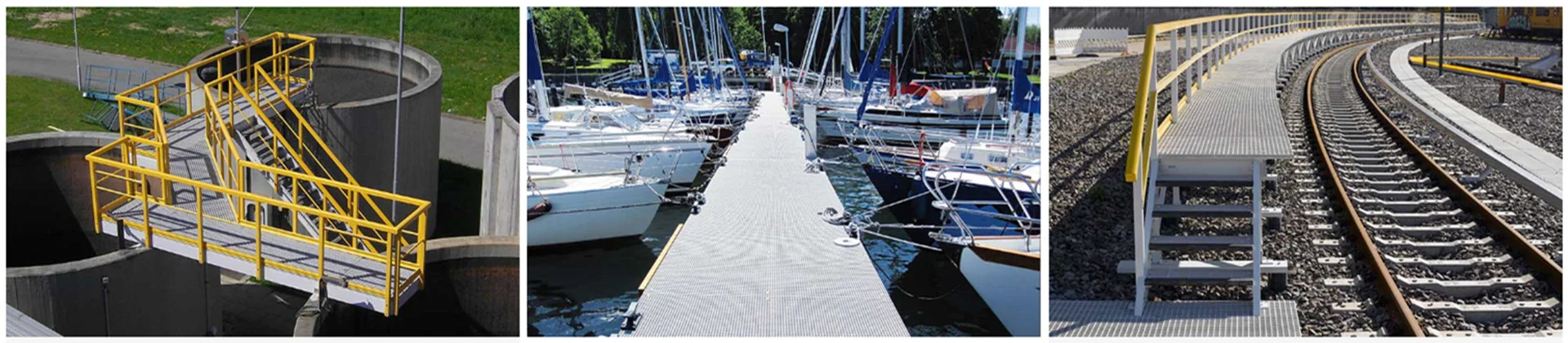
Introduction
Industrial flooring usually fails in plain sight. Steel rusts. Concrete traps moisture. Wood degrades. Wet access routes become slip hazards, and electrical areas may require materials that reduce conductivity risks.
Fiberglass floor grating gives engineers and procurement teams an FRP flooring option for platforms, walkways, trench covers, drainage zones, and corrosive access areas. The existing page introduces fiberglass floor grating as a corrosion resistant, non conductive, slip resistant, and low maintenance FRP material for industrial and commercial flooring applications.
This guide explains what fiberglass floor grating is, where it is used, how it compares with steel, concrete, and wood flooring, how to choose the right type, and what buyers should prepare before requesting a quote.
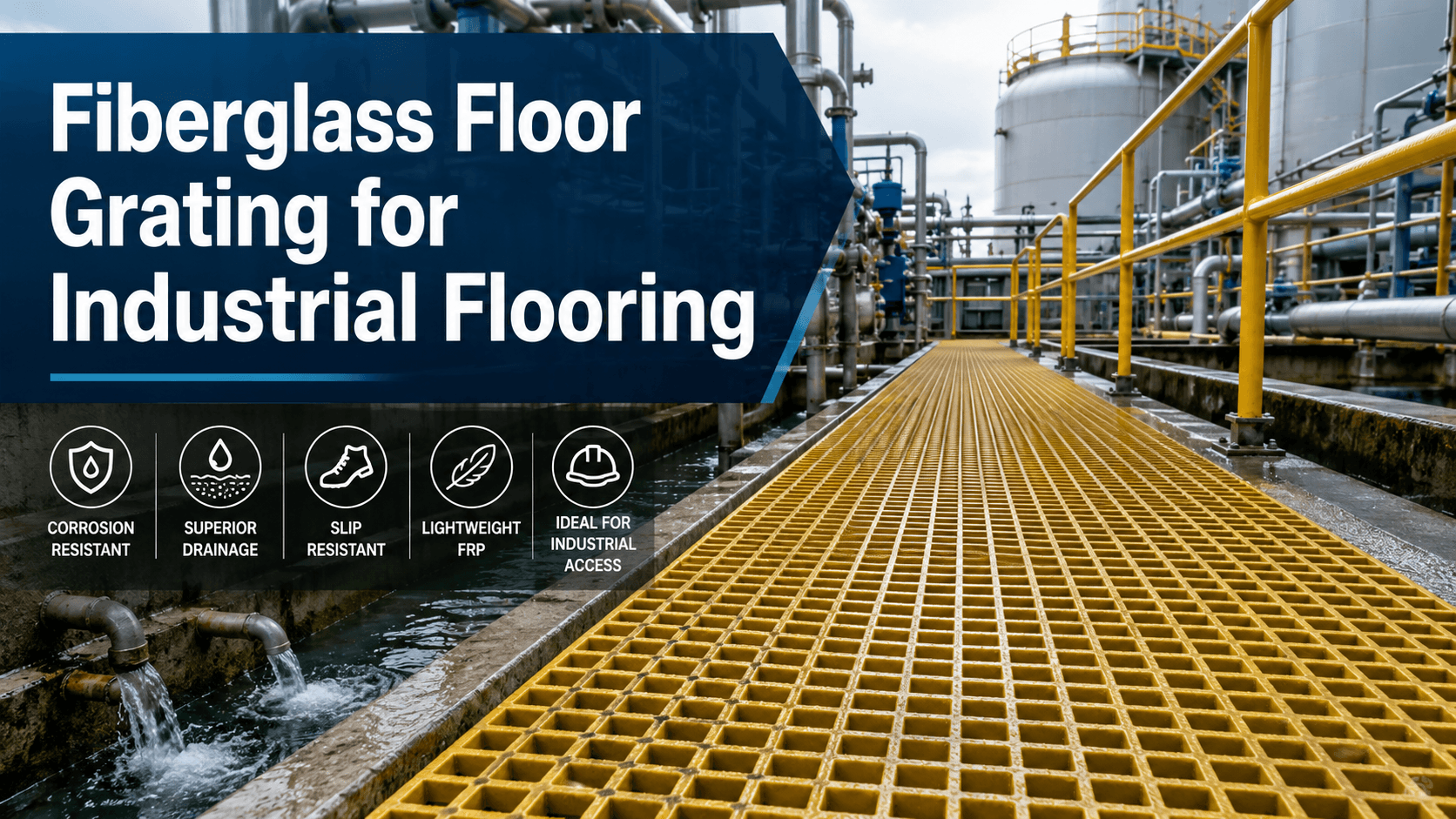
fiberglass floor grating for industrial flooring
What Is Fiberglass Floor Grating?
Fiberglass floor grating is an FRP grid flooring material used for industrial walkways, platforms, trench covers, access floors, wet areas, and corrosive environments. It combines glass fiber reinforcement with resin to create a lightweight, corrosion resistant walking surface.
In industrial upgrades, engineers often consider FRP grating when metal flooring shows rust, coating failure, poor drainage, or unsafe traction around wet process areas.
Definition of fiberglass floor grating
Fiberglass floor grating is a composite grid panel designed to support foot traffic, drainage, ventilation, and safe access. The glass fiber reinforcement provides strength, while the resin system affects chemical resistance, fire behavior, UV performance, and long term durability.
Common formats include molded FRP grating, pultruded FRP grating, covered panels, stair treads, and custom cut panels.
How does fiberglass floor grating work in industrial flooring?
Fiberglass floor grating works by creating a strong, corrosion resistant, open grid walking surface that allows water, debris, air, and light to pass through. It is commonly used in industrial flooring where drainage, slip resistance, low maintenance, and non conductive properties are needed.
This open structure is valuable in wastewater platforms, chemical plant walkways, power facility access floors, marine platforms, and food processing washdown areas. The grating must sit on a suitable support frame with correct span, panel orientation, clips, and edge support.
Fiberglass floor grating vs general fiberglass flooring
“Fiberglass flooring” is a broad term. It may refer to flat panels, decking, covers, decorative surfaces, or industrial grating.
Fiberglass floor grating usually refers to FRP grid panels designed for drainage, airflow, traction, and structural access. Buyers should specify whether they need open grating, covered panels, decking, stair treads, or solid FRP flooring before requesting pricing.
Why “floor grating” matters for drainage and ventilation
Floor grating matters because the open grid allows water, chemical residue, dirt, and small debris to pass through the walking surface. This helps reduce standing liquid on access routes.
Key specifications include open area, mesh size, panel thickness, bearing direction, and support span. These details affect drainage, foot comfort, load capacity, and cleaning.
Key Benefits of Fiberglass Floor Grating
After the basic definition, the real value comes from how FRP grating performs in demanding work areas. Buyers often select it when safety, maintenance, and environmental exposure all matter.
Corrosion resistance in wet and chemical environments
Fiberglass floor grating does not rust like carbon steel. It is widely used in chemical plants, wastewater treatment plants, marine sites, cooling towers, food processing areas, and outdoor platforms.
Performance depends on resin system, glass fiber reinforcement, molded or pultruded structure, grating thickness, surface treatment, support spacing, fastener material, installation method, and real site exposure. Buyers should describe chemical type, concentration, temperature, moisture, and cleaning process before selecting a resin system.
Non conductive flooring for electrical safety
FRP grating is non conductive, making it useful in power utilities, electrical rooms, utility platforms, equipment access areas, and telecom related facilities. This property can support safer material selection where metal conductivity creates concern.
Project teams should still verify the full safety design, including grounding plans, fire requirements, load requirements, and site procedures. Flooring material alone does not define electrical safety.
Slip resistant walking surface
Fiberglass grating can be supplied with grit top or concave surfaces to improve traction. Wet, oily, or washdown areas often need more aggressive surface texture.
Surface finish should match worker traffic, footwear, cleaning method, and contamination risk. Aggressive grit can improve grip, while smoother surfaces may be easier to clean.
Lightweight installation
FRP grating is lighter than many metal flooring systems, which can simplify handling during retrofit work. Field crews often value this when installing panels around tanks, pipe racks, rooftop access routes, or narrow platforms.
Lower panel weight can also reduce installation difficulty in elevated structures or areas with limited lifting equipment.
Low maintenance compared with metal flooring
FRP grating can reduce rust repair, repainting, coating failure, and corrosion related replacement. This is valuable where shutdown access is difficult or maintenance windows are short.
Low maintenance still requires planned inspection. Teams should check clips, fasteners, support condition, surface wear, impact damage, and exposure changes.
Fire retardant and UV options
Buyers should confirm flame retardant needs and outdoor exposure early. Fire behavior and UV performance depend on resin formulation, additives, product design, and project requirements.
Outdoor applications should include sunlight exposure, weather conditions, and expected service environment in the RFQ.
Fiberglass Floor Grating vs Steel, Concrete and Wood Flooring
Material choice should match the operating environment. The table below compares common industrial flooring materials.
| Factor | Fiberglass Floor Grating | Steel Flooring | Concrete Flooring | Wood Flooring | Buyer Takeaway |
|---|---|---|---|---|---|
| Corrosion resistance | Strong in wet and chemical areas | Can rust if coating fails | Can degrade in chemical exposure | Can rot in wet areas | FRP fits corrosive sites |
| Weight | Lightweight | Heavy | Very heavy | Light to moderate | FRP helps retrofit work |
| Electrical conductivity | Non conductive | Conductive | Usually low conductivity | Low conductivity | FRP supports utility areas |
| Drainage | Open grid allows drainage | Open grating possible | Needs drains or slope | Limited | FRP helps wet zones |
| Slip resistance | Grit or concave surface | Serrated options available | Depends on finish | Can become slippery | Match surface to risk |
| Maintenance | Low rust related maintenance | Coating repair may be needed | Crack repair may be needed | Replacement may be frequent | Compare lifecycle cost |
| Chemical exposure | Resin dependent | Coating dependent | Mix and coating dependent | Generally limited | Exposure details matter |
| Outdoor use | Good with UV package | Depends on coating | Durable but heavy | Limited in wet areas | FRP suits many outdoor platforms |
When should buyers choose fiberglass floor grating?
Buyers should choose fiberglass floor grating when industrial flooring needs corrosion resistance, drainage, slip resistance, low maintenance, lightweight installation, and non conductive performance. It is especially useful in wet, chemical, marine, wastewater, and electrically sensitive environments.
Typical use cases include industrial platforms, walkways, trench covers, utility access areas, washdown zones, offshore sites, and maintenance decks. Buyers should compare total cost by installation effort, downtime, corrosion repair, and expected service life.
When steel, concrete or wood may still be suitable
Steel can still suit very heavy mechanical abuse, welded structures, or dry environments with established maintenance systems. Concrete works well for fixed heavy duty slabs and permanent foundations.
Wood may fit light duty, dry, temporary, or low cost flooring. A balanced specification compares exposure, load, installation access, maintenance, and service expectations.
Common Applications of Industrial FRP Flooring
Industrial FRP flooring works best when site conditions justify its material advantages. The table below links common applications with buyer priorities.
| Application Area | Common Flooring Problem | Recommended FRP Feature | Why It Matters |
|---|---|---|---|
| Chemical plants | Chemical corrosion and washdown | Chemical resistant resin | Supports longer service life |
| Wastewater plants | Wet and corrosive access areas | Grit top open grating | Improves drainage and traction |
| Power utilities | Conductive metal concerns | Non conductive FRP | Supports safer access design |
| Marine platforms | Salt air and splash | UV and corrosion resistant system | Reduces rust maintenance |
| Food processing | Washdown and wet traffic | Drainage and cleanable surface | Helps keep access routes safer |
| Industrial walkways | Worker access and carts | Load matched grating | Supports daily traffic |
| Trench covers | Drainage channel access | Custom panel size | Improves fit and access |
Chemical plants
Chemical plants often expose flooring to acids, alkalis, salts, vapors, and washdown. Buyers should provide chemical type, concentration, temperature, and cleaning method before selecting resin.
This information helps avoid under specifying the grating.
Wastewater treatment plants
Wastewater sites usually combine moisture, corrosive air, slippery access routes, and maintenance work around tanks or channels. FRP grating can support drainage and reduce rust related maintenance.
In one anonymized treatment facility upgrade, the original metal floor grating had coating failure near wet access paths, and several clips showed corrosion after repeated washdown. The project team confirmed live load, support span, resin exposure, grit surface, panel orientation, clip type, and panel sizes before ordering FRP grating.
Power utilities and electrical areas
Power utilities may need non conductive access surfaces near equipment, substations, utility platforms, and electrical rooms. FRP grating can support this design goal.
Engineers should still verify the full safety plan, including grounding, fire requirements, load, and installation details.
Marine and offshore platforms
Marine sites face salt air, splash exposure, UV, and restricted installation access. Lightweight FRP panels can simplify handling and reduce corrosion maintenance.
Buyers should confirm resin system, UV package, fastener material, fire requirements, and support layout early.
Food and beverage processing
Washdown areas need drainage, slip resistance, and corrosion resistant surfaces. FRP grating may support safer walking routes in wet processing zones.
Buyers should check cleaning procedures, hygiene requirements, and surface cleanability before selecting grit level.
Industrial walkways, platforms and trench covers
Walkways, platforms, catwalks, and trench covers require careful review of load, span, support layout, and panel orientation. Panel thickness alone does not define performance.
Correct support spacing and bearing direction are just as important as the grating type.
How to Choose the Right Fiberglass Floor Grating
A good specification starts with the working conditions. Load, span, resin, surface, open area, and installation layout all affect performance.
What load and span data should buyers confirm?
Buyers should confirm live load, concentrated load, support span, deflection expectations, panel size, grating thickness, bearing direction, and whether workers, carts, or equipment will use the area. These details help suppliers recommend the correct FRP floor grating type and support layout.
Live load refers to people and movable loads. Concentrated load refers to force applied over a smaller area, such as a wheel or equipment foot. Span is the distance between supports. Deflection is panel movement under load. Bearing direction is the primary direction that carries load.
Load rating and support span
Load rating depends on support span, grating type, thickness, bearing direction, and installation layout. Buyers should avoid choosing grating by thickness alone.
The same panel may perform differently when the support spacing changes. A longer span usually requires a stronger grating type, thicker panel, or different support arrangement.
Molded vs pultruded floor grating
Molded FRP grating is often selected for corrosion resistance, drainage, and multi directional loading. It works well in wet and chemical areas with cutouts or irregular layouts.
Pultruded FRP grating is often selected for longer spans and stronger directional stiffness. It requires correct bearing bar orientation.
Open area, mesh size and drainage
Open area affects drainage, airflow, light transmission, debris fall through, and cleaning. Larger openings improve drainage, while smaller openings may improve foot comfort or reduce dropped object risk.
Buyers should match mesh size to the work environment.
Resin system and chemical exposure
Resin selection should reflect chemical exposure, temperature, concentration, moisture, UV, and cleaning process. A vague description such as “chemical area” is not enough for accurate selection.
Detailed exposure data helps suppliers recommend a more suitable grating system.
Surface finish and slip resistance
Common finishes include grit top, concave top, and covered panel surfaces. Wet or oily areas often need stronger traction.
Aggressive textures may improve grip but may also require different cleaning practices.
Fire retardant, UV and outdoor exposure
Fire retardant requirements, UV exposure, outdoor weathering, and project documentation should be confirmed before quoting. These requirements may affect resin selection and product design.
Outdoor platforms should always include sunlight and weather exposure details.
Fasteners, clips and installation layout
Hold down clips, support frames, panel orientation, edge support, cutouts, notches, and hardware compatibility all affect installation. Common issues include unsupported edges, wrong panel orientation, and incompatible fasteners.
A clear layout drawing reduces site errors.
FRP Non-Conductive Flooring: When It Matters
Non conductive flooring becomes important when metal conductivity creates safety or design concerns. This is especially relevant in utility, telecom, and electrical access areas.
Where is FRP non-conductive flooring most useful?
FRP non conductive flooring is useful in power utilities, electrical equipment areas, substations, telecom sites, industrial platforms, and locations where metal conductivity creates safety concerns. It helps reduce conductivity risks, but the full site safety design should still be verified by qualified project teams.
Examples include transformer access platforms, utility walkways, electrical equipment rooms, communication facilities, and industrial maintenance platforms.
Electrical facilities and utility environments
Power plants, electrical rooms, substations, and utility platforms may need non metallic access surfaces. FRP grating can support this requirement while also resisting corrosion.
Project engineers should still review load, grounding, clearance, fire, and maintenance requirements.
Non sparking and non conductive advantages
Non metallic FRP can be useful in electrically sensitive or corrosion prone environments. It can also help where buyers want to reduce reliance on metal flooring.
Buyers should verify fire behavior, static concerns, grounding strategy, and regulatory requirements before final selection.
Limitations and project verification points
FRP grating still requires engineering review for safety critical conditions. Load, impact, fire, chemical exposure, static concerns, UV exposure, and installation method should all be checked.
Material selection should follow the actual site risk, not only the product name.
Buying Guide for B2B Procurement Teams
A complete RFQ helps suppliers recommend the right product and reduce quote revisions. The table below shows what buyers should prepare.
| Requirement | Buyer Should Provide | Why It Matters |
|---|---|---|
| Application | Platform, walkway, trench cover, utility access | Defines performance priorities |
| Load | Live load and concentrated load | Guides grating strength |
| Span | Support spacing and bearing direction | Controls deflection |
| Panel size | Length, width, thickness | Affects fit and handling |
| Grating type | Molded, pultruded, covered | Guides product selection |
| Resin | General, chemical resistant, custom | Matches exposure |
| Surface finish | Grit, concave, covered | Affects traction and cleaning |
| Open area | Mesh size or drainage needs | Supports site function |
| Fire requirement | Flame retardant expectation | Supports project compliance |
| UV exposure | Indoor, outdoor, marine, coastal | Guides weathering package |
| Chemical exposure | Type, concentration, temperature | Helps resin selection |
| Fasteners | Clips and hardware type | Supports installation |
| Drawings | Layout, openings, cutouts | Reduces sizing errors |
| Quantity | Project volume or annual demand | Supports production planning |
| Packaging | Labels, pallets, sequence | Helps site handling |
What information should buyers send for a quote?
Buyers should send application, load, span, panel size, grating type, resin, surface finish, open area, fire requirement, UV exposure, chemical exposure, fasteners, drawings, cutouts, quantity, packaging, and delivery schedule. Complete data reduces wrong specifications, quote revisions, installation delays, and packaging problems.
Photos and sketches can help when formal drawings are not available.
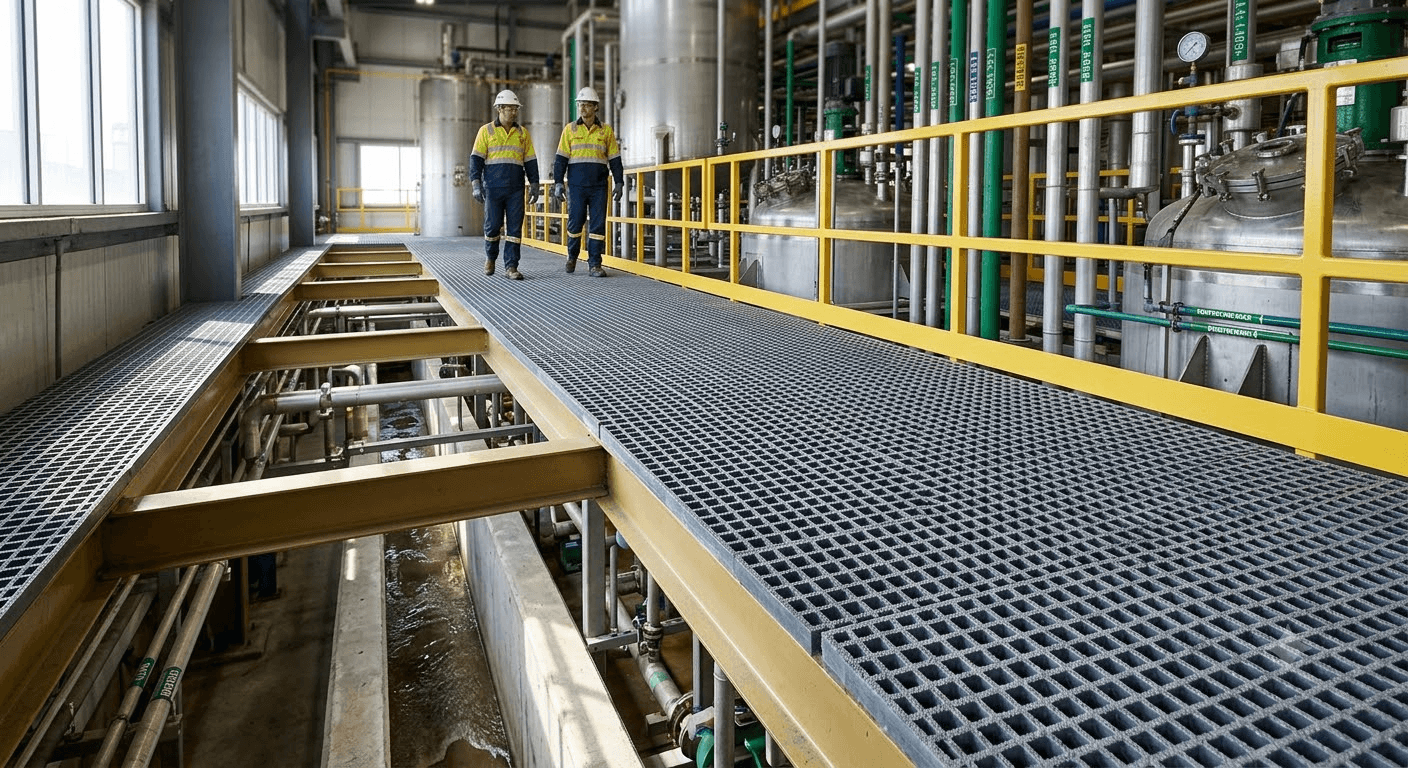
fiberglass floor grating
Custom panel sizes, cutouts and colors
Custom options may include cut to size panels, openings, notches, edge finishing, colors, surface options, and project labels. These details are useful for large platforms, retrofit areas, and repeated walkway sections.
Unicomposite Technology Co., Ltd is an ISO 9001 certified FRP and GRP composite manufacturer in Nanjing, China, with an 18,000 square meter facility. Its capabilities include pultrusion, pulwinding, SMC and BMC molding, hand lay up, and vacuum infusion for standard and custom composite products.
Unicomposite can review drawings, load and span data, chemical exposure, grating type, surface finish, cutouts, fasteners, quantity, packaging, and delivery schedule before recommending a floor grating solution.
Packaging and bulk order planning
Packaging should match the installation plan. Pallet labels, export packaging, panel grouping, and project sequence marks can reduce sorting time on site.
For large platform or walkway projects, buyers should align packaging with installation zones.
How to compare initial cost and lifecycle cost
Buyers should compare material price, freight, installation labor, corrosion repair, repainting, downtime, replacement frequency, and maintenance access. FRP should be justified by exposure, maintenance savings, and project service goals.
A low purchase price may not reduce total cost in corrosive environments.
Installation and Maintenance Tips
Correct installation protects performance. A suitable support frame, correct panel orientation, and compatible fasteners matter as much as the grating itself.
Prepare the support structure
Check support spacing, frame condition, levelness, edge support, and corrosion of existing structures. FRP grating should not compensate for an unsafe support structure.
Repair or reinforce the support system before installing new panels.
Confirm panel direction and support spacing
Bearing direction and support spacing affect deflection and load performance. Wrong orientation can increase movement or reduce performance.
Pultruded grating especially requires correct bearing bar direction.
Use suitable clips and fasteners
Hold down clips and fasteners should match the environment. Marine, chemical, outdoor, and vibration prone areas may need specific hardware choices.
Fastener compatibility matters because connection failure can create safety and maintenance problems.
Inspect surface wear, fasteners and chemical exposure changes
Routine inspection should include grit wear, clips, support condition, chemical exposure changes, debris buildup, and impact damage. Low maintenance still requires planned inspection.
Inspection should also follow process changes, new chemicals, or structural modifications.
Quick Buyer Checklist
Use this checklist before sending a quote request.
| Item | Confirm Before Ordering |
|---|---|
| Application | Platform, walkway, trench cover, utility access |
| Loads | Live load, concentrated load, carts, equipment |
| Span | Support spacing, bearing direction, deflection expectations |
| Grating type | Molded, pultruded, covered, custom cut |
| Material | Resin system, UV package, fire retardant needs |
| Surface | Grit top, concave surface, covered panel |
| Open area | Mesh size, drainage, foot comfort, dropped object risk |
| Fabrication | Cutouts, notches, edge finishing, color |
| Hardware | Clips, hold downs, fastener material |
| Environment | Chemicals, moisture, salt air, temperature, sunlight |
| Logistics | Quantity, packaging, labels, delivery schedule |
Conclusion
Fiberglass floor grating supports industrial flooring where drainage, corrosion resistance, slip resistance, non conductive performance, and low maintenance matter. It can be used in chemical plants, wastewater treatment plants, power utilities, marine sites, food processing areas, platforms, walkways, and trench covers.
Buyers should confirm load, span, resin, surface finish, open area, UV exposure, fire needs, fasteners, panel size, quantity, drawings, packaging, and delivery requirements before ordering. Material choice should compare FRP, steel, concrete, and wood by environment, safety, maintenance, and lifecycle value.
A clear RFQ helps suppliers recommend the right grating type, resin system, panel layout, fastener plan, and packaging approach.
[Contact Unicomposite for custom panel sizing or a bulk fiberglass floor grating quote →]


