 info@unicomposite.com


Introduction
Corrosion, access equipment, and shutdown labor can make an inexpensive metal rod costly over its service life. Engineers and procurement teams therefore need to evaluate how a material will perform after years of moisture, chemicals, UV exposure, and mechanical loading.
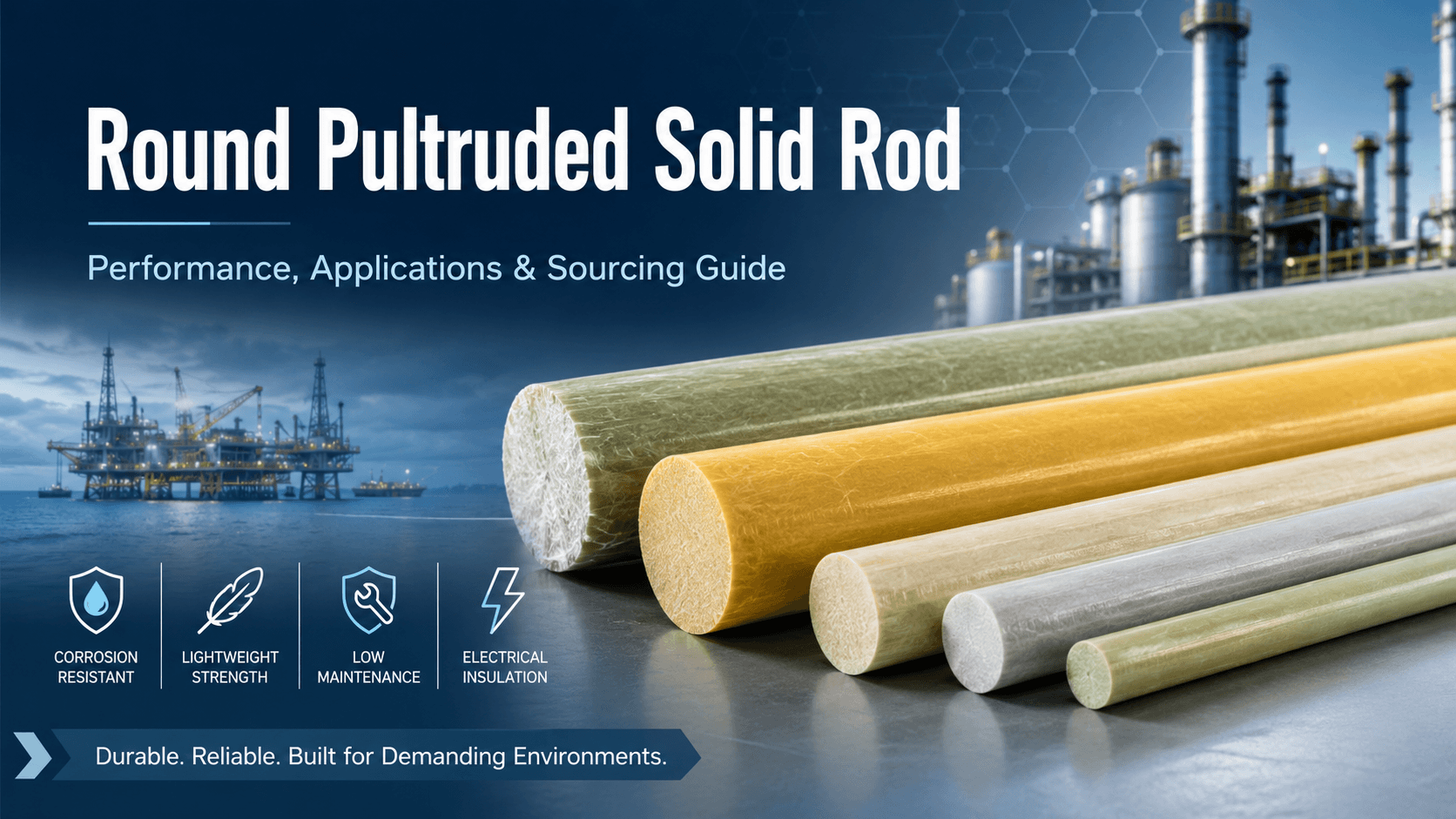
A round pultruded solid rod combines continuous glass fibers with a thermoset resin matrix. It offers low weight, corrosion resistance, electrical insulation, consistent geometry, and limited routine maintenance. This guide explains how to compare, specify, fabricate, and source it.
Unicomposite manufactures standard and customized FRP profiles at an ISO 9001-certified, 18,000-square-meter facility in Nanjing, China.
round pultruded solid rod
What Is a Round Pultruded Solid Rod?
How the Pultrusion Process Creates a Solid Rod
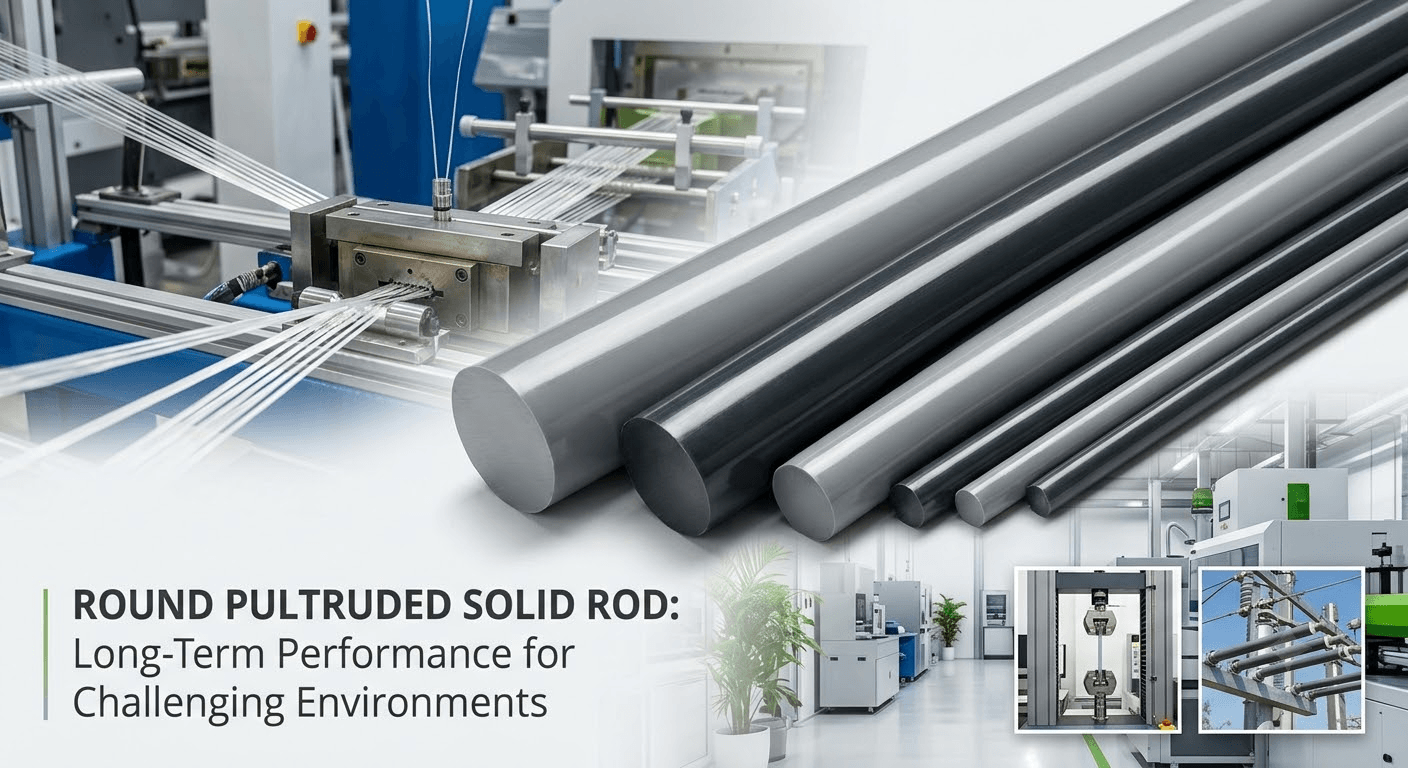
Pultrusion pulls continuous glass rovings through resin and a heated die, where the composite cures into a constant cross-section. Most fibers run along the rod axis, supporting strong longitudinal tensile and flexural performance.
Resin wet-out, glass content, die temperature, pulling speed, and cure consistency influence voids, surface quality, dimensions, and repeatability.
What Materials Are Commonly Used?
E-glass balances strength, electrical insulation, availability, and cost. Polyester suits many general uses, vinyl ester improves resistance in many wet or chemical environments, and epoxy may support demanding mechanical or electrical requirements.
A surface veil or UV-resistant finish can improve appearance and outdoor durability.
Which Properties Matter Most to Buyers?
The following ranges are useful only for preliminary screening:
| Property | Typical Screening Range | Buyer Benefit | Verification |
|---|---|---|---|
| Density | 1.8–2.0 g/cm³ | Easier handling than steel | ASTM D792 |
| Longitudinal tensile strength | 400–1,000 MPa | Axial load capacity | ASTM D638 or profile-specific method |
| Flexural strength | 400–900 MPa | Bending resistance | ASTM D790 |
| Flexural modulus | 20–45 GPa | Deflection assessment | ASTM D790 |
| Water absorption | Often below 1% | Wet-service screening | ASTM D570 |
| Dielectric strength | Product-specific | Electrical insulation | ASTM D149 |
| Diameter tolerance | Drawing-specific | Assembly fit | Dimensional inspection |
| Service temperature | Resin-dependent | Thermal suitability | Supplier data |
Actual values depend on diameter, fiber content, resin, test direction, specimen preparation, and process control. Critical projects require profile-specific reports and qualified engineering review.
Why Round Pultruded Solid Rod Delivers Long-Term Performance
How Does It Perform in Corrosive Environments?
A round pultruded solid rod does not rust like carbon steel, so it can reduce coating, corrosion inspection, and replacement work. Reliable service still requires a resin system matched to the chemicals, concentration, temperature, moisture, mechanical stress, and exposure duration.
This advantage supports wastewater, marine, agricultural, cooling-tower, and chemical-processing applications. Chemical-resistance charts provide initial guidance, while severe combined exposure may require coupon testing.
In one anonymized outdoor installation, coated metal supports required recurring rust removal. The project team selected vinyl ester FRP rods after reviewing chemical exposure, end sealing, connection loads, and a pilot installation.
How Does FRP Reduce Maintenance Requirements?
Painted steel may require recoating, galvanized surfaces can deteriorate after abrasion, and wood may split or decay. Properly specified FRP usually needs inspection, cleaning, and localized damage checks.
Where access is difficult, scaffolding and downtime may cost more than the rods. Lifecycle comparisons should include maintenance, access, lost production, and replacement.
Does Lightweight Construction Improve Project Efficiency?
Pultruded FRP typically has a density near one-quarter that of steel. Lower weight can simplify transport, positioning, and installation while reducing lifting requirements in selected projects.
Engineers must still check deflection, buckling, bearing stress, support spacing, and connections because FRP is less stiff than steel.
Round Pultruded Solid Rod vs Traditional Materials
How Do FRP, Steel, Aluminum, and Wood Compare?
| Factor | Pultruded FRP | Steel | Aluminum | Wood |
|---|---|---|---|---|
| Corrosion resistance | High with suitable resin | Usually needs protection | Good in many settings | Moisture-sensitive |
| Weight | Low | High | Low | Low |
| Conductivity | Generally nonconductive | Conductive | Conductive | Moisture-dependent |
| Stiffness | Moderate | High | Moderate | Variable |
| Maintenance | Usually low | Moderate to high | Low to moderate | Variable |
| Temperature capability | Resin-limited | High | Moderate to high | Limited |
FRP fits corrosion-prone, weight-sensitive, and electrically sensitive uses. Steel may remain preferable for high temperatures, extreme stiffness, heavy compression, welded assemblies, or metal-code-driven designs.
When Is Metal Still the Better Choice?
Metal is often the stronger option when compact sections must carry high loads, welding is essential, or the operating temperature exceeds the resin system’s capability. Selection should follow the complete load case and compliance requirements.
What Is the Main Lifecycle Cost Difference?
Lifecycle cost includes material, fabrication, freight, installation, coatings, inspection, downtime, repair, and replacement. FRP may cost more initially yet reduce ownership cost where corrosion creates recurring expense.
Common Applications for Round Pultruded Solid Rod
Electrical Utility and Insulation Components
Typical uses include hot sticks, insulating supports, cross-arm components, spacers, and equipment handles. Finished assemblies may require dielectric, water-absorption, tracking, conditioning, and certification tests.
Industrial and Infrastructure Uses
Applications include bracing, ladder parts, markers, machine supports, and grating accessories. Diameter, straightness, cut length, hole position, and surface condition often determine whether components assemble correctly.
Agricultural, Marine, and Outdoor Applications
Plant stakes, greenhouse supports, aquaculture parts, fence components, and marine accessories benefit from low weight and corrosion resistance. Resin and finish selection should consider fertilizer, salt spray, soil moisture, impact, UV radiation, and temperature cycling.
OEM and Custom-Fabricated Products
OEM uses include tool handles, tent parts, antenna supports, sports equipment, and machine components. Available services may include cutting, drilling, grinding, coating, inserts, and end finishing.
In one anonymized OEM trial, unclear hole-location tolerance caused misalignment. A revised drawing, approved sample, and first-article inspection prevented repeat rework.
How to Specify the Right Round Pultruded Solid Rod
What Diameter and Mechanical Properties Are Required?
Review tensile load, bending, span, deflection, impact, buckling, connection stress, fatigue, and safety factors. Capacity does not scale directly with diameter because glass content, resin, fiber alignment, and manufacturing control also matter.
Which Resin System Should Buyers Select?
Polyester suits many general environments, vinyl ester often provides stronger chemical and moisture resistance, and epoxy may support demanding mechanical or electrical applications. Selection should reflect concentration, exposure time, temperature, fire requirements, UV conditions, and required certifications.
Chemical charts are screening tools. Severe service may require manufacturer review, coupon testing, or a pilot installation.
How Should Tolerances and Surface Finish Be Defined?
Specify diameter, straightness, length, color, veil, smoothness, fiber-exposure limits, end condition, hole location, and packaging. Tight tolerances increase tooling and inspection costs, so they should match actual assembly needs.
What Testing and Documentation Should Be Requested?
Request profile-specific mechanical reports, resin identification, dimensional records, conformity certificates, electrical or fire results, and lot traceability. ASTM D570, D638, D790, D792, and D149 may be relevant, but buyers should confirm the current edition and suitability with the supplier or project engineer.
round pultruded solid rod 2
Fabrication, Installation, and Connection Considerations
Can Round Pultruded Solid Rod Be Cut and Drilled?
Carbide or diamond tooling, stable fixturing, controlled feed, dust extraction, and suitable PPE support clean machining. Dull tools or excessive pressure can cause splintering, exposed fibers, delamination, or inaccurate holes.
How Should FRP Rods Be Connected?
Options include fasteners, bonded joints, sleeves, inserts, and clamps. Designers should check bearing stress, edge distance, hole spacing, adhesive compatibility, surface preparation, and bolt torque.
Overtightening can crush the laminate locally, so suitable washers, sleeves, and controlled torque may be necessary.
How Can Field Damage Be Reduced?
Store rods on level supports, protect them from impact, and avoid unsupported stacking. Inspect cracks, fiber bloom, damaged ends, distortion, hole quality, alignment, and fastener seating before final acceptance.
How to Evaluate a Round Pultruded Solid Rod Supplier
What Manufacturing Capabilities Should Buyers Verify?
Review pultrusion capacity, die ownership, resin handling, fiber control, cure monitoring, fabrication, testing, and sample development. Unicomposite also supports pulwinding, molding, hand lay-up, and vacuum infusion for broader composite requirements.
In-house tooling, cutting, drilling, and inspection can reduce subcontracting risk.
Which Quality Signals Matter?
Look for ISO 9001 certification, lot traceability, calibrated equipment, documented procedures, sample approval, and corrective-action systems. Consistent records matter more than unsupported claims such as “premium quality.”
What Questions Should Procurement Teams Ask Before Ordering?
Confirm application, loads, diameter, length, resin, color, tolerances, quantity, fabrication, packaging, testing, documentation, and delivery. For a new design, request samples, a pilot order, or first-article approval.
Conclusion
Round pultruded solid rod can deliver long service when geometry, reinforcement, resin, fabrication, and installation match the operating environment.
- Verify data for the exact profile and resin system.
- Match the resin to chemical, thermal, UV, electrical, and fire exposure.
- Compare lifecycle cost instead of unit price alone.
- Define tolerances, machining, testing, and documentation before ordering.
- Choose a supplier with traceable production and technical support.


