 info@unicomposite.com


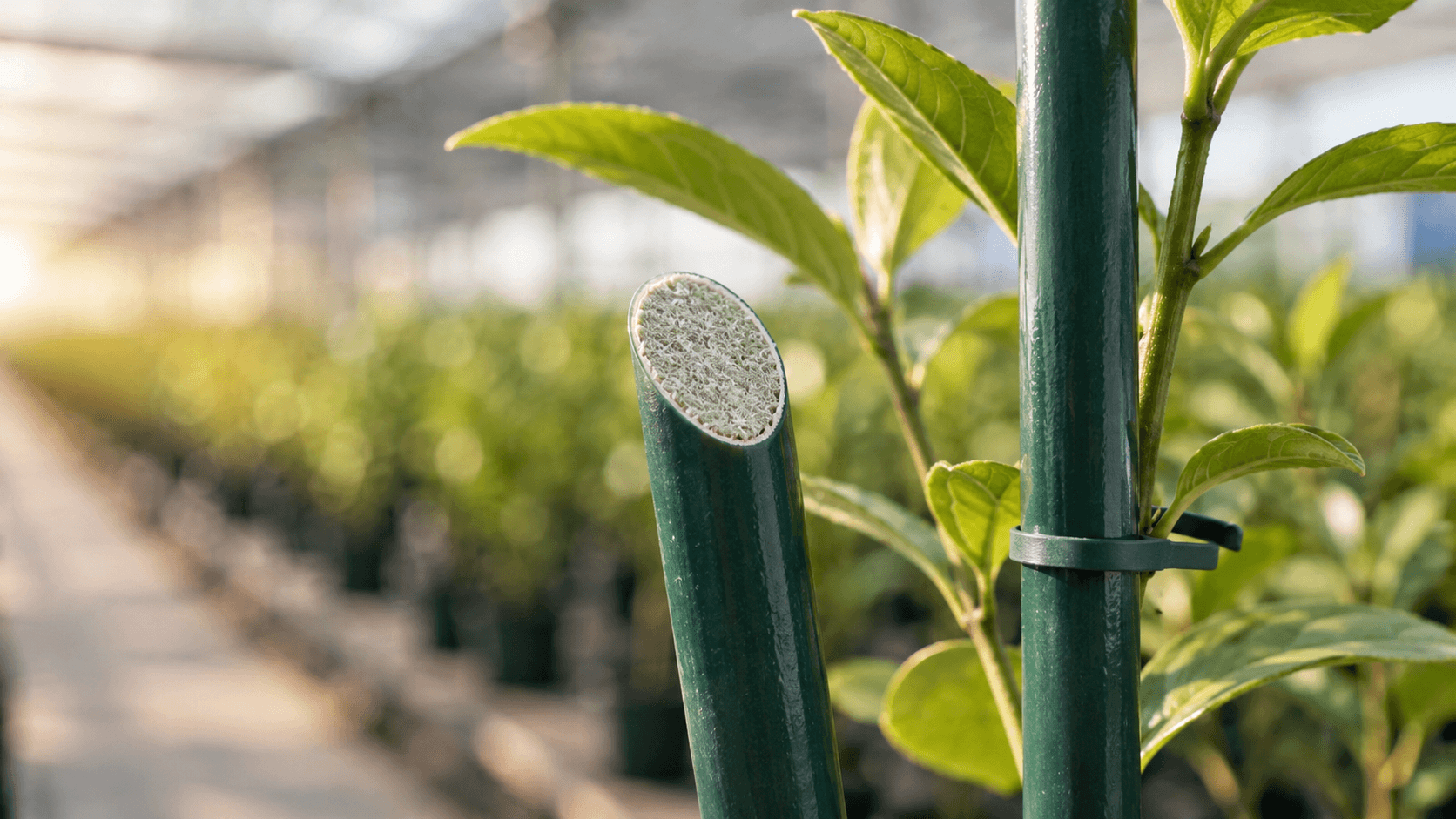
A surfacing veil can be used as part of the outer surface system of some fiberglass profiles. Depending on the veil, resin and manufacturing construction, it may contribute to a more resin-rich surface layer. A polyester veil should be evaluated as one component of the complete surface system, not as a standalone UV or durability rating. Specify the actual surface build, define the exposure and acceptance criteria, and send those requirements with your profile, quantity and application details for a project review.
polyester veil fiberglass stake
What a surfacing veil is
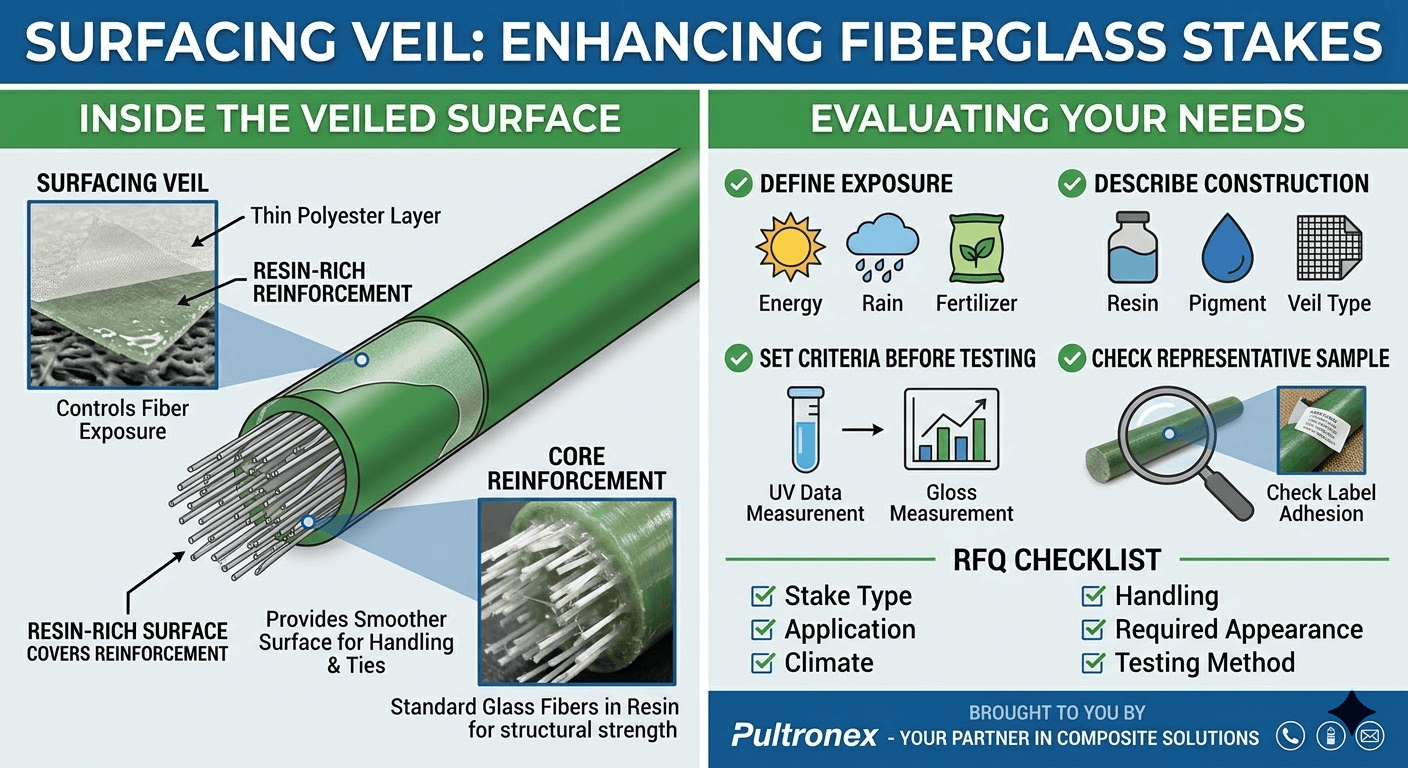
Fiberglass stakes are commonly made as pultruded FRP profiles: reinforcing fibers are combined with a polymer matrix and formed into a continuous section. Some profile designs add a thin surfacing veil at the outside of the section. The veil is a surface layer, not a substitute for the structural reinforcement that controls the profile’s load response.
The exact construction matters. “Polyester veil” can describe a component in a particular manufacturing system, but it does not identify the resin matrix, veil weight, pigments, stabilizers, coating, thickness or production process. Ask the supplier to describe the proposed surface system and to identify which items are confirmed for the quoted profile.
Research on glass-fiber-reinforced polyester sheet shows why the surface layer deserves its own review. In a defined accelerated-weathering study, the National Research Council of Canada reported that a glass surfacing veil created a resin-rich surface and improved resistance to fiber pop-out for the tested formulation [1]. That result is useful technical context, not a universal result for every veil material, resin system or plant stake.
What a veil may help with
Managing fiber exposure at the surface
When reinforcement is close to the outside of an FRP section, weathering, abrasion or finishing can expose fibers. A resin-rich surface layer can change how the outer fibers are covered and how surface damage develops. The NRC study above measured this effect on specific glass-fiber-reinforced polyester sheets; it did not establish a performance value for a commercial stake.
For a stake project, the practical question is whether the proposed surface remains acceptable after the handling and exposure that matter to your operation. Define what you will inspect: visible fibers, roughness, loose strands, cracking, gloss or color change, and any change that could affect labels, ties or workers handling bundles.
Supporting a smoother contact surface
A controlled, smooth surface may be desirable where workers handle stakes frequently or where labels and ties contact the profile. Whether a proposed veiled surface provides that condition should be verified on representative samples. Cutting, impact, abrasion, resin cure, storage and installation can all change the condition of an individual surface, so do not treat the veil label as a splinter-free handling guarantee.
Providing a defined surface for weathering evaluation
UV damage is controlled by the whole surface system: resin chemistry, pigments or stabilizers, veil or coating, profile geometry, moisture and the climate. A veil may be one part of that system. It is not a substitute for exposure data on the actual profile.
The University of Lisbon and National Laboratory for Civil Engineering studied commercial GFRP pultruded profiles made with different resin systems. Their specimens experienced 42 months of natural ageing in Lisbon and up to 3,000 hours in a QUV chamber. The study found visible aesthetic changes, with UV effects concentrated in the outer layers, and reported different durability behavior between the tested polyester and vinylester profiles [2]. Those are results for identified commercial profiles and test conditions, not a benchmark for all fiberglass stakes.
What a veil cannot prove by itself
A veil is a construction feature, not a performance rating.
Do not use “polyester veil” as shorthand for any of the following conclusions:
- a universal “best UV protection” result;
- a fixed outdoor service life or a guaranteed number of seasons;
- a specific bending, tensile, impact or dielectric rating;
- guaranteed resistance to splinters, cracks, chips or flaking;
- corrosion resistance in a named chemical or coastal environment;
- a lower total cost or a guaranteed payback period.
Those conclusions require a defined product, environment, test method and acceptance rule. A material name is not a test report.
How to evaluate UV and surface claims
Use the following sequence when comparing veiled and non-veiled fiberglass stakes.
1. Define the exposure and the handling cycle
Record direct sunlight, shade, moisture, irrigation, fertilizer, salt, cleaning chemicals, temperature swings and storage conditions. Add the handling cycle: manual insertion, bundling, tie contact, transport, seasonal removal or reuse. A surface requirement that is important for a nursery bundle may be different from one for a fixed trellis line.
2. Describe the proposed surface construction
Ask for the veil material, resin matrix, any coating or pigment system, and the location of the surface layer in the cross-section. If a supplier cannot disclose a formulation, request the performance and inspection information that can be shared instead. Do not infer the construction from a product name alone.
3. Set acceptance criteria before testing
Choose observable measures that match the use: color or gloss change, visible fiber exposure, surface roughness, cracking or crazing, mass change, or retention of a project-relevant mechanical property. State the inspection method, specimen orientation, sample count and pass/fail rule. If the concern is worker contact, define the surface condition that triggers rejection and the handling response.
enhancing fiberglass stakes
4. Read an ASTM G154 result as a complete test record
ASTM G154-23 describes how to operate fluorescent UV and water exposure equipment. ASTM states that the practice alone does not deliver a specific result; a report must include the operating conditions, and the exposure should be paired with a way to evaluate property changes [3]. Ask for the lamp type, irradiance, temperature, wetting or condensation cycle, duration, number of replicates, controls and pre/post measurements. Do not compare two “G154 tested” claims when those details are different or missing.
5. Check a representative sample or pilot lot
Inspect the actual profile, not only a brochure photograph. Record surface appearance, ends, labels, tie contact and any damage after the intended handling cycle. For an outdoor release, keep retained samples and document the exposure start date, location and inspection intervals. A pilot can reveal whether the proposed acceptance criteria are practical before a larger purchase.
Surface handling and worker safety
The U.S. Occupational Safety and Health Administration notes that glass-fiber exposure can cause mechanical irritation of the skin, eyes, nose and throat [4]. The surface construction can influence whether fibers become exposed, but a veil does not replace inspection or task-specific safety controls. Follow the supplier’s handling instructions and your site’s task-specific procedures for cutting, finishing, damaged parts, cleanup and waste.
If a stake arrives with exposed fibers, sharp damage or unexpected surface defects, isolate the affected pieces and record the lot or bundle information. Ask the supplier how the condition should be evaluated before use; do not assume that a generic “veiled” label resolves the issue.
When a veiled surface is worth evaluating
- Frequent hand handling, labels or tie contact: prioritize a documented surface condition and a sample inspection method.
- Long outdoor exposure: request resin/surface information and an exposure report tied to the proposed profile and climate; do not rely on the veil name alone.
- Moisture, fertilizer or salt exposure: add the relevant chemical and wetting conditions to the verification plan.
- Support-only or short seasonal use: review whether additional surface requirements are necessary for the actual exposure, handling and replacement plan.
- No usable evidence: choose a documented option or run a controlled pilot instead of assigning a universal winner.
RFQ checklist for a fiberglass stake surface review
Send these inputs with your inquiry:
- stake construction: solid or hollow;
- support application: individual stake, trellis-support or another defined system;
- required length, diameter or cross-section, with tolerances if critical;
- crop, tree or support-system purpose;
- direct-sun, moisture, fertilizer, salt and chemical exposure;
- manual handling, tie, label, abrasion and reuse requirements;
- desired surface appearance and the defects that are unacceptable;
- requested resin, veil or coating description, if specified;
- exposure method, duration and acceptance criteria for any test;
- sample quantity, inspection plan, packaging constraints and delivery destination.
We offer solid and hollow fiberglass plant stakes and fiberglass trellis-support products for greenhouse, vineyard, horticulture, garden-center, nursery, farm and ranch applications. Send us the profile type, dimensions, quantity, environment and surface/UV requirements through our FRP plant stake product page. We will use those inputs to define the quotation scope and identify any product or document requirements that still need confirmation.
For broader sizing and installation-planning inputs, see our fiberglass plant stake sizing and installation guide. For a neutral material-selection framework, see our plant stake material selection guide.
FAQ
Does a polyester veil make a fiberglass stake UV resistant?
Not by itself. UV behavior depends on the resin, surface system, profile, exposure and evaluation method. Request a complete test description for the proposed product rather than treating “polyester veil” as a universal rating.
Is a surfacing veil structural reinforcement?
Usually, a surfacing veil is an outer surface layer. It should not be counted as the core reinforcement or used to infer bending or tensile performance without a product-specific specification.
Does a veil guarantee no splinters or cracking?
No. Surface condition depends on construction, cure, finishing, handling, abrasion and weathering. Define an inspection method and acceptance criteria for the actual profile and use conditions.
What should a supplier provide for a surface and UV review?
Ask for the proposed surface construction, resin or coating description, applicable exposure method, operating conditions, evaluation metrics, sample or lot-inspection approach and any limitations on the data. A report that only names a standard, without the exposure and evaluation details, is incomplete for comparison.
References
[4] U.S. Occupational Safety and Health Administration — Technical Manual, Section III: Chapter 1


