 info@unicomposite.com


Introduction
Industrial flooring often fails first in wet trenches, chemical wash-down zones, wastewater platforms, marine walkways, and car wash bays. Steel grating can rust, coatings can break down, and heavy panels can make replacement work slow.
Fiberglass grating gives engineers and procurement teams a lighter, corrosion-resistant flooring option for platforms, walkways, trench covers, stair treads, drainage areas, and industrial access systems. This guide explains what fiberglass grating is, where it works best, and how buyers can specify the right type for long-term industrial performance.
a guide to durable corrosion resistant industrial flooring
What Is Fiberglass Grating?
Definition of Fiberglass Grating
Fiberglass grating, also called FRP grating or fiberglass reinforced plastic grating, is an open-mesh panel made from glass fiber reinforcement and resin. The glass fiber provides strength, while the resin binds the panel and protects it from moisture, chemicals, UV exposure, and corrosion.
For B2B projects, the main value is practical. FRP grating is used where steel may rust, require repeated coating, add excessive installation weight, or create electrical conductivity concerns.
How Glass Fiber and Resin Work Together
Glass fiber acts as the reinforcement. Resin acts as the protective matrix. Together, they create a composite material with useful strength, low weight, and resistance to many corrosive environments.
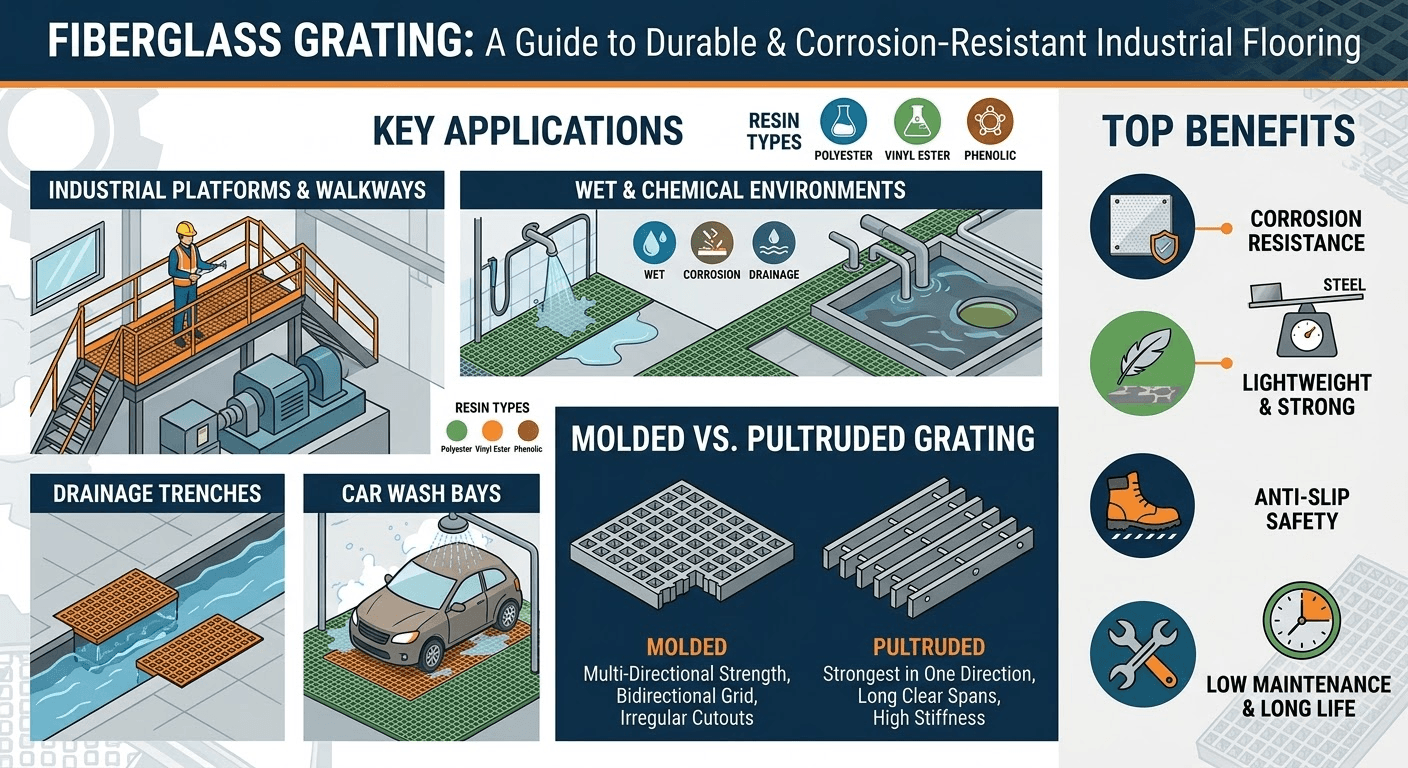
Resin selection matters. Polyester resin may suit general industrial use. Vinyl ester resin often fits stronger chemical exposure. Phenolic resin may be considered when flame and smoke behavior require closer review. Chemical resistance, fire behavior, and load performance depend on resin formulation, panel design, support layout, and project specifications.
Why Open Mesh Design Matters
Open mesh allows water, overspray, dirt, and process residue to drain through the walking surface. This helps reduce standing water in wash bays, wastewater facilities, trench covers, and outdoor access areas.
The open area also lowers panel weight and improves ventilation, which can make maintenance areas easier to clean and safer to access.
Key Benefits of Fiberglass Grating
Corrosion Resistance
Corrosion resistance is the main reason many buyers evaluate fiberglass grating. FRP does not rust like carbon steel, and in many wet or corrosive environments it does not require recurring paint or coating cycles.
Chemical plants, wastewater facilities, saltwater zones, and car wash floors often expose flooring to liquids, salts, cleaning agents, gases, and humidity. The right resin system can reduce maintenance pressure and replacement frequency.
Lightweight but Strong
Fiberglass grating is much lighter than steel grating. Many FRP panels are commonly described as about one quarter the weight of steel, depending on thickness, panel depth, resin content, and construction.
That lower weight helps during transportation, lifting, cutting, and installation. Engineers should still confirm clear span, uniform load, concentrated load, deflection limit, bearing surface, and fastener layout before replacing steel with FRP.
Slip Resistance and Workplace Safety
Wet industrial floors create slip risk. Fiberglass grating can be supplied with concave, gritted, or covered anti-slip surfaces.
Gritted surfaces usually provide stronger traction in wet or oily environments. Covered grating can reduce dropped-object risk and create a more solid walking surface. Surface finish should match foot traffic, footwear, drainage, cleaning method, and wheeled equipment use.
Low Maintenance and Long Service Life
FRP grating can reduce maintenance because it does not rust, needs no routine repainting in many applications, and resists many corrosive conditions. Inspection still matters around clips, supports, cut edges, and impact zones.
Buyers should compare installed cost, downtime risk, replacement frequency, coating labor, and maintenance access. The lowest initial material price may not deliver the lowest lifecycle cost.
Molded vs Pultruded Fiberglass Grating
What Is Molded Fiberglass Grating?
Molded fiberglass grating is made in a mold as a one-piece grid panel. Continuous glass fibers and resin form a bidirectional structure with strength in both directions.
It is often selected for chemical areas, wastewater facilities, trench covers, car wash floors, and layouts with irregular cutouts around pipes, drains, pumps, or equipment bases.
What Is Pultruded Fiberglass Grating?
Pultruded fiberglass grating is assembled from pultruded FRP bearing bars and cross rods. It usually provides stronger span performance in the primary load direction.
Engineers often choose it for platforms, walkways, elevated access systems, and structures where longer clear spans or higher directional stiffness matter. Bearing bar direction and support layout need careful review.
Molded vs Pultruded FRP Grating Comparison Table
The table below compares the two common FRP grating types during early selection:
| Factor | Molded Fiberglass Grating | Pultruded Fiberglass Grating |
|---|---|---|
| Structure | One-piece molded grid panel | Bearing bars with cross rods |
| Strength direction | Multi-directional | Strongest in bar direction |
| Best fit | Trenches, wash bays, cutouts | Walkways, platforms, longer spans |
| Buying focus | Mesh, thickness, resin | Span, bar depth, deflection |
Common Applications of Fiberglass Grating
Industrial Platforms and Walkways
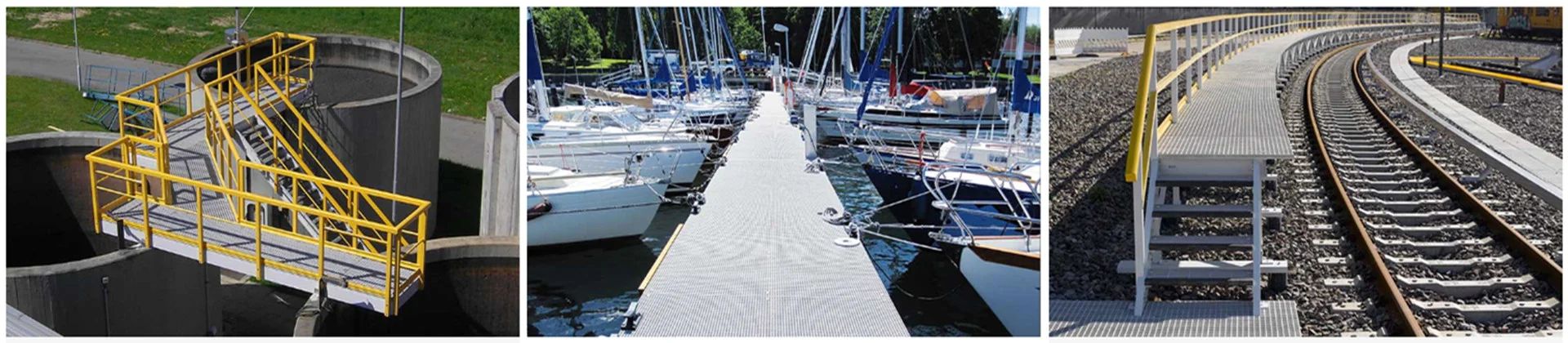
Fiberglass grating is widely used for work platforms, maintenance walkways, catwalks, and elevated operating areas. In chemical plants and wastewater facilities, its corrosion resistance can reduce replacement cycles.
For platform projects, engineers should confirm support spacing, live load, concentrated load, deflection limit, and fastener design.
Trench Covers and Drainage Areas
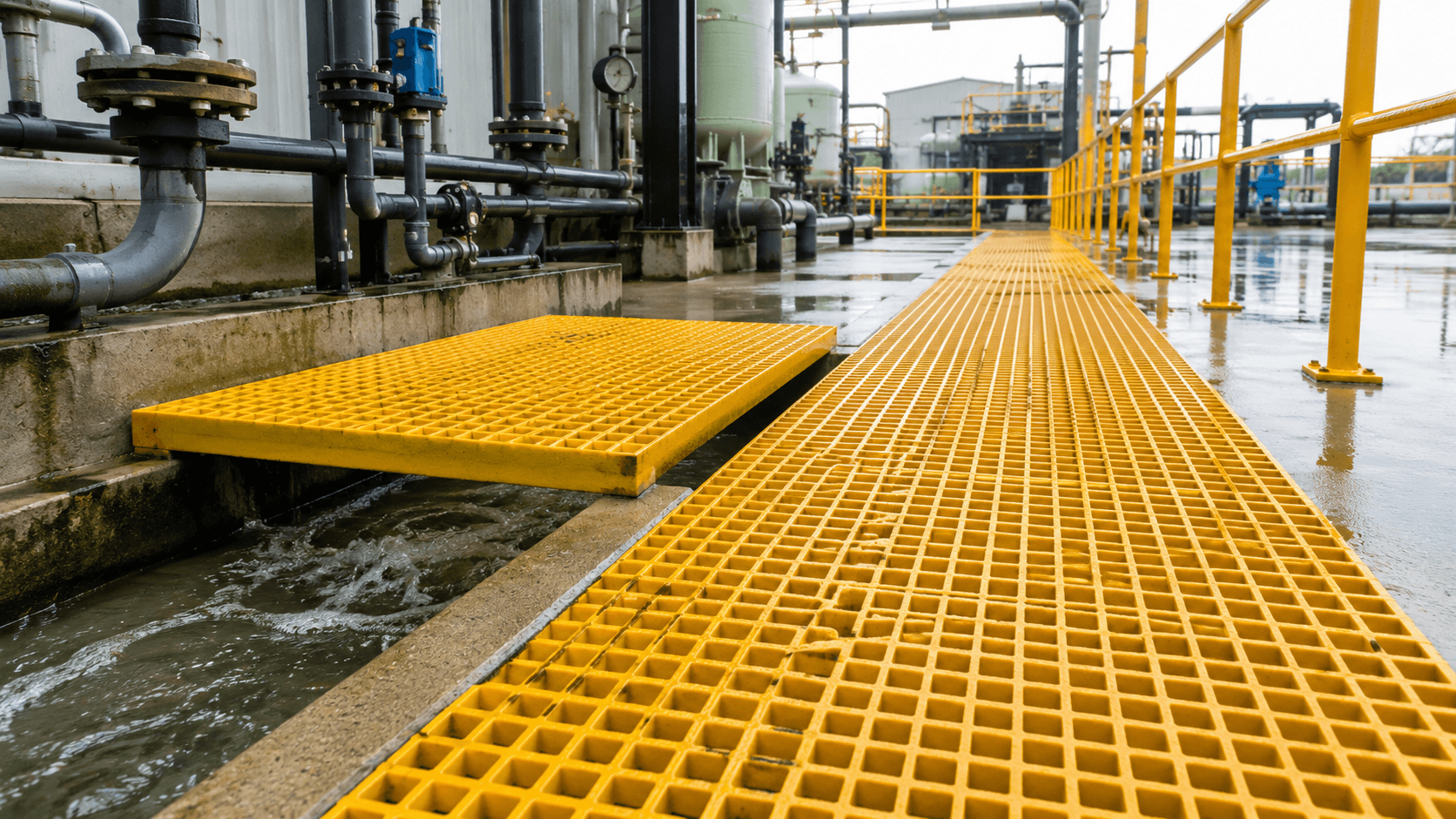
Trench covers need drainage, slip resistance, and enough load capacity for workers or site traffic. Molded fiberglass grating often works well because liquid can pass through the open mesh and panels can be cut around drains and equipment foundations.
In one anonymized wastewater retrofit, a facility replaced corroded steel trench covers near treatment tanks with molded FRP grating. The design team prioritized chemical resistance, drainage, lower handling weight, and irregular cutouts around pipe penetrations.
Chemical Plants and Wastewater Facilities
Chemical and wastewater sites may expose flooring to acids, alkalis, salts, gases, biological processes, and cleaning cycles. These conditions can shorten the life of coated steel grating.
FRP grating can help when the resin system matches the chemical exposure. Vinyl ester resin is often considered for aggressive chemical areas, while polyester may suit less severe conditions.
what is fiberglass grating
Car Wash Floors and Wet Environments
Car wash floors require drainage, slip resistance, and resistance to water and detergents. Fiberglass grating helps liquid drain away and avoids steel rust problems.
Buyers should confirm wheel load, support spacing, panel thickness, surface grit, and edge sealing before ordering.
Stair Treads and Access Systems
FRP stair treads are used where workers need safe access in wet, corrosive, or electrically sensitive locations. They often include gritted nosing to improve traction and visibility.
For stair systems, buyers should define tread width, tread depth, support span, nosing color, and fastening method.
How to Choose Fiberglass Grating for a Project
How do engineers choose the right fiberglass grating?
Engineers choose fiberglass grating by reviewing load requirement, clear span, resin system, mesh size, panel thickness, surface finish, cutout needs, fastener type, and installation environment. Drawings, chemical exposure data, traffic type, temperature, and support layout should be shared with the supplier before a bulk order is confirmed.
Load Requirement and Span
Load and span drive the design. A pedestrian walkway needs a different panel than an equipment platform, drainage trench, or vehicle wash area.
Better quotation inputs include clear span, uniform load, concentrated load, deflection limit, support width, bearing direction, and traffic type.
Mesh Size and Panel Thickness
Mesh size affects drainage, walking comfort, dropped-object risk, and wheel compatibility. Panel thickness affects stiffness and load capacity.
Smaller openings or covered grating may work better in areas with narrow wheels, small tools, or pedestrian safety concerns.
Resin Type: Polyester, Vinyl Ester or Phenolic
The table below summarizes common resin selection logic for early planning:
| Resin Type | Typical Use Case | Key Benefit |
|---|---|---|
| Polyester | General platforms and drainage covers | Cost-effective corrosion resistance |
| Vinyl ester | Chemical and wastewater areas | Stronger chemical resistance |
| Phenolic | Fire-sensitive areas | Improved flame and smoke performance |
Final resin selection should follow project specifications, site exposure data, and engineering approval.
Surface Finish, Color and Custom Cutting
Surface finish affects safety and cleaning. Concave surfaces may suit general areas, gritted surfaces often work better in wet or oily environments, and covered grating can reduce dropped-object risk.
Fiberglass grating can be supplied in different colors, sizes, thicknesses, and surface configurations. Cut edges should be sealed to protect exposed glass fibers and support long-term performance.
Fiberglass Grating vs Steel Grating
Weight, Corrosion and Maintenance Comparison
Steel grating remains useful in dry, high-load, or metal-specified projects. Fiberglass grating becomes attractive when corrosion, lower weight, electrical insulation, and maintenance reduction carry higher value.
The table below compares major buying factors:
| Factor | Fiberglass Grating | Steel Grating |
|---|---|---|
| Corrosion | Does not rust, resin matters | Can rust if coating fails |
| Weight | Lightweight | Heavy |
| Electrical behavior | Non-conductive | Conductive |
| Maintenance | Low in many environments | May need coating or replacement |
| Best fit | Wet, corrosive, electrical areas | Dry or heavy-load metal areas |
When Steel Still Makes Sense
Steel may still make sense for heavy loads, high-temperature exposure, dry industrial spaces, or specifications that require metal grating. Material choice should follow site conditions, safety requirements, engineering review, and lifecycle cost.
When FRP Grating Is the Better Long-Term Choice
Fiberglass grating often becomes the better long-term option when corrosion resistance, electrical insulation, slip resistance, lighter installation, and reduced maintenance matter more than the lowest initial material price.
This is especially true in wet chemical areas, wastewater plants, marine environments, wash-down zones, and access structures where repeated steel coating or replacement creates downtime.
Buying Checklist for B2B Projects
What information should buyers send to a fiberglass grating supplier?
Buyers should send drawings, panel dimensions, clear span, load requirements, support layout, chemical exposure, temperature, UV conditions, surface finish, resin preference, fastener needs, quantity, and delivery requirements. These details help suppliers recommend molded or pultruded fiberglass grating more accurately.
Drawings, Load Data and Installation Environment
A simple layout should show panel size, support direction, cutouts, fastening points, edge conditions, and installation sequence. Load data should define pedestrian load, equipment load, cart traffic, wheel load, or vehicle exposure.
Installation environment should include indoor or outdoor use, moisture, chemicals, UV exposure, temperature, fire requirements, and cleaning method.
Manufacturer Perspective from Unicomposite
Unicomposite reviews project drawings, exposure conditions, support spacing, target quantity, and application requirements before recommending a fiberglass grating solution. This helps determine whether molded grating, pultruded grating, a specific resin system, custom cutting, or additional FRP structural components are needed.
Unicomposite Technology Co., Ltd is an ISO 9001-certified FRP/GRP composite manufacturer based in Nanjing, China, with an 18,000 m² facility. Its production capabilities include pultrusion, pulwinding, SMC/BMC compression molding, hand lay-up, and vacuum infusion for standard and customized composite profiles and systems.
Questions to Ask Before Bulk Ordering
The table below can help buyers avoid missing key specification details:
| Question | Why It Matters |
|---|---|
| Is molded or pultruded grating better for this span? | Prevents deflection problems |
| Which resin system fits the exposure? | Reduces compatibility risk |
| What surface finish suits the site? | Improves safety |
| Can panels be cut and sealed before delivery? | Saves installation time |
| What fasteners or clips are required? | Avoids site delays |
Conclusion
Fiberglass grating works best when the specification matches the environment.
Four takeaways matter most. Resin selection should follow real chemical exposure, temperature, UV conditions, and fire requirements. Molded grating often fits corrosive areas, drainage, and irregular cutouts. Pultruded grating often fits longer spans and directional stiffness. Load, span, surface finish, mesh size, fasteners, and edge sealing should be confirmed before ordering.
A well-specified FRP grating system can reduce corrosion maintenance, lower handling weight, improve drainage, and support safer access in demanding industrial environments.
[Contact Unicomposite for a custom fiberglass grating quote →]


