 info@unicomposite.com


Introduction
Fiberglass rods show up in specs when teams want long service life in places where metal corrodes, wood rots, or electrical insulation matters. This guide highlights the most practical Fiberglass Rods Application scenarios across power, marine, agriculture, wastewater, and OEM manufacturing, plus a selection framework you can use for bulk purchasing and standardization.
Unicomposite is an ISO certificated pultrusion manufacturer producing standard pultruded fiberglass profiles and custom composite parts in China, serving applications in electricity, landscaping, wastewater treatment, cooling towers, agriculture, aquaculture, and marine. Pultrusion is its core process, with additional forming options available for custom requests.
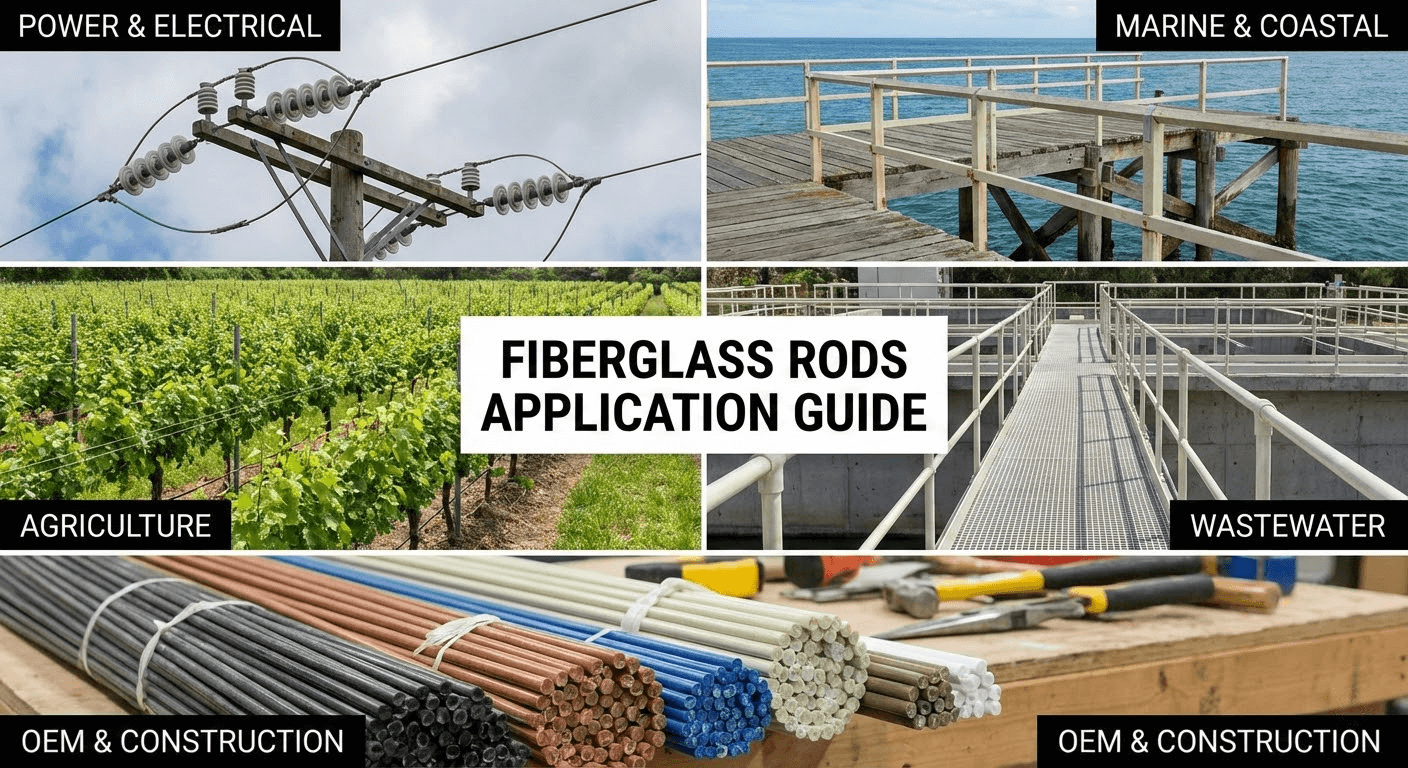
fiberglass rods application
Fiberglass Rods Application in Power and Electrical Systems
When the job site is wet, coastal, or outdoors, insulation plus corrosion resistance can matter as much as strength. A practical way to think about the Fiberglass Rods Application in this sector is “structural support that must stay electrically quiet.”
Typical uses buyers source in volume:
- Nonconductive supports, standoffs, and braces near energized equipment
- Cable management supports and hardware adjacent members where rust creates maintenance
- Outdoor assemblies where weight reduction speeds install
Why pultruded composites are frequently specified here: Exel Composites summarizes that pultruded composites offer excellent electrical insulation along with resistance to corrosion, UV, and chemicals.
Field reality check that prevents failures:
- Specify end sealing for any cut-to-length rod used outdoors
- Define clamp and fastener interfaces up front, torque control prevents crush damage
- Ask for tolerance and straightness targets that match your sleeves and drilled patterns
Fiberglass Rods Application in Marine and Coastal Infrastructure
Salt spray and constant wetting punish metals and fasteners. In coastal builds, the Fiberglass Rods Application often starts as “a member that needs to keep its shape without rusting, swelling, or seizing hardware.”
Common applications:
- Dock and pier components, handrail cores, and secondary supports
- Aquaculture frames and bracing exposed to brine and cleaning chemicals
- Coastal facility retrofits where corrosion drives repeated repainting and replacements
A useful real-world signal from a coastal project case study: Strongwell notes a team chose fiberglass due to corrosion resistance, durability, high strength-to-weight ratio, and ease of handling in a remote installation.
Coastal selection tips:
- Prefer resin systems and surface protection designed for UV exposure
- Treat holes, cut ends, and bonded joints as corrosion entry points, seal and protect them
- Design for impact and fatigue when loads are cyclic, like docks and wave zones
Fiberglass Rods Application in Agriculture and Landscaping
Here, buyers care about speed, consistency, and reusability. The Fiberglass Rods Application most often looks like stakes, trellis rods, greenhouse members, and fencing posts that must survive sun, moisture, and rough handling.
Common bulk uses:
- Plant supports, tree stakes, nursery frames, vineyard trellis rods
- Electric fencing posts and nonconductive spacers
- Greenhouse structural members exposed to humidity and fertilizers
Why vertical support keeps getting funded: University of Wisconsin Extension notes that trellising and staking can enhance yield, minimize disease, and ease harvesting.
Bulk standardization that saves labor:
- Standardize two or three diameters that cover most crops and hardware
- Lock in a small set of lengths and packaging to reduce staging time and breakage
- Decide on surface finish intentionally, smoother for easy cleaning, textured for better tie grip
Fiberglass Rods Application in Wastewater and Chemical Environments
Wastewater environments are a corrosion stress test, especially around hydrogen sulfide and acidic condensate zones. In the Fiberglass Rods Application for treatment plants and collection systems, fiberglass is often chosen to reduce maintenance in wet, chemical, or splash-prone areas.
Where rods and rod-based members fit:
- Grating accessories and secondary supports near chemical dosing and wet wells
- Bracing and components near areas with frequent washdown
- Custom fabricated parts where metals pit or seize
Two practical indicators from EPA guidance: the CMOM guide notes that a pipe crown pH less than four indicates further investigation is warranted, and it also states that concrete, steel, and iron pipes are more susceptible to hydrogen sulfide corrosion than vitrified clay and plastic pipes.
Spec and QA items to require:
- Chemical compatibility statement for your media and temperature range
- Traceability for batches used in regulated facilities
- Finishing requirements including sealed ends and protected drilled holes
Fiberglass Rods Application in Construction, Civil, and OEM Manufacturing
OEM teams buy consistency. Pultrusion is useful because it produces profiles with constant cross-sections, commonly including rods and tubes.
Common OEM and construction uses:
- Tool handles, guards, fixtures, and insulating members
- Corrosion-prone secondary structural components
- Rod-based assemblies needing repeatable cut lengths, holes, or end fittings
Engineering notes that reduce surprises:
- Compression and buckling: slender rods can fail early if the load case is wrong
- Connections: joints often decide service life, not the rod body
- Tolerances and straightness: define them to match your sleeves, clamps, and jigging
How to Choose the Right Fiberglass Rod for Your Application
A compact selection map that procurement and engineering can share:
Environment to material choices:
- High UV outdoors: UV-stabilized resin system, optional surface veil, specify color stability targets
- Coastal salt spray: corrosion-resistant resin, sealed ends, isolate metal interfaces
- Chemical splash: verify chemical compatibility and temperature range, specify protective surface where needed
- Electrical insulation critical: request dielectric testing and resistivity documentation
Reports buyers should ask for:
- Dielectric strength testing is commonly run to ASTM D149.
- Water absorption is commonly evaluated with ASTM D570.
- For mechanical verification, many labs and programs reference standards like ASTM D3039 for composites tensile and ASTM D790 for flexural, among others.
Connections and drilling do list:
- Use sharp bits and controlled feed, minimize heat
- Deburr holes, seal exposed fibers and cut surfaces
- Use sleeves or load-spreading washers where clamping loads are high
- Document torque limits and avoid point-loading
Limitations and Safety
When fiberglass rods are a poor fit:
- High temperature zones beyond the resin system capability
- Heavy abrasion without protective surface design
- Applications where crushing loads at clamps are unavoidable and cannot be redesigned
Shop safety basics for cutting and drilling:
- OSHA provides sampling and method notes for fibrous glass dust, which is a reminder to control airborne dust during fabrication.
- NIOSH health evaluations have discussed irritation risks for skin, eyes, and the upper respiratory tract with fibrous glass exposures, so PPE and ventilation matter.
Conclusion
Across power, marine, agriculture, wastewater, and OEM manufacturing, the highest value Fiberglass Rods Application decisions come from matching environment, load case, and connection design, then locking in resin choice and finishing details like sealed ends. If you build a one-page purchasing spec with environment, loads, interfaces, tolerances, and required test reports, supplier comparisons get faster and field failure risk drops.
For B2B buyers needing engineering support or custom processing, manufacturers with ISO systems and pultrusion capability, like Unicomposite, can help standardize rods at volume while supporting cut-to-length and end modifications for repeatable assemblies.
Frequently Asked Questions
Start with exposure, UV, salt spray, chemical splash, and temperature. Ask suppliers to state the resin system and provide compatibility guidance for your specific media and conditions, then align finishing details like end sealing to the same exposure profile.
Request dimensional tolerances, straightness targets, and batch traceability. Ask for test reports relevant to your use case, such as dielectric strength testing and water absorption, plus mechanical data for the load direction you care about.
Common causes include unsealed cut ends, crushed sections from over-tight clamps, and poorly protected drilled holes. Clear interface design, torque limits, and sealing exposed fibers typically prevent most of these issues.
They solve many corrosion and insulation problems, yet they are not universal. High heat, heavy abrasion, and extreme compressive loading at joints may require a different material or a redesigned connection.
Control dust during cutting and drilling, use PPE, and seal exposed fibers after machining. Treat joints as the highest risk area, specify sleeves and load spreaders, and document torque limits.


