 info@unicomposite.com


Introduction
Phenolic GRP Grating usually gets specified when two risks collide: corrosion (salt spray, chemicals, constant washdown) and fire/smoke sensitivity (enclosed spaces, evacuation routes, offshore modules). If your spec calls out ASTM E84, the common benchmark for “Class A” is FSI 0–25 with SDI ≤ 450.
This buyer guide keeps it practical: what Phenolic GRP Grating is, when it’s worth the premium, and the exact wording to use in an RFQ so approvals don’t blow up late. Unicomposite (ISO-certificated) supports bulk industrial programs with FRP pultrusion profiles and custom composite parts, which helps when a project needs grating plus related composite components—not just a single line item.
phenolic grp grating
What Is Phenolic GRP Grating
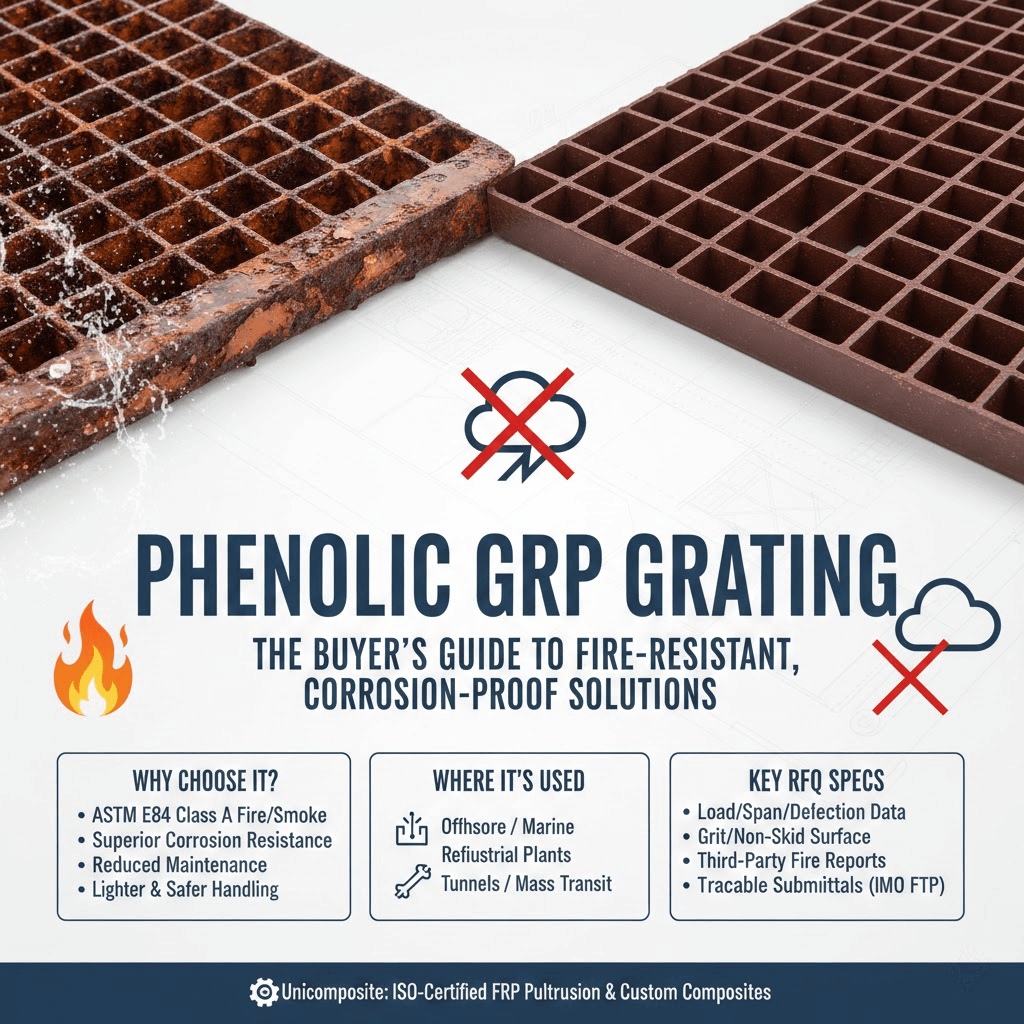
Phenolic GRP Grating is fiberglass-reinforced grating made with a phenolic thermoset resin system. Fiberglass carries load; the resin system heavily influences fire/smoke behavior.
A resin industry overview summarizes why phenolic is chosen: phenolic resins “boast outstanding fire resistance and low-smoke emission properties.” Fire-performance literature similarly describes phenolics as “well known” for low smoke/toxic gas evolution on burning.
Buyer reality check: “phenolic” on a quote isn’t an approval—configuration-matched test reports are.
Why Buyers Choose Phenolic GRP Grating
Fire + smoke performance you can document
ASTM E84 produces FSI and SDI. Intertek’s summary lists typical classifications as Class A: FSI 0–25; SDI max 450.
Action: require the report to match thickness/open area/surface (not “similar product”).
Corrosion resistance + less maintenance churn
Compared with steel, FRP avoids rust/coating failures and reduces maintenance touchpoints—often the real ROI in shutdown-driven facilities.
Handling and safety
One phenolic grating brochure states the product is approximately one-third the weight of steel bar grating, which can reduce handling time and risk during panel removals. (Verify actual weights on the data sheet for your exact series.)
Where Phenolic GRP Grating Shows Up
Commonly specified environments include:
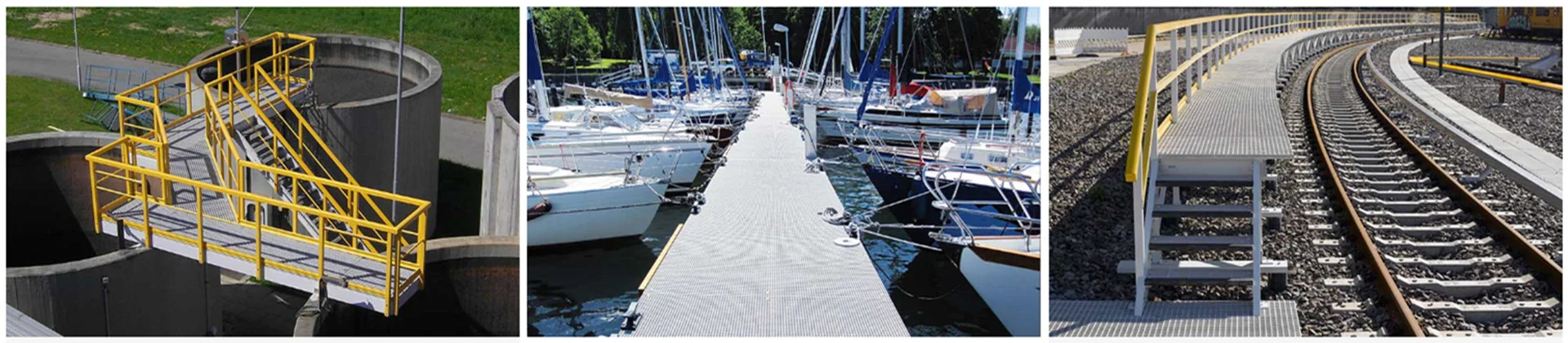
- Offshore / marine (the same brochure notes use on offshore platforms “since 1994”).
- Refineries / industrial processing plants.
- Tunnels / mass transit, where smoke/toxicity scrutiny is higher.
Quick “fit check” before you quote: chemicals + exposure mode, indoor/outdoor UV, slip contamination, and which fire/smoke standard(s) your owner/jurisdiction actually requires.
How to Specify Phenolic GRP Grating Like a Pro
Use this mini worksheet in your RFQ.
1) Loads, span, and deflection (don’t buy by thickness alone)
State span/support spacing, worst-case point load, and allowable deflection. Example: a published load table may be “based on a qualified span of 1120 mm (44″),” with loads tied to a midspan deflection of 6.35 mm (0.25″).
Action: request load/deflection confirmation for your span.
2) Surface selection for slip risk
Specify grit/non-skid type for oily/wet areas and stairs; don’t leave it as “standard.” Add edge finishing/cut-edge protection to avoid rough fiber exposure after field cuts.
3) Fire documentation (write it like a contract)
If you need ASTM E84 Class A, write: “Provide third-party ASTM E84 report(s) for the supplied configuration; Class A is typically FSI 0–25 with SDI max 450.”
4) Submittals + traceability (what approvals teams care about)
If your project references IMO requirements, the IMO 2010 FTP Code includes Part 2 – Smoke and toxicity test for materials that must not produce excessive smoke/toxic products.
Action: demand a submittal package that explicitly names the standard/part and ties it to batch/lot traceability.
Required submittals (copy/paste):
- Data sheet (thickness, open area, weight, surface)
- Load/deflection tables for your span + point load
- Third-party fire/smoke reports (configuration-matched)
- QA/traceability docs (ISO, tolerances, batch/lot)
Limitations and Safety Considerations
- Chemical compatibility must be verified for your exact exposure and temperature profile (resin choice matters).
- UV needs planning outdoors (topcoats/veils are formulation- and supplier-specific).
- Slip resistance is a design choice—pick for worst-case contamination.
- Don’t confuse marketing with compliance: the FTP Code explicitly defines Part 2 for smoke/toxicity requirements.
Experience note: the most common field failure mode is span mismatch—panels ordered off “typical” tables, then installed on wider supports.
Conclusion
Phenolic GRP Grating makes sense when you need corrosion resistance plus defensible fire/smoke documentation. The fastest risk reducer is an RFQ that locks span/loads/deflection and requires configuration-matched reports—because “Class A” is typically tied to FSI 0–25 and SDI ≤ 450.
CTA: send your span, load case, environment, surface requirement, and required standard(s) in one page—then ask for the full submittal pack before you commit to bulk quantity.
Frequently Asked Questions
No. Phenolic describes the resin system; approvals come from tested configurations. ASTM E84 classing is based on reported FSI/SDI values, where Class A is typically FSI 0–25 with SDI max 450.
Span/support spacing plus your worst-case load case (uniform + point) and a deflection limit. Some published tables are qualified on a specific span (e.g., 1120 mm / 44″) and deflection (6.35 mm / 0.25″).
Call out the exact requirement in your contract/spec and request traceable third-party reports. The IMO 2010 FTP Code includes Part 2 for smoke and toxicity testing, and submittals should clearly reference the correct part/annex.
Choose based on span/load direction, cutout complexity, and the supplier’s load tables for your support spacing. Either can work; the “better” option is the one proven by the data set that matches your design case.


