 info@unicomposite.com


Introduction
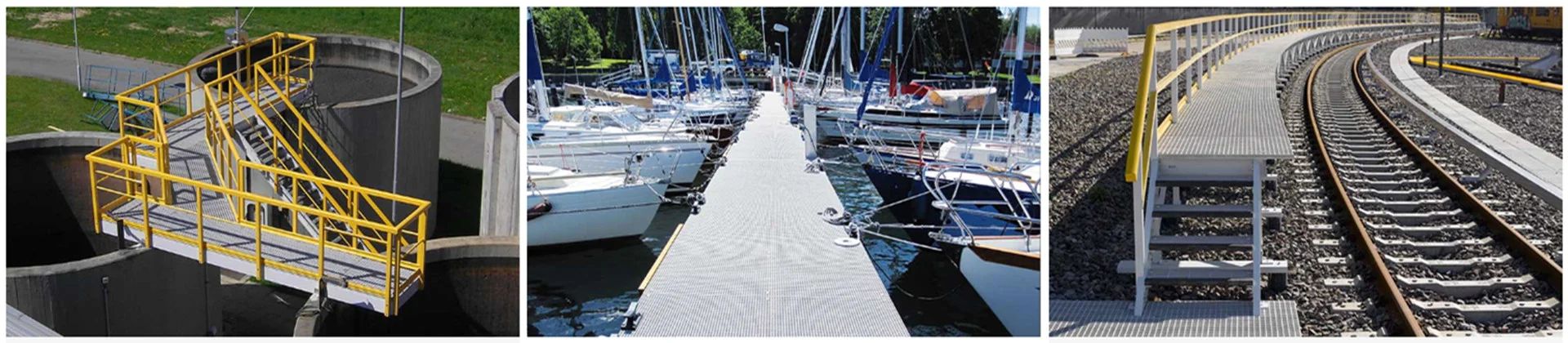
Fiberglass covered grating is FRP grating topped with a bonded, grit-coated solid plate that creates a sealed, slip-resistant walking surface. It shines where open-mesh or steel plate struggles—spill control, small-wheel traffic, hygiene zones, or corrosive atmospheres. As one applications engineer at Unicomposite notes: “A covered panel combines containment with traction in a way open mesh can’t.”
Unicomposite—an ISO-certificated pultrusion manufacturer in China—supplies standard and custom FRP profiles and assemblies, including cut-to-size covered panels for utilities, wastewater, cooling towers, agriculture, and marine. This guide gives you selection logic, a worked span example, installation practices, and a buyer checklist you can lift straight into an RFQ.

fiberglass covered grating
What It Is & How It’s Built
Covered FRP starts with a molded or pultruded grating base. A 3–6 mm (≈1/8–1/4″) solid plate is factory-bonded or co-laminated on top, then broadcast with mineral grit for traction. Molded bases offer easy field cutting and bi-directional strength; pultruded bases deliver higher axial stiffness for longer spans and concentrated loads. Choose cover thickness by span and traffic intensity—casters and pallet jacks benefit from thicker plates and pultruded bases.
Standards & Methods Referenced (specify in your RFQ)
-
Fire: ASTM E84 flame spread (target Class A, ≤ 25)
-
Slip resistance: Method disclosed (e.g., ANSI A326.3 DCOF or ASTM E303 pendulum) and target value by area type
-
Thermal movement: ASTM D696 (coefficient of thermal expansion)
-
Water absorption: ASTM D570 (resin-dependent)
-
Material properties: Relevant ASTM/ISO coupons as provided by the supplier
Tip: Always request the exact test method, date, and substrate condition on reports.
Quick Worked Example (span + deflection)
Goal: Select a panel for a 900 mm (36″) clear span walkway, uniform load 4.8 kN/m² (≈100 psf), deflection limit L/200.
-
Deflection target: L/200 ⇒ 900/200 = 4.5 mm max.
-
Base type: At 900 mm spans with small-wheel traffic, a pultruded base typically controls deflection better than molded.
-
Depth: Evaluate supplier span tables for 25–38 mm (1–1.5″) pultruded bases. Suppose the 25 mm base exceeds 4.5 mm deflection at 4.8 kN/m²; move to 38 mm.
-
Cover plate: Start at 5 mm with coarse grit for booted traffic; verify combined stiffness + serviceability.
-
Outcome: If the 38 mm + 5 mm cover meets ≤ 4.5 mm deflection in the table, you’re in spec. If not, either reduce span/support spacing, choose a thicker base/cover, or add an intermediate support.
Engineer note: Always check concentrated loads (e.g., 1–2 kN patch) in addition to uniform load; carts create localized demand.
Types, Surfaces & Resin Systems
-
Base: Molded (bi-directional, versatile cutting) vs. Pultruded (longer spans, directional stiffness).
-
Cover: Solid for hygiene/containment; perforated for pressure relief while blocking debris. Specify thickness, grit grade (fine for indoor shoes; medium/coarse for boots), color, UV package, and edge banding/nosing for visibility.
-
Resin:
-
Polyester – economical general duty.
-
Vinyl ester – better chemical/temperature resistance.
-
Phenolic – low smoke/toxicity in special environments.
-
-
Typical targets (confirm with supplier data): wet DCOF ≈ 0.6+ (method-dependent), CTE in-plane ≈ (2–3)×10⁻⁵ /°C, water absorption often < 1%/24 h, non-conductive and non-sparking.
Key Specs & Performance
-
Loads & Deflection: Define uniform and concentrated loads, set a deflection criterion (e.g., L/200 for walkways), then choose depth and cover thickness from span tables.
-
Slip Resistance & Safety: Match grit to footwear and cleaning regime; specify test method and target. Use contrasting nosings on edges and stairs.
-
Corrosion & Electrical: FRP resists splash zones, salts, and many chemicals; list chemical name, concentration, and temperature in RFQs. Non-conductive surfaces help in substations and around sensors.
-
Thermal Movement: Plan expansion gaps and layout breaks—FRP expands more than steel; detail clearance at perimeters and penetrations.
Field Note – Grit Choice: For indoor, smooth-soled shoes, fine grit reduces cleanup and snagging. For outdoor, muddy sites, medium/coarse grit sustains traction but plan for periodic cleaning.
Industries & Use Cases
-
Water & Wastewater: Odor-cap walkways, clarifier bridges, chemical dosing areas—sealed surfaces keep debris out and cleaning simple.
-
Power & Utilities: Non-sparking, non-conductive tops reduce shock risk near batteries and switchgear; fewer paint permits in corrosive yards.
-
Food/Chemical Processing: Vinyl ester covers tolerate caustics/acids; specify grit grade that balances hygiene with traction.
-
Marine & Coastal: UV-stabilized pigments and corrosion resistance suit pump stations and piers; lower weight eases handling.
Case snapshot: An anonymized WWTP moved from painted steel plate to covered FRP on 30 m of walkway; paint touch-ups dropped from annual to a 5-year interval, and a planned mid-cycle shutdown was avoided.
Design & Selection Checklist
-
Define loads (uniform + concentrated) and deflection target.
-
Pick base (molded vs. pultruded) and depth for span.
-
Choose cover thickness and grit for traffic.
-
Select resin system for chemicals and temperature.
-
Specify color, UV inhibitors, edge banding/nosing.
-
Detail fasteners/clips, support spacing, and expansion joints.
-
Require test reports (E84, slip test method/value, material certs).
-
Include a panel map showing penetrations and cutouts.
Field Note – Sealing Cuts: Any field cut exposes fibers. Seal immediately with the matching resin kit to block wicking and extend life.
Field Note – Expansion Gaps: On runs over ~6–9 m, add layout breaks and perimeter clearances; it’s the cheapest insurance against buckling.
Installation & Maintenance
-
Cutting & Safety: Use carbide/diamond blades, dust extraction, eye/respiratory PPE; seal all cuts/holes with compatible resin.
-
Fastening & Layout: Select hold-down clips for your support shape; follow torque guidance (many M6 stainless sets land in single-digit N·m—check vendor). Support perimeters and leave clearances at walls and penetrations.
-
Care & Upkeep: Clean with mild detergent + soft brush; schedule annual inspections for clip torque, grit wear, and sealed edges. Re-broadcast grit where traffic polishes the surface.
Safety & Compliance (put in your RFQ)
-
PPE for cutting and handling (gloves, eye/respiratory protection).
-
Dust extraction/vacuum shrouds on saws; no dry sweeping.
-
Cut-edge sealing protocol and verification step.
-
Slip-resistance verification by named method and target value.
-
Fastener torque check at handover and at annual PM.
Life-Cycle Cost & Sustainability
Compared with painted carbon steel, covered FRP avoids blasting/painting cycles, reduces outage hours through easier handling, and eliminates solvents in service. For a 5–10-year TCO, model: initial material + install, coating cycles (steel in splash zones is often 2–3 years), downtime for coatings, inspection labor, and transport/handling savings from lower weight.
Unicomposite Capabilities (for OEMs and projects)
Unicomposite offers ISO-certified pultrusion, molded/pultruded bases, and covered panels cut to size—custom colors, grit grades, edge treatments, and integrated assemblies (handrails, ladders, platforms). The team supports drawings, span checks, and submittals, with QA on resin batches and cure. Sectors served include power utilities, wastewater, cooling towers, marine, agriculture, and OEM fabrication.
Conclusion
Choose covered FRP when you need sealed, high-traction surfaces that resist corrosion, protect equipment from debris, and keep carts rolling smoothly. State loads, spans, resin, grit, edges, fasteners, and movement joints—then ask suppliers like Unicomposite to verify spans and provide cut-edge and torque procedures. Specify it well once, and maintenance will thank you for years.
Frequently Asked Questions
1) How do I choose between molded and pultruded bases?
Use molded for general duty, easy field cutting, and bi-directional loads. Choose pultruded when spans are longer, deflection is critical, or you expect concentrated loads from carts and jacks.
2) What cover thickness should I specify?
Start at 3–4 mm for foot traffic and light carts; go 5–6 mm for frequent small-wheel traffic or heavier loads. Always confirm with span tables and your deflection limit.
3) Which resin should I use in chemical areas?
General-purpose polyester fits mild environments; vinyl ester handles stronger acids/caustics and higher temperatures; phenolic is reserved for low-smoke applications. List chemicals, concentrations, and temperatures in the RFQ.
4) Do I need to seal field cuts?
Yes—unsealed edges wick moisture and chemicals. Request a matching resin kit and include a cut-edge sealing step in the installation method statement.
5) How do I verify slip resistance?
Specify the test method (e.g., ANSI A326.3 DCOF or ASTM E303) and your target value by zone. Ask vendors for recent test reports on the chosen surface/grit.
Who/How/Why: Written by a composites content team with input from Unicomposite applications engineering to help plant engineers and buyers specify covered FRP correctly. Sources include supplier span tables and standard test methods listed above.
Author: Technical Writer – Industrial Composites. Reviewed by: Applications Engineer, Unicomposite.
Conflict of interest: Unicomposite is a manufacturer/supplier of FRP products referenced herein.
Last reviewed: November 3, 2025


