 info@unicomposite.com


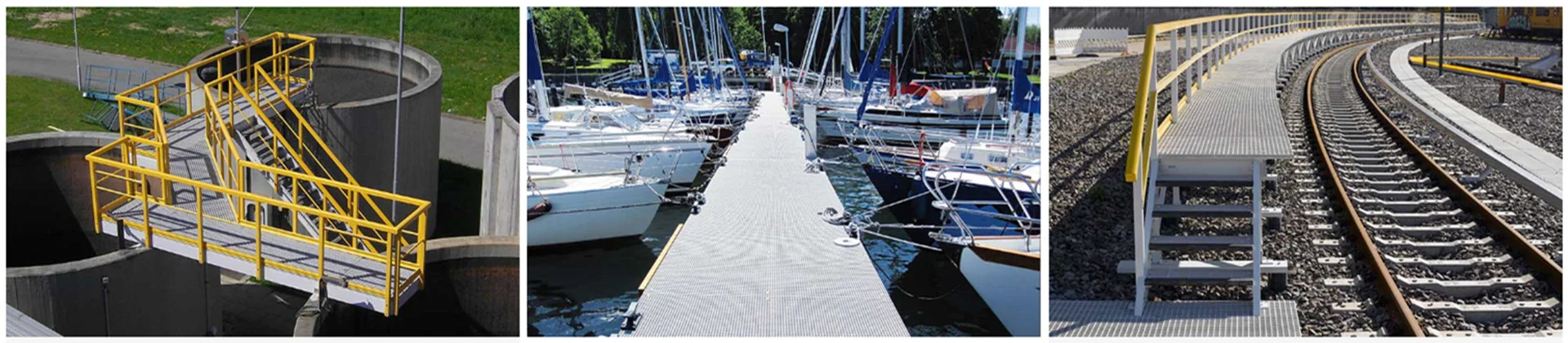
Steel fencing in high-voltage substations does more than mark a perimeter — it creates one. When steel fence panels run parallel to energized bus bars, electromagnetic induction drives currents through the fence structure itself. Maintenance personnel contacting ungrounded sections face real shock exposure. The steel corrodes faster at ground contact points, and the utility faces recurring inspection and re-grounding costs that compound over decades.
FRP fiberglass fence systems eliminate this entire class of risk. Non-conductive, non-magnetic, and corrosion-resistant by material nature — not by coating — fiberglass fence performs differently from steel from the first installation day. This article covers the three standard FRP fence series, the specification parameters procurement managers need to confirm before ordering, and the performance comparison that makes the material case in electrical, chemical, and marine environments.
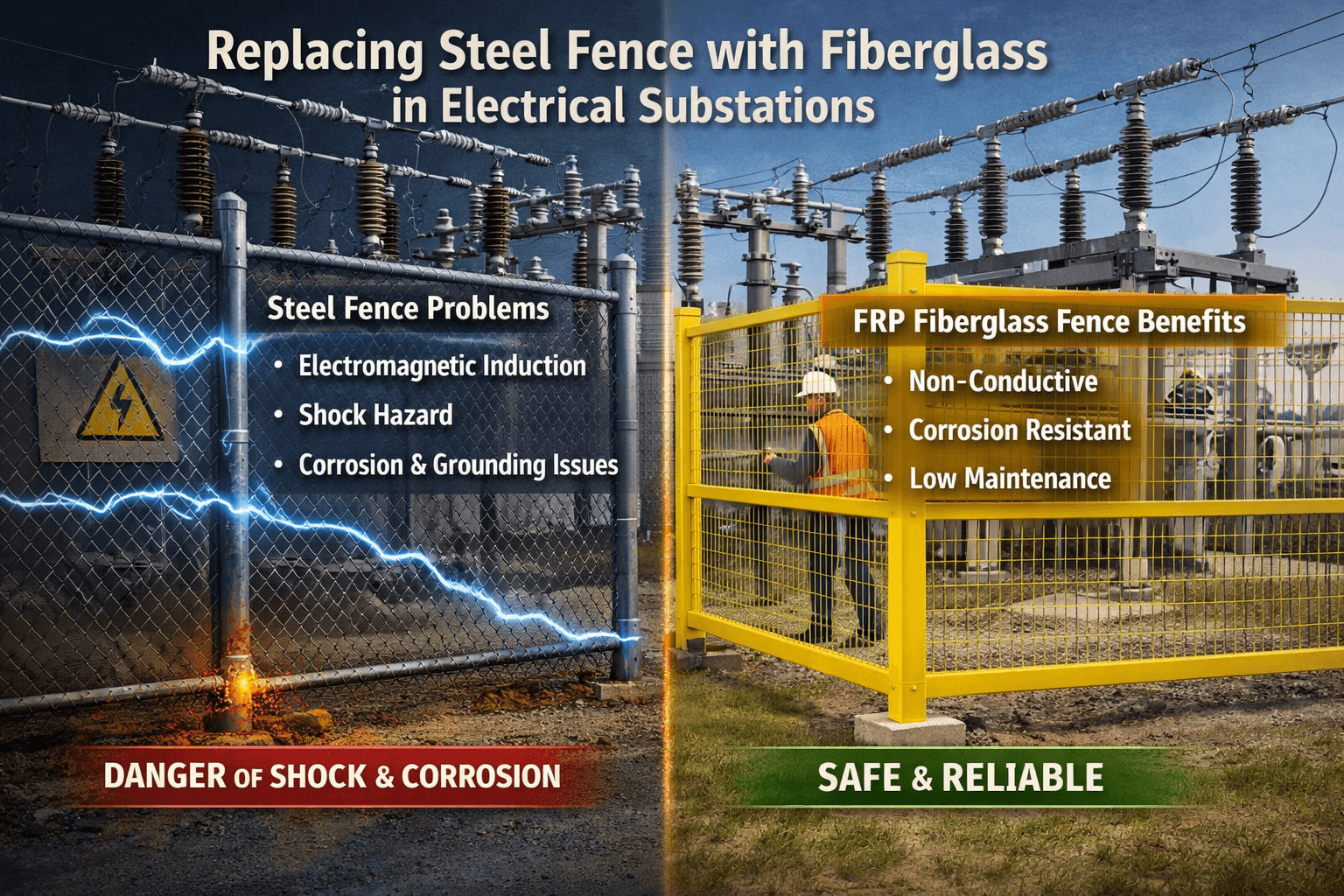
replacing steel fence with fiberglass
Why Industrial Sites Are Replacing Steel Fence with Fiberglass
The Hidden Cost of Conductive Metal Fencing in Electrical Environments
Steel fence in proximity to energized electrical equipment is not just a corrosion problem — it is a personnel safety problem. In switchyards and substation perimeters, electromagnetic induction generates circulating currents in metallic fence structures near high-voltage bus bars and transmission lines. Under IEEE 80 guidelines for substation grounding design, metallic structures within the zone of influence must be bonded and grounded to prevent dangerous touch and step potentials — a requirement that adds engineering cost, inspection obligations, and ongoing maintenance burden to every steel fence installation.
In substation perimeter projects, maintenance teams frequently discover that steel fence sections near bus bars require annual re-grounding inspections and periodic bond resistance testing. Over a 20-year facility life, that recurring cost often exceeds the original fence installation budget. FRP fence sections typically do not trigger grounding requirements under NEC and NESC provisions applicable to non-metallic structures — confirm this classification with your project’s electrical engineer of record before finalizing the specification.
Galvanic corrosion compounds the problem in mixed-metal installations. Where steel fence posts contact aluminum base plates or stainless fasteners in the presence of moisture, accelerated corrosion initiates at the contact point and propagates along the post. FRP fence eliminates galvanic risk completely — there is no metallic path for electrochemical attack to follow.
Corrosion, Maintenance, and Total Cost of Ownership
Carbon steel fence in industrial environments typically requires repainting every 3–5 years to maintain corrosion protection. In coastal, chemical, or high-humidity environments, that cycle shortens to 2–3 years. Each repainting cycle requires surface preparation, coating application, and a period where the fence is partially out of service — a maintenance burden that compounds across large perimeter installations.
FRP fence tubes are produced with a UV-stabilized surface veil integrated during the pultrusion process. The UV protection is not a field-applied coating that can chip, peel, or require reapplication — it is part of the profile wall from manufacture. Color is similarly integrated, not painted. Pultruded FRP fence profiles carry a design service life exceeding 20 years in standard industrial environments with zero repainting requirements.
FRP’s lower linear density — typically 30–40% lighter than equivalent steel fence sections — also reduces foundation loading, shipping cost, and installation labor. In retrofit projects where existing concrete foundations are being reused, that weight reduction can eliminate the need for foundation reinforcement work entirely.
How FRP Fiberglass Fence Is Manufactured
Understanding the manufacturing process explains why FRP fence performs the way it does — and why connector quality is as important as tube quality in a complete fence system.
Tube and Rail Production
Fence tubes and rails are produced by pultrusion. Fiberglass rovings and woven mats are pulled continuously through a resin bath, then through a heated steel die that shapes and cures the profile in a single pass. The die controls wall thickness, outer dimension, and fiber-to-resin ratio simultaneously. A UV-stabilized surface veil fed into the outer layer of the die provides weather resistance without any secondary coating process.
On a production line running 50×50mm square fence tubes, wall thickness consistency is monitored every batch — variation beyond ±0.3mm affects connector fit and panel rigidity in field assembly. That dimensional tolerance is why sourcing tubes and connectors from the same manufacturer matters: profiles and connectors designed and produced together fit as intended, without field shimming or forced assembly.
Connector Manufacturing
Connectors — elbows, T-fittings, and base flanges — are produced separately by molding. Compression molding or open-mold hand lay-up produces one-piece connector bodies with no mechanical joints in the fitting itself. The connector wall is continuous fiberglass composite throughout, which eliminates the delamination and crack initiation points that appear in connectors assembled from multiple bonded pieces.
Unicomposite’s ISO-certified facility manufactures both pultruded fence tubes and molded connectors in-house, maintaining traceable batch records for resin system and fiber specification on every production run — a documentation requirement that project engineers at power utilities and EPC contractors increasingly specify as a condition of supply. Dimensional compatibility between profile and fitting is controlled within a single quality system, not coordinated across two separate suppliers.
Standard FRP Fiberglass Fence Series & Specifications
Three standard series cover the majority of industrial fiberglass fence applications. The table below summarizes the configuration, dimensions, and primary use cases for each:
| Series | Tube Profile | Standard Panel Heights | Connector Type | Primary Applications | Available Resin |
|---|---|---|---|---|---|
| 50×50mm Square Tube Handrail | 50×50mm square + 25–35mm round intermediate rails | 1.0 m, 1.2 m, 1.5 m | Molded corner, T-connector, base flange | Substation perimeter, industrial safety barriers, platform handrail | Polyester, vinyl ester |
| 50mm Round Tube | 50mm OD round pultruded tube | 1.0 m, 1.2 m, 1.5 m, 2.0 m | Molded elbow, 3-way connector, assembly base | Marine dock fence, wastewater treatment perimeter, chemical plant barriers | Polyester, vinyl ester |
| Custom Profile | Non-standard dimensions per project spec | Custom heights to 2.4 m | Reinforced base plates, high-wind configurations | High-wind coastal zones, architectural perimeters, offshore platforms | Polyester, vinyl ester, phenolic |
Phenolic resin is available for the custom series in offshore and tunnel applications requiring compliance with fire performance standards such as BS 476 Part 7 or ASTM E84 Class 1. Values reflect standard commercial production ranges; confirm project-specific dimensions and resin selection with your supplier before finalizing the order.
50×50mm Square Tube Handrail Series
The square tube handrail series is the most widely specified configuration for electrical and industrial applications. The 50×50mm primary rail provides the flat bearing surface that molded corner connectors seat against cleanly — critical for maintaining panel alignment across long perimeter runs. Intermediate rails in 25–35mm round tube reduce panel weight while maintaining the spacing required by most industrial safety fence standards.
50mm Round Tube Series
The round tube series is preferred in marine and wastewater environments where debris shedding and bio-fouling resistance matter. Round profiles do not retain standing water at the top surface, reducing the moisture exposure that — even in FRP — can degrade surface finish over time in tidal zones. The 3-way connector configuration supports both horizontal and angled rail runs, which is relevant for sloped ground installations along containment berm perimeters.
Custom Profile Options
Non-standard tube dimensions, custom panel heights beyond 2.0 m, and reinforced base plate configurations are available for high-wind coastal zones where standard fence systems do not meet local building code wind load requirements. Color matching for safety zone marking — yellow, red, or custom RAL codes — is available with pigment integrated into the resin system, not applied as a surface coat.
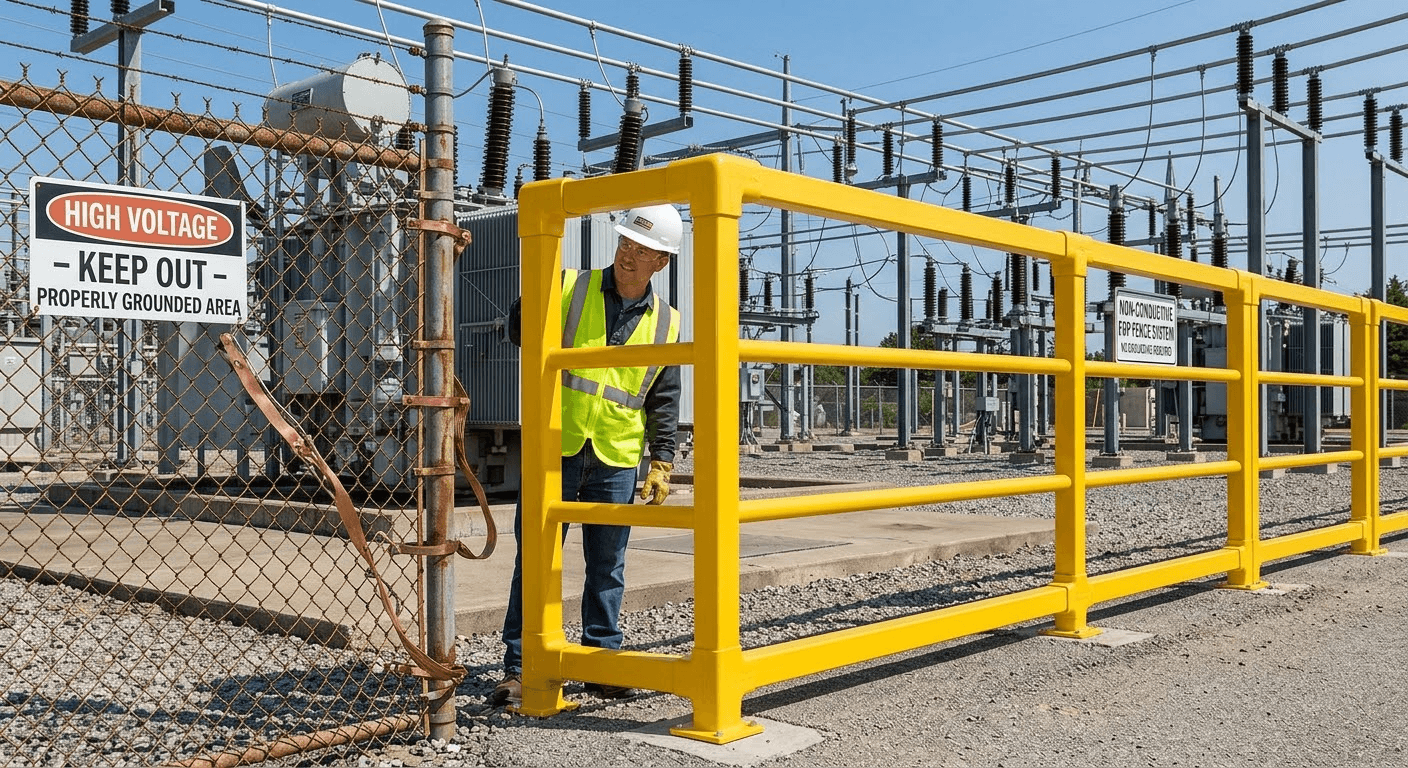
fiberglass fence systems
FRP Fence vs Steel Fence vs Aluminum: Side-by-Side Comparison
The specification table narrows the product selection — but the material comparison makes the procurement case. The table below evaluates the three most common industrial fence materials across the factors that determine long-term installed cost and operational performance:
| Property | FRP Fiberglass | Carbon Steel | Aluminum |
|---|---|---|---|
| Electrical Conductivity | Non-conductive (dielectric) | Highly conductive | Highly conductive |
| Dielectric Strength | >10 kV/mm (pultruded profiles) | N/A | N/A |
| Weight (approx.) | 3–5 kg/linear m | 8–14 kg/linear m | 4–7 kg/linear m |
| Salt Spray Resistance (ASTM B117) | >2,000 hrs — no surface degradation | 500–1,000 hrs to first corrosion at cut edges (coated) | 1,500+ hrs (varies by alloy and anodizing) |
| Corrosion Resistance | Excellent — no surface treatment required | Poor without coating; coating degrades in 3–5 years | Good in most environments; reduced in high-chloride or alkaline conditions |
| Electromagnetic Interference | None — non-magnetic | Significant near high-voltage equipment | Moderate |
| Maintenance Cycle | None required (20+ year design life) | Repainting every 3–5 years; annual inspection in electrical environments | Periodic inspection; anodizing degrades in tidal zones |
| Grounding Requirement | Typically not required (non-metallic) | Required per IEEE 80 / NESC in electrical installations | Required in electrical installations |
| Relative Installed Cost | Higher upfront; lower 20-year lifecycle cost | Lower upfront; higher lifecycle cost | Moderate upfront; moderate lifecycle cost |
Performance values reflect typical commercial-grade products; project-specific performance must be confirmed against supplier test reports and applicable standards.
In any electrical installation, FRP fence is not merely a preference — it is the technically correct specification where grounding elimination and electromagnetic interference management are design requirements. The weight differential reinforces the case further: at 3–5 kg/linear m versus 8–14 kg/linear m for steel, FRP fence reduces shipping cost, foundation loading, and installation labor on large perimeter projects — advantages that compound as linear meter count increases. For procurement managers evaluating 20-year lifecycle cost rather than unit price, the maintenance cycle row alone shifts the economic comparison decisively in FRP’s favor.
Key Applications for FRP Fiberglass Fence Systems
Power Utilities and Electrical Substations
The non-conductive and non-magnetic properties of FRP fence make it the technically correct material choice for substation perimeter applications — not merely a preference. Pultruded FRP profiles achieve dielectric strength values exceeding 10 kV/mm, which provides a meaningful safety margin in installations near energized equipment operating at distribution or transmission voltages.
In a 220 kV substation perimeter project, engineers specified FRP fence to eliminate the annual grounding inspection requirement that had been mandated for the previous galvanized steel installation. A 25-year TCO model comparing annual inspection costs, bond resistance testing, periodic re-grounding work, and documentation overhead against FRP’s zero-maintenance baseline showed projected maintenance savings exceeding 60% — the specific figure varies by facility size, local labor rates, and inspection frequency requirements, but the directional advantage of FRP is consistent across substation scale and voltage class.
FRP fence in electrical applications should specify polyester or vinyl ester resin depending on the ambient chemical environment, and confirm that the UV surface veil specification meets the project’s expected service life in the local climate zone.
Wastewater Treatment and Chemical Processing Plants
Chlorine off-gassing, hydrogen sulfide exposure, and acid splash create the corrosion conditions that destroy standard steel fence within 5–7 years of installation — sometimes faster in enclosed or poorly ventilated process areas. FRP fence with vinyl ester resin survives continuous exposure to these environments without structural degradation or surface coating failure.
The molded connector joints in FRP fence systems are sealed at manufacture — there are no crevice spaces at bar-to-fitting interfaces where process chemicals can accumulate and concentrate. In wastewater aeration basins and chemical containment berm perimeters, that joint integrity difference between FRP and bolted steel fence systems becomes visible within the first two years of service, as steel fasteners show rust staining and connector interfaces show coating disbondment that FRP simply does not produce.
Marine and Coastal Installations
Salt spray, tidal inundation, and sustained UV radiation combine to create the harshest long-term service environment for any fence material. Carbon steel fails rapidly without heavy galvanizing and regular maintenance. Aluminum performs better but suffers in high-chloride tidal zones and in contact with concrete foundations, where galvanic corrosion at the base flange initiates within a few years of installation.
In a coastal chemical terminal project where the previous galvanized steel fence had required full replacement within six years due to salt-accelerated corrosion at the base flanges, engineers switched to FRP round tube fence with vinyl ester resin — and the replacement cycle concern was removed from the 20-year facility maintenance plan entirely. FRP’s UV-stabilized surface veil and corrosion-resistant fiber-resin matrix resist all three degradation mechanisms simultaneously, without requiring surface treatment, cathodic protection, or periodic corrosion inspection. The 50mm round tube series is the standard specification for marine dock perimeters and coastal facility boundaries, where the round profile’s debris-shedding geometry also reduces post-storm maintenance.
Conclusion
FRP fiberglass fence systems outperform steel and aluminum across the environments where industrial facility managers face the highest long-term maintenance costs: electrical substations, chemical processing plants, and coastal installations.
- In any electrical installation, FRP fence is not just a preference — it is the technically correct specification where grounding elimination, electromagnetic interference management, and personnel safety near energized equipment are design requirements. No coating, alloy selection, or inspection program brings steel or aluminum to parity on these dimensions.
- Select vinyl ester resin for chemical and marine environments; polyester resin is sufficient for standard industrial and agricultural applications; phenolic resin for offshore or tunnel installations requiring BS 476 or ASTM E84 fire performance compliance.
- Confirm tube series and connector type together — square tube series for structural platform and substation applications; round tube series for marine and chemical plant perimeters where debris shedding and joint integrity in immersion conditions matter.
- Evaluate 20-year lifecycle cost, not unit price — the maintenance, inspection, and replacement cost differential between FRP and steel over a standard facility life consistently exceeds the upfront material cost premium, particularly in electrical and coastal environments.
Unicomposite’s ISO-certified production facility manufactures both pultruded fence tubes and molded connectors in-house, serving power utilities, wastewater treatment operators, marine facility contractors, and OEM manufacturers across North America and international export markets. Standard series configurations and fully custom profile designs — including reinforced base plates, non-standard tube dimensions, and project-specific resin specifications — are available within a single supply relationship.
Frequently Asked Questions
Pultruded FRP fence tubes achieve tensile strengths in the range of 200–300 MPa along the fiber axis — comparable to structural aluminum and sufficient for standard industrial perimeter security applications. Panel rigidity is a function of tube wall thickness, panel height, and post spacing; engineers specifying FRP fence for high-wind or high-impact environments should request load calculations matched to their panel configuration and post spacing before finalizing the design.
Standard colors include safety yellow, grey, and green, with custom RAL color matching available on request. Color pigment is integrated into the resin system during pultrusion — it is not a surface paint that fades or chips. The UV-stabilized surface veil integrated during manufacturing protects both color retention and structural surface integrity across the product’s 20-year design service life.
Yes — pultruded FRP tubes can be cut with standard carbide-tipped circular saw blades or angle grinders. Cut ends should be sealed with a compatible resin or end cap to prevent moisture ingress into the fiber bundle at the cut face, particularly in immersion or high-humidity environments. Molded connectors should not be field-modified; non-standard connection geometry should be specified at the order stage so the correct fitting is manufactured and supplied.
FRP fence in substation and switchyard applications is evaluated under IEEE 80 for substation grounding design and NESC provisions for non-metallic structures, as well as applicable local building codes for structural wind and impact loading. Because FRP is classified as a non-metallic structure, it typically does not trigger the grounding and bonding requirements that apply to steel and aluminum fence in the same environments — confirm this classification with your project’s electrical engineer of record before finalizing the specification.
Provide: fence series (square tube or round tube), tube dimensions, panel height, total linear meters, post spacing, connector types required (corner, T, end cap, base flange), resin system (polyester, vinyl ester, or phenolic), surface finish, color, fire rating requirement if applicable, and delivery location. For non-standard configurations — custom heights, reinforced base plates, or high-wind specifications — include site wind load data or reference the applicable local building code wind zone. Drawings or sketches of panel layout and post positions allow fabrication to proceed without clarification delays.


