 info@unicomposite.com


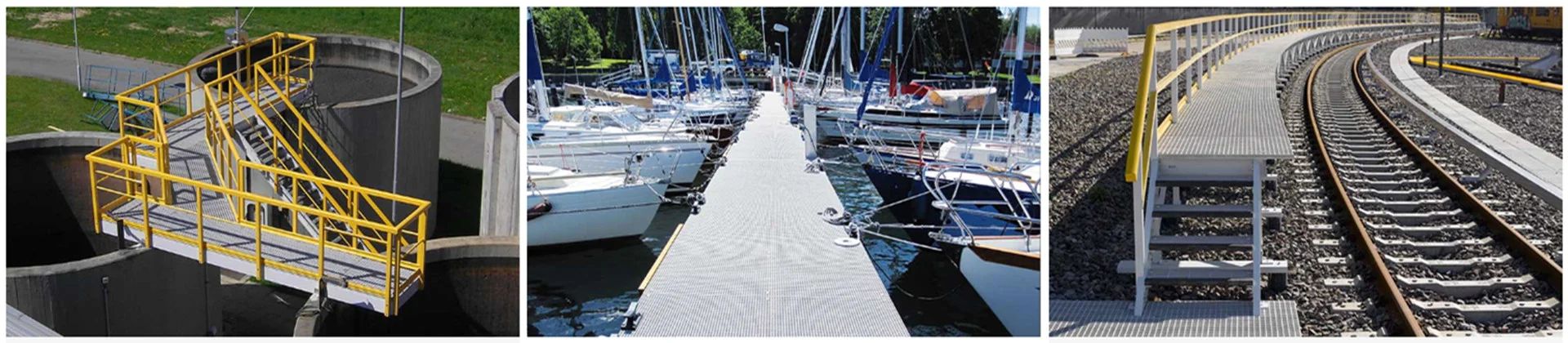
Introduction
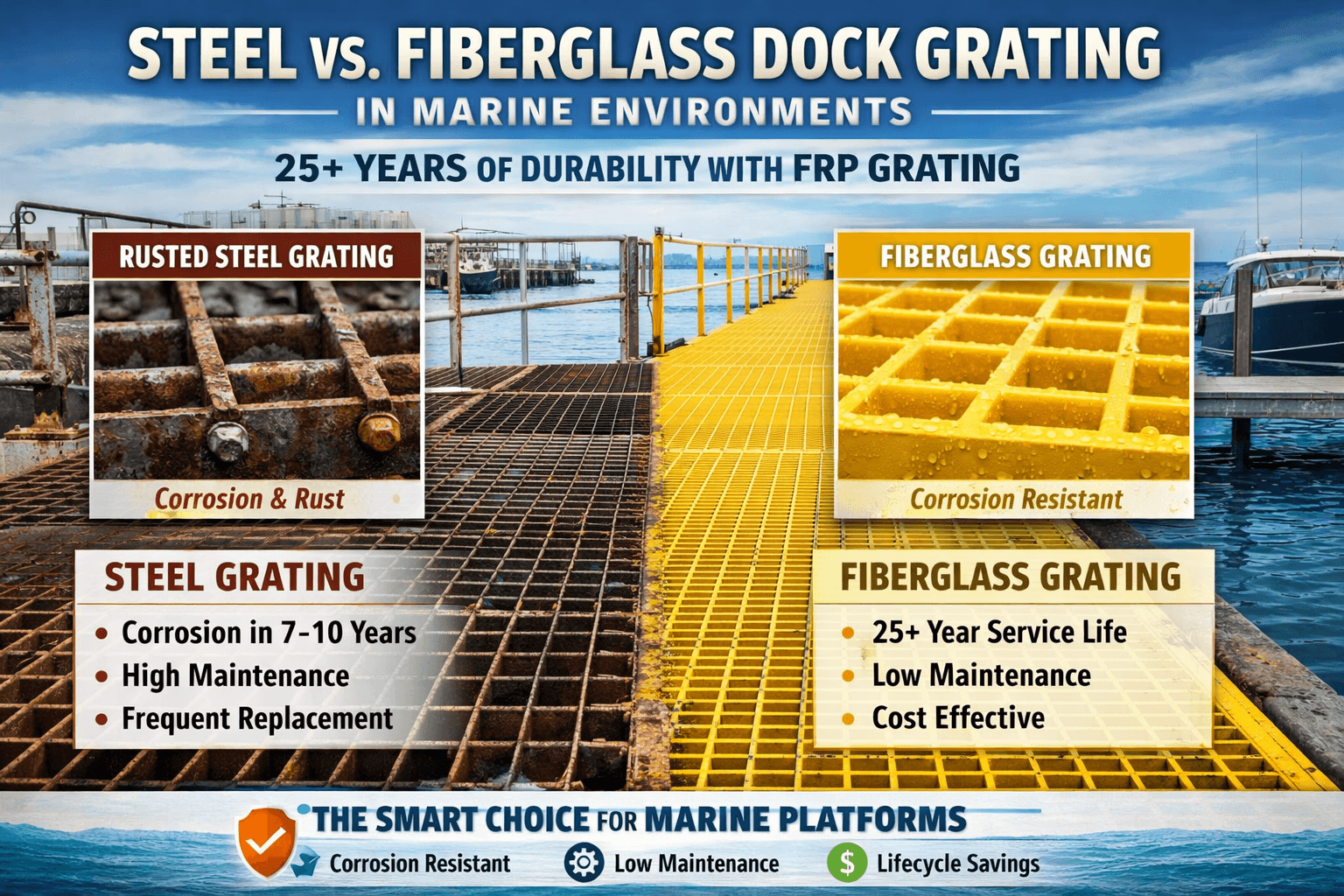
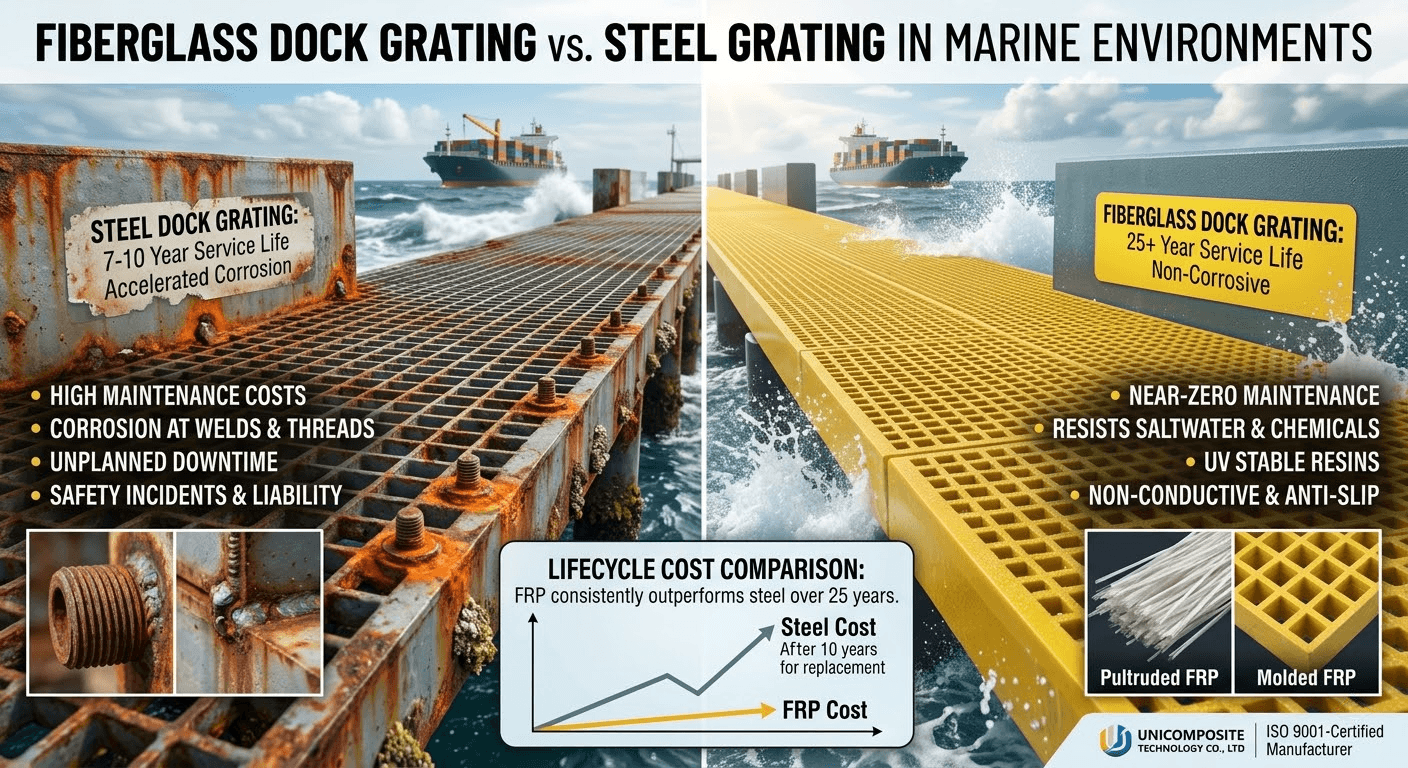
Steel dock grating in a saltwater environment typically requires full replacement within 7 to 10 years — sometimes sooner when tidal immersion and industrial chemicals accelerate corrosion at weld points and fastener threads simultaneously. Fiberglass dock grating, by contrast, routinely delivers 25-plus years of service life under standard marine exposure conditions with correct resin specification and proper edge sealing — with zero repainting and near-zero maintenance intervention across that entire service period.
For engineers and procurement managers specifying marine platform materials, that gap matters enormously. Corrosion failures don’t just generate replacement costs — they trigger unplanned downtime, safety incidents, and liability exposure that dwarf the original material budget. The higher upfront cost of FRP grating is a real trade-off; the lifecycle cost argument is the answer to it, and this article builds that case with the technical specificity procurement teams need to defend the specification.
This article gives buyers a structured framework for evaluating fiberglass dock grating: how pultruded and molded FRP types differ, which technical specifications drive real-world performance, and how to match grating selection to specific dock application scenarios. Unicomposite (Unicomposite Technology Co., Ltd), an ISO 9001-certified FRP manufacturer operating 18,000 m² of production capacity in Nanjing, China, supplies both pultruded and molded fiberglass grating systems — manufactured on in-house production lines — to marine, aquaculture, and industrial infrastructure clients globally.
steel vs fiberglass dock grating
1. Why Marine Environments Demand a Better Grating Material
Specifying grating for a dock is fundamentally different from specifying for an inland industrial platform. The variables that determine service life — chloride concentration, tidal cycling, UV exposure, biological fouling — operate at an intensity that eliminates most conventional materials from serious consideration within a decade.
1.1 The Hidden Cost of Corrosion in Dock Infrastructure
Salt spray doesn’t just surface-corrode steel grating — it attacks weld points, fastener threads, and load-bearing cross bars simultaneously. Marine environments classified as ISO 12944 corrosion category C5-M (high-salinity marine) subject structural steel to corrosion progression rates two to five times faster than inland industrial settings. A steel grating panel rated for 15-year inland service may reach structural failure threshold at a tidal dock in under eight years.
The true cost calculation extends well beyond material price. Replacement labor on a floating or elevated dock structure routinely runs two to three times the cost of equivalent inland platform work. Add permit requirements, crane mobilization for heavy steel panels, and operational downtime during replacement — and the total lifecycle cost of steel grating in marine environments consistently exceeds FRP alternatives, even where the initial FRP purchase carries a meaningful price premium.
Procurement managers who evaluate grating on unit price alone systematically underestimate this exposure. The more defensible metric is cost per year of reliable service — and on that basis, fiberglass dock grating wins in virtually every saltwater application scenario.
1.2 FRP Properties That Make It Marine-Grade by Default
Fiberglass reinforced plastic resists corrosion not through a surface coating that degrades over time, but through the material composition itself. The resin matrix — isophthalic polyester or vinyl ester for marine grades — forms a chemically inert barrier that chlorides, saltwater, and most industrial chemicals cannot penetrate under normal service conditions.
Additional properties align directly with marine platform requirements. FRP is electrically non-conductive, eliminating galvanic corrosion at contact points between dissimilar materials — a persistent and costly problem in steel-aluminum hybrid dock structures. It is inherently UV-stable when manufactured with appropriate resin additives, and it requires no paint, no galvanizing, and no annual inspection for surface coating integrity.
In coastal substation and harbor installations, maintenance teams consistently report that FRP grating sections installed alongside steel infrastructure are the last components requiring attention during routine inspections — often appearing functionally unchanged years after adjacent steel elements have been repaired or replaced. That maintenance-free performance profile is built into the material, not applied to its surface.
2. Pultruded vs. Molded Fiberglass Dock Grating — Choosing the Right Type
Beyond the corrosion advantage shared by all FRP grating, the manufacturing process determines the structural geometry, load distribution behavior, and chemical resistance profile of the finished panel. Those differences are directly relevant to dock application selection — and choosing the wrong type for a given scenario undermines the performance advantage FRP is specified to deliver.
2.1 Pultruded FRP Grating: High-Span, Directional Strength
Pultruded grating is manufactured by drawing continuous glass fiber rovings through a resin bath and a heated die, producing bearing bars and cross rods with precisely controlled fiber alignment. The result is a panel with high axial tensile strength — typically 240 to 310 MPa along the primary load axis — and excellent span-to-deflection performance under concentrated loads.
For dock applications involving long walkway spans, cargo handling corridors, or vehicle access ramps where load travels in a predictable direction, pultruded grating delivers superior structural performance per kilogram of material. The open mesh geometry allows water, debris, and marine growth to pass through freely — a practical advantage on tidal platforms where standing water accelerates biological fouling on closed surfaces.
2.2 Molded FRP Grating: Bi-Directional Load, Superior Chemical Resistance
Molded grating is manufactured as a one-piece interlocked grid in an open mold, with glass fibers distributed continuously in all directions through the resin matrix. This bi-directional fiber architecture distributes loads equally across both panel axes — making molded grating the correct choice for applications where foot traffic or equipment movement arrives from multiple directions.
Because molded panels contain no bonded joints or mechanical connections between bearing bars and cross rods, chemical resistance is uniform across the entire panel surface. There are no bond-line failure points for aggressive fluids to exploit. For wet deck areas, chemical handling zones, passenger boarding platforms, and aquaculture facilities with constant biological chemical exposure, molded FRP grating provides more reliable long-term performance where chemical attack is the primary degradation mechanism.
2.3 Pultruded vs. Molded Fiberglass Dock Grating — Side-by-Side Comparison
Selecting between the two types requires matching panel characteristics to specific load patterns, exposure conditions, and installation constraints. The table below compares the key performance and practical attributes of pultruded and molded FRP dock grating:
| Property | Pultruded FRP Grating | Molded FRP Grating |
|---|---|---|
| Load direction | Primarily unidirectional (bearing bar axis) | Bi-directional (equal in both axes) |
| Tensile strength | 240–310 MPa (axial) | 110–150 MPa (both axes) |
| Panel sizes | Longer spans available; custom up to 6m+ | Typically standard panel widths |
| Weight per m² | 8–14 kg (lower dead load) | 12–18 kg |
| Chemical resistance | High (resin system dependent) | Very high (no bond-line gaps) |
| On-site cut-to-fit | Straightforward with carbide blade | Straightforward; no structural compromise |
| Typical dock use | Long walkways, cargo ramps, catwalks | Wet decks, boarding platforms, chemical zones |
Buyers specifying for mixed-use dock environments often deploy both types — pultruded panels for primary structural walkways and molded panels for high-exposure or high-traffic platform areas where bi-directional load distribution and chemical uniformity take priority.
3. Key Technical Specifications Buyers Must Evaluate
Choosing the right grating type is only the first specification decision. Confirming the correct load rating, mesh geometry, and surface treatment for a given dock application requires working through a short but critical checklist of technical parameters — each of which carries direct consequences for structural safety and regulatory compliance.
3.1 Load Rating and Span Capacity
FRP grating load performance is expressed as uniform distributed load (UDL) capacity at a given span and deflection limit, alongside concentrated load ratings for equipment and personnel movement. For dock platforms, typical design requirements range from 3.0 kN/m² for pedestrian walkways to 7.5 kN/m² or higher for cargo handling areas and vehicle access zones.
Buyers should request supplier load tables referencing ASTM E1677 (Standard Specification for Type II Fiberglass Reinforced Plastic Grating) as the primary evaluation baseline for FRP-specific structural performance documentation. Specifying grating against a verified ASTM E1677 load table — rather than general marketing performance claims — provides the engineering documentation required for project approval, insurance compliance, and liability coverage in the event of a structural incident.
Span length between support members is the second critical variable. Pultruded grating maintains lower deflection at longer spans; molded grating typically requires closer support spacing for equivalent load ratings at the same panel thickness. Confirming the dock’s existing support grid spacing before specifying panel thickness prevents costly field modifications after delivery.
3.2 Standard Fiberglass Dock Grating Specifications
The table below summarizes standard specification ranges buyers should request and compare when evaluating fiberglass dock grating suppliers. All values reference panels manufactured to ASTM D4 composite material standards:
| Specification | Pultruded FRP | Molded FRP | Practical Benefit |
|---|---|---|---|
| Mesh opening | 38×38 mm / 50×50 mm | 38×38 mm / 50×50 mm | Debris drainage; anti-slip compliance |
| Standard panel size | 1,220×3,660 mm (custom available) | 1,000×2,000 mm (standard) | Minimizes on-site cutting waste |
| Thickness options | 25 mm / 38 mm / 50 mm | 25 mm / 38 mm / 50 mm | Match to span and load requirement |
| Weight per m² | 8–14 kg | 12–18 kg | Lower weight = easier floating dock installation |
| Surface finish | Gritted / concave top | Gritted / concave top | Slip resistance in wet conditions |
| Standard colors | Gray, yellow, green, custom | Gray, yellow, green, custom | Safety zoning and platform visibility |
3.3 Surface Finish and Slip Resistance
Slip resistance is a non-negotiable safety specification for any dock platform. Wet surfaces, marine growth, and fish processing residues create fall hazards that carry direct OSHA and maritime safety compliance implications — and surface finish selection determines whether the installed grating meets the required coefficient of dynamic friction (COF) for the application.
Gritted top surface — GRP anti-slip grit bonded to the panel top face during manufacturing — provides the highest COF and is the standard recommendation for dock walkways, boarding ramps, and any surface subject to regular wet or tidal conditions. Concave top surfaces offer a molded anti-slip profile suitable for lighter-duty pedestrian areas with lower contamination risk. Solid-top or covered grating is specified for environments where fine debris, liquids, or safety regulations demand a fully closed walking surface.
Buyers should request COF test data from suppliers and verify that the specified surface treatment meets the applicable safety standard for the project jurisdiction before finalizing the purchase order.
fiberglass dock grating
4. Marine Dock Application Scenarios: Where FRP Grating Performs Best
With material type and technical specifications established, the selection logic becomes application-specific. Fiberglass dock grating’s combination of corrosion immunity, lightweight construction, and design flexibility makes it the rational material choice across a wide range of marine platform scenarios — each with distinct performance priorities that drive different specification decisions.
4.1 Passenger Boarding Platforms and Ferry Terminals
Passenger boarding platforms carry the most demanding combination of requirements: high pedestrian traffic loads, mandatory slip resistance, safety visibility requirements, and zero tolerance for structural failure risk. FRP grating addresses all four simultaneously without the maintenance overhead that steel alternatives accumulate.
The lightweight nature of molded FRP panels — typically 30 to 40% lighter than equivalent steel grating — significantly reduces dead load on floating pontoon structures, extending the service life of flotation components and reducing structural fatigue at connection points. Yellow safety-edge panels and color-coded surface zones improve passenger directional guidance without additional signage infrastructure — a specification detail that boarding terminal operators consistently flag as a practical operational benefit.
4.2 Cargo Handling Walkways and Industrial Piers
Industrial pier environments combine heavy point loads from forklifts and pallet jacks with constant salt spray and chemical contamination from cargo handling operations. Pultruded FRP grating with 38mm or 50mm bearing bar depth provides the span capacity and load rating required for equipment access, while eliminating the corrosion maintenance cycle that steel grating demands in the same environment.
A critical practical field advantage: FRP grating panels can be cut on-site with a standard circular saw fitted with a carbide-tipped blade, allowing field modifications around bollards, cleats, mooring hardware, and utility penetrations without affecting the structural integrity of adjacent panels. Unlike steel, no hot-work permits, grinding, or post-cut galvanizing treatment are required — a meaningful reduction in installation complexity and cost on active pier environments where hot-work permitting carries both time and safety overhead.
4.3 Harbor Maintenance Catwalks and Aquaculture Facilities
Maintenance catwalks in harbor environments are among the most cost-sensitive dock structures — they generate no direct revenue, yet their structural failure creates immediate operational and safety consequences. FRP grating’s 25-plus year service life under standard marine conditions with near-zero maintenance cost makes it the defensible long-term choice against steel alternatives that require repainting every three to five years and full replacement within a decade in C5-M corrosion category environments.
Aquaculture facilities present an additional challenge: continuous biological chemical exposure from fish waste, feed additives, and antifouling treatments creates a corrosive environment that attacks conventional materials at the fastener and joint level. Unicomposite supplies molded FRP grating systems to aquaculture and marine infrastructure clients where vinyl ester resin grades provide enhanced resistance to organic acids and biological compounds — extending platform service life in the most chemically aggressive freshwater and marine fish farming environments where isophthalic polyester resin grades would underperform within the first five years of service.
5. Installation and Customization: What to Expect from an FRP Supplier
With the right grating type and specification confirmed, the final procurement decision comes down to installation practicality and supplier capability — two factors that determine whether the specified performance is actually delivered in the field and maintained across the platform’s full service life.
5.1 On-Site Cutting, Fitting, and Fastening
FRP grating installation does not require specialized trades, hot-work permits, or heavy lifting equipment for standard panel sizes. Panels are cut to dimension using a circular saw with a carbide-tipped or diamond blade; cut edges are sealed with a catalyzed resin coat to restore corrosion protection at exposed glass fiber ends — a straightforward field operation that takes under five minutes per cut edge and requires no specialized application tools.
Grating panels are secured to the supporting structure using standard FRP or stainless steel hold-down clips at a minimum of four points per panel. On a recent harbor maintenance catwalk installation over tidal water, the project team specified hold-down clips at 400mm intervals along each support beam — allowing individual panel removal for quarterly inspection of the subsurface steel frame without disturbing adjacent sections or requiring tools beyond a standard clip-release key. That panel-removal flexibility is an operational advantage that bolted steel grating cannot replicate without cutting and re-welding.
Unlike steel, FRP grating generates no hot-work exposure during field modification, eliminating the permit overhead and fire watch requirements that add cost and scheduling friction to active dock environments.
5.2 Custom Dimensions, Colors, and Resin Systems
Standard panel dimensions cover the majority of dock grating applications, but marine structures frequently require non-standard geometries: curved boarding ramps, tapered pontoon sections, or platform cutouts around existing structural elements. Unicomposite operates both pultruded and molded FRP production lines in-house, enabling custom panel dimensions, non-standard mesh configurations, and resin system substitutions without the subcontracting lead times that limit single-process suppliers.
Resin system selection should be driven by the specific chemical exposure profile of the installation environment. Isophthalic polyester resin provides excellent performance in standard saltwater and UV exposure conditions at a lower cost point — the correct specification for the majority of dock walkway and boarding platform applications. Vinyl ester resin is the appropriate upgrade for dock environments with solvent exposure, concentrated acid or alkali contact, or aggressive biological chemical loading; the higher resin cost is typically recovered within the first replacement cycle avoided.
Fire-retardant grades meeting ASTM E84 Class 1 or equivalent flame spread classifications are available for passenger terminal and enclosed dock environments where building code compliance requires ignition resistance beyond standard FRP formulations.
Conclusion
Fiberglass dock grating outperforms steel in marine environments not because of a single property advantage, but because its combination of corrosion immunity, lightweight construction, and 25-plus year service life eliminates the compounding cost and safety risks that conventional materials accumulate in C5-M saltwater environments over time. The upfront cost premium is real — and the lifecycle cost argument is what justifies it to finance and procurement stakeholders.
Four concrete takeaways for engineering and procurement teams finalizing dock grating specifications:
1. Evaluate lifecycle cost, not unit price. Steel grating’s lower upfront cost is consistently offset by accelerated corrosion replacement cycles under ISO 12944 C5-M marine conditions. Cost per year of reliable service is the defensible comparison metric.
2. Match grating type to load pattern and exposure. Pultruded FRP for directional, long-span walkways and cargo ramps. Molded FRP for bi-directional traffic, wet decks, chemical zones, and aquaculture environments where bond-line integrity matters.
3. Specify resin grade to match chemical exposure profile. Isophthalic polyester for standard marine environments. Vinyl ester for aggressive biological, solvent, or concentrated chemical exposure — and for aquaculture facilities where organic acid loading is continuous.
4. Require ASTM E1677-referenced load tables from suppliers. Engineering documentation referenced to the correct FRP-specific standard protects the specification through project approval, insurance compliance, and long-term liability management.
[Contact Unicomposite for a custom fiberglass dock grating quote →]
Frequently Asked Questions
Standard panel sizes are generally available from stock or within 2 to 4 weeks. Custom dimensions, non-standard mesh configurations, or specialty resin systems typically carry a 4 to 6 week production lead time depending on order volume and specification complexity. Buyers with project-critical timelines should confirm lead time requirements with the supplier at the RFQ stage.
MOQ varies by panel type, resin system, and customization level. Standard pultruded and molded panels in stock configurations typically carry lower MOQ thresholds than fully custom orders. Contact Unicomposite directly with project scope and panel specifications to receive an accurate MOQ and pricing structure for the specific application.
Unicomposite’s FRP grating is manufactured under ISO 9001 quality management certification. Product performance references ASTM E1677 for structural load rating and ASTM E84 for fire classification where specified. Buyers requiring project-specific third-party test reports or material certificates should specify this requirement at the quotation stage.
Yes. FRP grating is compatible with existing steel, aluminum, and concrete support structures using standard FRP or stainless steel hold-down clip systems. No structural modification to the support frame is typically required, provided the existing support spacing falls within the load table span limits for the specified panel thickness. Buyers should provide support grid dimensions when requesting load table documentation.
FRP grating manufactured with UV-stabilized resin additives maintains structural and surface integrity under prolonged high-UV tropical marine exposure. Color fade over time is a cosmetic effect and does not indicate structural degradation. For maximum UV performance in equatorial or high-altitude coastal environments, specifying a gel-coat top surface or UV-inhibitor enhanced resin system at the order stage provides additional long-term color and surface stability.


