 info@unicomposite.com


Introduction
Steel sheet piles in tidal zone and permanently submerged coastal infrastructure face a maintenance challenge that most project budgets underestimate at specification time. Zinc coating depletion in salt water typically begins within 3–5 years of installation, initiating active corrosion that requires cathodic protection systems — which themselves require periodic inspection, anode replacement, and electrical monitoring. In tidal zones where coatings are alternately wet, dry, and abraded by sediment movement, coating integrity inspection requires specialist dive teams or dewatering at significant cost. Based on documented infrastructure maintenance cost records from coastal port and bulkhead inspection programs, total cathodic protection and coating maintenance costs for steel sheet pile walls over a 30-year service life regularly exceed 40–60% of the original installation cost.
FRP sheet piles eliminate this maintenance cycle at the material level. Glass fiber reinforced polymer does not corrode, does not require cathodic protection, and provides no biological substrate for the marine boring organisms that destroy untreated timber piles within 5–10 years in infested waters. The performance data and specification guidance in this article draw on FRP sheet pile design and supply experience spanning coastal bulkhead, marina fender, and riverbank retention applications, developed through pile system production for civil construction and coastal infrastructure B2B customers in North American and international markets. It gives civil engineers and procurement managers a technical framework for specifying FRP sheet piles — covering pile types and configurations, performance specifications, material comparison, and application fit across seawall, dock, retaining wall, and marine fender applications.
frp sheet
What Are FRP Sheet Piles? Material and Manufacturing Basis
Understanding why FRP sheet piles outperform steel and timber in corrosive and marine environments begins with understanding the material system and manufacturing process that determines their structural and environmental performance.
Material Composition: Pultruded Fiberglass and Resin System
FRP sheet piles are produced by pultrusion — a continuous manufacturing process that aligns glass fiber rovings longitudinally through a profiled heated die, producing a constant cross-section with consistent fiber volume fraction and wall thickness throughout the pile length. The thermosetting resin matrix — polyester for freshwater and mild exposure applications, vinyl ester for salt water, tidal zone, and chemical exposure environments — binds the fiber system and provides chemical inertness and biological resistance. A UV-stabilized surface veil protects exterior faces from solar degradation.
Pultrusion’s dimensional consistency is critical for interlocking sheet pile wall systems. Every pile length off the same die produces identical interlock geometry, which allows field assembly without dimensional adjustment, gap formation, or soil loss through imperfect interlock engagement. This production consistency also means that the section modulus and bending stiffness — the structural properties that determine retained height capacity — are repeatable across every pile in a project delivery.
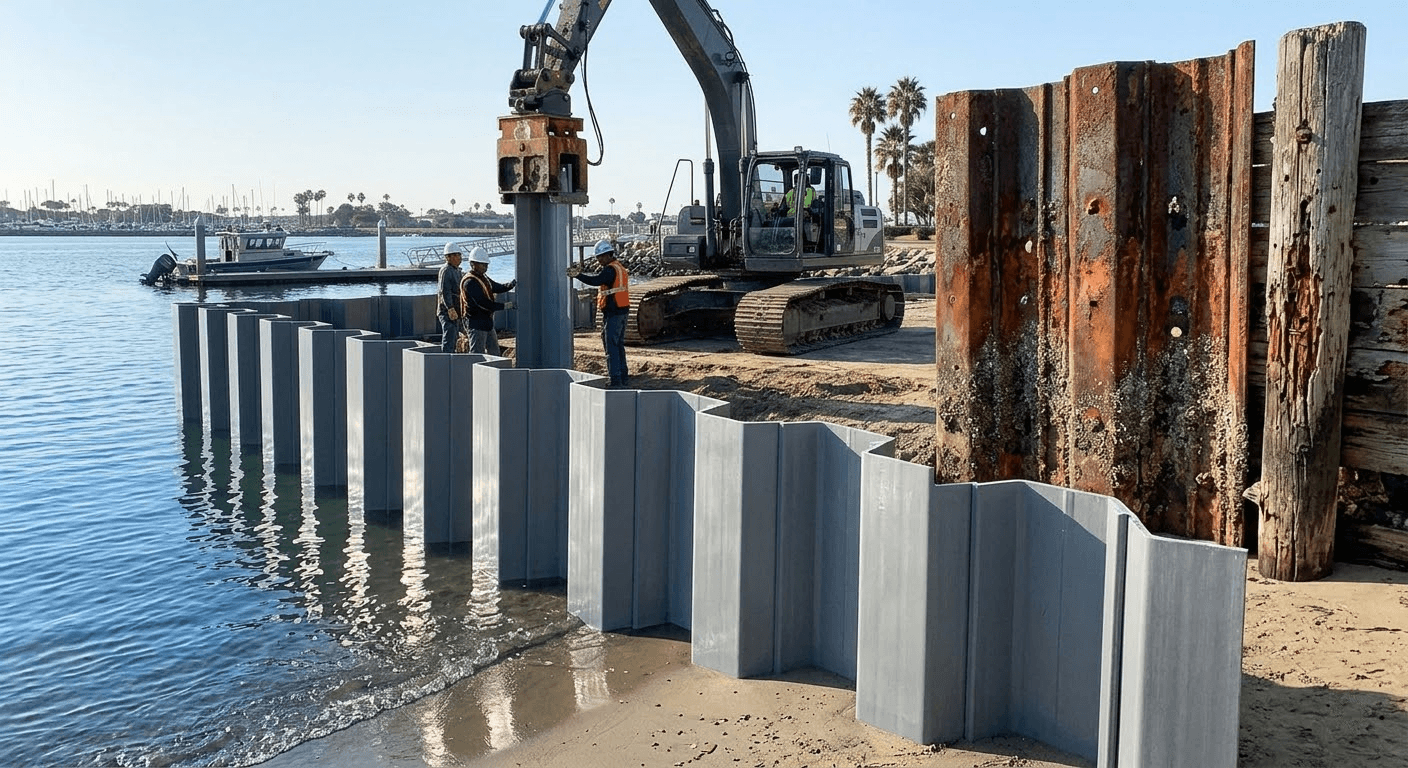
FRP sheet piles weigh approximately 25% of equivalent steel piles at the same cross-section — a weight reduction that directly changes the installation equipment requirement. Z-piles and box piles in standard retained height configurations can be installed by smaller crane or tracked excavator, without the heavy vibratory hammer rigs that steel sheet pile installation typically requires.
Why FRP Replaces Steel and Timber in Corrosive and Marine Environments
Steel sheet pile corrosion in salt water and tidal zone environments follows a documented timeline. Zinc coating depletion initiates within 3–5 years of installation in high-salinity environments; base metal corrosion becomes measurable within 8–15 years; and in documented steel sheet pile inspection programs from coastal port infrastructure, section loss of 1–2 mm of wall thickness has been measured within 20–25 years without cathodic protection intervention. Cathodic protection systems extend steel pile service life but add capital cost, ongoing monitoring, and anode replacement to the maintenance program.
Timber piles in marine environments fail through a different mechanism. Teredo navalis — a marine wood-boring bivalve present throughout coastal and tidal waters globally — penetrates timber pile surfaces and excavates the interior, leaving an intact-appearing outer shell concealing complete internal destruction. Untreated timber pile service life in Teredo-infested waters is typically 5–10 years. Chromated copper arsenate (CCA) treatment extends timber service life but generates environmental concerns in enclosed marina and sensitive aquatic habitat environments that have driven regulatory restrictions in some North American jurisdictions.
FRP’s corrosion immunity and marine organism resistance are structural properties — not coating-dependent surface treatments. The glass fiber and thermosetting resin matrix are chemically inert to salt water, brackish water, and the organic acids produced by biological fouling organisms. There is no zinc layer to deplete, no base metal to oxidize, and no biological substrate for wood-boring organisms — regardless of tidal cycling, biological fouling, or UV exposure duration.
FRP Sheet Pile Types and Configurations
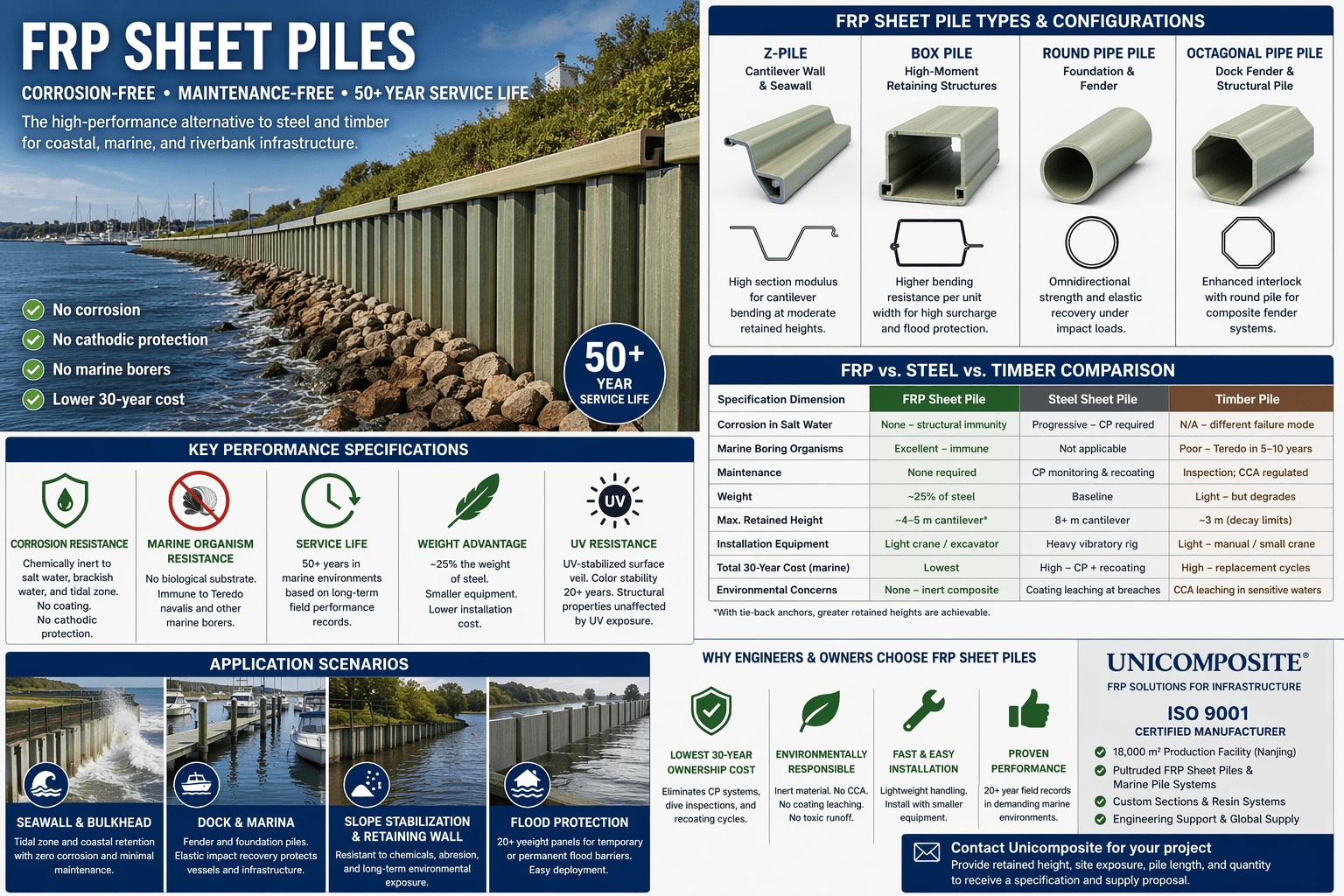
FRP sheet pile systems cover three primary structural configurations — Z-section, box section, and pipe pile — each suited to different lateral load, retained height, and installation method requirements.
The table below identifies the three FRP sheet pile configurations and their primary specification parameters:
| Configuration | Cross-Section | Typical Length Range | Primary Application | Key Structural Advantage |
|---|---|---|---|---|
| Z-Pile | Interlocking Z-profile | 4–20 ft standard; up to 30 ft custom | Seawall, coastal bulkhead, riverbank retention | High section modulus for cantilever bending at moderate retained heights |
| Box Pile | Closed box section | 4–20 ft standard | High-surcharge retaining wall, flood protection | Higher bending resistance per unit width than Z-pile at equivalent weight |
| Round Pipe Pile | 8″–14″ OD circular | 4–30 ft standard | Dock foundation, platform support, vessel fender | Omnidirectional bending resistance; elastic recovery under impact |
| Octagonal Pipe Pile | 8″–14″ OD octagonal | 4–20 ft standard | Dock fender, structural marine pile | Enhanced interlock with round pile for composite fender systems |
Z-Pile: Cantilever Wall and Seawall Applications
Z-profile sheet piles interlock through matching Z-shaped edges that engage adjacent piles to form a continuous wall, transferring lateral earth and hydrostatic pressure through the combined section of the assembled wall. The Z-geometry maximizes the distance between the tension and compression flanges, producing a high section modulus relative to wall width — the structural property that governs cantilever bending resistance in retaining wall applications.
Standard FRP Z-piles cover retained heights from 1.5 m to approximately 4 m in cantilever configuration, depending on wall thickness, soil pressure, and surcharge loading. For retained heights above this range, tie-back anchors connected through wales extend the effective retained height without increasing pile section size.
Box Pile: High-Moment Retaining Structures
Box pile cross-sections provide a higher section modulus per unit width than Z-pile at equivalent wall weight — achieved through the closed box geometry that places material at maximum distance from the neutral axis in both directions. This makes box piles the correct specification for retained height applications with high surcharge loading, soft clay foundations with large passive pressure coefficients, or flood protection walls requiring resistance to hydrostatic pressure from one side only.
Box pile interlocks engage through tongue-and-groove or snap-fit connection systems that provide continuous wall sealing against soil and water migration — a critical requirement in flood protection and groundwater containment applications where wall leakage defeats the installation purpose.
Round and Octagonal Pipe Piles: Foundation and Fender Applications
FRP round and octagonal pipe piles serve two distinct functions in marine infrastructure: foundation piles that transfer vertical and lateral structural loads from dock platforms and marine structures to competent bearing strata, and fender piles that absorb vessel berthing impact loads through elastic deformation.
The key distinction for fender pile specification is elastic recovery versus plastic deformation. Steel fender piles absorb impact through plastic deformation — a one-time energy absorption event that permanently deforms the pile and requires replacement after significant impact. FRP fender piles absorb impact through elastic deformation — the pile deflects under berthing load and returns to its original geometry, providing repeated impact absorption without permanent section damage.
In a marina fender system replacement program following storm damage, inspection of FRP pipe pile fenders struck by displaced vessels during the storm event found all piles structurally intact and returned to vertical alignment — in contrast to the steel pipe fender piles on the adjacent berth, which required replacement after the same event due to permanent lateral deformation. Engineers specifying fender pile systems should request elastic modulus and deflection recovery data from the supplier — not section modulus alone, which is the static design parameter, not the dynamic fender performance criterion.
frp sheet piles
Key Performance Specifications
Five performance properties differentiate FRP sheet piles from steel and timber alternatives in marine and coastal infrastructure — each addressing a specific failure mode that drives the lifecycle cost of conventional pile materials.
The table below summarizes the key performance specifications of FRP sheet piles relevant to coastal and marine B2B infrastructure procurement:
| Property | FRP Sheet Pile | Standard Value / Range | Operational Significance |
|---|---|---|---|
| Corrosion Resistance | Excellent — no coating required | Inert to salt water, brackish water, tidal zone | Eliminates cathodic protection and coating maintenance |
| Marine Organism Resistance | Excellent — no biological substrate | Immune to Teredo navalis and marine borers | Eliminates primary timber failure mode in infested waters |
| Service Life (marine) | 50+ years | Based on long-term field records | No replacement within standard infrastructure design life |
| Weight vs. Steel | ~25% of equivalent steel | Application-dependent | Smaller crane and installation equipment requirement |
| UV Resistance | High — UV-stabilized surface veil | Color stability 20+ years | No recoating required; structural properties unaffected by UV exposure |
| Resin System Options | Polyester / Vinyl Ester | Per exposure environment | Vinyl ester for salt water, tidal zone, and chemical exposure |
Corrosion and Marine Organism Resistance
FRP sheet pile composite is chemically inert to the salt water, brackish water, and biological acid concentrations present in coastal, tidal, and submerged marine environments. There is no zinc coating to deplete, no base metal to oxidize, and no cathodic protection system to maintain — the corrosion immunity is structural, present through the full wall thickness of every pile section and joint.
Marine boring organism resistance is equally inherent. Teredo navalis and similar wood-boring bivalves attack timber by penetrating the surface and excavating the interior along the grain — a feeding behavior specific to cellulosic substrates. FRP composite provides no cellulose, no biological nutrient pathway, and no surface texture that supports initial organism attachment in the boring lifecycle. Field inspection programs on FRP pile installations in Teredo-active waters confirm zero boring organism penetration at inspection intervals exceeding 15 years post-installation.
Structural Performance: Bending Stiffness, Section Modulus, and Installation Load
FRP sheet pile structural performance is specified by section modulus (S, in cm³/m of wall width) and flexural stiffness (EI, in kN·m²/m) — the properties that determine resistance to bending under lateral earth and hydrostatic pressure. Typical FRP Z-pile section modulus values run 150–400 cm³/m of wall width, depending on pile width and wall thickness. Buyers should request the supplier’s full section modulus and EI table for the specific pile configuration before structural design, as these values are pile-geometry-specific and cannot be interpolated from steel pile section tables.
FRP sheet piles support vibratory hammer, hydraulic press, and water jetting installation methods, subject to the pile’s compressive strength limit in the driving direction. Typical FRP pile compressive strength limits in the driving direction run 200–350 kN/m² point resistance — confirm against the site’s SPT N-value profile before specifying vibratory installation in dense or cemented soil. Pile driving resistance above the manufacturer’s specified limit risks fiber delamination at the pile head — a failure mode that does not occur in steel piles and must be explicitly confirmed with the supplier before specifying vibratory driving in challenging ground conditions.
Service Life and Lifecycle Cost Advantage
FRP sheet pile installations from early commercial programs in coastal and riverbank applications — installed in the mid-1990s through early 2000s — remain structurally intact and in service in documented infrastructure inspection records, providing genuine 20+ year field performance evidence rather than extrapolated accelerated aging data. This field service record is the most credible lifecycle cost data point available: documented installations in the same environments where steel requires significant maintenance investment to reach the same service interval and timber fails within 5–10 years in Teredo-active waters.
The 30-year ownership cost calculation that consistently justifies FRP over steel in marine and tidal environments requires including cathodic protection program cost, dive inspection cost, and replacement cycle risk — not just unit pile cost. Based on documented infrastructure maintenance cost records from coastal port and bulkhead inspection programs, cathodic protection and coating maintenance for steel sheet pile walls runs 40–60% of the original installation cost over 30 years — a figure that typically makes FRP’s higher unit price cost-neutral or cost-advantageous within 12–18 years of installation.
FRP Sheet Pile vs. Steel vs. Timber: Full Specification Comparison
The procurement decision between FRP, steel, and timber sheet piling depends on retained height, environmental exposure, installation method, and total ownership cost over the infrastructure service life. The comparison below covers the dimensions that most significantly affect B2B specification decisions.
The table below compares FRP, steel, and timber sheet piles across the key specification dimensions for coastal and marine infrastructure procurement:
| Specification Dimension | FRP Sheet Pile | Steel Sheet Pile | Timber Pile |
|---|---|---|---|
| Corrosion in Salt Water | None — structural immunity | Progressive — cathodic protection required | N/A — different failure mode |
| Marine Boring Organism Resistance | Excellent — no biological substrate | Not applicable | Poor — Teredo attack within 5–10 years |
| Coating / Treatment Maintenance | None required | Periodic inspection and recoating | Periodic inspection; CCA regulated in some jurisdictions |
| Weight | ~25% of steel | Baseline | Light — but degrades in service |
| Maximum Practical Retained Height | ~4–5 m cantilever; more with tie-backs | 8+ m cantilever | ~3 m (structural decay limits retained height over time) |
| Section Modulus Reference | 150–400 cm³/m (Z-pile, varies by section) | Higher per unit width at equivalent cost | Degrades as service life advances |
| Installation Equipment | Light crane or excavator | Heavy vibratory hammer rig | Light — manual or small crane |
| Total 30-Year Lifecycle Cost (marine) | Lowest | High — cathodic protection + recoating | High — replacement cycles |
| Environmental Concerns | None — inert composite | Coating leaching at breach sites | CCA leaching in sensitive aquatic environments |
When FRP Is the Required Specification
FRP sheet piles become the operationally required specification — not just the preferred option — in three conditions: tidal zone and permanently submerged installations where steel coating maintenance access requires specialist dive teams at costs that exceed coating material cost; environmentally sensitive sites where CCA-treated timber is prohibited or restricted by coastal regulatory authority; and marine environments where Teredo navalis is present and timber pile service life falls below the minimum design life requirement.
Unicomposite Technology Co., Ltd. — an ISO 9001-certified FRP manufacturer operating an 18,000 m² production facility in Nanjing — supplies pultruded FRP sheet piles and marine pile systems for coastal infrastructure, port, and marine B2B customers in North American and international markets. Standard Z-pile, box pile, and pipe pile configurations across polyester and vinyl ester resin systems are available with structural section documentation, installation guidance, and ISO 9001 manufacturing certification.
When Steel Remains the Better Specification
FRP sheet piles have structural limits that steel does not. Retained heights above approximately 4–5 m in cantilever configuration — without tie-back anchors — typically favor steel for its higher section modulus per unit width at equivalent wall installation cost. In high-surcharge loading environments such as port cargo handling areas and heavy rail proximity, steel’s higher compressive strength in the pile driving direction also provides an installation reliability advantage in dense or cemented soil conditions.
Specifying FRP where retained height or soil conditions require steel section properties that FRP cannot match at competitive cost is not a sound procurement decision — and honest material selection matching service conditions to material capability is the standard that produces long-term infrastructure reliability.
Application Scenarios: Where FRP Sheet Piles Perform Best
Steel’s structural advantage at high retained heights is real and worth specifying correctly — and outside those specific high-surcharge and deep-excavation scenarios, FRP’s corrosion immunity, marine organism resistance, and lightweight handling deliver operational value that is most clearly realized in the four application environments below.
Seawall and Bulkhead: Coastal and Tidal Zone Retention
Tidal zone bulkhead and seawall installations expose sheet piles to alternating wet, dry, and abrasive conditions that accelerate coating failure on steel piles faster than in permanent submersion or fully terrestrial conditions. The tidal zone is simultaneously the highest corrosion rate zone and the most difficult zone for coating inspection and repair — access for inspection requires either tidal timing, cofferdams, or dive teams, all of which add to the maintenance program cost.
In one tidal zone bulkhead installation on a 180-meter coastal protection wall project, FRP Z-piles installed alongside a steel Z-pile reference section were inspected at 10-year intervals by the project owner. At the 22-year inspection, FRP sections showed no measurable section loss and zero biological boring penetration. The steel reference section required cathodic protection anode replacement at year 8, full coating strip-and-recoat at year 14 — requiring temporary dewatering of a 40-meter section — and showed 1.4 mm average wall thickness reduction in the splash zone, approaching the project’s 25% section loss trigger for structural review.
Dock and Marina: Berthing Structure and Fender Pile
FRP round and octagonal pipe piles in marina and dock fender systems provide vessel berthing impact absorption through elastic deformation without the hull damage that steel fender pile contact can produce on fiberglass and aluminum vessel hulls. The non-toxic FRP composite surface also eliminates the CCA leaching concern that treated timber fender piles generate in enclosed marina basins where water exchange is limited and aquatic organism sensitivity is elevated.
Marine fouling organisms — barnacles, mussels, and algae — colonize FRP pile surfaces at similar rates to other marine structures, but do not penetrate or structurally compromise the composite matrix the way Teredo navalis attacks timber. Fouling removal from FRP surfaces requires no surface preparation or recoating — pressure washing restores the pile face for inspection without the damage risk that abrasive cleaning creates on coated steel surfaces.
Slope Stabilization, Retaining Wall, and Flood Protection
Inland riverbank and slope stabilization applications subject sheet piles to chemical contamination from industrial runoff, agricultural chemical leaching, and landfill leachate — environments where steel coating integrity degrades faster than in clean salt water due to combined chemical and mechanical abrasion from suspended solids in river flow. FRP sheet piles in these chemically aggressive freshwater environments with vinyl ester resin systems provide the same service life advantage that marine installations demonstrate in salt water.
Flood protection wall applications particularly benefit from FRP’s lightweight construction. Temporary or semi-permanent flood barrier deployment — where FRP sheet pile panels are installed prior to flood events and removed for storage afterward — is logistically feasible with small equipment and lightly equipped response crews. Equivalent steel panel systems require heavy handling equipment that may not be available in emergency deployment scenarios or accessible in confined urban flood barrier positions.
Custom Specification and B2B Procurement
The FRP sheet pile system’s configurability — in cross-section, wall thickness, pile length, resin system, and accessory hardware — is what makes it adaptable to the full range of coastal, marine, and riverbank infrastructure retention requirements.
Dimensions, Load Classification, and Resin System Selection
Standard FRP Z-pile and box pile configurations cover retained heights from 1.0 m through approximately 5 m in cantilever installation, with tie-back anchor configurations extending effective retained height further. Pipe pile diameters run 8″ through 14″ in standard production, with lengths from 4 ft to 30 ft. Wall thickness is specified by design load — provide the retained height, soil type, water table elevation, and surcharge loading at inquiry to receive a structural section recommendation with section modulus and EI values confirmed against the project’s design requirements.
Resin system selection follows exposure environment. Polyester resin covers freshwater, sheltered riverbank, and mild brackish water applications. Vinyl ester is specified for salt water, tidal zone, open marine, and chemical contamination environments — the additional material cost over polyester is recovered within the first avoided cathodic protection cycle in steel alternative comparisons.
Installation Accessories and System Components
FRP sheet pile wall systems require pile caps, wales, and tie-back anchor connections for retained height applications above the cantilever design limit. FRP-compatible caps and wales in pultruded composite provide a fully non-metallic wall system for environments where metallic accessories introduce corrosion initiation points. Stainless steel 316-grade hardware is available for applications where metallic accessories are structurally required — specifying stainless at marine interface connections provides corrosion resistance in salt water without the maintenance program that carbon steel hardware generates.
MOQ, Lead Time, and Engineering Documentation
Standard pile configurations from existing production tooling ship within 4–6 weeks from order confirmation, based on standard production scheduling — confirmed timing is provided at inquiry. Custom cross-section configurations or non-standard pile lengths extend lead time to 8–10 weeks from specification sign-off. Available documentation includes section modulus and flexural stiffness data per pile configuration, installation method guidance, resin system chemical resistance records, and ISO 9001 manufacturing certification.
Conclusion
FRP sheet piles earn their specification in coastal and marine infrastructure through four operational advantages that determine total project cost and long-term wall performance:
- Corrosion immunity eliminates the maintenance program that makes steel sheet pile walls expensive to own: Documented coastal installations confirm 20+ year service without cathodic protection, coating maintenance, or section loss — in environments where steel requires 40–60% of original installation cost in maintenance spending to reach the same service interval.
- Marine boring organism resistance terminates the primary timber pile failure mode: FRP provides no biological substrate for Teredo navalis, eliminating the attack mechanism that destroys untreated timber piles within 5–10 years in infested waters — without the CCA treatment environmental concerns that restrict treated timber in sensitive aquatic environments.
- Lightweight construction changes installation equipment requirements: At 25% of steel pile mass, FRP sheet piles enable smaller crane and excavator equipment, reducing mobilization cost and improving access in confined coastal sites and emergency flood barrier deployment scenarios.
- The 30-year ownership cost calculation that consistently justifies FRP over steel in marine and tidal environments requires including cathodic protection program cost, dive inspection cost, and replacement cycle risk: Procurement decisions based on unit pile cost alone systematically undervalue FRP’s maintenance-free service life — the cost crossover point, based on documented coastal infrastructure maintenance records, typically falls within 12–18 years of installation.
[Contact Unicomposite — ISO 9001-certified FRP sheet pile manufacturer with custom section and resin system engineering support — with your retained height, site exposure, pile length, and project quantity to receive a specification and supply proposal →]
Frequently Asked Questions
Standard FRP Z-pile and box pile configurations cover cantilever retained heights from 1.0 m to approximately 4–5 m, depending on pile section, wall thickness, soil pressure coefficients, and surcharge loading. Retained heights above this range are achievable with tie-back anchor systems connected through wales, which extend effective retained height without increasing pile section size. Buyers should provide retained height, soil type, and surcharge loading at inquiry to receive a confirmed structural section recommendation — section modulus and EI values for the specific pile configuration are provided before structural design is finalized.
Vinyl ester resin is the standard specification for salt water, tidal zone, and open marine environments — it provides significantly better resistance to hydrolysis, salt water chemical attack, and biological acid exposure than polyester resin. Polyester covers freshwater, sheltered riverbank, and mild brackish water applications where vinyl ester’s additional cost is not justified by the exposure environment. Provide the site salinity classification, tidal range, and any known chemical contamination at inquiry for resin system confirmation.
FRP sheet piles support vibratory hammer, hydraulic press, and water jetting installation methods, subject to the pile’s compressive strength limit in the driving direction — typically 200–350 kN/m² point resistance for standard FRP configurations. Sites with SPT N-values above 30 in dense granular or cemented soil should confirm vibratory driving feasibility with the supplier before specifying installation method, as driving resistance above the FRP pile limit risks fiber delamination at the pile head. For sites with difficult ground conditions, hydraulic press or water jetting installation eliminates the driving load risk.
Yes — FRP composite provides no cellulose content, no biological nutrient pathway, and no surface characteristics that support initial attachment by Teredo navalis and similar wood-boring bivalves. Field inspection records from FRP pile installations in Teredo-active waters confirm zero boring organism penetration at 15+ year inspection intervals. This immunity eliminates the primary failure mode that limits untreated timber pile service life to 5–10 years in infested waters, and removes the need for CCA treatment or alternative timber preservation systems that carry environmental restrictions in some coastal jurisdictions.
Available documentation includes section modulus (S, cm³/m) and flexural stiffness (EI, kN·m²/m) data for each pile configuration, installation method guidance including driving resistance limits, resin system chemical resistance records for the specified exposure environment, and ISO 9001 manufacturing certification covering the full production process. Buyers specifying FRP sheet piles for public infrastructure projects should request section modulus and EI data before structural design is complete — these values must be confirmed against the project’s retained height, soil pressure, and surcharge loading before pile selection is finalized.


