 info@unicomposite.com


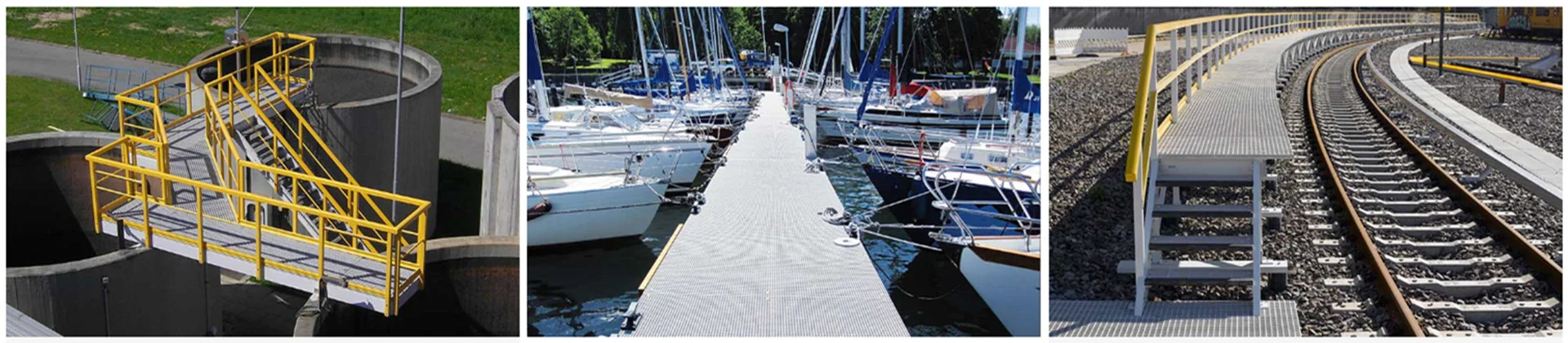
Introduction
Across power stations, desalination plants, and seaside boardwalks, owners are fed up with repainting corroded steel or replacing rotted timber every few years. FRP beams and columns—pultruded fiberglass profiles that shrug off salt, moisture, and stray current—are quickly becoming the structural answer of choice. In my own projects, I’ve watched crane costs plummet simply because three crew members could shoulder-carry 30 ft (9 m) FRP girders that would have required a boom truck if they were steel. Unicomposite, an ISO-certified pultrusion specialist headquartered in China, supplies those lightweight workhorses worldwide while backing every shipment with application engineering support.

frp beams and columns
What Are FRP Beams and Columns?
Composition & Pultrusion Manufacturing Basics
Continuous glass rovings, stitched mats, and surface veils are drawn through a resin bath and a heated steel die. The result is a profile with fibers precisely oriented for axial strength and a resin matrix that locks out oxygen and water. Typical density is 1.9 g cm-3—roughly one-quarter of carbon steel.
Key Performance Metrics vs. Steel and Concrete
| Metric | FRP (E-glass / vinyl-ester) | Carbon Steel (A36) | Cast-in-Place Concrete |
|---|---|---|---|
| Density | 1.9 g cm-3 | 7.8 g cm-3 | 2.4 g cm-3 |
| Tensile Strength | 300 MPa | 400 MPa | 3 MPa |
| Elastic Modulus | 24 GPa | 200 GPa | 30 GPa |
| Corrosion Resistance | Excellent | Needs coating | Moderate |
Because glass fibers don’t rust, service life in splash zones can exceed coated steel by 2–3 ×.
Core Advantages in Industrial Applications
Lightweight Handling & Rapid Installation
On a 2025 clarifier upgrade in Ohio, we discovered the new FRP beams were 68 % lighter than their galvanized predecessors. When a support column arrived 3 mm oversized, my team trimmed the end with a cordless saw in ten minutes—an on-site adjustment that would have meant waiting hours for a welder if the member were steel. Those hours saved pushed the contractor ahead of schedule and under budget.
Corrosion and Chemical Resistance in Aggressive Environments
According to the 2024 NACE International Cost of Corrosion Study, U.S. industry still loses $278 billion annually to rust. Vinyl-ester FRP shrugs off chloride pitting, sulfuric acid mist, and caustic soda, making it ideal for pickling lines, cooling-tower framing, and coastal boardwalk piles.
Dielectric & Non-Magnetic Benefits for Utilities
Pultruded profiles boast dielectric strength above 100 kV in-1 and zero magnetic permeability. Electric utilities deploy FRP columns around live bus bars to ensure maintenance crews stay clear of accidental fault paths and to eliminate eddy-current heating that can plague ferrous metals.
Design & Engineering Guidelines
Load-Bearing Calculations & Code Compliance
Because the elastic modulus of FRP beams and columns is roughly one-eighth that of steel, designers typically increase section depth or add flange stiffeners to satisfy deflection limits of L/240 for pedestrian decks and L/360 for machinery floors. Current guidance from ACI 440.1R-23 and ASCE/SEI 8-22 provides partial-safety factors and creep limits that let engineers model FRP confidently.
Connection Methods & Hybrid Designs
Stainless-steel splice plates, bonded gussets, and RTM-molded sleeves are common. Where uplift loads dominate—in hurricane zones—hybrid nodes pair FRP webs with galvanized bearing shoes to combine tensile capacity and ductile post-yield behavior.
Safety: Fire, UV, and Environmental Standards
Specifying a fire-retardant resin with antimony trioxide yields ASTM E84 Flame-Spread ≤ 25, satisfying most building codes. UV-inhibiting veils and gel coats keep color shift below 5 ΔE after 5 000 h of QUV exposure. FRP emits no service-phase VOCs and is fully REACH-compliant.
Case Study: 30-Year Coastal Boardwalk Retrofit
Project Scope & Initial Challenges
In 1995, a Mid-Atlantic city replaced rotting timber joists beneath its 1.2 km ocean boardwalk with pultruded beams and columns. Designers needed a material that resisted salt spray, dune sand abrasion, and Category-3 hurricane gusts.
Lifecycle Cost & Maintenance Savings
| Year | Timber (Historical $ ft-2) | FRP (Actual $ ft-2) |
|---|---|---|
| 30-Year Total | 17.40 | 4.80 |
After seven hurricanes, inspections recorded < 3 % section loss. Frequent recoating—budgeted at $85 000 per cycle for timber—was eliminated, saving an estimated $2.1 million.
Key Takeaways for Engineers and Owners
-
Weight reduction cut pile-driving time 15 %.
-
Zero corrosion coating renewals.
-
Wet coefficient of friction ≥ 0.8, improving public safety.
Selecting the Right Supplier & Customization Options
ISO-Certified Quality Control and Third-Party Endorsements
“Every lot we ship leaves with tensile coupons, cure profiles, and dimensional checks logged against ISO 9001 procedures,” says Zhao Wei, Engineering Director at Unicomposite. “That paperwork shortens clients’ submittal cycles and avoids costly re-tests.”
In 2024, the ASCE Composite Construction Institute cited Unicomposite’s QA program as a model for emerging pultruders in corrosive-environment structures.
Custom Profiles, Fabrication, and Logistics Support
Beyond standard I, H, and box sections, Unicomposite offers curve-pultruded arches, carbon-glass hybrids, CNC-milled end caps, and pre-drilled gussets so beams arrive “installation-ready.” Its export team coordinates door-to-site delivery—whether you’re in Dubai or Duluth.
Recent Market Data on Life-Cycle Cost
A 2024 study by Markets & Markets found that FRP beams and columns cut 20-year ownership costs by 38 % versus hot-dip-galvanized steel when maintenance coatings were included—reinforcing the boardwalk results at an industry scale.
Conclusion
Whether you’re designing a chemical-plant mezzanine or retrofitting a seaside pier, FRP beams and columns deliver unmatched corrosion resistance, electrical safety, and life-cycle value with half the installation labor. Consult Unicomposite’s engineering team early to tailor profiles, streamline on-site work, and keep your next project ahead of schedule and under budget.
Frequently Asked Questions
| Question | Answer |
|---|---|
| How long do FRP beams and columns last in coastal settings? | Field data and lab tests show service lives exceeding 30 years with minimal maintenance when fire-retardant vinyl-ester resins are specified. |
| Can FRP members carry the same loads as steel? | Yes—designers compensate for the lower modulus by selecting deeper sections or hybrid caps; published design guides (ACI 440, ASCE 8-22) provide the necessary factors of safety. |
| Are custom cross-sections expensive? | Because pultrusion uses a steel die, the cost is front-loaded. For bulk orders, Unicomposite amortizes tooling charges, making custom profiles competitive with standard steel fabrication. |
| Does FRP meet fire codes? | Fire-retardant FRP with antimony trioxide achieves ASTM E84 Class I (Flame-Spread ≤ 25), satisfying most industrial and commercial requirements. |
| What lead times should I expect? | Standard sections ship in 2–3 weeks. Custom tooling and large-volume runs typically require 6–8 weeks, including sea freight. |


