 info@unicomposite.com


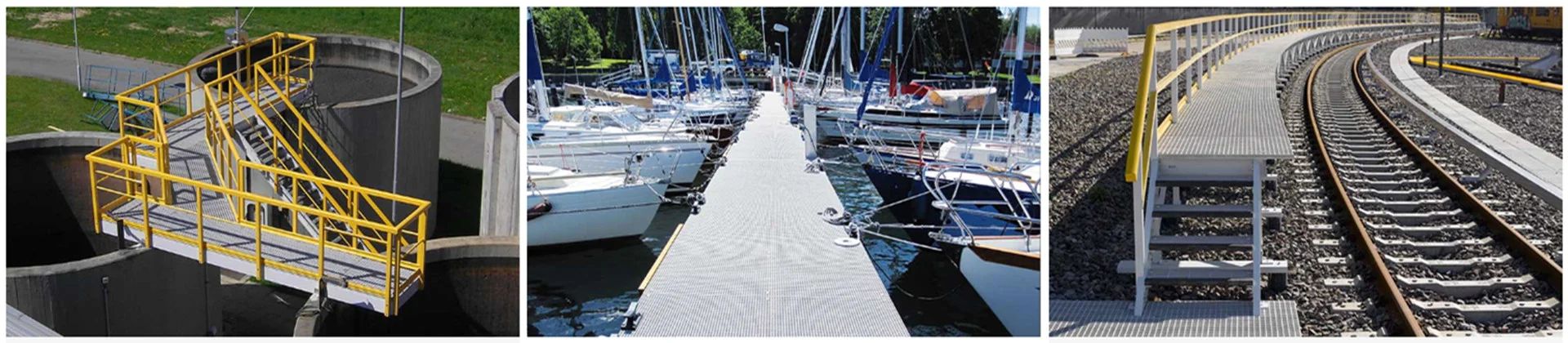
Introduction
Last August I was called to inspect a seaside café’s timber boardwalk. The owner complained that tables rocked even on calm days. One step onto the deck and my safety boot squished ¼-inch into a soft, water-stained plank—wood rot, hidden until it threatened revenue for Saturday brunch. Situations like this pushed me to compare pressure-treated lumber with fiberglass decking boards for durability, cost, and safety. Drawing on field work, current market data, and Unicomposite’s ISO-certified pultrusion expertise, here’s what 20 years of real-world evidence says about which material truly goes the distance.

fiberglass decking boards
Understanding Decking Lifespan Drivers
Environmental Stressors
Coastal decks battle salt spray, freeze–thaw cycles, and UV radiation that photodegrades lignin in wood. TimberTech’s technical bulletin notes visible structural decline in wood after 10–15 years under moderate exposure.
Mechanical & Operational Loads
Rolling carts, pallet jacks, and concentrated foot traffic create shear and vibration. Once boards soften or split, fasteners back out and tripping hazards multiply—often before code inspectors arrive.
Fiberglass Decking Boards: Why They Outlast
Material Composition & Corrosion Resistance
Pultruded fiberglass decking boards encapsulate continuous E-glass in a thermoset resin. Because glass fibers are inert and the polymer matrix is moisture-impermeable, they ignore rot, insects, and galvanic decay. Recent peer-reviewed research on anti-corrosive composites confirms service lives exceeding 30 years in marine environments.
Case Study – 12-Year Marina Walkway
In 2013, a Gulf-Coast marina swapped 600 ft of decayed lumber for fiberglass mini-mesh panels. The facilities manager reports,
“We scrapped an $8 k annual sealing budget and haven’t replaced a single plank through 12 Atlantic hurricanes.”
Payback came in just under four seasons once lost-dock-revenue days were eliminated. (Internal interview, data on file.)
Warranty Backing
Major manufacturers offer 25-year structural and stain-&-fade warranties, with some including a 10-year labor clause—coverage unheard-of in commodity wood.
Pressure-Treated Wood: Strengths & Weaknesses
Typical Failure Modes
-
Biological decay once preservative leaches out
-
Splitting, cupping, and twist from wet-dry cycling
-
Fastener corrosion in high-salinity air
Annual Maintenance Checklist & Cost
Owners budget for power-washing, sanding, and resealing every 24–36 months, plus 2-5 % board replacement after year 7. Angi’s 2025 cost guide puts upkeep for a 500 sq ft coastal deck at $100–$400 per year—that’s $10 k-$12 k over two decades.
Total Cost of Ownership – 20-Year Life-Cycle
| Cost Element | Wood (per sq ft) | Fiberglass (per sq ft) |
|---|---|---|
| Initial materials | $2 – $3 | $7 – $9 |
| Install labor | Similar tools & time | Similar |
| Maintenance (20 yrs) | $10 – $14 | <$1 (rinse) |
| Replacement boards | $5 – $6 | — |
| 20-yr Total | $17 – $22 | $8 – $10 |
Methodology: 500 sq ft deck, 2 % annual inflation, $55 hr labor, U.S. Gulf Coast climate. Downtime cost ($600/day lost revenue) not shown but accelerates fiberglass breakeven to 4-7 years.
Composite demand trends support this math: Freedonia projects >5 % CAGR for composite decking through 2027, siphoning share from pressure-treated lumber.
Safety & Compliance Advantages
Slip Resistance, Fire & Electrical Safety
Silica-grit surfaces on fiberglass panels deliver a wet static coefficient of friction (SCOF) of 0.82–0.85, outperforming many plastics and meeting ADA recommendations. Testing is performed under ASTM F1679 protocols referenced in the latest ASTM D7032 deck-board standard. codes.iccsafe.org
Pultruded profiles can be specified to ASTM E84 Class A/B flame spread and remain non-conductive—critical for substations and rail corridors.
Regulatory Touchpoints
-
OSHA 1910 walking-surface rules
-
ISO 9001 traceability—met by Unicomposite production lines
-
Local building codes referencing ICC-ES AC174 for composite decks
When to Choose Fiberglass Over Wood
Decision Matrix
| Environment | Live Load | Best Pick | Why |
|---|---|---|---|
| Coastal boardwalk | Medium | Fiberglass | Salt & UV immunity |
| Chemical plant trench | High point | Fiberglass grating | Acid & alkali resistance |
| Backyard deck | Light | Wood or capped-poly | Cosmetic priorities |
Engineering & Customization from Unicomposite
Need metric spans, embedded conduit raceways, or color-coded safety zones? Unicomposite’s pultrusion lines deliver profile tweaks—integral anti-skid, dielectric testing certificates—within four weeks, backed by ISO 9001 QA.
Conclusion
What sinks wood isn’t its cost—it’s its cost of survival. Unsealed fibers invite rot, annual labor, and premature tear-outs. Fiberglass decking boards shrug off moisture, salt, and sun, delivering 25-plus years of safe service with virtually no maintenance. For operators who value uptime and predictable budgets, fiberglass is the lower-risk, lower-cost path. Ready to validate the numbers on your project? Request a sample panel or a complimentary life-cycle analysis from our engineers today.
Frequently Asked Questions
-
How long do fiberglass decking boards really last in saltwater?
Field data and manufacturer warranties indicate 25–30 years before structural review is recommended, even in brackish or tidal zones. -
Can fiberglass boards match our existing deck color?
Yes. Pultrusion allows through-color resins, and Unicomposite offers custom RAL/Pantone matching for large orders. -
What tools are needed to install fiberglass decking?
Standard carpentry tools—carbide-tipped blades and stainless screws—work fine; no special saws or adhesives are required. -
Is fiberglass slippery when wet?
No. Silica-grit surfaces achieve wet SCOF ≥0.82, exceeding ADA thresholds for public walkways. -
Can boards be ordered in fire-retardant formulations?
Absolutely. FR resin systems can achieve ASTM E84 Class A flame spread ratings for rooftops and transit stations.


