 info@unicomposite.com


What Is FRP Pultrusion Grating?
FRP pultrusion grating is a structural grating made from continuous fiberglass rovings and resin that are pulled through a heated die to form bearing bars, which are then assembled with cross bars into a rigid panel. Unlike traditional steel grating, pultruded FRP grating is lightweight, corrosion resistant, electrically non conductive and easy to fabricate on site, making it a popular choice for industrial platforms, walkways and trench covers.
Because the glass fibers in pultruded grating are highly oriented along the length of the bearing bars, the grating offers very high strength and stiffness in the primary load direction. This directional strength, combined with customized resin systems, enables FRP pultrusion gratings to perform reliably in demanding environments where steel or aluminum would corrode, require frequent repainting or pose electrical safety risks.

frp pultrusion grating properties
Key Properties of FRP Pultrusion Gratings
1. Mechanical Strength and Stiffness
Pultruded FRP grating is designed around a high glass fiber content, typically about 60%–70% by weight in the bearing bars, which gives it a very high strength to weight ratio. The continuous fibers carry the load along the span, allowing the grating to resist high concentrated loads, rolling loads and long spans compared with many other materials.
- High flexural strength and modulus in the bearing bar direction.
- Suitable for heavy duty platforms, mezzanines, stair treads and equipment access areas.
- Less deflection than molded grating at the same span and load, improving walking comfort and perceived safety.
2. Lightweight and Easy Handling
FRP pultrusion grating weighs roughly one quarter of steel grating of comparable load capacity, which brings clear advantages during transport and installation. Panels can often be handled manually without lifting equipment, especially for retrofit or confined space projects.
- Lower transport cost and easier site logistics.
- Safer manual handling for maintenance teams.
- Reduced structural dead load on supporting beams and foundations.
3. Corrosion and Chemical Resistance
One of the most important properties of FRP pultrusion grating is its excellent resistance to corrosion. By selecting appropriate resin systems such as orthophthalic, isophthalic, vinyl ester or phenolic, the grating can withstand a wide range of chemicals, acids, alkalis, salts and solvents in splash, fume or even immersion conditions.
- Ideal for wastewater treatment plants, chemical process areas, pickling lines and cooling towers.
- No rusting, pitting or galvanic corrosion like steel grating.
- Greatly reduced need for repainting or coating repairs over the service life.
4. Fire Performance
With suitable resin formulations and additives, FRP pultrusion gratings can be produced to meet common fire performance requirements, including flame spread rating and smoke generation limits. Typical products are designed to achieve a flame spread index of 25 or less according to relevant test standards.
- Built in flame retardancy in the resin system, not just a surface coating.
- Self extinguishing behavior when the external flame source is removed.
- Fire performance classes can be selected according to project or code requirements.
5. UV and Weather Resistance
Outdoor platforms and walkways are continuously exposed to sunlight, rain and temperature cycling. Pultruded FRP grating uses UV resistant resins together with a protective surface veil to improve resistance to sunlight and weathering, helping to maintain appearance and mechanical properties over time.
- Reduced color fading and surface degradation under long term UV exposure.
- Good performance in coastal or marine atmospheres with salt spray.
- Stable mechanical properties across a wide service temperature range.
6. Electrical and Thermal Insulation
Unlike steel, FRP pultrusion grating is electrically non conductive, which is a key safety advantage in many industrial environments. The material also has low thermal conductivity, so walking surfaces are more comfortable to use in very hot or very cold climates.
- Improved electrical safety in substations, power plants and electrical rooms.
- No need for additional insulating covers in many applications.
- Reduced risk of condensation and icy surfaces compared with metallic grating.
7. Safety, Slip Resistance and Comfort
Pultruded gratings can be supplied with different surface finishes such as gritted top, meniscus or bonded anti slip plates. These finishes provide reliable slip resistance even in wet, oily or muddy conditions, helping owners to meet safety regulations and reduce accident rates.
- Anti slip walking surface for personnel safety.
- Uniform bearing bars create a comfortable walking feel.
- Optional ADA compliant openings and nosing for stair treads.
8. Low Maintenance and Long Service Life
Because FRP pultrusion gratings do not rust or rot and require no repainting in most environments, life cycle cost is often significantly lower than that of steel grating. Routine maintenance is usually limited to simple cleaning and periodic inspection of fixings, which reduces downtime and maintenance budget.
- No periodic sandblasting, repainting or galvanized coating repair.
- Excellent resistance to fatigue and impact for long term use.
- Stable performance makes whole life costing more predictable.
Pultruded vs Molded FRP Grating
Both pultruded and molded FRP gratings share many advantages over steel, such as corrosion resistance, low weight and electrical insulation. However, their internal structure and performance are different, so each type is better suited to specific applications. The table below summarizes the typical differences.
| Property | Pultruded FRP Grating | Molded FRP Grating | Design Notes |
|---|---|---|---|
| Load direction | Very strong in the bearing bar direction, directional strength | Bi directional, more uniform in both directions | Use pultruded for long spans and higher loads along one direction |
| Span capability | Longer allowable spans with less deflection | Shorter spans at the same load | Pultruded suits main platforms and heavy duty walkways |
| Open area | Typically lower open area, rectangular openings | Higher open area, mesh like square openings | Molded is preferred where drainage or debris fall through is critical |
| Impact resistance | High strength but more directional, slightly lower impact absorption | Excellent impact resistance due to integral mesh structure | Molded is often used under heavy falling objects or frequent dropping tools |
| Cost level | Generally higher unit price but lower quantity due to longer spans | Usually lower panel price but may need more supports | Total installed cost depends on support spacing and installation conditions |
| Cutting and fabrication | Easy to cut along bearing bars, cross cuts require care | Can be cut in any direction with uniform properties | Both types are workable with standard FRP cutting tools and PPE |
In summary, pultruded FRP grating is the best choice when you need high stiffness, long span capability and clear directional loads, while molded FRP grating is more suitable where bidirectional strength, high open area or complex cutouts are required.
How to Choose the Right FRP Grating for Your Project
Selecting the right grating is not only about material type but also about matching performance to real site conditions. The following steps can help you choose between pultruded and molded FRP grating and define suitable sizes.
1. Define Load and Span Requirements
Start by clarifying the design loads (uniform load, concentrated load, forklift or trolley load) and the clear span between supports. For long spans or heavy loads, pultruded FRP grating usually offers better stiffness and a more economical solution because you can reduce the number of supporting beams.
2. Consider the Environment and Chemical Exposure
List all chemicals, temperatures and exposure types (splash, fumes, immersion) around the platform or walkway. This information is essential for choosing the right resin system. Vinyl ester pultruded grating, for example, is a very good option for aggressive chemical or offshore environments, while isophthalic resins are suitable for many general industrial applications.
3. Check Safety and Compliance Requirements
Local safety codes may define maximum deflection, allowable opening size, slip resistance classes and fire performance criteria. Make sure that the selected pultruded grating profile and surface finish can satisfy these requirements, especially on stair treads, escape routes and elevated work platforms.
4. Evaluate Installation and Maintenance Conditions
On projects with limited crane access or confined spaces, the low weight of pultruded FRP grating can significantly simplify installation. At the same time, its long service life and minimal maintenance requirements will reduce operating costs over many years, which is important for utilities, chemical plants and marine structures.
5. Work with an Experienced FRP Grating Supplier
Because project conditions vary, it is helpful to consult with an experienced manufacturer who can recommend grating types, thicknesses and support spacing based on real application data. Unicomposite provides engineering support, load tables and sample panels to help designers make safe and economical decisions.
Typical Applications of FRP Pultrusion Grating
Thanks to the combination of high directional strength, corrosion resistance and low weight, pultruded FRP gratings are widely used in many industries.
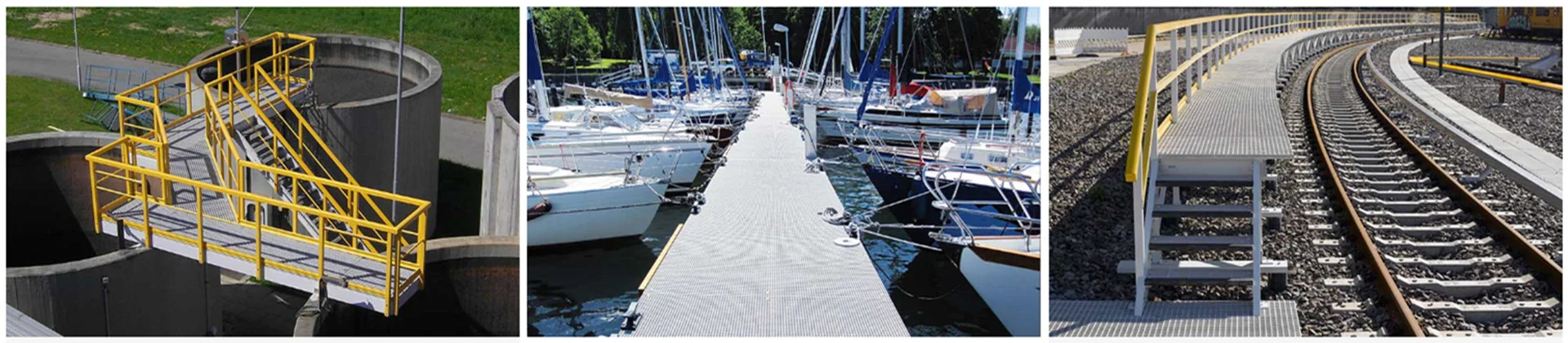
- Wastewater treatment plants – aeration tank walkways, clarifier bridges and access platforms exposed to moisture, chemicals and gases.
- Chemical process plants – platforms around storage tanks, mixing vessels and scrubbers where steel grating would corrode quickly.
- Power generation and substations – non conductive operating floors, transformer bays and cable trench covers that improve electrical safety.
- Marine and dock facilities – piers, jetties and offshore platforms where salt spray and splash zones cause rapid corrosion of metal gratings.
- Cooling towers and HVAC structures – maintenance walkways and fan decks with constant humidity and chemical dosing.
- Industrial plants and factories – mezzanines, conveyor access platforms, stair treads and machinery guards where lightweight and safe walking surfaces are needed.
Why Work With Unicomposite for FRP Pultrusion Gratings
Unicomposite has been focused on FRP pultrusion technology for many years and supplies a full range of grating products, including pultruded and molded types. Our engineering team helps customers select suitable grating profiles, resin systems and surface finishes based on project loads, chemical conditions and safety standards.
We manufacture and supply pultruded gratings in various bar heights, thicknesses and panel sizes, and can offer custom colors, non standard panel dimensions and factory fabricated cutouts to match your drawings. Matching clips and fasteners are also available to ensure safe and durable connections to supporting structures.
If you are planning a new platform or need to upgrade corroded steel gratings, you are welcome to contact us for technical support and a quotation. For more information about our fiberglass grating products, please visit the Molded / Pultruded Grating product page or request a quote directly from our team.


