 info@unicomposite.com


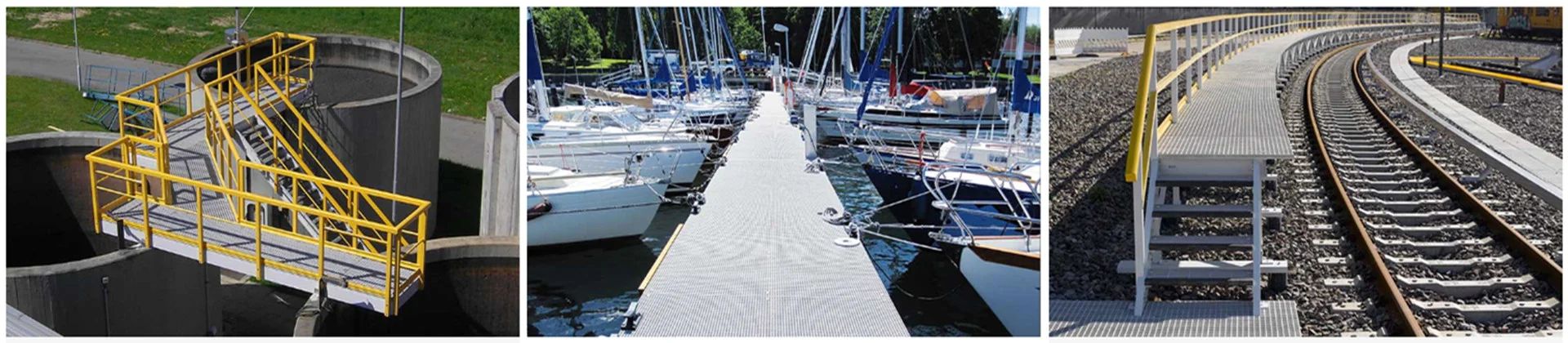
GFRP rebar is glass fiber reinforced polymer reinforcement used in concrete. It belongs to the broader FRP rebar family, while the common market term “fiberglass rebar” usually refers to GFRP.
A GFRP designation alone does not define the bar geometry, surface, mechanical properties, design values, or project suitability. GFRP rebar is not a generic rod, an FRP rock bolt, or a one-for-one replacement for steel; the actual material system, product data, governing design provisions, and acceptance requirements must match the intended concrete structure.
gfrp rebar explained
FRP, GFRP, and Fiberglass Rebar: What the Terms Mean
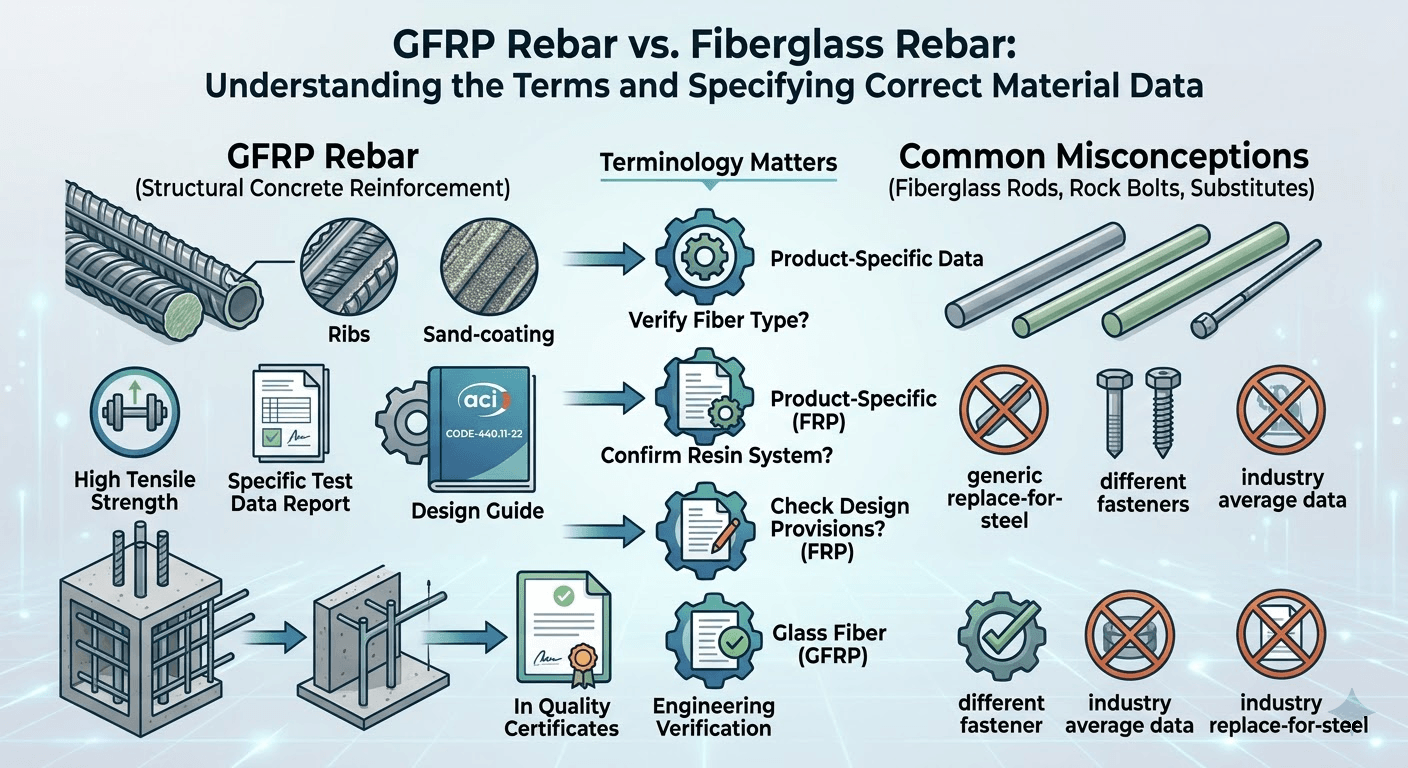
The terms are related, but they are not interchangeable in every context.
| Term | Practical meaning | What to verify |
|---|---|---|
| FRP rebar | The umbrella category: fiber-reinforced polymer bars used for concrete reinforcement | Fiber type, resin system, bar standard, geometry, and intended use |
| GFRP rebar | FRP rebar reinforced with glass fibers | Product-specific properties and documentation for the selected bar |
| Fiberglass rebar | Common market term for GFRP rebar | Confirm that the specification actually identifies GFRP, not a broader FRP category |
| Composite rebar | A broad commercial term that may include several fiber-and-resin systems | Do not assume glass fiber without checking the product data |
| CFRP or BFRP rebar | Carbon- or basalt-fiber-reinforced polymer bars | Treat as different material entities with their own data and design basis |
| FRP rod, rock bolt, dowel, or fastener | Products with different functions, geometries, or installation systems | Do not use these names as synonyms for concrete reinforcing bar |
The American Concrete Institute’s current GFRP building code is specifically written for structural concrete reinforced with glass fiber-reinforced polymer bars that meet the referenced material requirements. Its scope illustrates why “FRP” alone is not a complete project specification: the fiber type and bar standard matter.[1]
What Is GFRP Rebar Made Of?
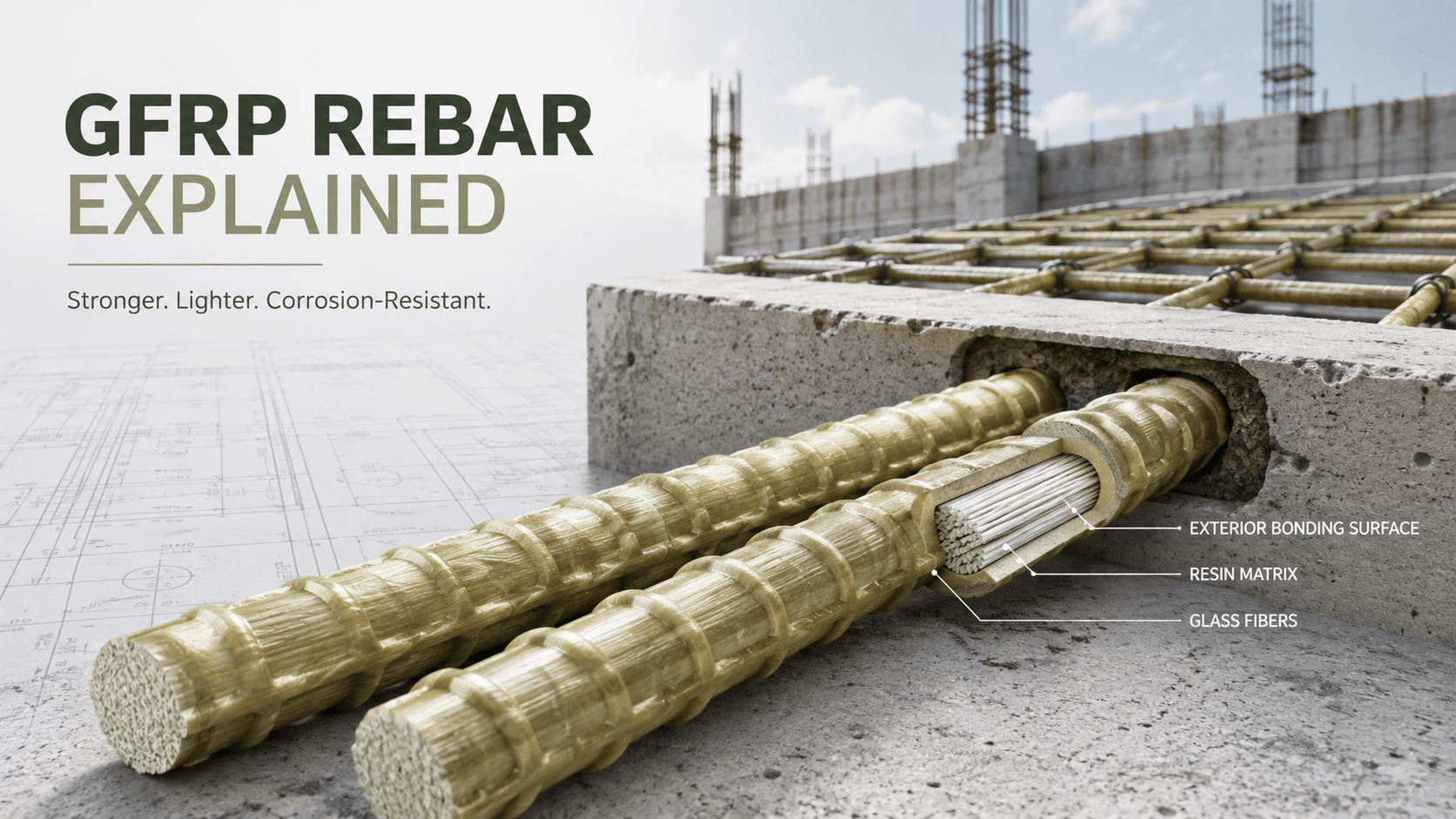
GFRP rebar has three functional parts: glass-fiber reinforcement, a resin matrix, and an exterior surface that transfers force between the bar and the surrounding concrete.
Glass-fiber reinforcement
The fibers are the principal longitudinal reinforcement inside the composite bar. They carry tensile force along the bar. The exact fiber grade, arrangement, content, and qualification are product-specific; they cannot be inferred from the words “fiberglass rebar” alone.
Resin matrix
The resin matrix binds the fibers into a bar, transfers stress among them, and separates the reinforcement from its surrounding environment. Resin chemistry and processing affect the finished bar, so a project submittal must identify the actual material system instead of relying on a generic FRP label.
Bonding surface
The bar’s exterior may use a textured, wrapped, sanded, ribbed, or otherwise formed surface. That surface is not merely cosmetic. It affects bond with concrete and therefore influences development, splicing, and detailing. The relevant geometry and test data must come from the selected product’s controlled documentation.
How Does GFRP Rebar Work in Concrete?
Concrete and reinforcement perform different structural roles. Concrete is strong in compression but needs reinforcement where tensile forces develop. GFRP bars provide tensile reinforcement through their embedded fibers, while the bar surface transfers force to and from the concrete.
That does not make GFRP a drop-in steel substitute. ACI CODE-440.11-22 provides dedicated requirements for GFRP-reinforced structural concrete, including strength, serviceability, durability, development, splicing, construction documents, inspection, and testing.[1] A change from steel to GFRP therefore requires design under the applicable GFRP provisions, not a same-size bar swap.
For a deeper explanation of property terminology and submittal data, see how to read FRP rebar property data. For a separate material-selection task, review GFRP rebar compared with steel.
What Is Fiberglass Rebar Used For?
GFRP rebar is used in reinforced-concrete work when the project’s design basis calls for glass-fiber polymer reinforcement. ACI CODE-440.11-22 covers cast-in-place, precast, nonprestressed, and composite structural concrete construction, including applicable nonbuilding structures.[1]
Bridge and transportation concrete are documented public-sector application areas. The Federal Highway Administration maintains current-practice resources for GFRP, CFRP, and other FRP reinforcement, including bridge demonstration projects and design information.[2]
GFRP may also be evaluated for other reinforced-concrete applications where nonmetallic reinforcement is being considered, but an application label does not establish suitability. The project team must define the exposure, governing code, structural requirements, verified bar data, detailing, construction controls, and acceptance documentation before approving a product for use.
What Must Be Verified Before Specifying GFRP Rebar?
The following framework turns a generic material question into a reviewable engineering and procurement task.
| Project input | Why it matters | Required review output |
|---|---|---|
| Jurisdiction and governing design code | Determines whether GFRP is permitted and which design provisions apply | Named code, edition, local amendments, and responsible design professional |
| Structural element and load path | Defines how reinforcement participates in strength and serviceability | Approved reinforcement design and drawings |
| Exposure conditions | Affects material qualification and durability requirements | Documented environment, material selection criteria, and required test evidence |
| Bar designation and geometry | Connects the design to the supplied bar | Bar schedule with designation, dimensions, surface description, shape, and length |
| Published mechanical properties | Supports calculations and acceptance | Controlled data sheet stating test methods and the statistical meaning of values |
| Bond, development, and splice requirements | Controls force transfer and reinforcement layout | Project-specific detailing reviewed under the governing GFRP provisions |
| Straight and bent-bar requirements | Finished shapes may have different manufacturing and qualification constraints | Approved bar list and shape drawings before ordering |
| Construction method | Handling, placement, support, and field modification affect installation | Project method statement based on approved product instructions |
| Inspection and traceability | Confirms that delivered material matches the approved submittal | Lot identification, inspection records, certificates, and acceptance plan |
The useful output is not “GFRP is suitable” in isolation. It is a coordinated set of calculations, drawings, material submittals, construction instructions, and acceptance records tied to one project.
How to Read a GFRP Rebar Data Sheet
A purchasing team should be able to connect every ordered bar to an approved technical requirement. At minimum, review the following fields before comparing suppliers:
- Product identity: fiber type, resin system, bar designation, surface configuration, and applicable material specification.
- Dimensions: nominal and measured geometry, cross-sectional basis, length, shape, and tolerances.
- Mechanical-property definitions: test method, sample basis, and whether each value is an average, guaranteed value, design value, or another stated statistic.
- Durability evidence: conditioning method, exposure conditions, duration, acceptance criteria, and applicability to the proposed bar.
- Bond and detailing data: information needed by the designer for development, splices, bends, and bar placement.
- Manufacturing and inspection records: product revision, lot traceability, inspection plan, and document approval.
- Project deliverables: drawings, bar list, certificates, reports, packaging marks, and any jurisdiction-specific submittals.
If a field is missing, do not fill it with an industry-average value or data from another manufacturer. Record the gap and resolve it through the responsible designer, supplier, testing body, or authority having jurisdiction.
gfrp rebar vs fiberglass rebar
Common Errors When Specifying FRP Rebar
Treating FRP and GFRP as exact synonyms
FRP identifies a family of materials. GFRP identifies the glass-fiber member of that family. The distinction affects standards, design data, and purchasing documents.
Specifying only a bar diameter
A diameter does not define fiber type, resin, surface geometry, guaranteed properties, test basis, or traceability. A complete bar specification must connect geometry to qualified material data.
Replacing steel bar-for-bar
GFRP-reinforced concrete has its own code provisions. The responsible design professional must review strength, serviceability, detailing, durability, construction, and inspection for the actual project.[1]
Using a standard name as proof of compliance
A reference to ACI or ASTM in marketing copy is not a test report or certificate. Verify the exact edition, scope, product identity, test record, and approval status.
Combining rebar with rock bolts, rods, or fasteners
These products may all contain fiber-reinforced polymer, but they serve different functions. Separate their technical records, page content, drawings, and RFQ fields.
Our FRP Rebar Product Scope
We offer FRP rebar for concrete reinforcement. Our current product information broadly identifies the material as a fiberglass-and-resin composite. Project-specific fiber and resin details, bar geometry, mechanical properties, applicable specifications, document availability, quantities, and commercial terms are confirmed during project discussion and quotation.
No industry value in this guide should be read as a guaranteed Unicomposite product specification. The approved product submittal and quotation must identify the actual supply scope.
Discuss an FRP Rebar Project
Review our FRP rebar product options, or send us the project location, governing code and edition, structural drawings, bar schedule, required shapes and lengths, quantity, exposure conditions, document requirements, destination, and acceptance criteria for a project discussion and quotation. The applicable product scope, material details, document availability, packaging, delivery terms, and commercial conditions will be confirmed after the project inputs are reviewed.
References
- American Concrete Institute. ACI CODE-440.11-22: Building Code Requirements for Structural Concrete Reinforced with Glass Fiber-Reinforced Polymer (GFRP) Bars—Code and Commentary. Publication page accessed August 18, 2026.
- Federal Highway Administration. Fiber Reinforced Polymer (FRP) Composite Technology: Current Practices and Design Information. Updated July 16, 2026; accessed August 18, 2026.


