 info@unicomposite.com


Introduction
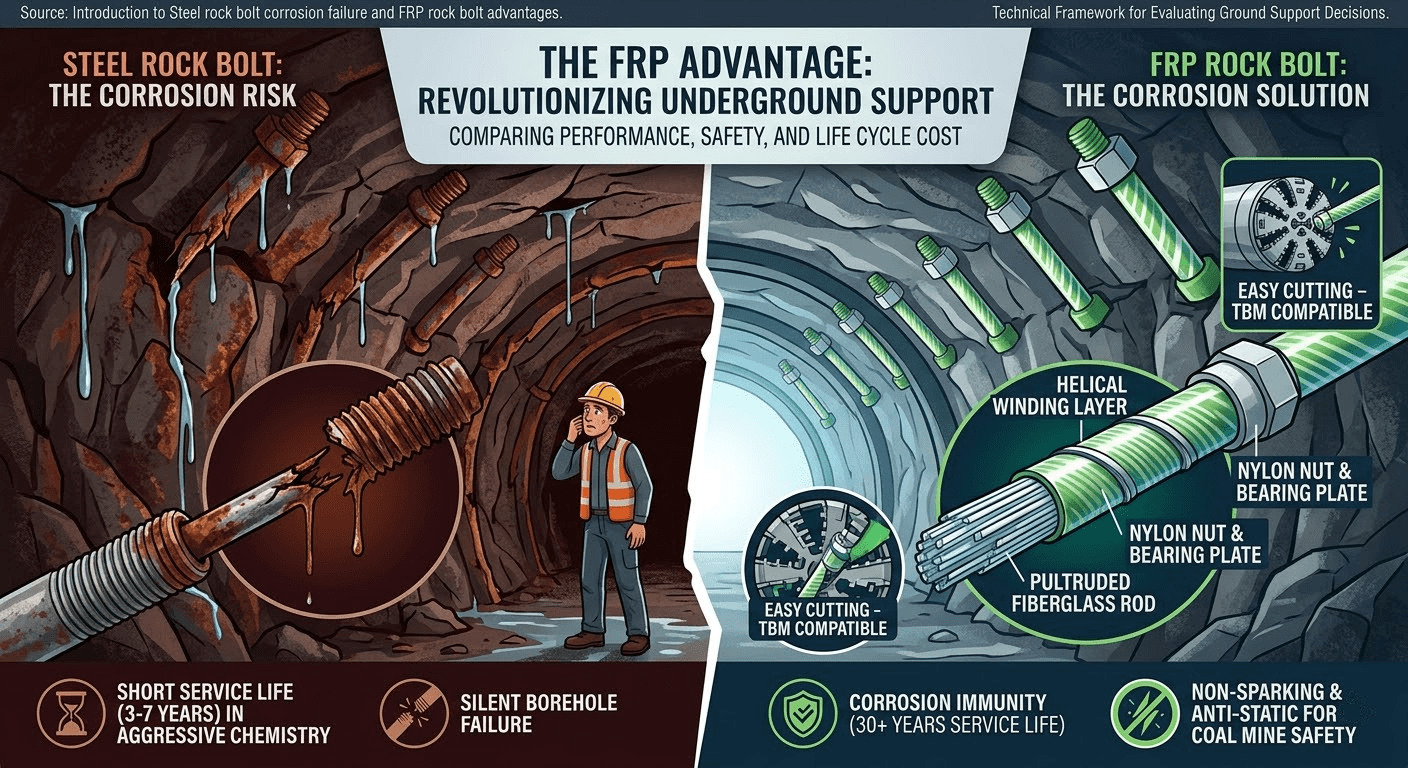
Steel rock bolt corrosion is one of the most underreported causes of unplanned ground support failure in underground operations. In documented acid mine drainage environments — where pH has been measured below 4.0 in groundwater contacting the bolt annulus — steel bolt service life reductions to 3–7 years have been observed in corrosion monitoring programs, well short of the design service life assumed during initial ground support engineering. When bolts fail silently inside a borehole, the consequences range from costly re-support programs to catastrophic roof falls.
FRP rock bolts address this failure mode at the material level — not through coatings or treatments that degrade over time, but through a fiber-reinforced polymer matrix that is chemically inert to the underground environments that destroy steel. The performance data and installation guidance in this article draw on FRP rock bolt design and supply experience spanning coal mine, hard rock mining, and mechanized tunneling applications across multiple markets. It gives mining engineers and procurement managers a technical framework for evaluating FRP rock bolts — covering material construction, mechanical specifications, safety-critical properties, and application fit — so that ground support decisions are based on performance data rather than material familiarity.
frp rock bolts vs steel rock bolts
What Is an FRP Rock Bolt? Construction and Manufacturing Basis
Understanding why FRP rock bolts perform differently from steel begins with understanding how they are built. The manufacturing process is not incidental — it directly determines the mechanical properties that make FRP suitable for primary ground support.
Component Breakdown: Pultruded Rod, Nylon Nut, and Bearing Plate
A standard FRP rock bolt assembly consists of three components: a pultruded fiberglass rod, a nylon nut, and a nylon bearing plate. Each component carries a specific engineering rationale.
The pultruded rod is the structural core. Pultrusion — a continuous manufacturing process in which glass fiber rovings are pulled through a resin bath and then through a heated die — aligns reinforcing fibers longitudinally with exceptional consistency. This longitudinal fiber alignment maximizes tensile strength along the bolt axis, which is precisely the load direction in roof and rib support applications. Alternative manufacturing methods produce less predictable fiber orientation and therefore less consistent axial tensile performance across a production batch.
The nylon nut and bearing plate complete the assembly. Nylon is specified — not steel hardware — because it maintains the bolt’s non-conductive and non-sparking properties from rod to surface. Using steel hardware with an FRP rod would reintroduce the ignition risk and conductivity that the FRP rod eliminates.
Helical Winding Layer: Torsional Strength and Resin Anchoring Function
Around the pultruded rod core, a helical winding layer of glass fiber bundle is applied in a left-hand direction. This winding serves two simultaneous mechanical functions that are easy to overlook when reviewing a bolt specification sheet.
First, it significantly increases torsional strength — the rotational resistance that allows the bolt to be spun during resin cartridge installation without twisting or delaminating under torque. Without adequate torsional strength, the bolt cannot effectively mix the two-component resin cartridge during the critical set phase.
Second, the helical surface texture creates a mechanical interface between the bolt rod and the cured resin annulus. The winding pattern increases the effective bonding surface area and creates interlocking geometry that resists axial pullout far more effectively than a smooth-surfaced rod of the same diameter.
One additional specification worth verifying at the procurement stage: the thermal expansion coefficient of glass-polyester FRP composites — approximately 8–12 × 10⁻⁶/°C — is closely matched to both concrete grout and rock mass (typically 6–12 × 10⁻⁶/°C for common rock types). This compatibility prevents thermally induced debonding at the bolt-grout interface over operational temperature cycles, a failure mechanism that affects dissimilar-material anchor systems over extended service life.
The manufacturing basis — pultrusion plus helical winding — is what enables FRP rock bolts to meet primary support specifications. The next question is what those specifications look like in numbers.
Technical Specifications: What Procurement Managers Need to Know
Specifying FRP rock bolts requires moving beyond material descriptions and into verifiable performance figures. Procurement managers should request supplier test certificates that reference a recognized testing standard — ASTM D2105 or an equivalent national standard — rather than accepting unattributed strength claims.
The table below provides a standard specification reference for FRP rock bolts used in coal mine and hard rock mining primary support applications:
| Parameter | Standard Value | Notes |
|---|---|---|
| Rod Diameter | 18 mm / 20 mm / 22 mm | Custom diameters available on request |
| Standard Length | 1,000–3,000 mm | Cut-to-length; project-specific lengths supported |
| Tensile Strength | ≥800 MPa | Longitudinal axis; supplier certificates should reference ASTM D2105 or equivalent |
| Elongation at Break | 2.0–3.5% | Lower than steel — design accordingly for dynamic load zones |
| Anchoring Force | ≥100 kN | In 42 mm diameter boreholes with two-component polyester resin cartridge; request test data matched to your borehole geometry and ground conditions |
| Thermal Expansion Coefficient | ~10 × 10⁻⁶/°C | Compatible with concrete grout and common rock types |
| Weight (per meter, 20 mm dia.) | ~0.6 kg/m | Approximately 25% of equivalent steel bolt weight |
Diameter, Length, Tensile Strength, and Anchoring Force Parameters
The tensile strength figure of ≥800 MPa is the headline specification, but anchoring force is the operationally critical number for ground support engineers. Anchoring force depends on three variables acting together: rod tensile capacity, resin bond quality, and borehole geometry. A bolt that achieves 800 MPa tensile strength but is installed in an oversized borehole with incomplete resin encapsulation will not achieve 100 kN anchoring force in practice.
The 100 kN figure cited above reflects test results in 42 mm diameter boreholes with standard two-component polyester resin cartridge under full encapsulation. Buyers working in soft rock, variable ground, or non-standard borehole geometries should request pull-test data from conditions representative of their specific installation environment — not just from the supplier’s standard test setup.
Surface Texture and Bonding Interface Design
The helical winding surface is a functional specification, not a cosmetic feature. When evaluating suppliers, engineers should confirm winding pitch (typically 15–25 mm), winding depth relative to rod diameter, resin cartridge compatibility testing documentation, and minimum pull-test results from a representative substrate.
Surface texture quality is a common point of variation between suppliers and is rarely captured in a headline tensile strength figure. Pull-test data from actual installation conditions is the more reliable procurement indicator — and the one that most directly predicts in-situ support system performance.
frp rock bolts
FRP Rock Bolt vs. Steel Rock Bolt: A Direct Comparison
Material cost is the number that appears first in most procurement comparisons. It is rarely the number that matters most when total support system cost is calculated over a 10- to 20-year mine life. The six performance dimensions below are where FRP and steel diverge most significantly — and where the unit cost comparison most consistently misleads.
Field service data and accelerated aging test results from high-corrosivity underground environments suggest the service life differences in the table below; buyers should request supporting documentation from suppliers for their specific ground chemistry conditions.
| Property | FRP Rock Bolt | Steel Rock Bolt | Operational Implication |
|---|---|---|---|
| Corrosion Resistance | Excellent — chemically inert | Poor without coating | Eliminates acid mine drainage failure mode in most mining pH ranges |
| Service Life (aggressive chemistry) | 30+ years (field and accelerated aging data) | 5–15 years (coated) | Reduces re-support frequency and lifecycle cost |
| Non-Sparking | Yes — inherent to material | No | Required under regulation in gassy mine environments |
| Anti-Static | Yes — inherent to material | No | Reduces ignition risk in coal dust environments |
| Electrical Conductivity | Non-conductive | Conductive | Safe in electrified tunnel infrastructure |
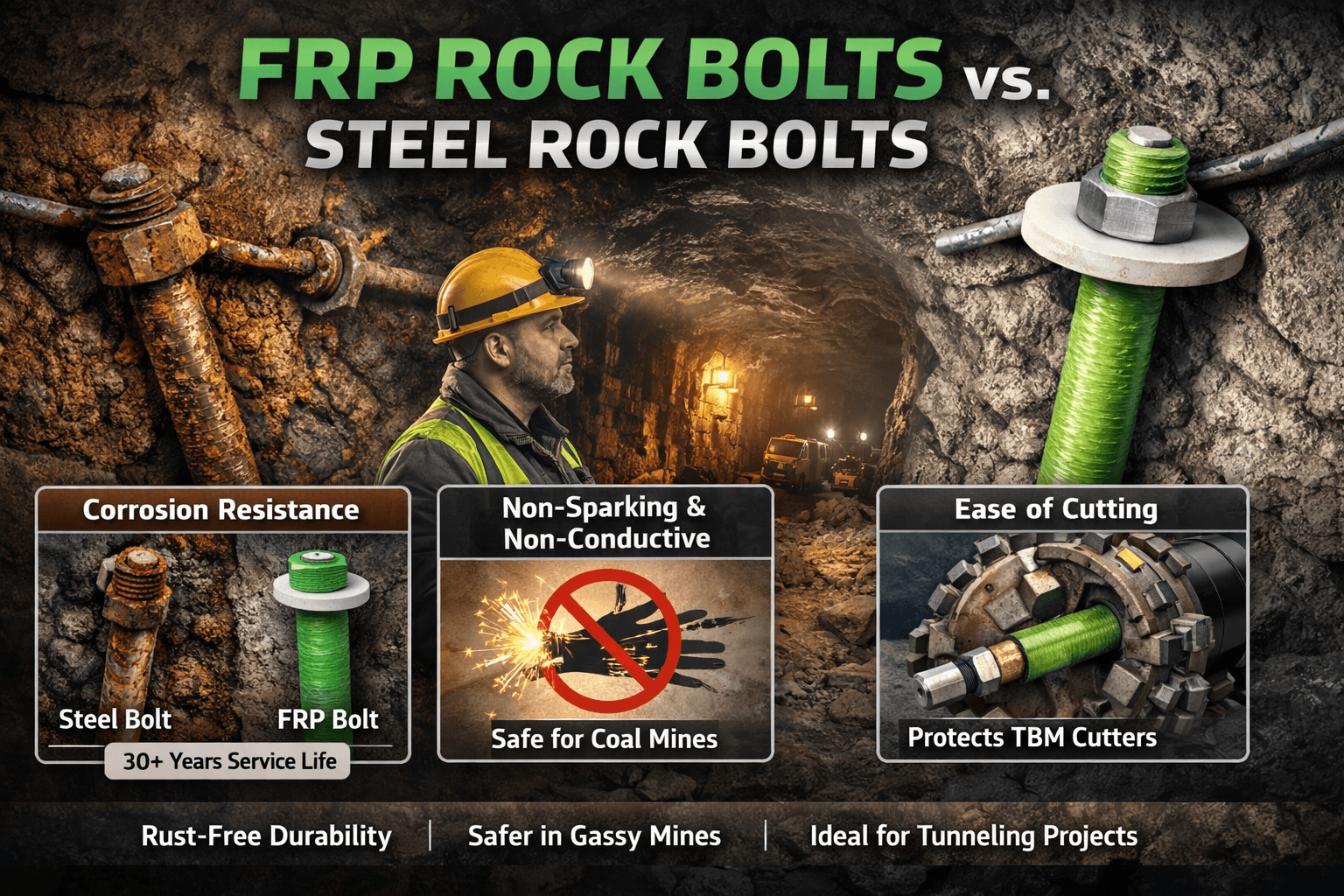
| Ease of Cutting (TBM / continuous miner) | High — no cutter damage | Low — damages cutterheads | Enables full-face mechanized advance without bolt avoidance |
| Weight | ~25% of steel | Baseline | Reduces installation labor intensity and transport cost underground |
Corrosion Resistance in Acid Mine Drainage and High-Humidity Environments
In a zinc-lead mine operating in pyritic ground with measured drainage pH of 3.2, ground support engineers documented measurable cross-section reduction in uncoated steel primary bolts within 28 months of installation. The re-support program that followed — involving secondary bolt installation through established workings — cost more per supported meter than the full-face FRP specification that replaced it in subsequent development headings. The pattern is consistent across documented acid mine drainage case histories: the initial material cost saving on steel bolts is absorbed by the first re-support cycle, typically within 3–5 years in aggressive ground chemistry.
Epoxy-coated steel bolts extend service life but do not eliminate the failure mode. Coating damage during installation — nearly impossible to avoid in rough borehole conditions — creates localized corrosion sites that propagate beneath the coating, a mechanism known as undercutting corrosion. Engineers inspecting failed coated steel support systems in aggressive underground chemistry consistently find that coating integrity, not coating specification, was the limiting variable.
FRP eliminates the corrosion failure mode in the acid and neutral pH underground environments characteristic of most mining and tunneling applications. The glass-polyester or glass-vinyl ester matrix does not oxidize, does not react with sulfuric acid at concentrations found in acid mine drainage, and does not depend on surface coating integrity for its protection. The protection is structural, not surface-applied.
Non-Sparking, Anti-Static, and Non-Conductive Properties for Coal Mine Safety
In underground coal operations, three material properties are not performance preferences — they are regulatory requirements in most jurisdictions: non-sparking, anti-static, and non-conductive. Steel satisfies none of these requirements inherently. FRP satisfies all three by material composition.
Non-sparking means that FRP does not generate incendive sparks when struck, cut, or abraded — a critical property in environments where methane concentrations can reach explosive levels. Anti-static means that the bolt does not accumulate or discharge static electricity, which can ignite suspended coal dust. Non-conductive means that the bolt does not provide an electrical path, protecting both workers and equipment in environments with electrical infrastructure.
These properties cannot be added to steel through surface treatment and maintained reliably in underground conditions. A conductive substrate with a non-conductive coating is still conductive wherever the coating is damaged — which, in abrasive rock environments, begins at installation.
Ease of Cutting: Protecting Tunnel Boring Machine Cutters and Continuous Miners
In mechanized tunneling — where a TBM advances through previously bolted ground — contact between cutterheads and steel rock bolts causes rapid disc cutter wear and potential cutter block fracture. Cutter replacement in a TBM requires removing the machine from the face, a process that idles a drive for 12–48 hours depending on cutter position and machine configuration.
FRP rock bolts cut cleanly with standard TBM disc cutters and continuous miner picks without causing cutter damage. In practice, this changes how advance planning is structured in mechanized tunneling contracts: when FRP bolts are specified in the face zone, advance engineers do not need to design cutterhead paths around bolt avoidance. In projects where steel bolts are already installed and a TBM advance is planned, the cost of pre-excavating bolts from the face — or absorbing increased cutter replacement frequency — frequently exceeds the material cost differential between FRP and steel many times over.
The cuttability advantage is not marginal in mechanized operations. It is frequently the single factor that determines whether FRP specification is economically justified before the first production meter is driven.
Application Scenarios: Where FRP Rock Bolts Perform Best
The six performance advantages in the comparison above do not apply equally to every underground environment — and recognizing where FRP delivers its strongest return prevents both over-specification in standard conditions and under-specification where it matters most.
Coal Mine Roof and Rib Support
Coal mine roof bolting is the application where FRP rock bolts have the strongest regulatory alignment. Anti-static and non-sparking requirements for ground support components in gassy coal mines are codified in mining regulations across major coal-producing jurisdictions, and FRP satisfies these requirements inherently — without exemptions, coatings, or periodic re-certification of surface treatment.
Typical primary support patterns in North American and Australian coal mine practice specify 1,500–2,400 mm bolt lengths at 1.0–1.2 m spacing, depending on roof classification. FRP rock bolts cover this length range in standard production, and cut-to-length capability accommodates non-standard roof heights without the lead time penalty of custom steel fabrication.
Hard Rock Mining and Mechanized Tunneling
In hard rock mining where TBM or roadheader advance intersects previously bolted ground, FRP specification at the face zone is a direct advance rate optimization. Projects where the face bolt pattern uses FRP while the permanent support zone uses steel can balance material cost with operational efficiency — a hybrid specification that procurement engineers in mechanized tunneling increasingly adopt as advance rate sensitivity increases.
Corrosion resistance is equally relevant in hard rock environments with sulfide ore bodies, where acid mine drainage chemistry can be as aggressive as in coal mines despite the different lithology. The material failure mechanism is identical regardless of rock type — the acid source differs, the bolt cross-section reduction does not.
Underground Infrastructure with Electrical or Chemical Hazard Requirements
Beyond mining, FRP rock bolts find application in electrified rail tunnels, water conveyance tunnels, and underground utility infrastructure where electrical conductivity or chemical exposure of the support system creates a secondary hazard. Unicomposite Technology Co., Ltd. — an ISO 9001-certified FRP manufacturer operating an 18,000 m² production facility in Nanjing — supplies FRP rock bolts for mining and tunneling applications alongside a broader range of corrosion-resistant FRP structural products used in underground utility and civil infrastructure environments, including cable trays, ladder systems, and structural profiles where dielectric properties and long service life are primary design requirements.
Installation: Resin Compatibility, Torque Procedure, and Quality Verification
In each of the application environments above, FRP rock bolt performance depends not only on material specification but on installation quality — which is where the gap between rated and achieved anchoring force most often originates.
Resin Anchor Agent Selection and Mixing Mechanics
FRP rock bolts are compatible with standard two-component resin cartridges — polyester and vinyl ester formulations are both proven with glass-FRP rod surfaces. Resin cartridge selection should account for gel time (fast-set for immediate load transfer, slow-set for longer bolts requiring full encapsulation) and ambient temperature at the installation face, as gel time is highly temperature-sensitive and can vary by a factor of 2–4× across the underground temperature range of 10–35°C typical in active mining environments.
The helical winding surface drives resin mixing during installation rotation. As the bolt is spun — typically 15–30 seconds at 200–400 rpm depending on bolt length and cartridge type — the winding geometry ruptures the cartridge, mixes the resin and catalyst components, and displaces mixed resin through the annulus. Rotation speed consistency matters: too slow produces incomplete mixing and a weak bond zone; too fast in a fast-set cartridge risks partial gelation before full encapsulation is achieved.
Installation Steps and Common Errors to Avoid
The standard FRP rock bolt installation sequence follows six steps: drill the borehole to the specified diameter (typically 3–5 mm larger than bolt diameter), clear drill cuttings, insert resin cartridge or cartridges, insert bolt to full depth, rotate at specified speed for the required mixing time, and hold without rotation until the resin achieves initial set.
Three common installation errors account for the majority of pull-test failures in FRP bolt installations: borehole oversizing (reduces resin annulus thickness and bond area), insufficient rotation time (incomplete catalyst mixing), and premature load application before initial set (disturbs the resin-rock interface during cure). Quality verification through random pull-testing — minimum 5% of installed bolts per shift, with acceptance criteria matched to the design anchoring force — provides the installation feedback loop that prevents systematic under-performance from going undetected until a roof or rib event occurs.
Conclusion
FRP rock bolts earn their specification through four performance advantages, each addressing a real operational or safety risk in underground mining and tunneling:
- Corrosion immunity: In acid mine drainage environments, FRP eliminates the failure mode that limits steel bolt service life to a fraction of the design mine life — without relying on surface coatings that degrade in abrasive underground conditions. Re-support program costs in documented case histories consistently exceed the original FRP cost premium.
- Inherent safety properties: Non-sparking, anti-static, and non-conductive characteristics are structural properties of FRP, not surface treatments. They cannot be compromised by installation damage, abrasion, or coating degradation in aggressive underground environments.
- Mechanized advance compatibility: FRP cuttability removes rock bolts from the list of obstacles that interrupt TBM and continuous miner production. In mechanized tunneling contracts, this scheduling advantage frequently justifies the material cost differential before the first production month is complete.
- Calculate support system cost over design mine life, not unit bolt cost, before finalizing material specification: Re-support programs, cutter replacement cycles, corrosion inspection overhead, and regulatory compliance costs all shift the total cost comparison in FRP’s favor when quantified over a realistic underground service life.
Frequently Asked Questions
Standard production targets ≥800 MPa tensile strength along the bolt axis, consistent with the longitudinal fiber alignment achieved through pultrusion. Supplier test certificates should reference ASTM D2105 or an equivalent national standard; Unicomposite provides test documentation upon request. Buyers should specify the required standard at inquiry to ensure the supplied documentation matches their project quality requirements.
Standard two-component polyester and vinyl ester resin cartridges are compatible with FRP rock bolt rod surfaces. Resin selection should account for gel time relative to bolt length and ambient face temperature — fast-set cartridges are appropriate for short bolts requiring immediate load transfer, while slow-set formulations are specified for longer bolts where full annulus encapsulation requires extended rotation time. Unicomposite can provide resin compatibility guidance based on your specified bolt length and installation conditions.
Rod body length is set per project requirement; Unicomposite accommodates both standard lengths (1,000–3,000 mm) and custom specifications. Lead time for custom lengths depends on diameter, quantity, and current production scheduling — confirmed lead time is provided at the inquiry stage. Standard diameter and length combinations are typically available from production stock with shorter lead times.
The manufacturing workflow operates under ISO 9001 certification, covering design, production, and quality inspection processes. Product-specific regulatory certifications — including MSHA compliance documentation for North American coal mine applications — should be confirmed at inquiry based on destination market and application requirements.
Anchoring force in FRP rock bolt installations is ground-condition dependent — the 100 kN figure cited in this article reflects test results in competent ground with standard borehole geometry and full resin encapsulation. In soft or fractured ground where borehole stability is reduced, effective anchoring force may be lower, and installation technique (borehole diameter, resin cartridge volume, rotation protocol) requires adjustment. Buyers should request pull-test data matched to their specific ground classification and provide ground condition data at inquiry to receive an appropriate specification recommendation.


