 info@unicomposite.com


Introduction
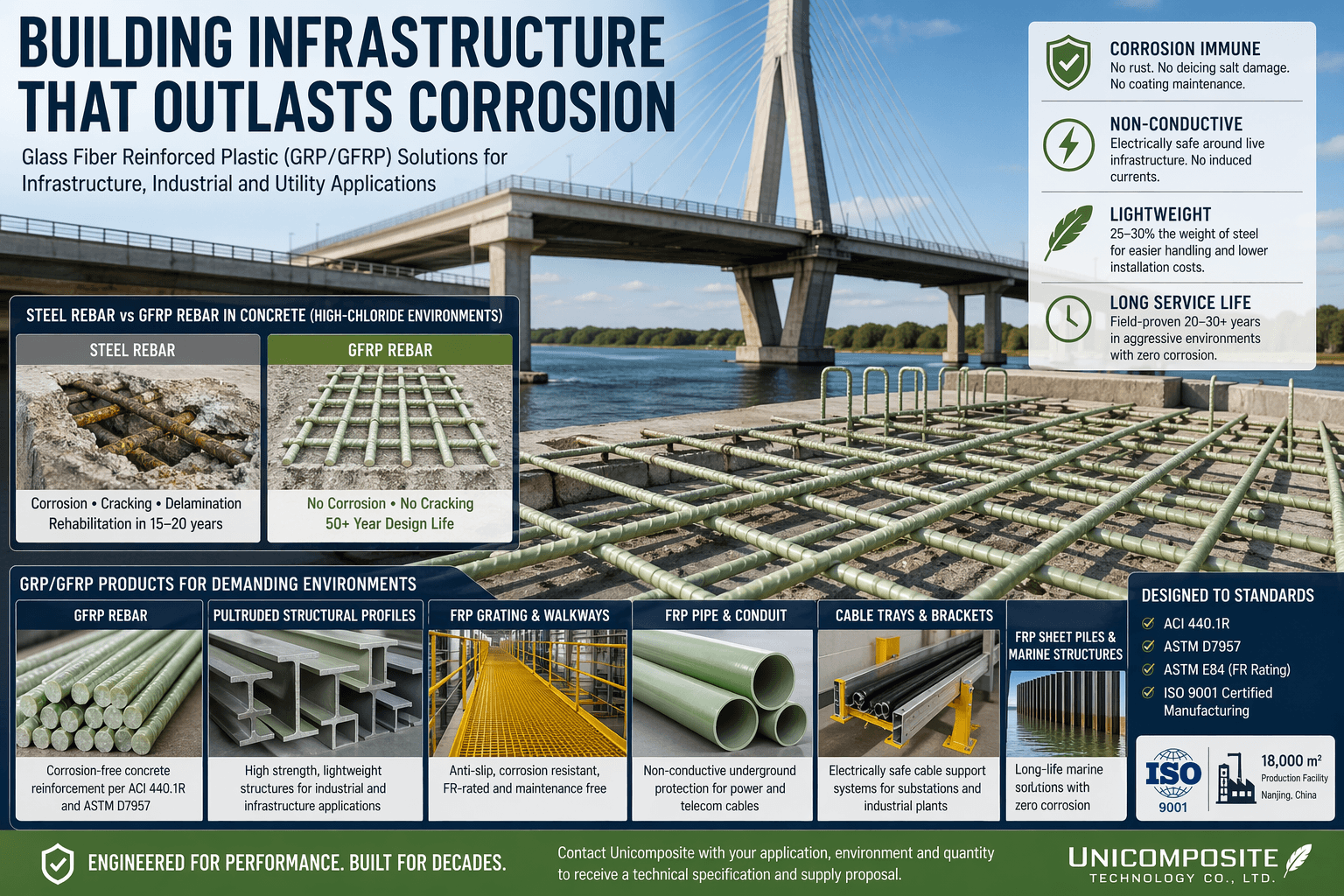
Based on ASCE Infrastructure Report Card data, more than 40% of bridges in the United States are either structurally deficient or in need of significant repair — and the leading cause of that deterioration is not concrete failure, but the corrosion of the steel reinforcement inside it. Chloride ions from road salt penetrate the concrete cover, initiate electrochemical corrosion of the steel rebar, generate expansive corrosion products that fracture the concrete from within, and trigger a rehabilitation cycle that costs North American infrastructure owners tens of billions of dollars annually. The same corrosion mechanism destroys steel structural members in chemical plant environments within 8–15 years. The same electrical conductivity that makes steel rebar corrode in concrete makes steel enclosures a safety hazard near live utility infrastructure.
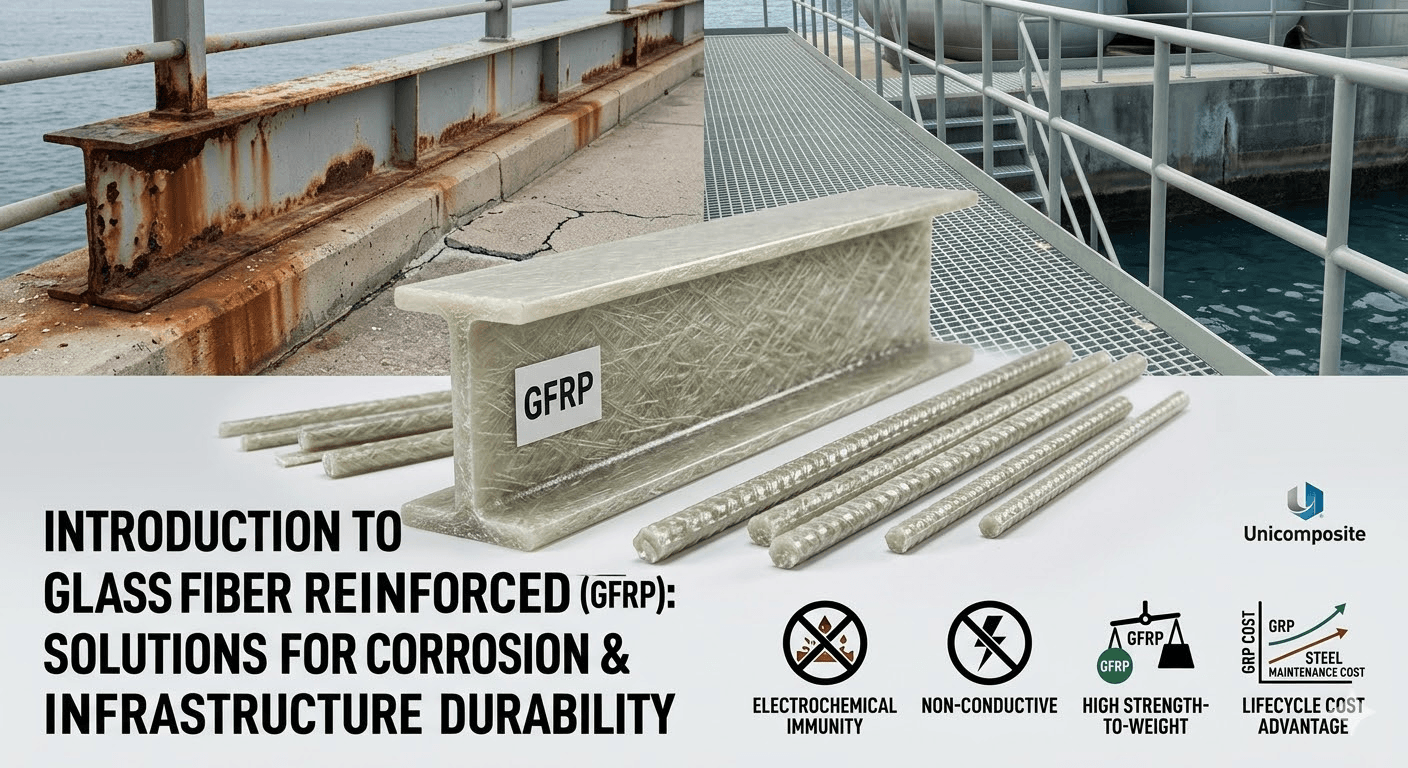
Glass fiber reinforced plastic addresses all three failure modes with a single material system. It does not corrode, does not conduct electricity, and does not require the coating maintenance programs that make steel’s lifecycle cost in aggressive environments consistently higher than its upfront unit cost suggests. The material guidance, design standard references, and performance data in this article draw on glass fiber reinforced plastic design and supply experience spanning infrastructure, utility, chemical plant, and marine construction programs for B2B customers in North American and international markets. It gives engineers and procurement managers a technical framework for understanding glass fiber reinforced plastic — covering material composition, mechanical and physical properties, manufacturing processes, and application fit — so that material selection decisions are based on performance data rather than material familiarity.
glass fiber reinforced plastic
What Is Glass Fiber Reinforced Plastic? Material Composition and Terminology
Glass fiber reinforced plastic is a composite material — a two-component system in which the properties of the finished product are determined by both component materials and the manufacturing process that combines them. Understanding both components clarifies why GRP performs as it does, and why specification decisions about fiber type and resin system are engineering decisions with structural consequences.
The Two-Component Material System: Glass Fiber and Thermosetting Resin
The glass fiber reinforcement provides tensile strength and stiffness. Standard E-glass fiber is used in the vast majority of structural GRP applications — general industrial, civil, and electrical infrastructure. ECR-glass (corrosion-resistant glass) provides improved resistance to the alkaline concrete pore solution and to acidic environments, specified for the most aggressive long-term exposures. S-glass achieves higher tensile strength than E-glass at higher cost, specified in applications requiring the maximum strength-to-weight ratio.
The thermosetting resin matrix binds the fiber system, protects the glass from the service environment, and determines the product’s chemical resistance and long-term durability ceiling. Isophthalic polyester resin covers standard outdoor atmospheric, freshwater, and general chemical service. Vinyl ester resin extends chemical resistance to marine salt water, coastal environments, chemical plant acid and alkali exposure, and high-chlorine water treatment — required wherever polyester resin’s chemical resistance ceiling is exceeded by the service environment. Epoxy resin provides the highest chemical resistance, the lowest moisture absorption, and food-grade suitability for pharmaceutical and water contact applications.
Fiber volume fraction — the percentage of the product cross-section occupied by glass fiber — directly determines mechanical properties. Standard pultruded GRP profiles run 50–65% fiber volume fraction. Pultruded GFRP rebar and structural profiles with 50–65% fiber volume fraction achieve 400–1,000+ MPa tensile strength per ASTM D7957 and equivalent standards; molded FRP products with random fiber orientation typically run 100–250 MPa. Products at the same FRP label but produced by different processes require completely different structural design approaches — which is why process confirmation belongs in the procurement specification alongside the property minimums. Fiber volume fraction confirmation from the supplier’s test records is a procurement requirement, not a specification assumption.
FRP, GRP, GFRP: Understanding the Terminology
FRP (fiber reinforced plastic or fiber reinforced polymer) is the broadest term — it covers glass, carbon, aramid, and basalt fiber composites. When a procurement specification says “FRP,” it technically includes all fiber types, which can create ambiguity in multi-supplier programs where carbon fiber CFRP and glass fiber GFRP products might both qualify under the same abbreviation.
GRP (glass reinforced plastic) is the standard term in British and European industrial markets — used in BS and EN standards to specify glass-fiber-specific composite products. In North American technical usage, GRP and GFRP are equivalent in meaning. GFRP (glass fiber reinforced polymer) is the most precise technical designation — the term used in ACI 440.1R, ASTM D7957, and ISO structural composite standards.
Procurement specifications should use the most precise term for the product type. GFRP for concrete reinforcing bar — distinguishing it from CFRP prestressed systems; GRP or FRP for structural pultruded profiles, grating, and pipe — where fiber type is less critical than resin system and section properties; and explicit resin system designation (polyester, vinyl ester, or epoxy) in every procurement specification regardless of product type. Specifying by material label alone — “FRP pipe” or “GRP grating” — without resin system and process confirmation creates specification gaps that suppliers can fill with products that share the label but not the performance.
Key Mechanical and Physical Properties
Six material properties determine whether glass fiber reinforced plastic is the correct specification for a given application — understanding each property, its typical value range, and its design implication prevents the most common specification errors that lead to premature failure or structural inadequacy.
The table below compares the key mechanical and physical properties of glass fiber reinforced plastic against structural steel and aluminum across the dimensions most relevant to B2B industrial and infrastructure procurement:
| Property | GRP / GFRP | Structural Steel | Aluminum Alloy |
|---|---|---|---|
| Density | 1.8–2.1 g/cm³ | 7.85 g/cm³ | 2.7 g/cm³ |
| Tensile Strength | 200–1,000+ MPa (fiber/process dependent) | 400–550 MPa | 150–500 MPa |
| Elastic Modulus | 20–55 GPa | 200 GPa | 70 GPa |
| Failure Mode | Linear elastic — brittle rupture | Ductile — yield plateau | Ductile — yield plateau |
| Corrosion in Salt/Chemical | None — electrochemical immunity | Progressive — coating required | Moderate — galvanic risk |
| Electrical Conductivity | Non-conductive | Conductive | Conductive |
| Thermal Expansion | 6–14 µm/m·°C (direction dependent) | 12 µm/m·°C | 23 µm/m·°C |
Mechanical Properties: Strength, Stiffness, and Failure Mode
GRP tensile strength ranges from 200 MPa for molded products with random fiber orientation to 1,000+ MPa for pultruded products with highly aligned longitudinal fiber at high volume fraction. The elastic modulus range (20–55 GPa) reflects the same variables — with pultruded products in the upper half of the range and molded products toward the lower end.
The elastic modulus difference from steel (200 GPa) is the most consequential mechanical property distinction for structural design. GRP’s lower stiffness means deflection and crack width typically govern GFRP rebar concrete section design per ACI 440.1R — requiring higher reinforcement ratios than equivalent steel sections — rather than ultimate strength, which is the primary design criterion for steel per ACI 318. For structural profiles, deflection-governed design means that section selection must confirm EI (flexural stiffness) against the serviceability limit state, not just section modulus against the strength limit state.
The failure mode distinction is equally significant. Steel yields before fracture — providing plastic deformation as a warning and energy absorption mechanism. GRP fails in a linear elastic mode — deforming proportionally to applied load up to rupture without a yield plateau. This is why structural design standards for GRP profiles and GFRP rebar differ from equivalent steel design standards: safety factors, deflection limits, and development length calculations all require adjustment to account for the absence of ductile energy dissipation.
Corrosion Resistance, Non-Conductivity, and Weight
GRP’s corrosion immunity is electrochemical — not coating-dependent. The glass fiber and thermosetting resin matrix participate in no oxidation-reduction reaction in the presence of chloride ions, oxygen, and moisture. There is no corrosion threshold to exceed, no passive film to break down, and no expansive corrosion product to generate. The immunity applies equally in dense concrete with low permeability and in cracked concrete with direct chloride access.
Non-conductivity operates by the same material logic: no free electrons in the glass fiber or thermosetting resin matrix means no current path for eddy currents, no induced voltage on structural members near live electrical infrastructure, and no interference with MRI magnetic fields or RFID signal frequencies. The property is through the full material cross-section — not a surface coating that can wear or breach.
At 1.8–2.1 g/cm³, GRP structural products weigh approximately 25–30% of equivalent steel sections. The installation implications are operationally significant on access-restricted sites: rooftop cooling tower replacement where building deck loading constrains the replacement tower weight, railway corridor infrastructure where possession windows limit crane time, and offshore marine structures where helicopter or barge access limits lifting capacity.
Service Life and UV/Thermal Performance
Documented field inspection records from early GRP structural installations confirm structural integrity at 20–30 year inspection intervals without corrosion-driven degradation. In one GFRP rebar bridge deck program supplied by Unicomposite on a 4-lane highway bridge in a high-deicing-salt northern climate, inspection cores at the 18-year post-construction inspection confirmed zero chloride penetration to the bar surface and no visual or mechanical evidence of bar degradation — while the adjacent steel-reinforced approach slabs on the same bridge had required partial deck rehabilitation at year 15 due to corrosion-driven delamination. Similar service records from cooling tower GRP structure installed in the 1990s and marine fender pile from the early 2000s confirm the same pattern: no corrosion-driven maintenance requirement at inspection intervals where equivalent steel would have required multiple rehabilitation cycles.
UV and thermal performance determine GRP’s outdoor service suitability over the full design life. UV-stabilized surface veil on pultruded and molded GRP products prevents surface fiber blooming and structural property degradation under sustained solar exposure — maintaining the mechanical properties that structural design relies on without repainting. Standard pultruded GRP profiles and grating are rated for continuous service to 60–80°C, covering the full operating temperature range of hot water contact zones in cooling towers, chemical process environments, and outdoor solar exposure. Specialty resin formulations extend the service temperature ceiling to 130°C+ for elevated thermal applications.
Glass Fiber Reinforced Plastic Manufacturing Processes
The manufacturing process determines the achievable fiber orientation, fiber volume fraction, product geometry, and dimensional consistency — all of which directly determine the mechanical property profile and the range of applications the product can serve.
The table below compares the five primary GRP manufacturing processes across the specification dimensions relevant to industrial B2B procurement, including the fiber volume fraction range that governs mechanical performance:
| Process | Fiber Orientation | Fiber Volume Fraction | Typical Products | Dimensional Consistency | Key Strength |
|---|---|---|---|---|---|
| Pultrusion | Longitudinal (high) | 50–65% | Profile, rod, rebar, pipe, channel | Excellent — die-controlled | Highest axial properties; consistent section for structural design |
| Filament Winding | Controlled angle (hoop + axial) | 50–70% | Pipe, tank, pressure vessel | Good — mandrel-controlled | Optimized for cylindrical pressure loading |
| Pulwinding | Longitudinal + helical | 50–65% | Utility pole, high-stiffness tube | Good | Combined axial and transverse strength |
| SMC/BMC Compression | Random (3D) | 20–35% | Enclosure, manhole cover, complex shape | Excellent — mold-controlled | Complex geometry; high surface quality |
| Hand Lay-Up / Infusion | Random or directional | 25–55% | Large panel, custom structure, hull | Variable | Unlimited size; lowest tooling cost |
Pultrusion: Continuous Profiles and Structural Sections
Pultrusion pulls glass fiber rovings through a resin bath and a heated die — aligning fiber longitudinally through the profile cross-section and curing the composite in a single continuous pass. The result is a constant cross-section with consistent fiber alignment and volume fraction from one end of the production run to the other. This dimensional and property consistency is the structural design requirement that makes pultrusion the preferred process for GRP structural profiles: the section modulus and flexural stiffness (EI) values published in the manufacturer’s section table apply to every profile in the delivery, enabling structural design from published data without individual member testing.
In one chemical plant cable support system retrofit program where GRP pultruded channel and angle profiles were installed across 18 separate process buildings over a 3-year procurement program, the structural engineer confirmed that property consistency between production deliveries from the same die eliminated the per-delivery retesting requirement that had been specified for the welded steel bracket alternative — reducing project qualification cost by an estimated 15% of the total procurement value. Property consistency between deliveries is the procurement advantage that distinguishes pultrusion from fabricated composite alternatives where fiber orientation and volume fraction can vary between production batches.
Filament Winding and Pulwinding: Cylindrical and Pressure-Rated Products
Filament winding wraps glass fiber at controlled angles over a rotating mandrel — allowing the designer to optimize fiber angle for the hoop and axial loading ratio of the specific application. Pipe wound for internal pressure loading uses a predominantly hoop-oriented fiber angle; pipe for combined bending and pressure uses a multi-angle winding pattern. Pulwinding combines continuous pultrusion with simultaneous helical winding, producing profiles with higher transverse strength and stiffness than pultrusion alone — the preferred process for GRP utility poles that must resist combined wind and conductor loading in both longitudinal and transverse directions.
SMC/BMC Compression Molding and Hand Lay-Up
SMC (sheet molding compound) and BMC (bulk molding compound) compression molding presses fiber and resin charges into heated matched molds — producing complex three-dimensional shapes with consistent surface finish and tight dimensional tolerances. The lower fiber volume fraction (20–35%) compared to pultrusion reflects the random fiber orientation in the molded product: mechanical properties are adequate for enclosures, covers, and housings, but not for structural members where directional load-bearing performance is required.
Hand lay-up and vacuum infusion provide unlimited geometric freedom for products where tooling investment cannot be justified by production volume, or where structure size exceeds the practical limit of press or pultrusion equipment. Large marine hulls, custom architectural panels, and one-off infrastructure components are produced by these processes — at fiber volume fractions that depend on the process control discipline of the specific production program.
glass fiber reinforced
FRP Product Categories and Industrial Application Fit
Material properties and manufacturing processes determine what GRP can do — the four application categories below show where those capabilities translate into clear lifecycle cost advantages over steel, aluminum, and concrete in documented industrial and infrastructure programs.
Infrastructure and Civil Engineering
GFRP rebar for corrosion-resistant concrete reinforcement is the application where glass fiber reinforced plastic’s lifecycle cost advantage over steel is most thoroughly documented. In bridge deck and parking structure applications in northern US states and Canadian provinces with high deicing salt application rates, steel rebar chloride-induced corrosion drives deck rehabilitation within 20–35 years of construction. GFRP-reinforced bridge deck sections with 18–22 year inspection records in the same high-salt environments show no corrosion-driven deterioration and no projected rehabilitation requirement within their 75-year design lives.
FRP sheet piles in tidal zone coastal retention — seawall, bulkhead, and marine fender applications — provide 50+ year service in environments where galvanized steel requires cathodic protection and periodic coating maintenance to reach 25 years. FRP bridge deck panels and road markers round out the civil infrastructure product category, extending GRP’s corrosion immunity to additional concrete-contact and outdoor exposure applications.
Industrial and Utility Structure
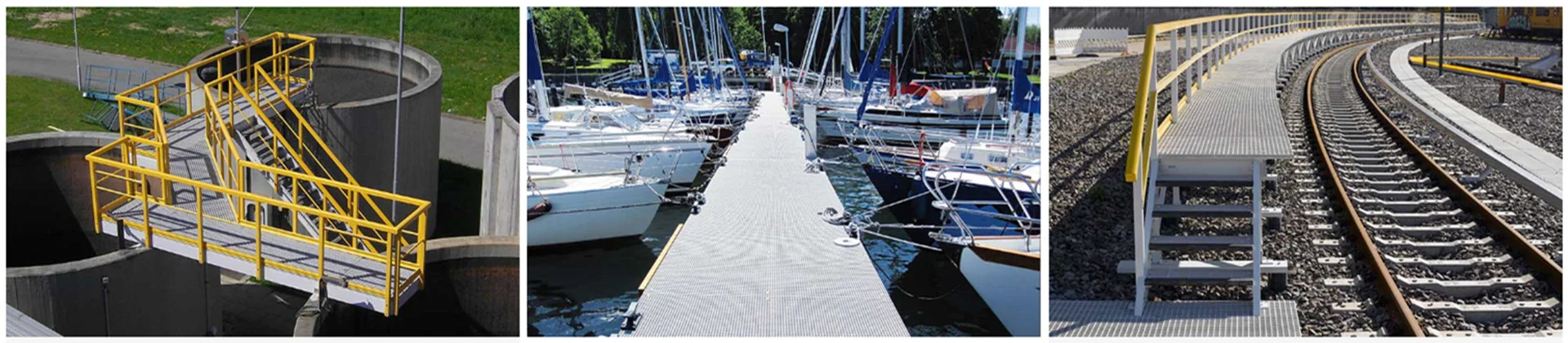
FRP pultruded structural profiles in cooling tower frames, chemical plant walkways, and cable support systems eliminate the recoating maintenance cycle that steel structure in hot water contact zones and chemical vapor environments requires every 5–10 years. FRP grating on cooling tower fan decks, chemical plant walkways, and wastewater treatment platforms provides FR-rated, non-conductive, anti-slip maintenance access without the galvanic corrosion that accelerates steel grating degradation in these environments.
FRP cable protection pipe provides non-conductive, 130°C-rated underground conduit for power and telecommunications cable in direct burial applications without concrete encasement — the specification required for single-core high-voltage cable laying where steel conduit creates eddy current losses and electrolytic corrosion at coating breach sites.
Power Utility and Electrical Infrastructure
FRP cable brackets and cable trays in electrical substations and transmission line infrastructure eliminate the induced current hazard and eddy current heating that steel structural members create in proximity to live high-voltage equipment. FRP equipment enclosures for switchgear, telecommunications, and outdoor control equipment provide corrosion-free, non-conductive shelter without the recoating lifecycle that steel enclosures require in coastal and industrial atmospheric environments.
Unicomposite Technology Co., Ltd. — an ISO 9001-certified FRP manufacturer operating an 18,000 m² production facility in Nanjing — supplies pultruded FRP structural profiles, GFRP rebar, grating, cable protection pipe, cable brackets, sheet piles, and enclosure systems across polyester, vinyl ester, and epoxy resin systems for B2B customers in North American and international infrastructure, utility, and industrial markets. Standard configurations ship within 4–6 weeks from order confirmation, based on standard production scheduling — confirmed timing is provided at inquiry. Standard and custom configurations are available with structural section data, chemical resistance records, and application-specific certification documentation.
Agricultural and Marine Applications
FRP greenhouse support structures in high-humidity agricultural environments provide UV-stable, moisture-immune framing without the rust and rot that limit steel and wood service life in covered growing environments. FRP aquaculture and marine platform structure in coastal and offshore environments eliminates the coating maintenance program that represents the highest recurring cost in marine infrastructure asset management — providing maintenance-free service in the most corrosive environment GRP occupies in any application category.
Resin System Selection: The Specification Decision That Determines Service Life
Material composition, manufacturing process, and product geometry all matter — but resin system selection is the single procurement decision that most determines whether a GRP product achieves its rated service life or fails prematurely due to resin-environment mismatch.
Polyester, Vinyl Ester, and Epoxy: Selecting by Exposure Environment
Isophthalic polyester resin covers standard outdoor atmospheric service, general freshwater and low-salinity environments, and water treatment applications within standard chlorine and biocide concentration ranges. It provides 30+ year service life in these conditions with proper UV stabilization at the lowest resin system cost.
Vinyl ester resin extends chemical resistance to marine salt water, coastal salt spray, chemical plant acid and alkali exposure at elevated concentrations, and high-chlorine water treatment where polyester resin’s resistance ceiling is exceeded. The cost premium over polyester resin is recovered within the first avoided replacement cycle in aggressive chemical and marine service — where polyester GRP replacement within 5–7 years represents a total cost significantly exceeding the vinyl ester premium at initial procurement.
Epoxy resin provides the highest overall chemical resistance, the lowest moisture absorption, and the alkaline resistance required for GFRP rebar in concrete pore solution. It is specified for food-grade and pharmaceutical liquid contact, for the most aggressive chemical service, and wherever the structural design requires the ACI 440.1R CE environmental reduction factor for GFRP bar in concrete — CE = 0.70 for GFRP bars in concrete exposed to earth and weather, CE = 0.75 for GFRP bars in concrete not exposed to earth and weather. Confirm the applicable CE category with the structural engineer for the specific project exposure classification before procurement is finalized.
Resin Selection as a Structural Design Input, Not a Cost Option
In structural applications governed by ACI 440.1R, the CE factor applied to the design tensile strength determines the structural adequacy of the finished section. The resin system determines whether the bar achieves the long-term durability that these CE values assume — specifying polyester resin for a bar in a marine concrete environment where the CE factor assumes 75-year structural adequacy produces a design that satisfies the calculation but fails the durability assumption behind it.
Procurement programs that specify GRP resin type by cost rather than exposure environment consistently generate premature failures attributed to material inadequacy — when the actual cause is a specification error in the resin selection step that occurred before the structural design was completed. The resin system must match the exposure environment, and the specification must confirm this match before the structural engineer finalizes the design tensile strength. This is a structural durability decision that belongs in the specification before design — not a procurement cost optimization after design is complete.
Conclusion
Glass fiber reinforced plastic earns its specification across infrastructure, industrial, utility, and marine applications through four material properties that address the fundamental failure modes of conventional structural materials:
- Fiber volume fraction and manufacturing process determine mechanical performance — not product label alone: Pultruded GFRP at 50–65% fiber volume fraction achieves 400–1,000+ MPa tensile strength; molded FRP at 20–35% random fiber runs 100–250 MPa. Products sharing the FRP label but produced by different processes require completely different structural design approaches — process confirmation and certified test records against minimum property specifications are the procurement discipline that ensures structural design assumptions are met.
- Resin system selection determines whether GRP achieves its rated service life: Vinyl ester is required where polyester’s chemical resistance ceiling is exceeded — in marine, coastal, chemical plant, and high-chlorine water treatment environments. Specifying GRP to eliminate corrosion failure modes produces a permanent result only when the resin system matches the exposure environment — a structural durability decision that belongs in the specification before design, not a cost optimization after.
- Specifying GRP to eliminate corrosion and conductivity failure modes produces a result that is permanent across the full structural service life: Unlike coated steel or surface-insulated metal, where the failure mode is deferred rather than eliminated and maintenance programs must be funded to keep the surface treatment effective, GRP’s corrosion immunity and non-conductivity derive from the glass fiber and thermosetting resin matrix — properties that cannot degrade with surface wear, coating breach, or service age.
- Lifecycle cost comparison must include avoided maintenance — not just unit material cost: Documented field records confirm GRP service lives at 18–22 year inspection intervals without maintenance cost — while equivalent steel in the same environments required partial rehabilitation within 15 years. The lifecycle cost crossover point — where GRP’s initial premium is recovered by avoided maintenance — typically falls within 15–25 years in high-chloride and chemical exposure environments.
[Contact Unicomposite — ISO 9001-certified GRP manufacturer with pultrusion, SMC/BMC, and custom fabrication capability across polyester, vinyl ester, and epoxy resin systems — with your application environment, product type, required design standard, and quantity to receive a glass fiber reinforced plastic product specification and supply proposal →]
Frequently Asked Questions
For concrete reinforcing bar, use GFRP — it distinguishes glass fiber bars from carbon fiber (CFRP) alternatives and aligns with ACI 440.1R and ASTM D7957. For pultruded structural profiles, pipe, and grating, FRP or GRP are both acceptable, but the resin system (polyester, vinyl ester, or epoxy) must be specified explicitly in all cases. Specifying by label alone without resin system and minimum property requirements creates specification gaps that suppliers can fill with products sharing the label but not the performance.
Vinyl ester resin is the standard specification for marine, tidal zone, and coastal salt spray environments — it provides the chemical resistance to salt water hydrolysis and biological acid from fouling organisms that isophthalic polyester cannot match over a 30+ year design life in these exposures. Polyester covers standard outdoor atmospheric and freshwater service. Epoxy provides the highest chemical resistance for the most aggressive exposures and food-grade applications. Provide the site salinity, distance from coastline, and any chemical exposure at inquiry to confirm the appropriate resin system.
Request supplier test records per ASTM D7957 (for GFRP rebar) or equivalent product standards confirming guaranteed minimum tensile strength, elastic modulus, and fiber volume fraction for the specific product supplied. Manufacturer catalog values may be based on mean test results rather than guaranteed minimums — and ACI 440.1R structural design uses guaranteed minimums. Specify minimum property values in the procurement document and require certified test records from the production batch before structural design calculations are finalized.
ACI 440.1R (Guide for the Design and Construction of Structural Concrete Reinforced with FRP Bars) is the primary North American design standard for GFRP rebar concrete structures. It requires a fundamentally different design methodology from ACI 318 steel rebar design — with environmental reduction factor (CE) applied to design tensile strength, modified development and splice length calculations, and deflection-governed section design rather than strength-governed. ASTM D7957 defines the minimum property requirements for GFRP rebar procurement compliance. CSA S807 covers Canadian projects.
Available documentation includes tensile strength and elastic modulus test records per ASTM D7957 or equivalent standards, chemical resistance records for the specified resin system and exposure environment, fire retardancy certification per ASTM E84 or equivalent for grating and structural profiles, UV weathering performance records, and ISO 9001 manufacturing certification covering the full production process. Specify required certification standards at inquiry to confirm documentation availability before order placement — and confirm the CE exposure category with the structural engineer before finalizing GFRP rebar procurement.


