 info@unicomposite.com


Introduction
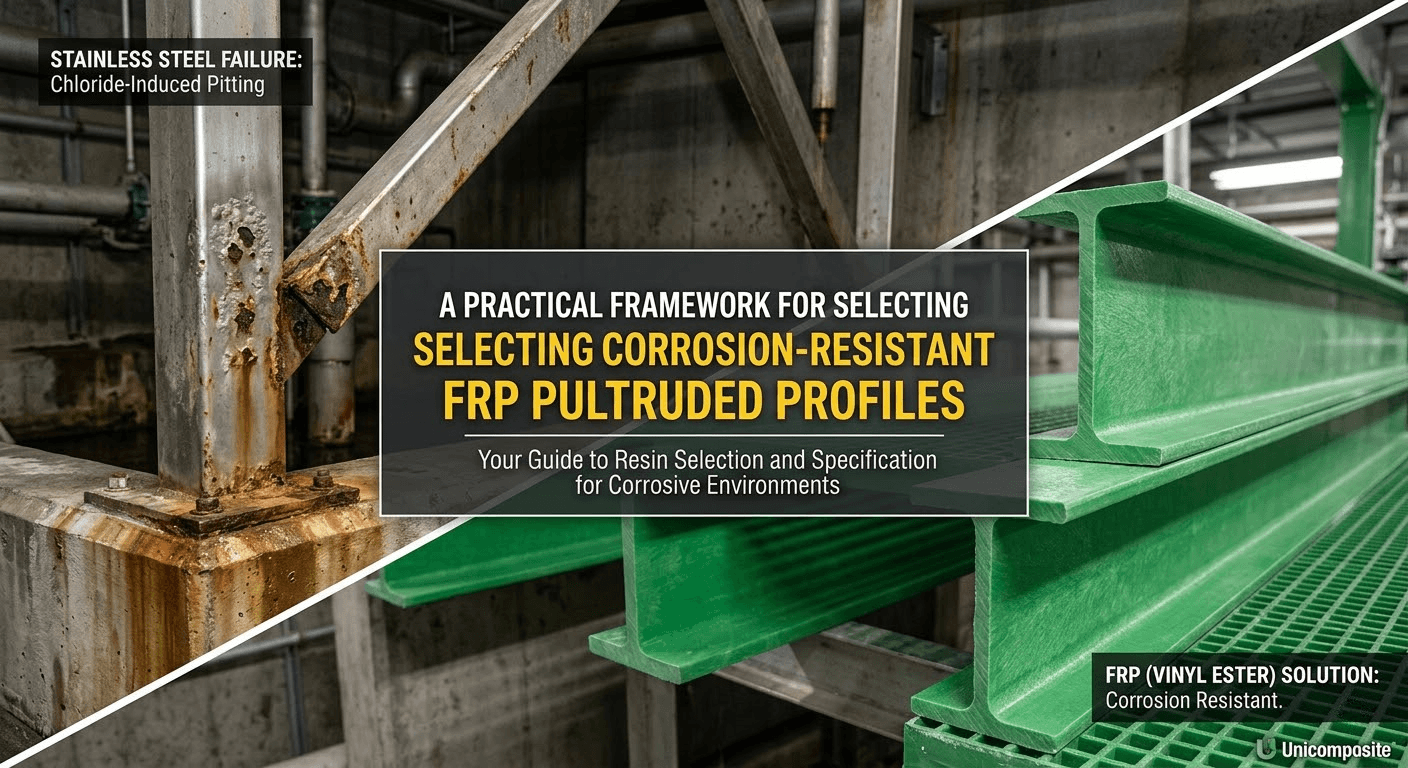
Three years after commissioning a new wastewater treatment facility, a procurement manager receives an unexpected maintenance report: the 316 stainless steel structural supports in the chlorination zone have developed pitting corrosion. Replacement cost — including labor, downtime, and re-specification — exceeds $180,000. The root cause? Chloride-induced stress corrosion cracking, one of stainless steel’s most well-documented failure modes, and one that the original material selection process failed to account for.
This guide gives engineers and procurement managers a practical, resin-by-resin framework for selecting fiberglass (FRP) pultruded profiles in corrosive environments. You will find a resin performance matrix, a chemical compatibility reference, a direct material comparison against steel and aluminum, and a four-step specification process you can apply immediately to your next project.
Unicomposite Technology Co., Ltd is an ISO 9001-certified FRP manufacturer based in Nanjing, China, supplying pultruded profiles across chemical processing, power utilities, wastewater infrastructure, and offshore applications for global customers. The technical guidance in this article draws on real-world deployment patterns across these environments — including recurring specification conversations with utility engineers and industrial procurement teams in North America and Europe.
frp pultruded profiles corrosion resistance
1. Why Corrosion Is the Leading Cause of Structural Failure in Industrial Facilities
1.1 The True Cost of Corrosion in Industrial Infrastructure
Corrosion costs global industry an estimated 3–4% of GDP annually — a figure consistently referenced in NACE/AMPP research and widely used as a baseline for life-cycle cost modeling. For heavy industrial facilities, the direct costs of replacement and repair represent only part of the picture. Unplanned downtime, regulatory penalties, and safety incidents tied to structural failure compound the financial exposure considerably.
What makes corrosion particularly damaging in chemical and process environments is not uniform surface rusting — that is predictable and manageable. The real risk comes from localized attack: pitting on stainless steel in chloride environments, galvanic corrosion at dissimilar metal joints, and crevice corrosion in bolted assemblies exposed to acidic condensate. These failure modes are difficult to detect visually until structural integrity is already compromised.
A simplified 20-year life-cycle model comparing coated carbon steel against FRP illustrates the economic case clearly. Assuming 5-year recoating cycles, ongoing cathodic protection, and structural replacement at year 15 for carbon steel versus near-zero maintenance and a 25+ year service life for FRP, the total cost of ownership advantage for FRP in a moderately corrosive environment consistently falls in the 30–50% range. The exact figure depends on labor rates, chemical environment severity, and profile geometry — but the directional conclusion holds across most industrial scenarios. The upfront premium on FRP typically recovers within 5–7 years through eliminated maintenance alone.
1.2 How FRP Pultruded Profiles Resist Corrosion at a Molecular Level
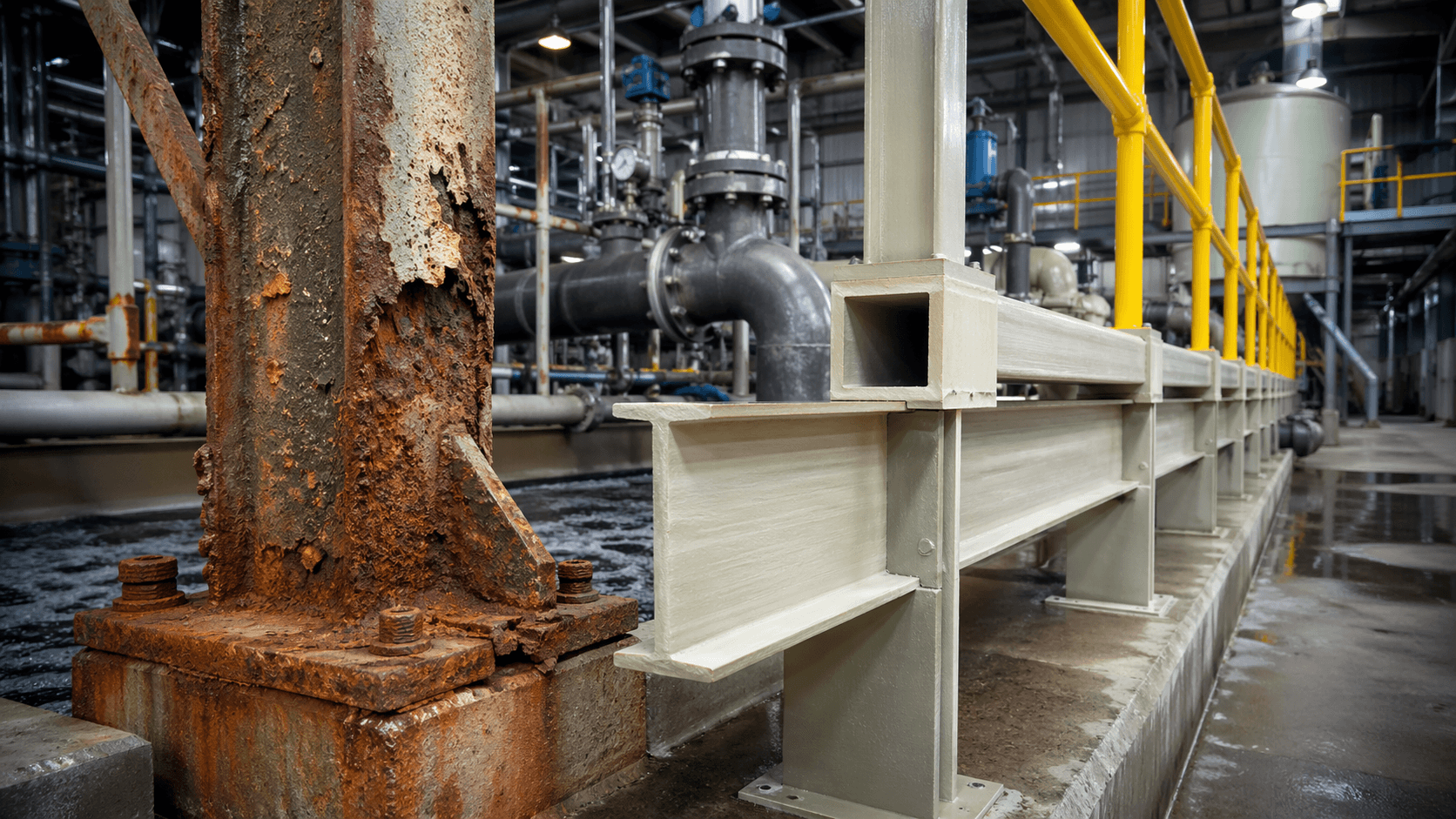
FRP resists corrosion through a mechanism fundamentally different from coated or alloyed metals. As a non-conductive material, FRP cannot participate in electrochemical corrosion reactions. It does not release ions into electrolyte solutions, does not develop galvanic potential differences, and does not undergo the oxidation-reduction cycles that destroy metallic structures over time.
The corrosion resistance of a pultruded FRP profile operates on two levels. The outer resin-rich surface veil — typically a C-glass or synthetic fiber mat bonded to the profile surface — acts as the primary chemical barrier, absorbing and deflecting aggressive media before they reach the structural core. Beneath it, the fiber-resin bulk matrix provides the structural load-bearing function, with the resin binder sealing glass fiber bundles against moisture ingress.
One point engineers frequently underestimate: corrosion resistance in FRP is driven almost entirely by the resin matrix, not the glass fiber. Glass fiber has limited intrinsic resistance to prolonged acid or strong alkali exposure — in direct contact with aggressive media, fiber degradation accelerates. The resin system determines how effectively the fiber is protected, which is why resin selection is the single most important specification decision you will make.
2. Resin Selection: The Core Variable in FRP Corrosion Performance
Choosing a pultruded FRP profile without specifying the resin system is equivalent to specifying “stainless steel” without identifying the grade. The structural form may be identical, but the chemical performance varies dramatically. The five resin systems below cover the full range of industrial corrosion environments.
2.1 Orthophthalic Polyester — General-Purpose Baseline
Orthophthalic polyester is the entry-level resin for FRP pultrusion. It processes easily, costs less than higher-performance alternatives, and provides adequate resistance to atmospheric exposure, freshwater, and mild chemical contact.
Its limitations become apparent in sustained liquid immersion, elevated temperatures above 60°C, or exposure to acids and chlorinated media. Hydrolytic stability is relatively poor — water molecules gradually penetrate the ester linkages and degrade the resin matrix over time. For indoor structural applications with no direct chemical contact, orthophthalic polyester is a practical choice. For anything involving sustained chemical exposure, specify upward.
2.2 Isophthalic Polyester — Improved Moisture and Mild Acid Resistance
Isophthalic polyester offers meaningfully better hydrolytic stability than its orthophthalic counterpart. The isophthalic acid molecular structure reduces water absorption and extends service life in wet or mildly acidic environments.
Engineers commonly specify isophthalic polyester for municipal wastewater infrastructure, outdoor structural platforms, and light chemical processing environments where pH stays above 4 and temperatures remain below 80°C. It is not suitable for concentrated acids, chlorine service, or oxidizing environments. Think of it as the correct step up from a general-purpose resin when moisture resistance matters but aggressive chemistry does not.
2.3 Vinyl Ester — High-Performance Acid and Chlorine Environments
Vinyl ester is the workhorse resin for demanding corrosive environments. Its chemical resistance derives from an epoxy backbone — providing the toughness and hydrolytic stability of an epoxy resin — combined with vinyl ester end groups that enable processing through standard thermoset pultrusion systems. Longitudinal tensile strength of vinyl ester pultruded profiles typically falls in the 200–300 MPa range per ASTM D638, comparable to structural steel on a weight-adjusted basis.
The practical result is superior resistance to hydrolysis and oxidative chemical attack. Vinyl ester profiles perform reliably in hydrochloric acid (HCl), chlorine gas (Cl₂), sodium hypochlorite (NaOCl), dilute sulfuric acid (H₂SO₄), carbon dioxide environments, and a broad range of organic solvents. These are precisely the media where 316 stainless steel is most vulnerable to pitting and stress corrosion cracking.
Chemical plants, bleaching lines in pulp and paper mills, desalination pre-treatment systems, and chlorination infrastructure in water treatment facilities represent the core deployment environments for vinyl ester FRP profiles. In field installations supplied to water treatment facilities in North America, engineers have consistently specified vinyl ester profiles for chlorination channels specifically because 316 stainless steel had failed in that same position within 3–5 years on prior projects — a pattern Unicomposite’s project teams encounter regularly in utility procurement conversations. If your environment involves chlorinated media or reducing acids, vinyl ester is the correct resin specification.
2.4 Epoxy Resin — Structural Integrity with Chemical Resistance
Epoxy resins offer the strongest adhesion to glass fiber of any standard pultrusion resin, producing profiles with superior mechanical properties and excellent dimensional stability. Their chemical resistance profile differs from vinyl ester: epoxy performs well against alkalis, many organic solvents, and moderate acid exposure, but is generally less suitable than vinyl ester for strong oxidizing acids or chlorine service.
Epoxy pultruded profiles are the preferred choice where structural performance and chemical resistance must coexist at high levels — offshore platform walkways, electrical infrastructure in corrosive substations, and industrial ladder systems in alkaline processing environments. Unicomposite’s pultrusion lines produce epoxy-based profiles across standard structural shapes including I-beams, channels, angles, and square tubes. In practice, epoxy specifications dominate electrical infrastructure and offshore platform orders — a pattern that directly reflects the resin-environment matching framework in this guide.
2.5 Furan Resin — Extreme Chemical Resistance at High Temperature
Furan resin occupies a narrow but critical niche: environments where concentrated acids, solvents, and sustained elevated temperatures exceed vinyl ester’s capability. Furan-based FRP profiles resist concentrated sulfuric acid, concentrated hydrochloric acid, and many organic solvents at temperatures up to 150°C depending on formulation and load conditions — confirm the specific heat deflection temperature (HDT) against the manufacturer’s published data before specifying.
The trade-off is processing complexity and brittleness relative to polyester or epoxy systems. Furan resin profiles are harder to manufacture to tight dimensional tolerances and carry a higher unit cost. Reserve furan resin for environments genuinely beyond vinyl ester’s capability — it is not a universal performance upgrade.
The table below summarizes key performance characteristics across all five resin systems to support direct comparison during specification:
| Resin Type | Acid Resistance | Alkali Resistance | Solvent Resistance | Max Service Temp | Typical Application |
|---|---|---|---|---|---|
| Orthophthalic Polyester | Limited | Moderate | Poor | ~60°C | Indoor structures, low chemical exposure |
| Isophthalic Polyester | Moderate | Moderate | Poor | ~80°C | Wastewater, outdoor platforms, mild acid |
| Vinyl Ester | Excellent | Good | Good | ~100°C | Chemical plants, chlorination, desalination |
| Epoxy | Good | Excellent | Good | ~120°C | Offshore, electrical, alkaline environments |
| Furan | Excellent | Good | Excellent | Up to 150°C (verify HDT) | Concentrated acids, high-temp solvent service |
Understanding which resin fits your chemical environment is the necessary first step. The next step is matching that resin to the specific media your profiles will contact — which is where a compatibility reference becomes the working tool.
3. Chemical Compatibility Reference for FRP Structural Profiles
A resin performance matrix tells you what each system does well in general terms. A chemical compatibility table lets you match a specific medium at your site to the recommended resin — the decision you actually need to make.
| Chemical Medium | Recommended Resin | Suitability | Notes |
|---|---|---|---|
| Hydrochloric acid (HCl, dilute–moderate) | Vinyl Ester | Excellent | Significantly outperforms 316 stainless steel in this medium |
| Sulfuric acid (H₂SO₄, dilute <30%) | Vinyl Ester | Excellent | Reduce to “Good” above 60°C; avoid at high concentration |
| Sodium hypochlorite (NaOCl) | Vinyl Ester | Excellent | Critical specification for water treatment chlorination infrastructure |
| Chlorine gas (Cl₂, wet) | Vinyl Ester | Good | Confirm with ASTM C581 immersion test data for sustained exposure |
| Sodium hydroxide (NaOH, <30%) | Epoxy | Excellent | Epoxy preferred over vinyl ester in strong alkali service |
| Seawater / saline environments | Isophthalic or Vinyl Ester | Excellent | Iso-poly adequate for splash zone; vinyl ester for full immersion |
| Carbon dioxide / carbonic acid | Vinyl Ester | Good | Common in CO₂-scrubbing and carbonation systems |
| Organic solvents (general) | Epoxy or Furan | Good–Excellent | Furan required for concentrated solvent service above 80°C |
| Atmospheric / UV exposure | Isophthalic Polyester | Good | Specify UV-stable surface veil for extended outdoor service life |
Two variables consistently underestimated during specification: concentration and temperature. A resin rated “Excellent” against dilute sulfuric acid at 25°C may perform only “Good” at 60°C or “Limited” at higher concentration. Published compatibility ratings assume ambient conditions (20–25°C) and moderate concentrations unless explicitly stated. Always validate against your actual operating parameters before finalizing.
Combined exposure adds further complexity. Simultaneous heat, mechanical stress, and aggressive chemistry degrades FRP faster than any single factor alone. In a hot acid environment with vibration loading — common in chemical pump bases or agitated tank supports — specify conservatively and request immersion test data from the supplier.
Use this table as an initial screening tool, not a final specification. Request the supplier’s published ASTM C581 or ISO 175 immersion test data for your specific medium before placing an order.
frp pultruded profiles
4. FRP vs. Competing Materials in Corrosive Structural Applications
Beyond understanding FRP’s internal chemistry, procurement managers need a clear picture of how it performs against the materials they are currently using. The comparison below focuses on the environments where the differences matter most.
4.1 FRP vs. Carbon Steel
Carbon steel delivers high strength at low initial cost. In a dry, non-corrosive environment, it remains a rational structural choice. In any environment involving moisture, chemical exposure, or saline atmosphere, its corrosion performance depends entirely on coating systems and cathodic protection — both of which require continuous maintenance investment.
FRP eliminates the maintenance cycle entirely. No painting schedule, no anode replacement, no coating inspection program. The 20-year life-cycle cost modeling described in Section 1.1 consistently favors FRP by 30–50% in moderately corrosive environments — a gap that widens as labor costs and regulatory compliance requirements increase.
4.2 FRP vs. Stainless Steel
Stainless steel’s corrosion resistance is well understood and reliable within its specified operating envelope. That envelope excludes chloride-rich environments, reducing acids, and conditions that trigger pitting or stress corrosion cracking. These are not edge cases — they describe the majority of chemical process and water treatment environments.
Vinyl ester FRP profiles outperform 316 stainless steel directly in HCl service, NaOCl service, and wet chlorine environments. Beyond chemistry, FRP carries a weight advantage of approximately 75% at equivalent cross-section, reducing structural load on supporting systems and simplifying installation without lifting equipment. For projects where both material cost and installation cost matter, the combination of superior chemical resistance and lower installed weight makes vinyl ester FRP a compelling alternative to stainless steel in these specific environments.
4.3 FRP vs. Aluminum
Aluminum performs adequately in neutral and mildly acidic environments but degrades rapidly in strong alkalis and many acid media. Its susceptibility to galvanic corrosion in mixed-metal assemblies — a common condition in maintenance-repaired or retrofit infrastructure — creates an additional failure risk that requires careful fastener and isolation specification.
FRP is electrically inert and generates no galvanic potential regardless of adjacent materials. This makes FRP pultruded profiles the correct choice for mixed-material assemblies, grounding-sensitive electrical infrastructure, and any environment where galvanic isolation is a design requirement.
The table below provides a side-by-side comparison across the properties most relevant to corrosive structural applications:
| Property | FRP (Vinyl Ester) | Carbon Steel | 316 Stainless Steel | Aluminum (6061) |
|---|---|---|---|---|
| Corrosion resistance (chemical) | Excellent | Poor (uncoated) | Good (limited in Cl⁻) | Moderate |
| Density (kg/m³) | ~1,800 | ~7,850 | ~8,000 | ~2,700 |
| Electrical conductivity | None (insulator) | High | High | High |
| Maintenance requirement | Minimal | High | Moderate | Low–Moderate |
| Approx. service life (corrosive env.) | 25–30+ years | 5–10 years (coated) | 10–20 years (env. dependent) | 10–15 years |
| Relative installed cost (index) | 1.2–1.5× | 1.0× | 2.5–4.0× | 1.5–2.0× |
Cost index anchored to standard carbon steel structural angle at mid-2024 market pricing, ex-works. Regional variation ±20% depending on supply chain and fabrication requirements.
With the material comparison established, the practical question becomes: how do you translate this framework into a procurement-ready specification?
5. How to Specify a Corrosion-Resistant FRP Pultruded Profile
5.1 Four-Step Specification Framework
Resin selection alone does not constitute a complete FRP specification. Follow this four-step process to arrive at a document that procurement, engineering, and your supplier can all execute against.
Step 1 — Define the chemical environment precisely. Identify the specific chemical medium or media, concentration range, operating temperature, and whether exposure is intermittent (splash) or continuous (immersion). Vague descriptions like “corrosive atmosphere” are not actionable. Output: a written chemical exposure summary — medium, concentration, pH range, temperature, and exposure mode — to share with the supplier at the outset.
Step 2 — Match resin system to the compatibility reference. Use the table in Section 3 as a first filter, then request supplier immersion test data (ASTM C581 or ISO 175) for your specific medium. Where combined chemical and thermal exposure applies, specify against the worst-case condition. Output: a confirmed resin system specification with supporting test data reference.
Step 3 — Specify the surface veil type. The resin-rich surface veil is the profile’s first line of chemical defense. For acid and chlorine service, specify a C-glass or synthetic (ECR or polyester) veil with a minimum 0.25 mm resin-rich surface layer. A profile with the correct bulk resin but a poorly specified or inadequately bonded veil will degrade from the surface inward faster than the bulk chemistry alone would suggest. Output: a veil material and minimum thickness requirement added to the purchase specification.
Step 4 — Confirm structural requirements and request documentation. Provide load, span, and connection requirements to the manufacturer. Request test certificates, QC records, and third-party material validation relevant to your environment. Unicomposite maintains documented QC procedures across resin batching, fiber wet-out consistency, and finished profile dimensional inspection as part of its ISO 9001 system — the same controls that directly determine the realized corrosion resistance of the profile delivered to site. Ask to see the relevant records before committing to a volume order. Output: a supplier qualification checklist including resin batch records, immersion test certificates, and dimensional inspection reports.
5.2 Standards and Testing References
No single universal standard governs FRP corrosion resistance across all applications. Reference the following as appropriate:
- ASTM C581: Standard practice for determining chemical resistance of thermosetting resins using a square panel immersion method — the most commonly requested test for chemical immersion service.
- ASTM D543: Resistance of plastics to chemical reagents — evaluates changes in tensile properties, mass, and dimensions after chemical exposure.
- ISO 175: Plastics determination of the effects of immersion in liquid chemicals — the ISO equivalent of ASTM D543, commonly required for European and international project specifications.
Request that suppliers identify which standard applies to any test data they provide, and verify that test conditions — concentration, temperature, and duration — match your actual service environment.
5.3 Common Specification Mistakes to Avoid
In field practice, three specification errors account for the majority of premature FRP failures in chemical environments.
First, selecting resin by category name without verifying formulation. “Vinyl ester” covers a wide range of commercial formulations with meaningfully different performance characteristics. Request the specific resin supplier and commercial grade, and cross-reference against published chemical resistance data for that exact product.
Second, omitting the surface veil specification. Engineers focused on bulk resin selection frequently leave veil requirements out of their purchase documents entirely. The veil is not a cosmetic feature — it is a functional chemical barrier. In sustained acid or chlorine service, a profile without a properly specified veil can fail at the surface within 2–5 years regardless of bulk resin quality.
Third, assuming equivalent quality across suppliers at the same resin specification. Fiber wet-out consistency, resin-to-glass ratio control, and curing profile directly affect the realized corrosion resistance of the finished profile. Process controls matter as much as material selection — supplier qualification belongs in your procurement process, not just material specification.
Conclusion
FRP pultruded profiles offer a fundamentally different approach to corrosion management in industrial infrastructure — one that eliminates the maintenance cycle rather than managing it. Five takeaways for specifiers:
- Resin selection is the primary lever. Vinyl ester for acid and chlorine environments, epoxy for alkali and structural-priority applications, furan for extreme chemical and high-temperature service. Do not default to the lowest-cost resin without evaluating your specific chemical exposure.
- FRP outperforms stainless steel and carbon steel in defined, high-value environments. Chlorinated media, reducing acids, and saline immersion are exactly where stainless steel fails and FRP excels — and where the life-cycle cost case is strongest.
- Specify the surface veil explicitly. The bulk resin and the veil system work as a system. One without the other leaves a specification gap that field performance will eventually expose.
- Validate against actual site conditions. Published compatibility tables assume ambient temperature and moderate concentration. Always request immersion test data relevant to your specific operating parameters.
- Supplier process quality is part of the specification. ISO 9001 certification, documented resin batching, and fiber wet-out controls are not administrative formalities — they directly determine the corrosion resistance of the profile you receive on site.
As industrial facilities face longer expected asset lifetimes, tighter environmental compliance requirements, and rising maintenance labor costs, the total cost of ownership case for FRP continues to strengthen relative to coated metals and stainless alloys.
[Contact Unicomposite to specify a corrosion-resistant FRP pultruded profile for your project →]
Frequently Asked Questions
At minimum, request ISO 9001 certification covering the pultrusion process, resin batch records for the specific order, and immersion test data (ASTM C581 or ISO 175) for the resin system against your target chemical medium. For projects with formal engineering sign-off requirements, third-party mechanical test reports per ASTM D638 (tensile) and ASTM D790 (flexural) provide additional specification assurance.
Yes. Pultrusion tooling can be manufactured to virtually any constant cross-section — I-beams, channels, angles, tubes, solid rods, and fully custom profiles are all achievable. Lead time for custom tooling typically runs 4–8 weeks depending on profile complexity; standard profiles ship from existing tooling on shorter lead times. Provide your load requirements and dimensional constraints at the outset to allow the manufacturer to optimize wall thickness and fiber architecture.
The combination of heat and chemical exposure accelerates degradation faster than either factor alone. Vinyl ester profiles maintain adequate mechanical properties up to approximately 100°C in most chemical environments; epoxy extends that range to around 120°C. For sustained service above these thresholds in aggressive media, furan resin is the appropriate specification — confirm the specific heat deflection temperature against the manufacturer’s published data for your resin grade.
The standard corrosion-resistant finish is a resin-rich surface veil — C-glass or synthetic fiber mat — applied during pultrusion to create a smooth, fiber-free outer surface that resists chemical penetration. Grit surfaces for anti-slip applications, UV-stable pigmented surfaces for outdoor exposure, and additional topcoat systems for extreme UV or abrasion environments are available depending on application requirements.
Standard profiles in isophthalic polyester and vinyl ester resin systems are generally available from stock or on short production runs of 2–4 weeks. Epoxy and furan resin profiles are produced to order and typically require 4–6 weeks. Custom cross-sections in any resin system require tooling lead time in addition to production — factor 8–12 weeks for first-article delivery on a new custom profile.


