 info@unicomposite.com


Introduction
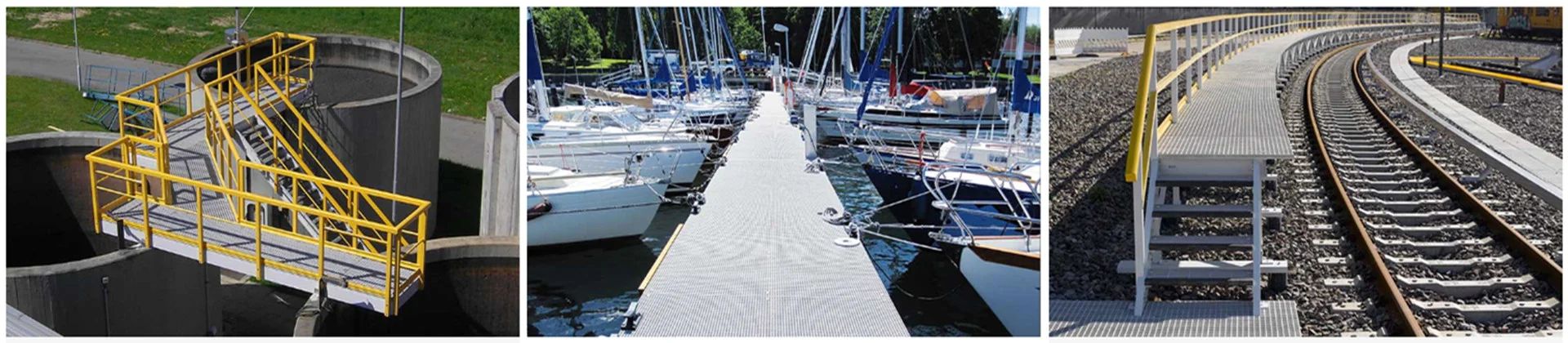
When a gangway is wet from spray, deck washdowns, or rain, the walking surface stops being “just a platform” and becomes a safety system. That’s where square mesh use in marine gangways earns its reputation: an open grid that drains fast, maintains traction more predictably than flat plate, and can be specified for long service life in salt and chemical exposure.
This guide is for B2B buyers, marine contractors, OEMs, and maintenance teams who purchase in bulk and need clear selection logic (Who/How/Why), not vague brochure claims. The guidance combines field-driven priorities (slip hotspots, edge-trip issues, cleaning reality) with engineering and manufacturing constraints (span, deflection, fastening, tolerances).
Where composites fit the service environment, you’ll see notes grounded in manufacturing practice: Unicomposite is an ISO-certificated pultrusion manufacturer with in-house production of FRP (fiberglass-reinforced plastic) profiles and custom composite parts for harsh-service sectors including marine, aquaculture, wastewater treatment, cooling towers, and more—supporting both standard pultruded profiles and custom fabrication.

square mesh use in marine gangways
Square Mesh Use in Marine Gangways: What It Is and Where It Fits
What “square mesh” means in gangway platforms
In gangway specs, “square mesh” usually means a square-pattern open walking surface—either welded metal mesh panels or square-pattern FRP grating—chosen to balance:
- Open area (drainage and debris pass-through)
- Foot contact (traction and comfort)
- Structural performance (load capacity and deflection at span)
Buyers sometimes bundle “square mesh” together with other open surfaces (expanded metal, bar grating, perforated plate). The critical difference is the opening geometry and edge behavior—which affects heel safety, tool drops, and how fast surfaces foul.
Typical gangway zones that use square mesh
Square-pattern open surfaces are commonly used in:
- Main walking panels (highest need for drainage + traction)
- Stair treads and intermediate landings
- Dock-to-gangway transition zones (where puddling and slime build-up concentrate)
- Retrofit sections (swapping corroded panels without replacing the whole structure)
If you’re dealing with shore-access gangways carried on ships, a relevant reference point is ISO 7061, which specifies requirements for aluminium shore gangways used for ship-to-shore access (and limited ship-to-ship access under favorable conditions).
Why Square Mesh Use in Marine Gangways Is Popular
Drainage, slip resistance, and fouling control
Open mesh wins in marine environments because it doesn’t “hold” water. The fastest path to fewer slips is usually less standing water + less slime film, and open area helps both.
One practical insight from walkthroughs: slip incidents cluster where water re-accumulates—right after landings, near hose-down zones, and at transition plates. When we’ve audited similar setups, the first visible warning sign is often not “rust” but polished high-traffic lanes where grit or serrations have worn smooth, while low-traffic corners stay textured.
Traction is still a design choice, not a given. Common approaches include:
- Serrated contact edges (often with metal grating/mesh)
- Gritted or textured surfaces (common with FRP grating)
- Heel-safe / mini-mesh patterns where small heels, cane tips, or small tools are a concern
Housekeeping matters as much as surface type. OSHA’s walking-working surface requirements emphasize maintaining surfaces clean and orderly, keeping floors “to the extent feasible” dry, and maintaining drainage where wet processes exist.
Visibility and safety compliance considerations
Open mesh can improve visibility and hazard awareness (you can see obstructions below), but it introduces design risks:
- Heel entrapment if openings are too large
- Dropped objects (tools, fasteners) falling through
- Edge trip hazards when panel seams aren’t flush or edge banding is inconsistent
A buyer-grade takeaway: most “mystery trips” are edge, seam, and transition problems, not mid-panel problems.
Material Choices for Square Mesh in Marine Gangways
Metal square mesh (steel/aluminum): pros, cons, and coatings
Metal mesh is attractive when you want familiar fabrication, high stiffness, and easy welding integration. The trade-offs show up in:
- Corrosion and coating maintenance in salt spray zones
- Slip variability as coatings wear and surfaces polish
- Galvanic corrosion risk at mixed-metal joints (structure, clamps, fasteners)
If corrosion has already been a pain point on-site, make “coating system + inspection interval” part of your specification—not a note buried in installation instructions.
FRP square mesh / grating alternatives: when composites win
FRP grating (molded or pultruded) is often chosen where corrosion resistance and uptime dominate. NOV describes FRP grating as lightweight—“typically one-third the weight” of its steel grating equivalent—and notes suitability for marine vessels and offshore platforms.
In practice, the benefit stack is:
- Lower corrosion-driven downtime
- Weight reduction that can simplify handling and reduce load on hinges/supports
- Dielectric properties (useful around electrical infrastructure)
- Consistent traction options (gritted/textured surfaces)
Manufacturing note (where Unicomposite’s experience fits naturally): beyond deck panels, pultruded profiles and custom composite fabrication can support structural members, handrail components, and custom interfaces built to drawings—helpful for OEMs and contractors standardizing gangway designs across multiple sites.
How to Specify Square Mesh for Marine Gangways
Key specification parameters buyers should define
If you want clean, comparable quotes, define these up front:
- Load case + span + deflection expectation
- “Supports the load” isn’t enough—buyers reject panels later because they feel springy.
- Require vendors to provide load/deflection tables at your stated span.
- Opening size and pattern
- Bigger openings drain better, but increase heel/tool-drop risk.
- For dock/marina contexts, some products are explicitly designed around open-area and accessibility considerations;
- Traction method + renewal plan
- Serrations vs grit vs molded texture
- Ask: “How does traction performance change after X years of washdowns and foot traffic?”
- Edge finishing + transitions
- Edge banding, toe plates, kick strips, transition plates
- Specify a maximum allowable step/lip at seams if trips have been an issue.
- Fastening system
- Hardware material, clamp type, redundancy (what happens if one clamp loosens?)
- Removability for inspection access (especially near hinges/rollers/connection points)
Environmental and operational inputs that change the spec
Write these into your RFQ so suppliers can recommend correctly:
- Salt spray intensity, UV exposure, and temperature swings
- Fuel/cleaner/chemical exposure
- Biofouling risk and cleaning frequency
- Traffic type: crew only vs carts/equipment; emergency egress expectations
Installation, Maintenance, and Lifecycle Cost
Installation best practices
Field-proven practices that reduce callbacks:
- Match hardware to environment and isolate dissimilar metals when needed.
- Support spacing should be driven by deflection targets, not just “it fits the frame.”
- Anti-rattle and uplift control with proper clamps and edge restraint.
- Design for inspection: if it’s hard to remove, it won’t get inspected.
OSHA explicitly calls out keeping walking-working surfaces free of hazards such as corrosion, leaks, spills, snow, and ice—useful language for building a maintenance checklist and audit routine.
Maintenance plan and inspection checklist
A simple quarterly/biannual checklist:
- Surface traction: worn grit/serrations, polished lanes, slime build-up
- Fasteners: missing clamps, corrosion, torque loss, loosening patterns near hinges
- Panels: deformation, broken welds (metal), cracks/chips/damage (FRP)
- Edges: lifted banding, seam lips, sharp protrusions
- Drainage paths: blocked scuppers/gutters that re-create puddle zones
Anonymized Field Example: Choosing the Right Square Mesh for a Dock-to-Vessel Gangway
Scenario and constraints
A port operator had repeat slip incidents during washdowns and recurring corrosion at panel edges. Downtime windows were short, and maintenance teams wanted fewer coating touch-ups.
Decision process and outcome
They compared:
- Coated metal mesh (lower first cost, familiar repairs)
- FRP grating with a slip-resistant surface and corrosion-focused material selection
What made the difference:
- The safety team focused on where slips happened: transitions and landings. They tightened edge requirements (banding + seam flushness) and mandated a fastening layout that prevented panel lift at the gangway pivot.
- Maintenance added one rule: “If traction can’t be restored without a shutdown, it won’t be restored.” That pushed selection toward a surface option with a clear renewal path and predictable inspection intervals.
- Handling mattered. The team used published weight guidance (e.g., FRP grating described as typically one-third the weight of steel equivalents) to justify faster panel swaps and less crew strain.
Anonymized quote (role-based):
“Our biggest improvement wasn’t the material alone—it was specifying the edges and clamps like they were part of the walking surface.” — Port maintenance supervisor (anonymized)
Conclusion
Better square mesh use in marine gangways comes from fit-for-service specs, not guessing:
- Balance opening size for drainage and heel/tool safety.
- Match material and traction to real exposure (salt, UV, washdowns, fouling).
- Specify load and deflection so the gangway feels stable underfoot.
- Treat edges, transitions, and fastening as safety-critical design features.
Next step for buyers: build a one-page spec sheet (span, load case, deflection expectation, opening pattern, traction method, edge detail, fastening hardware, inspection access). Request vendor load/deflection tables and material documentation to keep quotes comparable. If composites are in scope, Unicomposite can contribute as a technical manufacturing partner—supporting standard pultruded profiles and custom composite components for harsh-service marine access systems.
Frequently Asked Questions
Pick an opening that drains well but doesn’t create heel or tool-drop problems at transitions. If you’ve had trip incidents, tighten seam and edge requirements first, then adjust opening size where heels or small tools are common.
It depends on span and load case. Require vendors to provide load/deflection tables at your exact support spacing; pultruded FRP designs can carry higher loads with lower deflection than molded options in many cases.
Specify the traction method and an inspection/renewal plan. Many failures come from worn grit or polished metal lanes, plus slime buildup—so cleaning frequency and drainage paths are part of the traction strategy.
State your environment (salt spray, UV, chemicals), load case, span, deflection expectation, opening pattern, edge details, and fastening requirements. Also require documentation (load tables, material certificates) so “equivalent” claims can be verified.
Often, yes. For aluminium shore gangways carried onboard ships for ship-to-shore access, ISO 7061 is a relevant reference point—verify what your client, flag state, port authority, or classification society requires for your specific project.


