 info@unicomposite.com


Yes. Glass fiber-reinforced polymer (GFRP), commonly called fiberglass rebar, can be used as internal reinforcement in concrete when the exact bar, structural design, detailing, exposure conditions, construction procedures, and project approvals all meet the governing requirements. It is not a bar-for-bar substitute for steel.
That distinction matters. A material may be generally suitable for concrete reinforcement while a particular product, member, or project remains outside the applicable standard or code. The engineer of record and the authority having jurisdiction determine whether the proposed reinforcement system is acceptable for the project.

fiberglass rebar for concrete
Fiberglass Rebar Is Not the Same as Glass Fiber-Reinforced Concrete
GFRP rebar consists of continuous glass-fiber reinforcement held in a polymer resin matrix and formed as a bar. The bar is placed in concrete to carry reinforcement forces through bond and anchorage.
Glass fiber-reinforced concrete (GFRC) usually refers to concrete or mortar containing short, dispersed glass fibers. Those fibers and continuous GFRP reinforcing bars are different materials with different structural functions. Chopped fibers in a concrete mix do not replace a designed GFRP reinforcing-bar layout, and a generic fiberglass rod is not automatically a qualified concrete reinforcing bar.
When Is GFRP Rebar a Reasonable Candidate?
GFRP rebar is worth evaluating when the project needs nonmetallic reinforcement or when corrosion of conventional steel is a major durability concern. The Federal Highway Administration identifies low weight and corrosion resistance as advantages of GFRP rebar in new bridge construction, but these advantages are screening reasons—not approval for every bridge component or product.[3]
Common candidate conditions include:
- concrete exposed to chlorides or other environments in which reinforcing-steel corrosion is a major project risk;
- projects that require nonmetallic reinforcement for a defined technical reason;
- sites where reinforcement package weight materially affects transport or handling planning; and
- projects whose design team can use GFRP-specific material properties, detailing rules, submittals, and inspection requirements.
The next step is not to select a bar from a generic application list. It is to match the structural system, adopted code, exposure, and acceptance requirements to a qualified product and a project-specific design.
Why GFRP Cannot Replace Steel One for One
Steel and GFRP are different reinforcement systems. A direct substitution based only on nominal diameter or tensile strength can miss the checks that govern member behavior.
Structural response and serviceability
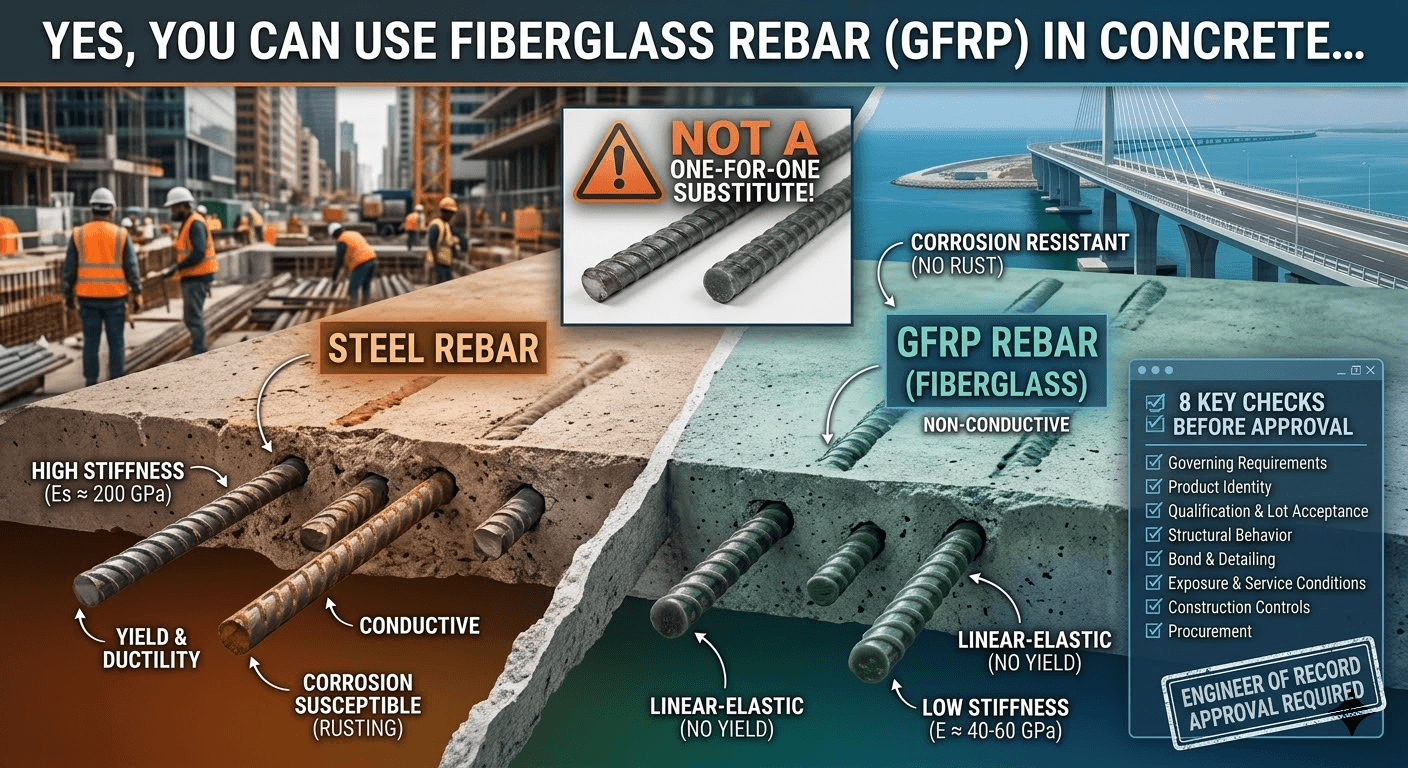
GFRP reinforcement is generally designed as a linear-elastic material without the steel-like yield behavior used in conventional reinforced-concrete design.[4] Its stiffness also differs from steel. As a result, deflection, crack control, reinforcement ratio, member geometry, and failure mode require GFRP-specific calculations. A tensile-strength value alone cannot establish equivalence.
For a deeper comparison of the two reinforcement systems, see Fiberglass (GFRP) Rebar vs Steel Rebar.
Bond, development, splices, and bends
Force must transfer between the concrete and the bar. Bar geometry and surface enhancement therefore affect the applicable qualification data and the detailing used for development and splices. Bent shapes, lap locations, bar spacing, concrete cover, and connections must follow the adopted design requirements and approved construction documents. Field changes cannot be treated as routine steel-rebar adjustments.
Exposure, sustained load, temperature, and fire
Project teams need the specified environmental reductions and product data for the actual exposure and service conditions. Moisture, alkaline exposure, sustained stress, service temperature, and required fire resistance belong in the design and submittal review. “Does not rust like steel” does not mean “unaffected by every environment.”
ACI CODE-440.11-22 covers strength, serviceability, durability, deflection, development, splicing, construction documents, inspection, and testing for structural concrete reinforced with qualifying GFRP bars. Its scope also contains limitations; for example, its table of contents identifies earthquake-resistant structures as not addressed.[1] Projects outside the code’s scope need a separate, documented approval and design route.
Product Specification and Design Code Serve Different Purposes
ASTM D7957/D7957M is a product specification. The current active 2025 edition covers a defined class of solid, round GFRP bars with external surface enhancement, including cut lengths and bent shapes. It addresses qualification, production-lot acceptance, geometry, material properties, mechanical properties, physical properties, and traceability. The standard excludes hybrid bars, smooth bars or dowels, non-round bars, and premanufactured grids and gratings.[2]
ACI CODE-440.11-22 is a structural design code. ACI’s official description states that the code applies to GFRP bars conforming to ASTM D7957-22 and provides minimum requirements for materials, design, and detailing.[1]
This creates a practical version-control check. ASTM lists D7957/D7957M-25 as the current active edition, while the ACI code description references the 2022 edition. The project team must identify the editions adopted by the contract, design documents, local code, and approving authority. A newer standard edition should not be substituted automatically without reviewing the project requirements.
Eight Checks Before Approving Fiberglass Rebar for Concrete
The following framework turns a general suitability question into a documented project decision.
| Decision check | Required input | Verification action | Required output |
|---|---|---|---|
| 1. Governing requirements | Project location, occupancy or asset type, contract specifications, adopted code editions | Confirm applicability with the licensed design professional and approving authority | Written code and approval basis |
| 2. Product identity | Manufacturer, bar designation, fiber and resin system, geometry, surface, sizes, and shapes | Match the proposed bar to the material specification and project specification | Product identification and compliance matrix |
| 3. Qualification and lot acceptance | Qualification reports, test methods, lot records, markings, and traceability | Compare required documents with the specified standard edition and acceptance criteria | Approved submittal register |
| 4. Structural behavior | Drawings, loads, member types, reinforcement layout, and design properties | Complete GFRP-specific strength, serviceability, and failure-mode checks | Sealed calculations and approved drawings where required |
| 5. Bond and detailing | Bar size, surface, concrete properties, cover, development, laps, bends, and connections | Check development, splice, bend, spacing, and constructability provisions | Bar schedule and detailing package |
| 6. Exposure and service conditions | Chloride or chemical exposure, moisture, sustained loading, service temperature, and fire rating | Apply the governing durability and environmental provisions using qualified data | Design assumptions and durability basis |
| 7. Construction controls | Delivery form, storage, lifting, cutting, placement, supports, tolerances, and permitted field changes | Establish procedures and inspection hold points before placement | Approved method statement and inspection plan |
| 8. Procurement and acceptance | Quantities, delivery sequence, required tests, certificates, and document format | Align the purchase package with the approved design and submittal requirements | Quotation scope, purchase specification, and acceptance checklist |
If one of these outputs is missing, the result is not yet a product approval. It is an open design, documentation, or procurement item.
What Information Belongs in a GFRP Rebar Submittal?
A project submittal needs to identify the exact product and the basis on which it will be accepted. Depending on the contract and adopted standards, the review may call for:
- bar designation, nominal size, geometry, surface enhancement, and supplied shapes;
- fiber and resin identification required by the specification;
- guaranteed design properties and the test methods used to establish them;
- qualification, production-lot, marking, and traceability records;
- bend details and minimum bend information for supplied shapes;
- bar schedule, development and splice details, cover, supports, and placement tolerances;
- exposure, sustained-load, temperature, and fire-design inputs; and
- inspection, handling, storage, cutting, placement, and field-change procedures.
The specification, structural design, drawings, purchase order, and delivered documents need to identify the same reinforcement system. A generic “fiberglass rebar” label is not enough for acceptance.
you can use fiberglass rebar gfrp in concrete
Common Mistakes to Avoid
Treating a material standard as a complete design method
ASTM D7957/D7957M defines product requirements within its scope. It does not replace structural analysis, member design, detailing, or local approval under the applicable building or infrastructure requirements.
Comparing only ultimate tensile strength
Strength, stiffness, serviceability, bond, sustained-load behavior, and failure mode answer different engineering questions. Select the required design properties first, then compare products using the same code basis and acceptance criteria.
Assuming every FRP product falls under the same standard
GFRP bars, carbon FRP bars, basalt FRP bars, hybrid bars, grids, dowels, and structural profiles are not interchangeable categories. Confirm material, geometry, surface, and intended use before citing a standard.
Leaving construction questions until delivery
Bar shapes, bend locations, laps, supports, cutting rules, and permitted field changes affect both procurement and placement. Resolve them in approved documents before material arrives on site.
Using the latest edition without checking the contract
Standards change. Record the edition required by the project and resolve differences among the material specification, design code, contract documents, and local adoption before approval.
So, Can You Use Fiberglass Rebar in Your Concrete Project?
Yes—if the project establishes a valid code and approval basis, uses a product within the required specification, completes GFRP-specific structural and durability checks, and controls detailing, documentation, and construction. If the product data or approval route is incomplete, fiberglass rebar is still a candidate, not an approved substitution.
We offer FRP rebar for concrete reinforcement. To discuss a quotation, send us the project location, adopted standards, drawings, bar schedule, quantities, exposure and service conditions, required shapes, delivery sequence, and document or acceptance requirements. We will use those inputs to define the quotation scope and identify the product and document items that need to be addressed. Exact material, sizes, surface configuration, qualification documents, commercial terms, and delivery requirements will be set out in the quotation and confirmed project records.
References
- American Concrete Institute, ACI CODE-440.11-22: Building Code Requirements for Structural Concrete Reinforced with Glass Fiber-Reinforced Polymer (GFRP) Bars—Code and Commentary.
- ASTM International, ASTM D7957/D7957M-25: Standard Specification for Solid Round Glass Fiber Reinforced Polymer Bars for Concrete Reinforcement.
- Federal Highway Administration, FRP Composites—Structures.
- American Concrete Institute, FRP Reinforcement: Engineering Education Resource.


