 info@unicomposite.com


Introduction
A Fiberglass Perforator is a perforated FRP (fiberglass reinforced plastic) component that allows liquid, air, or debris to pass through while still providing structure and coverage. Buyers choose it for a very practical reason: in wet, corrosive, salty, or electrically sensitive environments, metal solutions often turn into recurring maintenance—while FRP can stay stable and low-touch when it’s specified correctly.
This article is written for B2B buyers sourcing for wastewater treatment, power utilities, marine/aquaculture, agriculture, and OEM fabrication. You’ll get a usable selection framework, an RFQ template you can copy, and a quality checklist that helps you avoid common procurement mistakes.
A quick “manufacturer’s lens” before we start: most failures don’t come from “FRP is bad.” They come from the wrong resin for the environment, unclear span/load/deflection requirements, or a perforation pattern that sacrifices stiffness more than the buyer expected.

fiberglass perforator
What Is a Fiberglass Perforator and Where Is It Used?
What it typically looks like and how it works
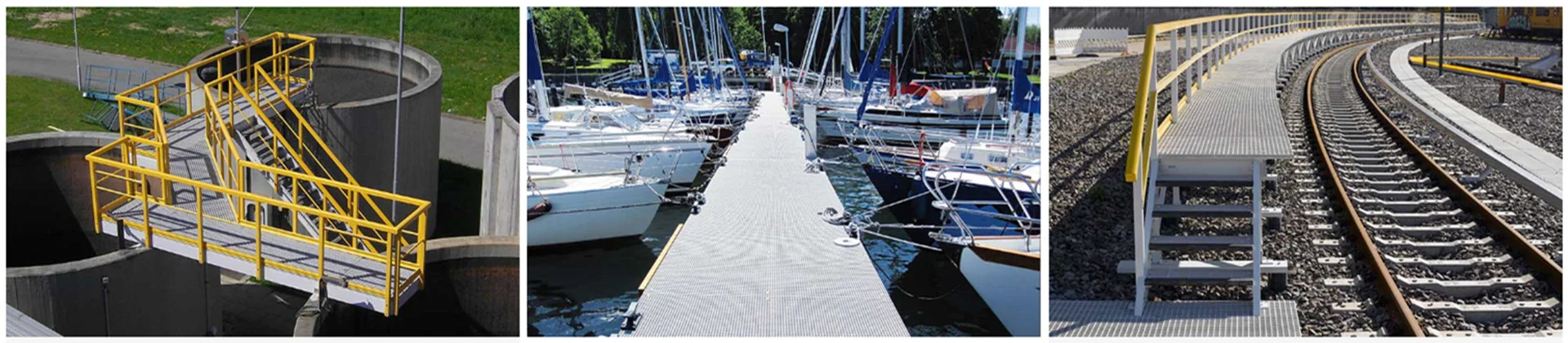
In real-world procurement, “Fiberglass Perforator” often refers to FRP parts like perforated panels, plates, covers, screens, or walkway-style components with a repeating hole pattern. The open area is designed to provide:
- drainage (water/process liquids)
- ventilation (airflow, heat dissipation)
- screening/separation (debris control, splash management)
- weight reduction (when the application allows it)
Because it’s a composite, it’s frequently selected for:
- corrosion resistance in humid/chemical/salt exposure
- lighter handling compared with many metal alternatives
- dielectric advantages in certain electrical environments (application-specific; confirm requirements)
Typical industrial applications
Common use cases include:
- Wastewater treatment: humid channels, splash zones, chemical dosing areas, covers where mist and washdowns are constant
- Power & utilities: platforms/covers near infrastructure where corrosion resistance and jobsite safety matter
- Marine & aquaculture: salt spray and constant moisture where many metals pit or rust quickly
- Agriculture/landscaping/outdoor facilities: UV + water exposure where long service life and low maintenance are valuable
Fiberglass Perforator vs Metal: Tradeoffs Buyers Actually Care About
Corrosion and chemical compatibility
Corrosion is the main driver. If your site deals with chlorides, humidity, chemical vapor, or frequent washdowns, metal performance often depends on coatings, surface condition, and consistent maintenance. A Fiberglass Perforator can reduce that dependence—but only if the resin system matches your exposure.
Metal can still be the right choice when:
- temperatures are beyond FRP system limits
- codes/specs require metal
- the application demands properties your FRP design is not built to meet
Weight, handling, and installation labor
Weight becomes cost in the field. Lighter perforated FRP parts can mean:
- easier manual handling and positioning
- faster swaps during shutdown windows
- reduced crew fatigue (especially on stairs, platforms, narrow access routes)
Also plan for site realities:
- will there be on-site cutting/drilling?
- do you need pre-drilled fastening points?
- do edge zones need reinforcement where fasteners and traffic concentrate?
Electrical and thermal considerations
Many buyers value FRP in electrically sensitive areas, but your spec should define what you need (insulation properties, clearance, grounding practices for adjacent systems, etc.). Don’t rely on a vague “non-conductive” label—make it a requirement and validate it.
Thermal and fire/smoke performance can vary widely by formulation. If you have fire performance or temperature constraints, address them in the RFQ early.
Key Specifications and Selection Criteria
Materials: resin system + reinforcement (what to ask for)
If you take one point from this guide, make it this: the resin system is the job. The same geometry can perform very differently depending on resin selection and surface protection.
Ask your supplier:
- what resin system they recommend for your environment (chemicals, humidity, UV, salt)
- whether a surface veil/coating is used to improve durability and finish
- how reinforcement is designed to carry load paths (important when perforations reduce effective section)
Perforation pattern and open-area design
Perforation design is always a balance:
- more open area = better drainage/ventilation
- less open area = better stiffness/strength
Key variables to specify:
- hole shape (round/slot/custom)
- hole size and spacing
- total open area %
- edge distance (holes too close to edges can weaken edge zones)
If it will be walked on or used where slip risk exists, specify anti-slip needs (grit, texture, or traction patterning).
Mechanical performance: load, span, and deflection
A common procurement trap: the part doesn’t “break,” but deflects too much, creating safety or usability concerns.
Define these in your spec:
- load type (uniform / point / rolling)
- span and support conditions
- maximum allowable deflection
- safety factor expectations (if your internal standard requires it)
Copy-ready deflection requirement statement (example):
“Supplier to confirm design for a clear span of ___ mm under a service load of ___ (uniform/point). Maximum mid-span deflection not to exceed ___ mm (or L/___). Provide supporting calculation basis or span/load guidance.”
Dimensional tolerances and finishing details
These details drive fit-up speed and long-term performance:
- thickness tolerance and flatness expectations
- edge finishing (sealed/finished edges where needed)
- UV protection approach (for outdoor exposure)
- cut-to-size and fabrication needs (notches, slots, fastener holes)
Spec Sheet Snapshot: What to Specify (Fast)
Use this as a quick scoping tool in your RFQ:
- Environment: salt spray / humidity / chemical mist / UV / temperature range
- Material focus: resin compatibility + reinforcement design for stiffness
- Surface/finish: UV protection, anti-slip texture (if walked on), edge finishing
- Perforation: pattern, open area %, hole size/spacing, edge distance
- Structural: load type, span, deflection limit, mounting method
- Quality/docs: traceability, inspection records, first-article approval
Quality, Compliance, and Inspection: How to Reduce Procurement Risk
How manufacturers validate a perforated FRP part
A good supplier typically runs an engineering + QA loop like this:
- drawing review (dimensions, perforation layout, tolerances)
- environment confirmation (resin/finish recommendation based on exposure)
- prototype or first-article build for custom parts
- dimensional control checks (hole geometry, pitch, thickness, flatness)
- batch traceability (materials + production records)
- final inspection and packaging protection (edges and corners are vulnerable)
This is where ISO-style process discipline matters most: consistency in repeat orders and fewer surprises when you scale to bulk.
First-article inspection checklist (copy/paste)
When you receive samples or a first shipment, check:
- Dimensions: length/width/thickness match drawing; flatness acceptable
- Perforations: hole size, spacing, pattern alignment; no chipped edges
- Edges: finished/sealed if specified; no fraying or fiber exposure hotspots
- Surface: uniform finish; anti-slip treatment consistent (if required)
- Defects: no visible delamination, voids, dry spots, or major surface cracks
- Fit-up: fastener holes align; mounting method works without forcing
- Documentation: inspection record, material traceability, packing list labeling
Common failure modes (and how to prevent them)
- Wrong resin for the environment
- Prevent with: clear exposure description + written material recommendation.
- Over-spanning and excessive deflection
- Prevent with: explicit span/load/deflection requirement + supplier confirmation.
- Weak edge zones due to perforation layout
- Prevent with: minimum edge distance + edge finishing requirements.
- Fastener and mounting mismatch
- Prevent with: mounting details included in RFQ + approval of hole layout.
Safety & Compliance Considerations
A few boundaries that protect both the buyer and the project:
- Fire/smoke/temperature performance is formulation-dependent. If you have facility requirements, specify them and request confirmation.
- Electrical assumptions should be validated. Define what “insulating” means in your context and confirm suitability.
- Load ratings must be verified for your support conditions. Don’t infer capacity from thickness alone.
- Installation matters: fastening method, backing supports, and edge protection can decide performance more than material choice.
Sourcing and Customization: Lead Times, Drawings, and What to Send a Supplier
RFQ template (practical and complete)
Copy this into your RFQ email:
- Application: __________
- Environment exposure: (chemicals, humidity, salt, UV, temperature range) __________
- Part type: (panel/cover/screen/walkway) __________
- Dimensions (L×W×T): __________
- Perforation: hole shape ___ / size ___ / spacing ___ / open area % ___ / edge distance ___
- Structural: load type ___ / service load ___ / clear span ___ / deflection limit ___ / mounting method ___
- Surface: anti-slip required? ___ / UV protection? ___ / color requirement? ___
- Fabrication: cut-to-size? slots/notches? fastener holes? __________
- Quantity: __________
- Documentation required: inspection record / traceability / test reports (if applicable) __________
- Delivery terms: destination, Incoterms, required date __________
Attach drawings (CAD/PDF) and photos of the installation area if available.
Where Unicomposite fits (capability + engineering support, no hard sell)
Unicomposite is an ISO certificated professional pultrusion manufacturer with its own factory producing FRP pultrusion profiles and custom composite parts in China. It supports standard pultruded fiberglass profiles and custom fiberglass fabrication used across electricity, landscaping, wastewater treatment, cooling tower construction, agriculture, aquaculture, and marine environments. For projects that need different manufacturing routes, it can also supply products via Pulwound, SMC/BMC, and hand lay-up according to custom requirements—useful when perforated components are part of a broader composite system.
Conclusion
A Fiberglass Perforator can be a smart long-life alternative when corrosion, moisture, chemicals, and maintenance labor drive your total cost—not just the initial price.
Use this buyer framework:
- define environment exposure
- match resin + reinforcement to exposure
- design perforation/open area for function and stiffness
- confirm load/span/deflection with engineering support
- lock tolerances, finishing, and fastening method
- require QA, traceability, and first-article inspection checkpoints
If you want fewer replacements and smoother installs, buy “by spec,” not by assumption. Share your environment conditions, target dimensions, and span/load needs with your supplier, and you’ll get a recommendation that balances performance, safety, and cost.
Frequently Asked Questions
What information should I provide to quote a Fiberglass Perforator accurately?
Provide the environment exposure (chemicals/salt/UV/temperature), part dimensions, perforation pattern (hole size/spacing/open area), and the structural requirement (span, load type, deflection limit). Also include mounting method and any finishing needs like UV protection or anti-slip surface.
How do I choose the right resin system for my application?
Start with your exposure profile: chemical presence, humidity, salt spray, and outdoor UV. Ask the supplier to recommend a resin system in writing based on those conditions, and request supporting guidance or documentation aligned with your procurement standards.
Can a Fiberglass Perforator be used as a walking surface or cover?
Yes, if it’s specified for the correct load and deflection limits and includes appropriate surface traction. For traffic areas, also pay attention to edge finishing, hole layout near edges, and fastening method to prevent localized wear or movement.
What are the most common reasons these parts fail in the field?
The big ones are wrong resin selection, over-spanning that causes excessive deflection, weak edge zones due to perforation layout, and poor mounting/fastening alignment. Most of these are preventable by tightening the RFQ specs and doing a first-article inspection.
What should I inspect when I receive the first batch?
Verify dimensions and perforation accuracy, check for delamination/voids or rough hole edges, confirm edge finishing, and test fit-up with your mounting hardware. Ensure documentation matches what you requested (inspection records, traceability, labeling) before approving full rollout.


