 info@unicomposite.com


Introduction
Most engineers specifying FRP structural profiles focus on the end product — tensile strength, dimensional tolerance, resin system. Fewer examine how the manufacturing process itself determines whether those specifications are achievable in production at consistent quality. In filament winding, fiber bending and overlapping reduce fiber strength utilization to 75–85% of theoretical maximum. In hand layup, operator variability introduces quality scatter that no inspection protocol fully eliminates. Pultrusion achieves near-ideal fiber straightness and full longitudinal alignment — which means the fiber’s theoretical tensile strength is expressed in the finished profile, not sacrificed to process geometry.
The process framework and specification guidance in this article draw on pultrusion manufacturing experience spanning structural profiles, electrical insulation components, and civil infrastructure applications, developed through custom profile production for B2B customers in utility, construction, and agricultural markets. It gives engineers and procurement managers a technical framework for evaluating pultrusion technology — covering process mechanics, performance advantages relative to competing FRP processes, emerging development trends, and application fit — to support FRP profile specification decisions with process knowledge, not just product data.
understanding pultrusion technology
How Pultrusion Technology Works: Process Mechanics and Key Stages
Pultrusion is a continuous manufacturing process — and that continuity is the source of every performance and consistency advantage it delivers. Understanding the sequence from fiber delivery to finished profile clarifies why pultrusion produces properties that batch processes cannot replicate at scale.
The Pultrusion Line: Step-by-Step from Creel to Puller
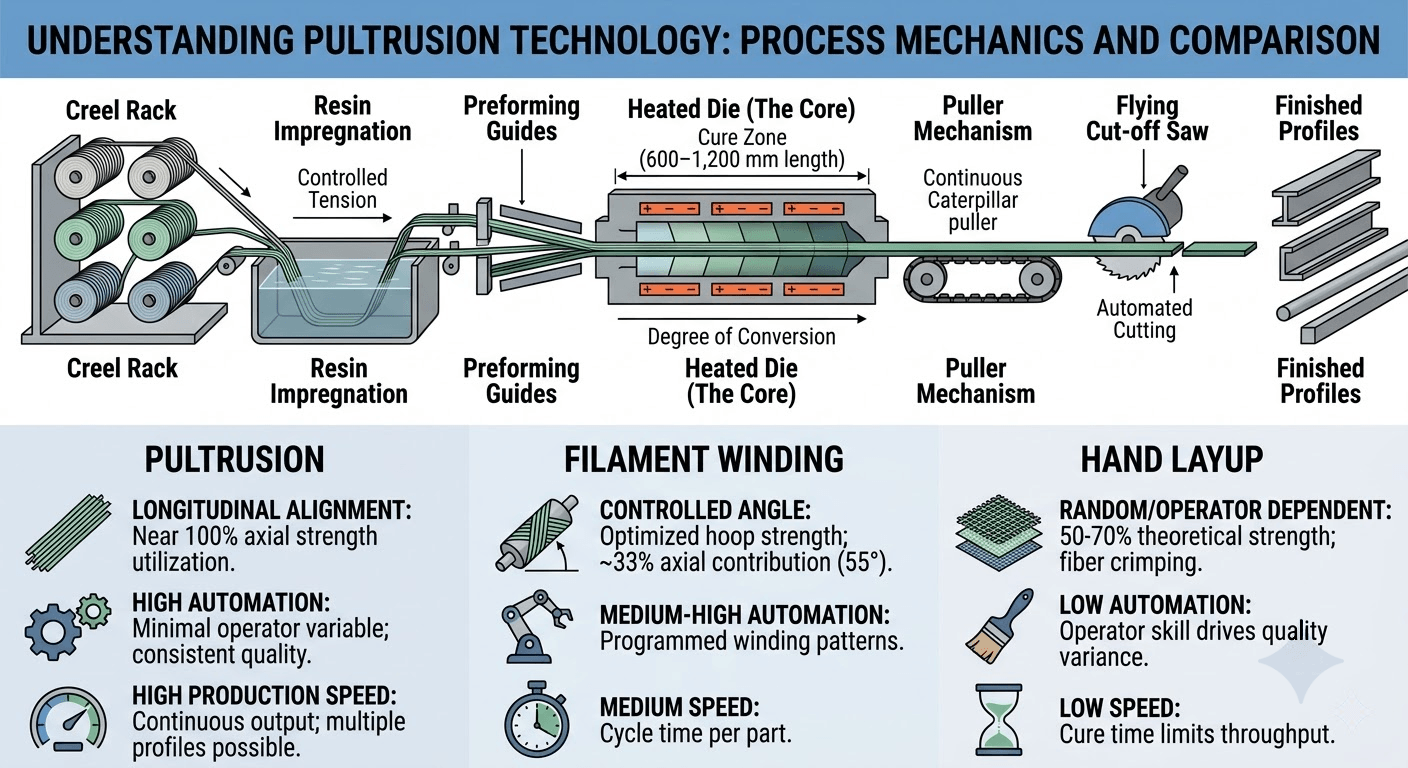
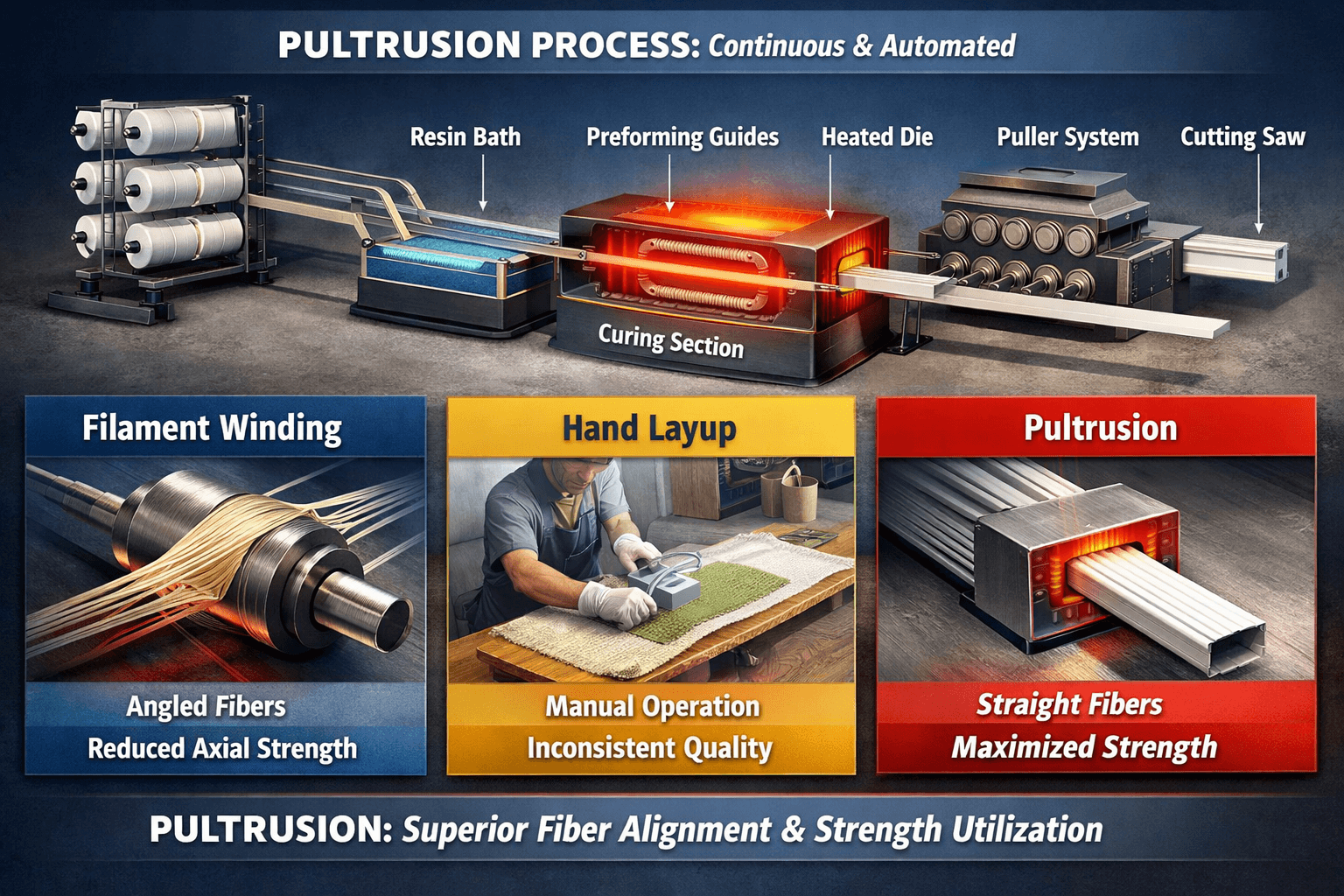
A pultrusion line moves reinforcement through a fixed sequence of stations without interruption. Fiber rovings unwind from a creel rack and pass through a liquid resin bath, where impregnation occurs under controlled tension. Preforming guides then consolidate the wet fiber bundle into a shape that approximates the final profile cross-section before it enters the die.
The heated die is where cure occurs. As the fiber-resin bundle passes through the die at controlled speed, the resin crosslinks progressively through the wall thickness. A hydraulic or caterpillar puller downstream maintains constant tension and line speed, drawing the cured profile out of the die continuously. A flying cut-off saw sections the profile to length without stopping the line.
The continuous nature of pultrusion is what produces its consistency advantage. Every meter of profile passes through identical die geometry, temperature zones, and pulling conditions — which means quality variation between the beginning and end of a production run is inherently lower than in batch processes where each part represents a separate setup.
The Heated Die: Where Fiber Architecture and Cure Profile Meet
The pultrusion die performs two functions simultaneously: it locks in the cross-section geometry to dimensional tolerance, and it delivers the thermal profile that drives resin cure to the required degree of conversion before the profile exits. Both functions must be achieved within the same physical length of steel — typically 600–1,200 mm — which makes die design the most technically demanding element of the pultrusion process.
Die zone temperature control divides the die into entry, cure, and exit zones, each set to a different temperature to manage the resin’s gel time, exotherm peak, and post-cure requirements. Setting entry zone temperature too high triggers premature gelation before the fiber pack has fully consolidated; setting exit zone temperature too low produces an under-cured profile that passes visual inspection but fails under mechanical load.
The shift from empirical die development — adjusting temperatures and line speeds through trial and error — to computational curing kinetics modeling has been the defining development in pultrusion die engineering over the past decade. Engineers who now use finite-element cure simulation to design temperature profiles before cutting steel reduce die qualification time from months to weeks, and achieve tighter degree-of-cure targets across a wider range of profile wall thicknesses. Die design is no longer a “black art” practiced by experienced operators; it is an engineering discipline with quantifiable inputs and verifiable outputs.
Pultrusion vs. Filament Winding vs. Hand Layup: Process Comparison
The right FRP manufacturing process depends on cross-section geometry, fiber orientation requirement, production volume, and dimensional tolerance. The comparison below covers the six parameters where the three processes diverge most significantly — and where the choice between them determines whether a procurement specification is achievable at the required quality level.
The table below compares pultrusion, filament winding, and hand layup across the parameters most relevant to B2B FRP profile procurement:
| Parameter | Pultrusion | Filament Winding | Hand Layup |
|---|---|---|---|
| Fiber Orientation | Longitudinal — fully straight, near 100% axial strength utilization | Controlled angle (typically 55° for pressure) — ~33% axial contribution at standard winding angle | Random / operator-dependent — typically 50–70% of theoretical |
| Cross-section Capability | Constant cross-sections only | Cylindrical and conical bodies | Complex and variable shapes |
| Automation Level | High — minimal operator influence on quality | Medium-high — winding pattern is programmed | Low — operator skill drives quality variance |
| Dimensional Tolerance | Tight — die geometry controls all critical dimensions | Good for diameter; variable for length features | Variable — dependent on tooling and operator |
| Production Speed | High — continuous output, multiple profiles per line | Medium — cycle time per part | Low — cure time limits throughput |
| Best Application | Structural profiles, rods, beams, channels | Pressure pipe, tanks, cylindrical vessels | Complex geometry, large one-off parts, field repair |
Fiber Utilization: Why Pultrusion Maximizes Axial Strength
In pultrusion, fiber rovings enter the die fully straightened and longitudinally aligned. There is no winding angle, no fiber crimp from weave architecture, and no bending around a mandrel. The result is that the fiber’s theoretical tensile strength is directly expressed in the finished profile’s axial tensile performance — near 100% utilization of the reinforcement’s straight-line capacity.
Filament winding places fiber at a controlled angle to the axis, which optimizes hoop strength for pressure containment but reduces axial fiber contribution proportionally. At a 55° winding angle — the standard for pressure pipe optimization — axial fiber strength utilization drops to approximately 33% of the fiber’s straight-line tensile capacity, with hoop strength maximized instead. For structural profiles where axial tensile or flexural load governs, this is a fundamental limitation that winding angle cannot fully compensate.
Hand layup introduces additional strength loss through fiber crimping at weave crossover points, resin-rich zones between plies, and inconsistent fiber volume fraction driven by operator technique. In practice, hand layup structural components routinely achieve 50–70% of theoretical fiber strength — a variance range wide enough to require conservative design factors that add cost and weight without adding structural capability.
Automation, Consistency, and Volume Production Capability
Pultrusion’s high automation level means that once a die is qualified and line parameters are set, the process runs with minimal operator intervention in the quality-determining stages. Fiber tension, resin bath temperature and viscosity, die zone temperatures, and line speed are all monitored and controlled continuously. The operator’s role shifts from shaping the product to monitoring process parameters and responding to deviations.
Multi-die production extends this efficiency further. A single pultrusion line can run multiple dies simultaneously, each producing a different profile cross-section from the same resin system, provided the fiber volume fraction and die geometry are compatible. In high-volume FRP profile facilities, four to six profiles pulling simultaneously on a single line is a standard production configuration — one that batch processes cannot approach at equivalent unit cost.
Process consistency across high production volumes is the specification reliability that infrastructure and utility supply chains require — and it is what makes pultrusion the dominant process for structural FRP profiles globally.
Pultruded FRP Profile Specifications
Specifying pultruded FRP profiles for B2B procurement requires matching cross-section, resin system, and fiber architecture to the service environment. The table below provides a standard specification reference for structural pultruded FRP profiles across common industrial and infrastructure applications:
| Parameter | Standard Range | Notes |
|---|---|---|
| Cross-section Types | Rod, tube, I-beam, channel, angle, flat sheet | Custom cross-sections available via DFM process |
| Wall Thickness | 3–25 mm | Profiles >15 mm require extended die or reduced line speed |
| Fiber Volume Fraction | 45–65% | Higher Vf increases tensile strength; confirm against die design |
| Tensile Strength (E-glass) | 200–400 MPa | Per ASTM D3916 (rod) or ASTM D638 (flat laminate) |
| Flexural Modulus | 15–30 GPa | Per ASTM D790; increases significantly with carbon fiber content |
| Standard Length | 3,000–6,000 mm | Cut-to-length standard; custom lengths available |
Standard Cross-Sections, Dimensional Tolerances, and Wall Thickness Range
Standard pultruded FRP cross-sections cover solid rod (4–150 mm diameter), hollow square and rectangular tube, I-beam, channel (C and U profile), equal-leg angle, and flat sheet. Dimensional tolerances on critical dimensions — typically ±0.5 mm on width and height for structural profiles, tighter for insulation and precision applications — are maintained by die geometry rather than post-processing, which means tolerance is consistent across the full production run rather than dependent on operator adjustment.
Wall thickness specification should account for both structural load requirements and the pultrusion process’s fiber-to-resin balance. Below 3 mm, fiber pack consolidation becomes difficult at standard line speeds. Above 15 mm, die thermal management requires careful zone temperature optimization to achieve full cure at the wall center without surface over-cure — a constraint that affects lead time and should be confirmed at the DFM review stage before order placement.
Resin System Selection: Polyester, Vinyl Ester, and Epoxy
Resin system selection establishes the performance ceiling for chemical resistance, temperature service, and dielectric properties — and it is the specification decision that most determines long-term system reliability in aggressive service environments.
Polyester resin covers general-purpose structural applications at the lowest material cost, appropriate for dry or mildly corrosive environments at ambient to moderate temperature service. Vinyl ester raises the chemical resistance ceiling significantly for acid and solvent environments and improves hydrolytic stability for wet or submerged service. Epoxy delivers the highest dielectric strength, lowest cure shrinkage, and broadest chemical resistance at the highest material cost — specified for high-voltage electrical infrastructure, precision insulation tube, and chemically aggressive service where vinyl ester reaches its exposure limit.
The decision rule is straightforward: match resin to the most demanding service condition the profile will face, and confirm selection against actual fluid exposure and temperature data — not against generic chemical resistance charts that omit temperature and concentration qualifiers.
Fiber Reinforcement Types and Volume Fraction
E-glass fiber is the standard reinforcement in most structural pultruded FRP profiles, providing the balance of tensile strength, cost, and processability that covers the majority of infrastructure and industrial applications. ECR-glass (corrosion-resistant glass) is specified for profiles in contact with acidic environments, where standard E-glass fiber sizing chemistry is vulnerable to accelerated degradation. Carbon fiber provides a step-change increase in stiffness — flexural modulus increases from 15–20 GPa for E-glass profiles to 50–80 GPa for carbon-dominant profiles — at a cost premium justified in weight-critical or deflection-governed applications.
Fiber volume fraction (Vf) between 45% and 65% covers most structural pultrusion specifications. Higher Vf increases tensile strength proportionally but reduces resin flow through the fiber pack in the die, which can generate void content if not managed with appropriate die design and impregnation pressure. Vf should be confirmed against the die design and resin system at the specification stage — not treated as a fixed value independent of the manufacturing process.
pultrusion process
Development Trends in Pultrusion Technology
With the process mechanics and specification parameters established, the more strategically relevant question for procurement engineers planning long-horizon infrastructure supply is where pultrusion technology is heading — because the profiles available from leading manufacturers in three to five years will differ meaningfully from what is available today across section size, cure precision, and reinforcement capability.
Large-Section and Complex-Profile Production
Early pultrusion lines were optimized for small structural profiles — rods, angles, and channel sections below 200 mm in any dimension. Current production capability extends to wide-flange I-beams with flange widths above 300 mm, multi-cavity hollow sections for bridge deck panels, and complex structural sections that replace welded steel assemblies in infrastructure applications.
In one coastal highway bridge rehabilitation project, engineers evaluating deck replacement options found that the pultruded FRP deck panel specification — multi-cell hollow profiles produced on a large-section pultrusion line — reduced substructure loading sufficiently to avoid pier strengthening works that the steel deck alternative would have required. The die investment for the custom panel profile was recovered within the avoided pier work cost, a result that has become a template for FRP deck specification in weight-sensitive bridge rehabilitation projects. As large-section die fabrication capability has matured, pultrusion has transitioned from a specialty process for niche applications to the primary manufacturing method for corrosion-resistant structural profiles in coastal bridges, cooling tower structures, and chemical plant platforms.
Scientific Mold Design: Curing Kinetics Modeling and Resin Injection
The characterization of pultrusion die design as a “black art” — where experienced operators adjusted temperatures and speeds through intuition — has given way to computational cure simulation as a standard engineering tool in advanced pultrusion facilities. Finite-element curing kinetics models allow engineers to predict the degree-of-cure profile through the full die length before any steel is cut, reducing die qualification iterations and enabling systematic optimization for new profile geometries.
Resin injection pultrusion — where resin is injected into a closed die under pressure rather than being applied in an open bath — reduces void content from the 2–5% typical in open-bath impregnation systems to below 1% in closed-die injection, improving structural consistency and eliminating styrene emission from open resin baths. Engineers who have managed the transition from open-bath to closed-die pultrusion in structural profile production consistently cite two triggers: surface finish complaints from customers specifying profiles for visible architectural applications, and void content failures at the wall center in profiles above 12 mm wall thickness where open-bath impregnation leaves resin-starved zones that ultrasonic inspection cannot detect until post-production testing.
Advanced Reinforcement: Carbon Fiber Hybrid and High-Performance Applications
Carbon fiber hybrid profiles — combining carbon fiber tows in the flange or tension face of an I-beam with E-glass webs and standard rovings — deliver targeted stiffness improvement where deflection governs the design without the cost of full-carbon construction. In multi-cell bridge deck panel configurations, hybrid profiles with 20–30% carbon fiber content by weight have demonstrated deflection performance matching structural steel at 30–40% of the equivalent steel deck mass per square meter — a ratio that varies with panel depth and span configuration, and should be confirmed against project-specific structural calculations before specification.
The cost justification for carbon hybrid reinforcement depends on the application’s deflection sensitivity and the cost of secondary structure required to support a heavier all-glass or steel alternative. For applications where deflection does not govern, all-glass profiles remain the cost-optimized specification.
Infrastructure and Utility Applications Driving Demand Growth
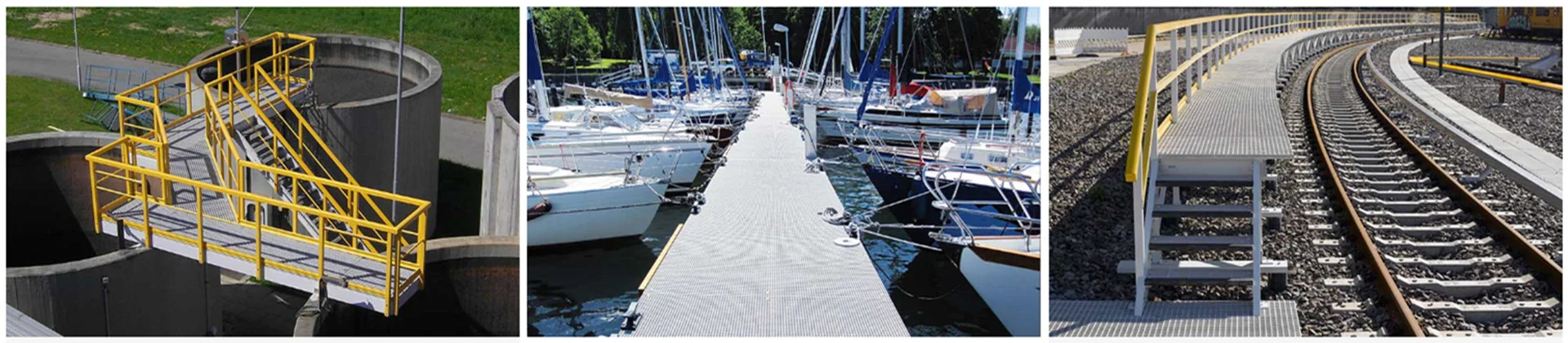
Power transmission, railway infrastructure, coastal bridge structures, and marine platforms represent the application categories where pultrusion adoption is growing fastest in North American and international markets. The common driver is the combination of corrosion immunity and electrical non-conductivity that pultruded FRP profiles deliver inherently — properties that coated steel cannot maintain over a 30-year service life in aggressive environments without ongoing maintenance cost.
Unicomposite Technology Co., Ltd. — an ISO 9001-certified FRP manufacturer operating an 18,000 m² pultrusion and composite production facility in Nanjing — supplies pultruded FRP profiles to B2B customers in North American power utility, heavy civil construction, and agricultural infrastructure markets. Standard and custom cross-sections are produced across polyester, vinyl ester, and epoxy resin systems, with engineering support for custom profile DFM review and specification development.
Industrial Applications of Pultruded FRP Profiles
The development trends above translate directly into application categories where pultruded FRP profiles deliver performance advantages at lifecycle cost levels that steel, aluminum, and competing FRP processes cannot match.
Power Transmission and Utility Infrastructure
Pultruded FRP profiles are the material of choice for utility cross arms, insulation rods, hot sticks, cable trays, and ladder systems in electrical infrastructure. The selection driver is the combination of high dielectric strength, corrosion immunity in coastal and industrial atmospheric exposure, and light weight that reduces pole loading and installation labor simultaneously.
In high-voltage transmission applications, the dielectric consistency of pultruded FRP across the full profile cross-section is critical. A surface coating on a conductive structural profile does not provide the same electrical safety as an inherently non-conductive FRP profile — and coating integrity degrades in UV exposure, mechanical contact, and temperature cycling that utility infrastructure routinely experiences over a 25–40 year service life. The dielectric property is structural in FRP; in coated steel, it is surface-applied and maintenance-dependent.
Civil Engineering: Bridge Decking, Structural Beams, and FRP Rebar
Pultruded FRP bridge deck panels have accumulated a service record in coastal and chemically aggressive bridge environments spanning more than two decades. Field inspection records from coastal highway bridges in high-chloride environments document painted steel deck replacement within 12–15 years in applications with continuous salt water exposure and heavy traffic loading — in the same environments where FRP deck panels show no structural degradation at 20-year inspections, with no maintenance intervention required in the intervening period.
FRP rebar produced by pultrusion serves a parallel function in reinforced concrete: corrosion immunity eliminates the concrete cracking and spalling that chloride attack on steel rebar causes in coastal and de-icing salt environments, extending structural service life without the maintenance cycles that dominate the total ownership cost of steel-reinforced coastal infrastructure.
Application Fit Summary: When to Specify Pultruded FRP Over Steel and Aluminum
The lifecycle cost comparison favors pultruded FRP over alternative materials in environments where annual coating inspection and maintenance is required to maintain steel structural integrity — because FRP’s corrosion protection is structural, not surface-applied. The table below summarizes the application fit conditions where pultruded FRP profiles deliver their strongest procurement value relative to steel and aluminum alternatives:
| Application Environment | Pultruded FRP Advantage | Steel / Aluminum Limitation |
|---|---|---|
| Coastal and marine (salt spray, immersion) | No corrosion, no coating maintenance | Steel corrodes; aluminum suffers crevice corrosion |
| Chemical plant platforms and walkways | Broad chemical resistance; no coating degradation | Steel requires lining; aluminum limited to mild environments |
| High-voltage electrical infrastructure | Inherent dielectric strength through full section | Steel conductive; requires surface insulation that degrades |
| Bridge decking in de-icing salt environments | Chloride immunity; 30+ year service life documented | Steel deck replacement within 12–15 years in high-chloride conditions |
| Weight-sensitive structures (long spans, elevated platforms) | 25–30% of steel mass; reduces substructure loading | Steel weight increases foundation and support structure cost |
Engineers specifying structural profiles for projects with 20-year-plus service life horizons should confirm whether closed-die pultrusion and carbon hybrid reinforcement options are available from their supplier — these capabilities are transitioning from advanced-facility options to infrastructure-grade production standards, and they are becoming specification-relevant for structural bridge, utility, and marine applications that would previously have defaulted to steel.
Conclusion
Pultrusion technology earns its position as the dominant manufacturing process for structural FRP profiles through four performance advantages that translate directly into procurement value:
- Fiber utilization: Near-ideal longitudinal fiber alignment delivers the theoretical tensile strength of the reinforcement into the finished profile — a structural efficiency that winding and layup processes cannot match for axially loaded applications, and that directly determines the structural reliability of infrastructure-grade profiles under long-term service loading.
- Process consistency: High automation and continuous die-controlled production generate tight dimensional tolerance and low quality variance across high production volumes — the specification reliability that infrastructure and utility supply chains require from a primary structural material.
- Development trajectory: Engineers specifying structural profiles for projects with 20-year-plus service horizons should confirm whether closed-die pultrusion, curing kinetics modeling, and carbon hybrid reinforcement are available from their supplier — these capabilities are becoming production-standard in leading facilities and are increasingly specified in bridge, utility, and marine infrastructure procurement.
- Lifecycle cost: In environments where annual coating inspection and maintenance is required to maintain steel structural integrity, pultruded FRP profiles consistently deliver lower total ownership cost when replacement frequency, maintenance overhead, and substructure loading implications are included in the comparison period.
Frequently Asked Questions
Yes — custom cross-sections are supported through a structured DFM review process. Customers submit 2D cross-section drawings along with service condition data: load requirements, chemical exposure, operating temperature, and any dielectric specifications. The engineering team reviews fiber pack configuration, resin system selection, and die feasibility before production begins. Both prototype quantities for new profile development and full production volumes for ongoing supply contracts are accommodated.
Vinyl ester is the standard specification for marine and coastal atmospheric exposure, providing improved hydrolytic stability and chemical resistance compared to polyester without the cost of epoxy. For profiles with direct seawater immersion or contact with aggressive cleaning chemicals, epoxy should be evaluated. Provide your specific exposure conditions — fluid type, concentration, and temperature — at inquiry to receive a confirmed resin system recommendation.
Tensile strength for pultruded rod is tested per ASTM D3916; flat laminate tensile properties per ASTM D638. Flexural strength and modulus are tested per ASTM D790. Unicomposite provides test certificates referencing the applicable standard upon request — specify the required standard and acceptance criteria at the inquiry stage to ensure documentation matches your project quality requirements.
Carbon fiber hybrid profiles are produced as custom orders with DFM review, not from standard stock. The hybrid specification — carbon fiber percentage, placement within the cross-section, and target flexural modulus — is developed during the DFM process based on the structural load case and deflection criteria. Lead time for carbon hybrid profiles is typically 6–8 weeks from DFM sign-off, depending on fiber availability and die configuration.
The full manufacturing workflow — from raw material inspection through production process control and dimensional verification — operates under ISO 9001 certification. Product-specific test documentation, including mechanical property certificates and dielectric test records for insulation-grade profiles, is available upon request. Regulatory compliance documentation for specific destination markets should be confirmed at the inquiry stage based on application and jurisdiction requirements.


