 info@unicomposite.com


Introduction
Corrosion costs industrial facilities an estimated $270 billion annually in the United States alone — a figure documented by NACE International’s landmark corrosion economics study. A significant share of that cost traces back to one specification decision: the wrong structural material on the plant floor. Steel grating rusts. Aluminum grating pits in salt and acid environments. Both impose recoating cycles that consume maintenance budgets and take platforms out of service at the worst possible moments.
FRP fiberglass grating eliminates that cycle entirely. Made from continuous glass fiber reinforcement locked in a thermosetting resin matrix, FRP grating delivers structural performance without the corrosion liability — across a service life measured in decades, not years.
This article gives engineers and procurement managers a complete technical reference: how FRP grating is manufactured, how it performs against steel and aluminum across five critical dimensions, and exactly how to specify it for your application. Unicomposite Technology Co., Ltd. manufactures molded and pultruded FRP grating across 18,000 m² of production capacity in Nanjing, China, supplying standard panels and custom-engineered configurations to power utility, chemical plant, and marine infrastructure projects across North America and Europe.

frp fiberglass grating
What Is FRP Fiberglass Grating?
FRP fiberglass grating is a load-bearing panel product constructed from continuous glass fiber rovings saturated in thermosetting resin. The fibers provide tensile strength; the resin matrix provides chemical resistance and binds the structure together. The result is a panel that carries structural loads while resisting the chemical and environmental forces that degrade metals over time.
Two manufacturing processes dominate the market — molded and pultruded — and the choice between them has direct consequences for load performance, panel geometry, and long-term cost.
How Is FRP Grating Manufactured?
Molded FRP grating is produced by layering continuous glass fiber rovings in a bi-directional pattern inside an open mold, then saturating the lay-up with resin under heat and pressure. The cured panel carries equal load capacity in both directions — the defining advantage of the molded process — making it the standard specification for platforms where loads arrive from multiple orientations. The open-mold process also allows irregular panel shapes and field-cutting without compromising structural integrity at the cut edge.
Pultruded FRP grating is assembled from individual pultruded load bars and cross rods. Each bar is produced by pulling continuous rovings through a resin bath and a heated die, aligning fibers in the primary load direction. The assembled grid delivers superior stiffness and span capability in the bearing direction, making pultruded grating the correct choice for long-span walkways and applications with predictable, unidirectional traffic loads.
What Resin Systems Are Available — and Why Does It Matter?
The resin system you select determines your grating’s chemical resistance ceiling — and choosing the wrong one is the most common specification error in corrosive environments, typically producing visible delamination or surface degradation within 18–24 months of installation.
Three resin families cover the majority of industrial applications. Isophthalic polyester serves general-purpose environments with mild chemical splash, UV exposure, and light manufacturing service. Vinyl ester resin is the specification default for chemical plants, wastewater treatment, and marine applications: it offers superior resistance to acids, alkalis, and organic solvents, with continuous immersion performance validated under ASTM C581. Phenolic resin systems are reserved for high-temperature and flame-critical environments — offshore topsides, tunnels, and transit infrastructure — where ASTM E84 Class 1 fire performance is non-negotiable.
Specify resin type explicitly in your procurement documents. A panel labeled “FRP grating” without a resin designation leaves the door open for substitution that may fail in service long before the structure reaches its design life.
Key Performance Advantages of FRP Fiberglass Grating
The performance case for FRP grating rests on five properties that, in conventional metals, typically trade off against each other. The table below summarizes the core mechanical and physical characteristics that define FRP grating performance across industrial service conditions.
| Property | FRP Fiberglass Grating | Carbon Steel Grating | Aluminum Grating |
|---|---|---|---|
| Specific Gravity | ~1.9 | 7.85 | 2.70 |
| Corrosion Resistance | Excellent (no coating required) | Poor (coating mandatory) | Moderate (pits in salt/acid) |
| Electrical Conductivity | Non-conductive | Conductive | Conductive |
| Maintenance Cycle | 20+ yr, wash-down only | 3–5 yr recoat cycle | 5–10 yr inspection cycle |
| Relative Lifecycle Cost | Lower | Higher | Medium |
Each advantage below expands on one row with field context and the specification data you need to write it into an engineering brief or procurement document.
Corrosion Resistance Rated to ASTM C581
Vinyl ester FRP grating maintains structural integrity after 12-month immersion in 10% sulfuric acid and 25% sodium hydroxide solutions under ASTM C581 immersion test protocols — the standard against which chemical plant grating specifications are written.
What that means in practice: at a municipal activated sludge treatment facility, the aeration tank walkway decking was originally galvanized steel grating. Continuous exposure to sodium hypochlorite wash-down at 5–8% concentration caused coating delamination at weld points within four years of installation, followed by accelerating substrate corrosion that required full platform replacement at year seven. The replacement specification moved to vinyl ester FRP molded grating. Eleven years into that second installation, the panels require no maintenance intervention beyond quarterly pressure washing — no coating inspection, no recoating, no spot repair.
For procurement managers calculating total cost of ownership, the elimination of recoating cycles alone — material, contractor labor, and platform downtime — frequently offsets the higher unit price of FRP grating within the first maintenance interval. Lifecycle cost modeling across a 20-year asset horizon, assuming steel recoating at years 4, 9, and 15 at $35–55/m² per cycle versus FRP wash-down maintenance only, consistently shows FRP reaching cost parity by year 6–8 and delivering 30–40% lower total cost of ownership over the full asset life.
Strength-to-Weight Ratio and Structural Load Ratings
FRP grating’s specific gravity of approximately 1.9 g/cm³ compares to 7.85 g/cm³ for carbon steel — a panel of equivalent area weighs roughly one-quarter as much. That weight difference reduces structural dead load on secondary framing and measurably cuts installation labor cost on elevated platforms and retrofit projects where crane time is constrained.
Molded FRP grating panels in a standard 38 mm depth, 38×38 mm mesh opening configuration carry uniform distributed loads of 3.0–4.5 kN/m² across typical 600–900 mm clear spans. Pultruded panels in the same 38 mm depth range extend that span capability to 1,200–1,500 mm at equivalent deflection limits. Deflection under design load should remain within L/100 — span divided by 100 — the accepted threshold for industrial personnel walkways. Suppliers should provide certified load/span tables for each panel series; do not size panels from generic marketing data.
The weight reduction does not compromise safety factor. FRP grating panels designed to AS 1657 or OSHA 1910.23 walkway standards carry the same personnel and equipment loads as steel equivalents, with a minimum 4:1 safety factor under rated conditions.
Maintenance-Free Design Over a 20-Year Service Life
Beyond corrosion resistance, the structural properties of FRP deliver a second, compounding advantage: the complete elimination of coating-based maintenance. FRP grating has no paint system to delaminate, no galvanizing layer to sacrifice, and no substrate to rust from beneath a compromised surface.
Routine maintenance consists of washing with water or mild detergent. Periodic inspection for mechanical damage from impact — dropped tools, fork tine contact, or heavy equipment movement — remains a standard practice, but chemical degradation maintenance is removed from the planned maintenance schedule entirely. Across a large multi-level platform or a plant-wide walkway network, that reduction in annual maintenance hours compounds into a material reduction in operations cost over the asset’s life.
Non-Conductive and Non-Magnetic Properties
FRP grating is electrically non-conductive by material composition. Dielectric strength for standard FRP panel stock exceeds 20 kV measured on a 6 mm laminate per ASTM D149 — well above the threshold required for structural decking in electrical substation and switchgear environments.
This property makes FRP the specification default for transformer yard decking, cable trench covers, and walkways around live equipment where accidental contact with energized components represents a design-basis hazard. The non-magnetic characteristic carries equal significance in electrolytic processing facilities, naval applications where magnetic signature control is required, and MRI suite structural decking where ferrous materials are excluded by clinical safety requirements. Neither property requires special treatment or additive — it is inherent to the glass fiber and resin composite system.
Slip Resistance and Workplace Safety Compliance
FRP grating panels are produced with either a concave meniscus top surface — formed during the molding process — or an applied aggregate grit layer bonded into the resin surface. Both configurations exceed the slip resistance requirements of OSHA 1910.23 and AS 1657 for industrial pedestrian walkways.
Gritted surfaces deliver a coefficient of friction of 0.8 or higher in wet conditions, measured per ASTM D2047. For food processing, pharmaceutical, and chemical plant environments where liquid spillage is frequent and continuous, the gritted surface is the standard procurement specification. Color-coded panels — yellow for active pedestrian lanes, red for restricted equipment zones, green for general access — can be integrated during manufacturing without surface painting, preserving full slip resistance across the panel’s rated service life.
FRP Grating vs. Steel Grating: Side-by-Side Specification Comparison
The decision between FRP and steel is not always straightforward, and a one-sided technical case does not serve engineers who need to justify specification choices to project owners and structural review boards. The comparison below makes the trade-offs explicit, including the conditions where steel remains the correct specification.
| Specification Factor | FRP Molded Grating | FRP Pultruded Grating | Hot-Dip Galvanized Steel |
|---|---|---|---|
| Panel Weight (typical) | 3.5–5.0 kg/m² | 4.0–6.0 kg/m² | 18–22 kg/m² |
| Max Continuous Service Temp | 110°C (polyester) / 120°C (VE) | 130°C (VE resin) | 450°C+ |
| Long-Span Capability | Moderate (≤900 mm) | High (≤1,500 mm) | High |
| Custom Panel Color | Yes (molded-in) | Yes (molded-in) | No (surface paint only) |
| Fire Rating (FR grade) | ASTM E84 Class 1 | ASTM E84 Class 1 | Non-combustible, unrated |
| Corrosive Environment Suitability | Excellent | Excellent | Poor without active recoating |
| Concentrated Point Load | Moderate | Moderate-High | High |
Steel grating retains clear advantages at very high concentrated point loads — forklift wheel loads exceeding 10 kN on a single bearing bar, for example — and in sustained high-temperature service above 150°C where thermosetting resin systems progressively lose stiffness. For those specific conditions, the specification should remain steel.
For the broad middle ground of industrial platforms, walkways, drain trench covers, and structural decking in corrosive, electrically sensitive, or weight-critical environments, FRP grating is the technically superior and lifecycle-economical specification.
Common Industrial Applications of FRP Fiberglass Grating
Knowing where FRP grating performs best is only half the picture; understanding the specific performance driver in each application tells you which panel type and resin system to reach for first.
Chemical Plants and Wastewater Treatment Facilities
The problem this application presents is not one chemical — it is the combination of chemical splash, biological exposure, UV loading, and constant humidity cycling that destroys coating systems on steel grating within a few years of installation. Vinyl ester FRP grating resolves all four simultaneously, without a maintenance response to any of them.
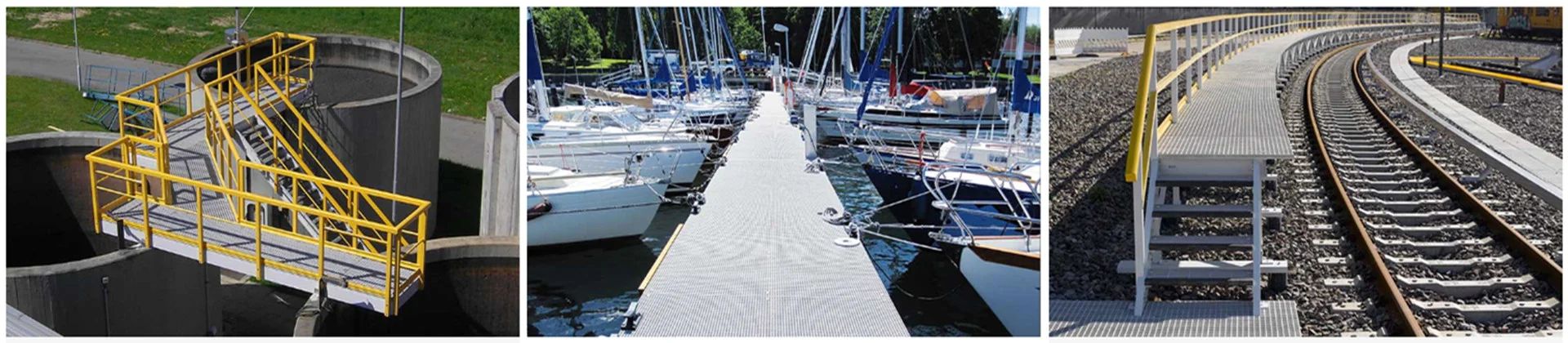
Drain trench covers, aeration tank walkways, secondary containment decking, and chemical dosing platform grating all represent high-volume FRP applications in this sector. In wastewater treatment specifically, FRP grating on clarifier platforms and pump station walkways consistently outlasts galvanized steel by a factor of two or more on a first-cost comparison — and eliminates the downtime cost of recoating entirely on a lifecycle basis.
Marine, Offshore, and Coastal Infrastructure
Saltwater is among the most aggressive corrosion environments for both steel and aluminum. Chloride ion penetration destroys galvanizing and initiates pitting corrosion in aluminum alloys; FRP grating is chemically inert to seawater across its full service life.
For offshore oil and gas topsides, non-sparking FRP grating certified to ASTM E84 Class 1 satisfies the fire performance requirements of offshore safety cases while eliminating the ignition risk that steel-on-steel impact introduces in flammable gas zones. On coastal jetties, fish farm walkways, and marina decking, the combination of saltwater resistance and low panel weight significantly reduces the structural load on timber or composite subframes — a compounding benefit in retrofit applications where subframe capacity is constrained.
Power Utilities and Electrical Substations
Which structural decking material satisfies both load requirements and dielectric safety in a live switchgear environment? FRP grating is the answer that structural and electrical engineers agree on. Non-conductive FRP decking around transformer bays, cable trench covers in switchyards, and walkways adjacent to live buswork all require a panel material that carries personnel and equipment loads without introducing electrical conductivity into the structure.
Unicomposite supplies FRP structural grating and cable tray systems to power utility projects where dielectric performance and structural integrity must coexist in the same panel. The non-magnetic property further enables use in proximity to power transformers, where induced currents in conductive decking would produce resistive heating and measurable energy losses.
Walkways, Mezzanines, and Stair Treads in Heavy Industry
Color-coded FRP grating panels on mezzanine walkways and stair treads satisfy personnel load requirements and workplace safety zone marking simultaneously — without surface painting that degrades in chemical or high-humidity environments. Specify molded FRP grating for stair treads at 4.5 kN/m² minimum uniform load rating with a gritted surface profile; for mezzanine walkway decking, 2.5 kN/m² covers the majority of personnel and light equipment applications.
The corrosion resistance advantage also applies to the fastening system: stainless steel or FRP-compatible fixings should be specified at installation to prevent the galvanic and crevice corrosion at the panel-to-framing interface that can undermine an otherwise well-specified installation.

fiberglass grating
How to Specify FRP Fiberglass Grating for Your Project
Specification errors — primarily underspecified resin type and missing load data — account for the majority of early FRP grating failures in service. The four-step sequence below prevents those errors and produces a procurement document that any qualified FRP manufacturer can respond to accurately.
Step 1 — Define Your Load and Span Requirements
Begin with the structural numbers: the uniform distributed load the platform must carry (kN/m²), any concentrated point loads from equipment or vehicles (kN), and the clear span between supporting members (mm). Apply a deflection limit of L/100 as the standard industrial walkway threshold.
For spans above 900 mm, pultruded grating or additional intermediate supports are typically required to remain within deflection limits at standard panel depths. Request certified load/span tables — specific to panel depth, mesh opening, and resin system — from your supplier before finalizing framing centres.
Step 2 — Select the Right Resin System for Your Chemical Environment
Match resin to chemical exposure using the manufacturer’s chemical resistance guide. As a working decision matrix:
- Isophthalic polyester — mild chemical splash, UV exposure, agricultural and general industrial environments
- Vinyl ester — continuous immersion or frequent splash exposure to acids, alkalis, or solvents; marine and wastewater environments
- Phenolic — continuous service above 120°C; offshore and transit applications requiring ASTM E84 Class 1 fire rating
If your environment involves multiple chemicals, specify for the most aggressive agent present — not the most commonly occurring one.
Step 3 — Choose Molded vs. Pultruded Based on Application
Molded grating is the correct choice when loads arrive from multiple directions, panels require field cutting to irregular shapes, or the installation involves omnidirectional chemical splash on the panel surface. Pultruded grating is the correct choice when spans exceed 900 mm, traffic is predominantly unidirectional, or higher panel stiffness in the primary load direction is a structural requirement.
Do not interchange molded and pultruded panels within the same platform level without verifying that deflection and load ratings remain equivalent across the transition.
Step 4 — Confirm Fire Rating and Surface Profile
For classified hazardous areas, offshore platforms, or public transit infrastructure, specify ASTM E84 Class 1 flame-spread rating explicitly in the procurement document — FR resin is not a standard inclusion in all FRP grating product lines and must be called out. Confirm whether your project authority requires third-party certification or accepts manufacturer self-declaration.
For surface profile: specify gritted surfaces for all walkways with liquid spillage risk. Specify concave meniscus surfaces for food processing and pharmaceutical environments where grit particle migration into process streams represents a contamination risk.
Conclusion
FRP fiberglass grating delivers a performance profile that steel and aluminum cannot match in corrosive, electrically sensitive, or weight-critical industrial environments. Five principles define every successful FRP grating specification:
- Specify resin type explicitly — vinyl ester for chemical and marine service; phenolic where ASTM E84 Class 1 fire rating is required.
- Match panel type to load geometry — molded for omnidirectional loads and irregular cuts; pultruded for long-span unidirectional applications.
- Use certified load/span tables (panel depth and mesh opening specified) to confirm deflection within L/100 at your design span.
- Calculate total cost of ownership, not unit price — FRP lifecycle cost consistently undercuts galvanized steel once recoating cycles are included in the model.
- Confirm fire rating before procurement — ASTM E84 Class 1 must be explicitly specified and verified, not assumed.
Unicomposite Technology Co., Ltd. manufactures molded and pultruded FRP fiberglass grating to ISO 9001 quality standards, with resin options covering general industrial through offshore flame-critical service and panel configurations ranging from standard stock to fully custom-engineered designs.
[Contact Unicomposite for a custom FRP fiberglass grating specification sheet and certified load/span data →]


