 info@unicomposite.com


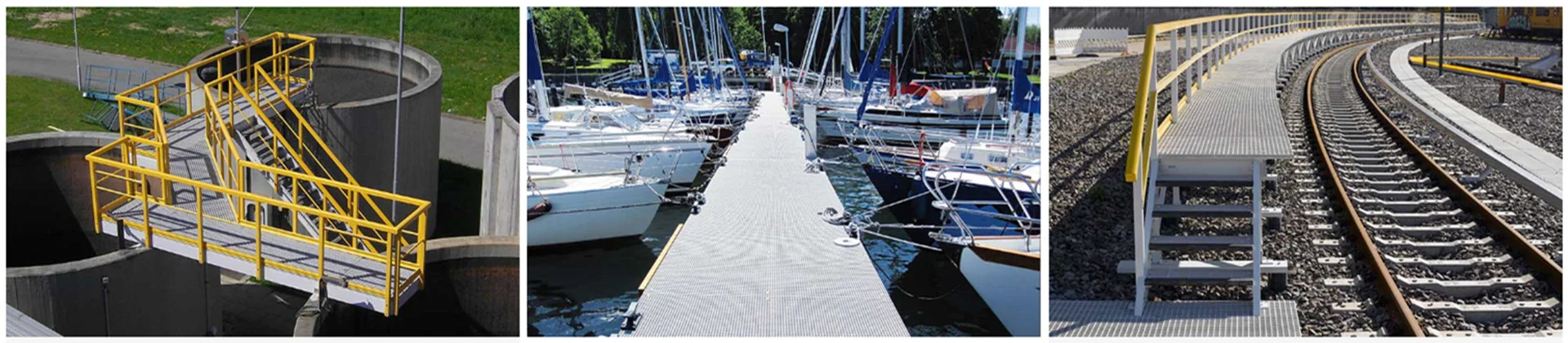
Introduction
Steel walkways corrode. In a chemical processing plant operating at 90% humidity, a steel platform can show structural rust within 18 months — long before its design life is reached. That replacement cycle drives up lifecycle costs far beyond the original capital investment. The global FRP grating and platform market is projected to grow at a CAGR of 4–6% through 2029 (Grand View Research, 2024), a trend driven directly by industrial operators replacing steel in corrosive service environments.
FRP catwalk and platform systems solve the corrosion problem at the structural level. Fiberglass reinforced plastic does not rust, does not conduct electricity, and does not require the repainting cycles that drain maintenance budgets on steel installations. For engineers and procurement managers specifying elevated access systems in harsh environments, FRP represents a fundamentally different — and often superior — engineering choice.
This guide covers how FRP catwalk and platform systems are built, how they compare to steel across key performance dimensions, what specifications to verify before purchasing, and which industries are driving adoption.

frp catwalk platform systems
What Is an FRP Catwalk and Platform System?
An FRP catwalk and platform system is a modular elevated access structure assembled entirely — or predominantly — from fiberglass reinforced plastic components. Each element serves a defined structural role.
Key Components
FRP grating panels form the walking surface. Molded or pultruded gratings provide load distribution, drainage, and anti-slip performance. Surface options include gritted, concave, and meniscus profiles depending on slip-resistance requirements.
Pultruded structural profiles — I-beams, channels, angles, and square tubes — carry the primary structural loads. Pultrusion produces continuous, consistent cross-sections with fiber orientations optimized for axial strength.
FRP handrail systems use round or square tube profiles connected with molded FRP brackets. These meet OSHA 1910.23 top rail height and load requirements without welding or galvanizing.
Molded connectors and FRP kick plates complete the system, preventing tool or foot slip-off at platform edges.
Available Configurations
FRP catwalk and platform systems ship in straight-run, elevated, stair-access, and cantilevered configurations. Components arrive pre-drilled to project specifications, allowing field assembly with standard hand tools. In corrosive environments — offshore decks, chemical secondary containment areas — this tool-only assembly eliminates the hot-work permits that welded steel requires. The modular nature also means sections can be replaced individually without taking down an entire platform structure.
FRP vs. Steel Platform: Side-by-Side Comparison
Beyond corrosion resistance, the full performance picture matters when specifying elevated access systems. Procurement managers evaluating total cost of ownership — not just capital outlay — consistently find the comparison more favorable to FRP than initial pricing suggests.
The table below compares FRP and structural steel across the dimensions most relevant to industrial procurement decisions.
| Performance Dimension | FRP Catwalk & Platform | Carbon Steel (Painted / Galvanized) |
|---|---|---|
| Corrosion resistance | Inherent; no coating required | Requires painting or galvanizing; recoat every 5–10 years |
| Weight (approx.) | 1.5–2.0 kg/m² (grating) | 4.5–6.0 kg/m² (steel grating) |
| Electrical conductivity | Non-conductive (dielectric) | Conductive — requires grounding in electrical zones |
| Maintenance cycle | Virtually none over 20+ years | Regular inspection, repainting, fastener replacement |
| Field installation | Standard tools, no welding | Welding or bolting; may require hot-work permits |
| Flame retardancy | Available (vinyl ester / phenolic resin) | Inherently non-combustible, but surface coatings burn |
| Typical design life | 20–25 years in corrosive service | 10–15 years before major maintenance intervention |
| Color options | Moulded-in safety yellow, grey, custom | Paint-applied; fades and chips over time |
In field installations, engineers consistently cite two factors that tip the decision toward FRP: the elimination of repainting cycles in high-humidity environments, and the ability to install in electrically sensitive zones without grounding infrastructure. For facilities such as substation service platforms or battery storage walkways, non-conductivity is not a preference — it is a code requirement. These structural and safety advantages set the foundation for understanding where FRP specifications matter most.
Technical Specifications
FRP catwalk and platform systems are not commodity products. Specifying the correct combination of resin system, grating type, and profile geometry determines long-term performance in ways that are difficult and expensive to correct after installation.
Load Capacity and Structural Data
Pultruded FRP structural profiles are available in two performance tiers. Standard profiles achieve tensile strength of approximately 207 MPa (ASTM D638) along the fiber axis, suitable for general industrial platform applications. High-fiber-content structural-grade profiles reach 345 MPa, specified for longer spans or elevated point-load requirements. In platform applications, the critical specification is the allowable uniform load on the grating panel at a given span.
The table below reflects industry-typical performance ranges for molded and pultruded FRP grating panels; buyers should request supplier-specific test data per ASTM E985 to confirm values against their exact span and resin configuration.
| Grating Type | Panel Thickness | Typical Span | Allowable Uniform Load | Data Basis |
|---|---|---|---|---|
| Molded FRP grating | 25 mm (1 in) | Up to 600 mm | 3.6 kPa (75 psf) | Industry typical, ASTM E985 |
| Molded FRP grating | 38 mm (1.5 in) | Up to 900 mm | 4.8 kPa (100 psf) | Industry typical, ASTM E985 |
| Pultruded FRP grating | 25 mm (1 in) | Up to 750 mm | 4.8 kPa (100 psf) | Industry typical, ASTM E985 |
| Pultruded FRP grating | 50 mm (2 in) | Up to 1,200 mm | 7.2 kPa (150 psf) | Industry typical, ASTM E985 |
Resin System Options
Three resin families cover the majority of industrial applications:
Orthophthalic polyester suits general industrial and low-chemical-exposure environments. It carries the lowest unit cost of the three systems.
Isophthalic / vinyl ester provides significantly improved resistance to chlorinated solvents, acids, and alkalis — including sulfuric acid up to 50% concentration, sodium hydroxide, and chlorinated solvents at ambient temperature, verified per ASTM C581 immersion testing. Recommended for chemical processing and wastewater applications.
Phenolic resin meets the strictest fire, smoke, and toxicity (FST) requirements for offshore platforms and tunnel environments where smoke toxicity under fire conditions is regulated.
Surface Treatment and OSHA Compliance
FRP catwalk and platform systems manufactured to OSHA 1910.23 standards include: top rail height of 42 inches (±3 inches), mid-rail at 21 inches, toe boards at 3.5 inches minimum height, and grating surfaces rated for the required slip resistance. Unicomposite Technology Co., Ltd — an ISO 9001-certified FRP manufacturer operating an 18,000 m² production facility in Nanjing, China (figures per Unicomposite company disclosure) — supplies platforms pre-configured to these specifications, with standard safety yellow and grey moulded-in color options available for immediate OSHA visual compliance.

FRP catwalk and platform
Industry Applications
FRP catwalk and platform systems perform across a wide range of industries where steel faces accelerated degradation or creates active safety hazards. The pattern across all sectors is consistent: FRP’s advantage compounds over time as steel maintenance costs accumulate.
Wastewater Treatment and Water Plants
Aeration basins, clarifier walkways, and pump station platforms operate in constant high-humidity, hydrogen-sulfide-rich atmospheres. Steel corrodes aggressively in these conditions. In a municipal wastewater treatment facility in the U.S. Pacific Northwest, maintenance crews replaced corroded steel catwalk sections with FRP grating systems in 2019; five years later, zero recoating interventions had been required on the FRP sections, compared to two full repaint cycles completed on the remaining steel areas of the same facility. FRP platforms in wastewater applications eliminate the recoating shutdowns that interrupt operations — and that cost an estimated USD 8–15/m² per cycle based on published industrial maintenance rate surveys.
These chemical resistance properties carry directly into the most demanding process chemical environments — where the variety of aggressive media makes material selection even more critical.
Chemical and Petrochemical Facilities
Secondary containment walkways, tank farm access platforms, and reactor service catwalks involve direct or splash exposure to acids, alkalis, and solvents. Vinyl ester resin FRP systems, verified to ASTM C581, resist sulfuric acid concentrations and chlorinated solvent exposure that would strip protective coatings from steel within months. The non-spark surface of FRP grating also reduces ignition risk in classified areas where hot-work permits carry significant operational cost and delay.
The same dielectric inertness that protects FRP from chemical degradation makes it the default choice in another critical environment: high-voltage electrical infrastructure.
Marine and Offshore Environments
Salt spray and tidal splash zones are among the most aggressive corrosion environments in industrial service. Offshore operators increasingly specify FRP for maintenance walkways, boat landing platforms, and module catwalks where a 20-year corrosion-free service life eliminates replacement operations during platform uptime. The weight advantage — FRP grating at 1.5–2.0 kg/m² versus steel at 4.5–6.0 kg/m² — also reduces dead load on aging topsides structures, extending structural service life without reinforcement.
The same dielectric properties that resist saltwater corrosion make FRP the natural specification choice where electrical safety is the primary concern.
Power Generation and Electrical Utilities
Substation service platforms, transformer walkways, and battery storage area access structures require non-conductive walking surfaces. FRP’s inherent dielectric properties — with electrical resistance exceeding 10⁹ Ω — meet this requirement without additional insulation layers. In a recent high-voltage substation project, the engineering team specified FRP catwalk systems specifically to eliminate the arc flash exposure risk that steel platforms create for maintenance personnel working near energized busbars. No additional insulation matting, grounding continuity checks, or lock-out/tag-out procedures for the platform structure itself were required.
Why Choose Unicomposite FRP Platforms?
Unicomposite Technology Co., Ltd designs and manufactures FRP catwalk and platform systems from its ISO 9001-certified facility in Nanjing, China. With 18,000 m² of production floor space dedicated to pultrusion, pulwinding, and molded composites manufacturing, Unicomposite supports both standard catalogue configurations and fully engineered custom platform systems for B2B buyers across North America, Europe, and the Asia-Pacific region.
Projects receive pre-drilled components dimensioned to supplied drawings. On projects where steel would have required field welding, FRP’s bolt-only assembly has reduced on-site labor hours by 30–50% in Unicomposite-supplied installations — a figure reflecting projects where hot-work elimination was the primary scheduling driver, and not a universal guarantee across all site conditions.
Engineering support covers load calculations, resin system selection, and OSHA compliance documentation. Standard configurations carry a 4–6 week lead time from order confirmation. Complex engineered systems — non-standard spans, specialty resin specifications, or multi-level platform geometry — run 8–12 weeks. Submitting a site environment description and structural load requirement at inquiry stage typically completes the specification process within one business week.
[Contact Unicomposite for a custom FRP catwalk and platform quote →]
Frequently Asked Questions
Standard FRP grating panels support uniform loads from 3.6 kPa (75 psf) to 7.2 kPa (150 psf) depending on panel thickness and span configuration. For concentrated point loads or heavy equipment access platforms, pultruded structural profiles can be engineered to project-specific requirements. Always request ASTM E985-compliant test data from your supplier to verify load ratings against your exact span and grating type before finalizing structural panel selections.
FRP catwalk and platform systems can be manufactured to full OSHA 1910.23 compliance, covering top rail height, mid-rail placement, toe board dimensions, and grating slip resistance. For jurisdictions requiring IBC structural compliance or local equivalents, engineering documentation including calculated load tables, material certifications, and resin test reports is available upon request. Buyers should confirm code applicability with their project engineer of record before specification.
Standard catalogue configurations typically ship in 4–6 weeks from order confirmation. Custom-engineered systems — including non-standard span configurations, specialty resin systems, or complex multi-level geometry — carry an 8–12 week lead time. Submitting project drawings or load specifications at the inquiry stage accelerates engineering review and reduces the risk of scope changes mid-production.
FRP structural profiles and grating panels cut cleanly with standard carbide-tipped circular saw blades and drill bits. No welding, grinding permits, or hot-work authorizations are required. Exposed cut edges should be sealed with a compatible resin or gel coat to maintain corrosion resistance at fiber ends — sealing compound recommendations and application guidance are provided with each project shipment.
The initial installed cost of FRP typically runs 10–30% higher than galvanized steel on structurally equivalent configurations (estimate based on published market pricing ranges; buyers should obtain project-specific quotes for accurate comparison). Over a 20-year service period, FRP’s elimination of repainting cycles — which cost an estimated USD 8–15/m² every 5–7 years for steel, based on published industrial maintenance rate surveys — and reduced inspection frequency produces a lower total cost of ownership in corrosive service environments. Procurement teams evaluating total lifecycle cost rather than first cost consistently find FRP competitive or favorable.


