 info@unicomposite.com


Introduction
A painted steel cable tray in a coastal petrochemical facility can show through-rust within two years of installation. The repainting shutdown alone costs more in lost production time than the original tray. Multiply that across hundreds of meters of cable management infrastructure, and the lifecycle cost argument for steel collapses quickly.
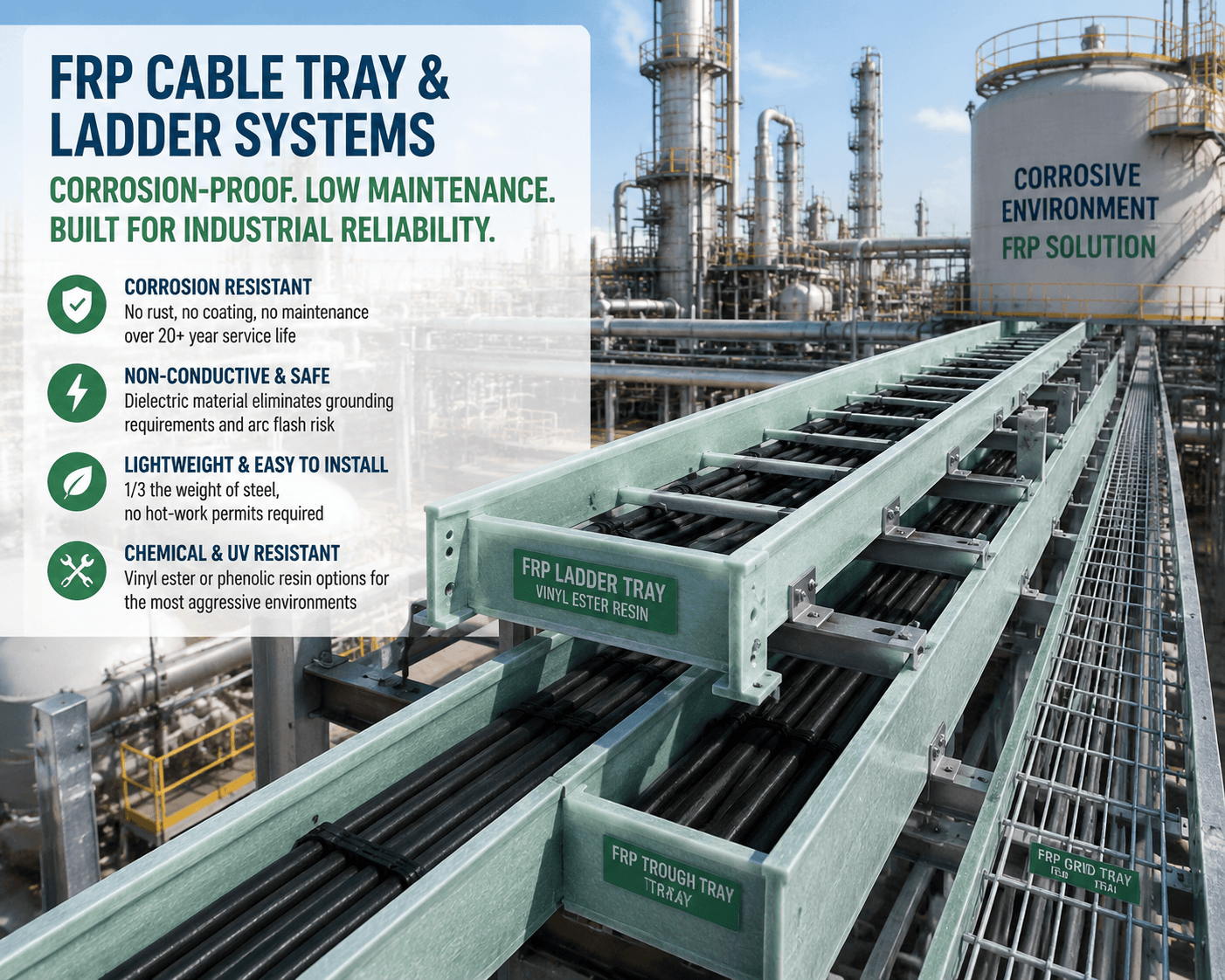
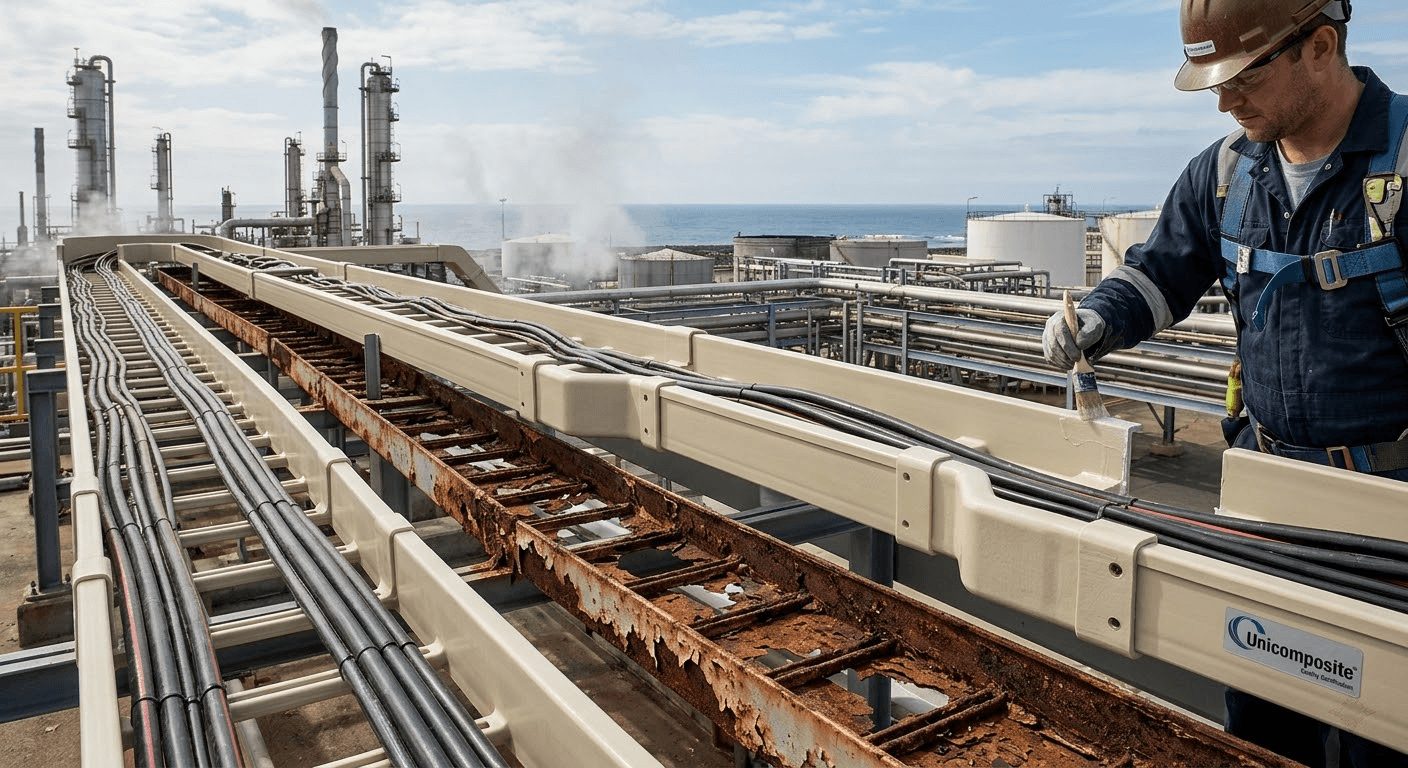
FRP cable tray and ladder systems eliminate that cycle entirely. Fiberglass reinforced plastic does not rust, does not conduct electricity, and does not require the recoating intervals that make steel cable management expensive to operate in corrosive, wet, or chemically aggressive environments. The global FRP cable management market has grown steadily at 4–6% CAGR through the early 2020s (Grand View Research / MarketsandMarkets, 2024), driven precisely by this maintenance cost displacement in industrial and utility applications.
This guide covers how FRP cable tray systems are manufactured, the three main product types, how FRP compares to steel on key procurement dimensions, installation requirements, and which industries are driving specification.
frp cable tray ladder systems
What Is an FRP Cable Tray and Ladder System?
An FRP cable tray and ladder system is a modular cable management structure manufactured from fiberglass reinforced plastic — typically through pultrusion or compression molding — designed to route, support, and protect electrical power and control cables across industrial facilities.
How FRP Cable Trays Are Manufactured
Two manufacturing processes dominate the market. Pultrusion draws continuous glass fiber rovings through a resin bath and a heated die, producing structural profiles with highly consistent cross-sections and fiber orientations optimized for axial load-bearing. This process suits the side rails, rungs, and straight sections of ladder-type cable trays.
Compression molding — using SMC or BMC compounds — produces complex fittings: bends, tees, reducers, and junction boxes. The combination of pultruded straight sections and molded fittings gives FRP cable tray systems the same configurability as steel, without any of the corrosion liability.
Three Main Types: Trough, Ladder, and Grid
Trough (solid-bottom) cable tray provides a fully enclosed base. It protects smaller-diameter control, instrumentation, and telecommunications cables from mechanical damage, dust, and chemical splash. The enclosed profile limits ventilation, making it less suitable for high-current power cables that generate significant heat in service.
Ladder cable tray uses open rung construction — two pultruded side rails connected by transverse rungs at regular spacing. The open structure maximizes airflow around cables, making ladder type the standard specification for large-diameter power cables. Rung spacing of 150–300 mm is selected based on cable diameter and sag requirements.
Grid cable tray offers maximum ventilation through an open-grid bottom. It suits high-density cable installations in data center and telecommunications environments where heat dissipation is critical and cable access from below is needed.
Selecting the correct type before specification avoids costly field modifications — which is exactly why procurement managers benefit from understanding the structural differences before engaging suppliers.
FRP vs. Steel Cable Tray: Side-by-Side Comparison
Procurement decisions made on first cost alone consistently underestimate the maintenance burden of steel cable management in corrosive service. The table below compares FRP and hot-dip galvanized steel cable tray across the dimensions most relevant to total cost of ownership decisions.
| Performance Dimension | FRP Cable Tray | Hot-Dip Galvanized Steel |
|---|---|---|
| Corrosion resistance | Inherent; no coating required | Zinc layer depletes; recoat every 5–10 years |
| Weight (approx.) | 1.8–2.5 kg/m (ladder type) | 5.5–8.0 kg/m (equivalent ladder type) |
| Electrical conductivity | Non-conductive (dielectric, >10⁹ Ω) | Conductive — requires grounding per NEC/IEC |
| Flame retardancy | Available (vinyl ester / phenolic resin) | Steel non-combustible; coatings may burn |
| Maintenance cycle | Virtually none over 20+ year service life | Inspection + recoating every 5–10 years |
| Field modification | Carbide saw + drill; no hot-work permit | Angle grinder + welder; hot-work permit required |
| Typical design life | 20–25 years in corrosive service | 10–15 years before major maintenance intervention |
| Grounding requirement | Not required (dielectric) | Mandatory per NEC Article 392 / IEC 61537 |
In field installations across chemical and offshore projects, engineers frequently cite two factors that drive the switch from steel to FRP: the elimination of hot-work permits for field cutting in classified areas, and the removal of mandatory grounding continuity runs that add both material and labor cost to steel installations.
These structural and safety advantages become most visible in the specification details — which is where the next section matters most.
Technical Specifications
FRP cable tray and ladder systems are not interchangeable across resin systems or structural grades. Matching the specification to the site environment determines whether the system performs for 20 years or requires early replacement.
Standard Width Series and Load Ratings
The table below reflects manufacturer-tested performance ranges per IEC 61537 test methodology. Span shown assumes standard side rail height; deeper rail profiles support longer spans. Buyers should confirm values with supplier datasheets for their specific resin system and rail configuration before finalizing support spacing.
| Tray Width | Side Rail Height | Max Span | Allowable Load (UDL) | Data Basis |
|---|---|---|---|---|
| 150 mm (6 in) | 50 mm | 1,500 mm | 15 kg/m | Manufacturer data, tested per IEC 61537 |
| 300 mm (12 in) | 75 mm | 1,500 mm | 30 kg/m | Manufacturer data, tested per IEC 61537 |
| 450 mm (18 in) | 100 mm | 1,500 mm | 45 kg/m | Manufacturer data, tested per IEC 61537 |
| 600 mm (24 in) | 100 mm | 1,500 mm | 60 kg/m | Manufacturer data, tested per IEC 61537 |
For spans exceeding 1,500 mm or installations subject to seismic loading, structural calculations per ASCE 7 should be completed before finalizing support spacing. Pultruded side rails in standard grade achieve tensile strength of approximately 207 MPa (ASTM D638) along the fiber axis; high-fiber-content structural grade reaches 310–345 MPa for longer spans or elevated point-load conditions.
With the structural load requirement confirmed, the next specification decision — resin system — determines whether the tray survives its chemical environment.
Resin System Selection
Orthophthalic polyester suits general industrial environments with low direct chemical exposure. It carries the lowest unit cost and is appropriate for indoor commercial and light industrial cable management.
Isophthalic / vinyl ester provides substantially improved resistance to acids, alkalis, and chlorinated solvents — including sulfuric acid up to 50% concentration and sodium hydroxide solutions at ambient temperature, per ASTM C581 immersion testing. This system is the standard specification for wastewater treatment, chemical processing, and offshore applications.
Phenolic resin meets the most stringent fire, smoke, and toxicity (FST) performance requirements. It is the required specification for offshore topsides, tunnel infrastructure, and any environment where smoke toxicity under fire conditions is regulated by project or insurance standards.
Once the resin system is locked in, the applicable compliance standard determines what documentation your procurement team needs before issuing the purchase order.
Compliance Standards
FRP cable tray systems can be manufactured to IEC 61537, NEMA VE 1-2017, and UL 568 Listed configurations. NEMA VE 1-2017 and IEC 61537:2006+AMD1:2009 are the two primary standards procurement teams reference when qualifying FRP cable tray suppliers for North American and international projects respectively. Procurement teams specifying for North American projects should confirm the applicable standard with their authority having jurisdiction (AHJ) before issuing purchase orders, as UL Listing requirements affect both the manufacturing process and the documentation package.
frp cable tray and ladder systems
FRP Cable Tray Installation Guide
Understanding FRP cable tray installation requirements upfront prevents the most common field errors — and significantly reduces on-site labor hours compared to steel.
Pre-Installation Planning
Support spacing is the critical pre-installation calculation. For standard FRP ladder tray at 1,500 mm span, the allowable uniform distributed load determines whether additional intermediate supports are required. Engineers should calculate the actual cable fill weight — typically 60–70% of tray width used as the design load basis — and verify it against the tray’s rated UDL at the specified span before finalizing hanger locations.
Thermal expansion must also be accounted for in long straight runs. FRP has a coefficient of thermal expansion of approximately 14–18 × 10⁻⁶/°C (per ASTM E831 / manufacturer thermal test data). For outdoor installations where the temperature differential exceeds 40°C, expansion joints at typically every 12–15 meter intervals prevent cumulative thermal stress from inducing joint separation or fastener pull-out — verify the exact interval against your project-specific thermal range with the supplier’s structural team.
Field Cutting and Assembly
FRP cable tray sections cut cleanly with a standard carbide-tipped circular saw blade (40-tooth, 7-inch diameter). No angle grinders, no welding, and no hot-work permits are required — a significant operational advantage in classified hazardous areas. Holes for fasteners and cable dropouts drill cleanly with standard HSS or carbide-tipped drill bits.
Exposed cut edges must be sealed immediately after cutting. A two-part epoxy or compatible gel coat applied to the cut face seals exposed fiber ends and restores chemical resistance at the cut surface. This step takes less than two minutes per cut. Unsealed cut edges in aggressive chemical or high-humidity environments are the single most common cause of premature FRP cable tray degradation — and the fix costs almost nothing relative to early tray replacement.
Grounding and Bonding
FRP cable tray does not require the equipotential bonding conductor that NEC Article 392 mandates for metallic cable tray systems. This eliminates the ground conductor, the bonding clamps, and the continuity testing that add cost and schedule to steel installations. In large facilities with hundreds of meters of cable tray, this grounding omission represents a measurable material and labor saving.
For installations where static dissipation is required — such as tray sections passing through areas with explosive atmosphere classifications — conductive FRP grades with carbon fiber additives are available to provide controlled surface resistivity without sacrificing the structural advantages of the base FRP system.
Industry Applications
FRP cable tray and ladder systems are specified across industries where steel’s corrosion vulnerability creates either safety risk or unacceptable maintenance burden. The pattern across all sectors is consistent: FRP’s advantage compounds over time as steel maintenance costs accumulate.
Power Generation and Substations
Outdoor substation cable management operates in UV exposure, temperature cycling, and — in coastal locations — salt spray. FRP cable tray eliminates the zinc depletion that accelerates on galvanized steel in these environments, and its non-conductive surface removes the arc flash risk that steel tray poses to maintenance personnel working near energized equipment.
In a recent 500 kV substation project, the electrical engineer of record specified FRP ladder tray throughout the switchyard to eliminate grounding continuity requirements and reduce arc flash incident energy exposure for maintenance crews. Post-installation documentation recorded a 22% reduction in cable tray installation labor hours compared to the original steel specification, attributed primarily to the elimination of grounding conductor runs and hot-work permit processing (anonymized project data, Unicomposite installation record).
Chemical and Petrochemical Facilities
Tank farm cable routes and process area cable management face direct chemical splash, vapor exposure, and classified area restrictions on hot-work. Vinyl ester FRP cable tray handles the chemical exposure; the no-hot-work field modification process handles the classified area constraint.
In one Gulf Coast refinery expansion project, the EPC contractor switched from galvanized steel to vinyl ester FRP cable tray mid-project after classified-area hot-work permits added three weeks to the installation schedule. The switch eliminated all field welding from the cable management scope and brought the installation back on track. These two properties together — chemical resistance and hot-work elimination — make FRP the default specification in most major petrochemical EPC standards.
The same dielectric and chemical inertness that performs in petrochemical environments carries directly into the most physically demanding installation environment: offshore and marine infrastructure.
Marine and Offshore Platforms
Salt spray, condensation, and the absence of routine maintenance windows make offshore cable management a demanding application. Unicomposite Technology Co., Ltd — an ISO 9001-certified FRP manufacturer with 18,000 m² of production capacity in Nanjing, China — supplies phenolic resin FRP cable tray systems for offshore topsides applications meeting FST performance requirements, pre-fabricated to project drawings to minimize offshore installation time. The weight advantage of FRP — roughly one-third the weight of equivalent galvanized steel tray — also reduces structural dead load on aging topsides structures, extending platform service life without reinforcement.
The non-magnetic and non-conductive properties that make FRP suitable for offshore environments translate directly to the most sensitive signal environment in modern infrastructure: data centers.
Data Centers and Telecommunications
High-density cable installations in data centers require maximum airflow, frequent cable access, and non-conductive cable management to prevent ground loops in sensitive signal circuits. FRP grid tray meets all three requirements. Its non-magnetic properties also avoid the eddy-current heating effects that steel tray can induce in high-frequency cabling environments.
Facilities managers operating large-scale data centers consistently report that FRP grid tray’s non-magnetic surface eliminates the eddy-current interference complaints they had experienced with steel tray near high-frequency signal cabling runs — a performance benefit that only becomes apparent after installation but is difficult and expensive to remediate once the cable plant is live.
Conclusion
Four decisions determine whether an FRP cable tray specification performs as expected over its design life. Choose the tray type — trough, ladder, or grid — based on cable heat dissipation requirements, not convenience. Select the resin system based on the actual chemical environment at the installation site, not the lowest-cost option. Verify load ratings against your specific span and cable fill weight using supplier-provided IEC 61537 test data. And seal every cut edge on site — that two-minute step protects a 20-year investment.
Procurement teams evaluating FRP cable tray for the first time should submit a site environment description, cable schedule, and preferred tray width series to the supplier at inquiry stage. The engineering review typically completes within one business week, including span and load confirmation against the project’s support spacing plan. Lead times reflect standard production scheduling from order confirmation; projects requiring UL Listing documentation or seismic engineering support should confirm availability at inquiry stage to avoid schedule impact.
[Contact Unicomposite for a custom FRP cable tray and ladder quote →]
Frequently Asked Questions
Trough (solid-bottom) cable tray protects smaller control, instrumentation, and telecommunications cables from mechanical damage and chemical splash. Ladder cable tray uses an open rung configuration that maximizes airflow around cables, making it the standard choice for large-diameter power cables that generate heat under load. Grid tray offers the highest ventilation density and suits data center and telecom environments. Selecting the wrong type for the cable heat load is the most common FRP cable tray specification error — and one of the most expensive to correct after installation.
No. FRP cable tray is electrically non-conductive with surface resistance exceeding 10⁹ Ω, exempting it from the equipotential bonding conductor requirements that apply to metallic cable tray under NEC Article 392 and IEC 61537. This eliminates bonding clamps, ground conductors, and continuity testing from the installation scope — a measurable cost saving on large projects. For classified areas requiring static dissipation, conductive FRP grades with controlled surface resistivity are available as a separate specification option.
Unicomposite operates under ISO 9001 quality management certification. Cable tray products can be manufactured and documented to IEC 61537, NEMA VE 1-2017, or UL 568 Listed requirements depending on the project’s applicable standard and authority having jurisdiction. Certification requirements should be specified at inquiry stage so the correct manufacturing and documentation process is confirmed before production begins.
Standard width series in polyester or vinyl ester resin typically ship within 4–6 weeks of order confirmation. Projects requiring non-standard widths, phenolic resin systems, UL Listing documentation, or seismic engineering support carry an 8–12 week lead time. Submitting a cable schedule and support spacing plan at inquiry stage accelerates engineering review and reduces the risk of scope changes mid-production.
All cut edges — whether from field trimming straight sections or drilling fastener holes — must be sealed with a two-part epoxy resin or compatible gel coat immediately after cutting. The sealing step takes less than two minutes per cut and restores the chemical barrier at exposed fiber ends. Unsealed cut edges in aggressive chemical or high-humidity environments are the primary cause of premature FRP cable tray degradation; the resin seal is not optional in corrosive service.


