 info@unicomposite.com


Introduction
If you’re looking at Filament Wound FRP/GRP Pipe, you’re usually fighting one (or more) of these: corrosion, weight/handling, or lifecycle maintenance headaches. The big advantage is real—but only when the system is specified correctly: resin + corrosion barrier/liner + structural laminate + joints + installation QA.
A practical anchor to keep bids comparable: ASTM D2996 describes machine-made reinforced thermosetting resin pressure pipe made by filament winding, up to 60 in nominal size, and includes requirements for materials, dimensions, performance, testing, and marking.

filament wound frp grp pipe
Key Characteristics of Filament Wound FRP/GRP Pipe
Corrosion resistance is engineered, not assumed
Think in two layers:
- Corrosion barrier/liner: what “sees” the chemistry
- Structural wall: what carries pressure/vacuum/surge and external loads
Buyer takeaway: don’t accept “chemical resistant” as a spec. Require the resin family + liner construction to be tied to your media, concentration, temperature, and cleaning cycles.
Strength-to-weight helps… as long as supports are part of the design
FRP/GRP is lighter than metal, which can simplify handling and reduce install labor. But poor supports can concentrate loads at joints and fittings—one of the most common failure patterns in the field.
Hydraulics: smooth bore assumptions are common (and should be labeled)
Many designs assume low roughness and stable hydraulic coefficients for fiberglass pipe. For example, one engineering design guide cites absolute roughness of 0.00021 in (1.7×10⁻⁵ ft) for fiberglass piping and notes typical operating velocities of 3–12 ft/s for many systems.
Use these as typical design inputs, then validate against your project constraints (abrasives, scaling, pump curves, surge).
Common Uses by Industry
Water & wastewater (pressure services and corrosive zones)
Chemical feed lines, chloride-heavy streams, odor-control interfaces, coastal sites, and buried runs where coating maintenance becomes a recurring cost center.
Standards-first procurement is common here: AWWA C950 states its purpose is to provide minimum requirements for fiberglass pressure pipe, including design, fabrication, and testing requirements.
Mini case (anonymized): A coastal facility replaced a corrosion-prone sidestream line after repeated pinhole leaks in coated steel. The FRP/GRP upgrade held up because the team treated joints and alignment as QA checkpoints (surface prep, cure control, torque pattern), not as “installer preference.”
Chemical processing & industrial utilities
Acids/alkalis, brines, chloride-laden services, scrubber-related streams—when the resin/liner is matched to the real envelope (concentration + temperature + cleaning).
A simple rule: if your RFQ doesn’t define concentration and upset temperature, suppliers will design to assumptions—and you’ll be the one paying for the gap.
Marine, aquaculture, coastal infrastructure
Seawater exposure and salt spray drive buyers toward non-metallic systems for lifecycle reasons (less corrosion-driven replacement work).
How to Specify the Right Pipe
Here’s the “buyer walk-through” that saves the most pain:
- RFQ: lock service conditions
- Tech clarifications: force resin/liner/joint answers into writing
- Submittal review: check standard basis + QA docs
- Install: verify alignment, cure/torque discipline, supports
- Commissioning: test and document what was installed
ASTM D2996 is helpful language for filament-wound pressure pipe because it explicitly covers classification, properties, dimensions, test methods, and marking—so “meets spec” becomes auditable.
Service inputs → required outputs (copy/paste spec table)
Service Inputs you must define
- Media + concentration range
- Normal + upset temperature
- Operating pressure + surge scenario
- Vacuum events (startup/shutdown, drain/fill)
- Solids/abrasives (yes/no, ppm if known)
- Aboveground vs buried + UV exposure
- Supports/anchors constraints (span limits, vibration areas)
Required Outputs you should demand
- Resin family + liner/corrosion barrier construction (stated explicitly)
- Pressure/vacuum rating basis + test/standard references
- Stiffness/deflection requirements (for buried runs)
- Joint type + installation QA steps (prep/cure/torque)
- Marking/traceability + QA documentation pack
What I ask suppliers to confirm in writing (before PO)
- “Confirm resin/liner suitability for [media] at [temp] and [concentration].”
- “Confirm vacuum and surge conditions included in design basis.”
- “Provide jointing procedure + cure/torque requirements + acceptance checklist.”
- “Provide QA/testing documentation and product marking/traceability approach.”
Practical hydraulic coefficients (treat as typical assumptions)
One widely used reference table lists Hazen–Williams C = 150 for fiberglass (FRP) pipe.
A fiberglass piping design guide also states Manning n = 0.009 and Hazen–Williams C = 150 for ambient temperature water (as equivalent sizing values).
These are great starting points—just label them as assumptions and verify for your application.
Practical Selection Tips and Red Flags
Red flags (procurement-level “nope”)
- Resin system not disclosed
- No liner/corrosion barrier definition
- Pressure class stated without test/standard basis
- No surge/vacuum guidance
- Jointing described vaguely (“field fit”) with no QA steps
Fast wins that prevent expensive rework
- Put surge + vacuum on the design review agenda (not in the punch list)
- Specify supports/anchors early (especially long aboveground runs)
- Require an install method statement + acceptance checklist (alignment, cure/torque, test)
Small but useful reality check: typical fiberglass piping velocity ranges like 3–12 ft/s are often cited; if your design is far outside that, re-check abrasion, surge, and noise assumptions.
Safety & Quality Controls
This is the section teams skip—and then regret.
- Adhesives/solvents: treat bonding chemicals as controlled materials (SDS on site, ventilation/PPE, correct storage).
- Cure control: bonded joints fail when cure time/temperature isn’t respected.
- Flange torque discipline: use a torque pattern and re-check after initial seating if required by the joint procedure.
- Inspection & documentation: keep a record of joint type, batch/traceability, crew method, and test results.
Why the paperwork matters: AWWA C950 positions itself as minimum requirements for fiberglass pressure pipe (design/fabrication/testing). Your project spec still needs to define the “options” and the job-specific requirements.
Where Unicomposite Fits
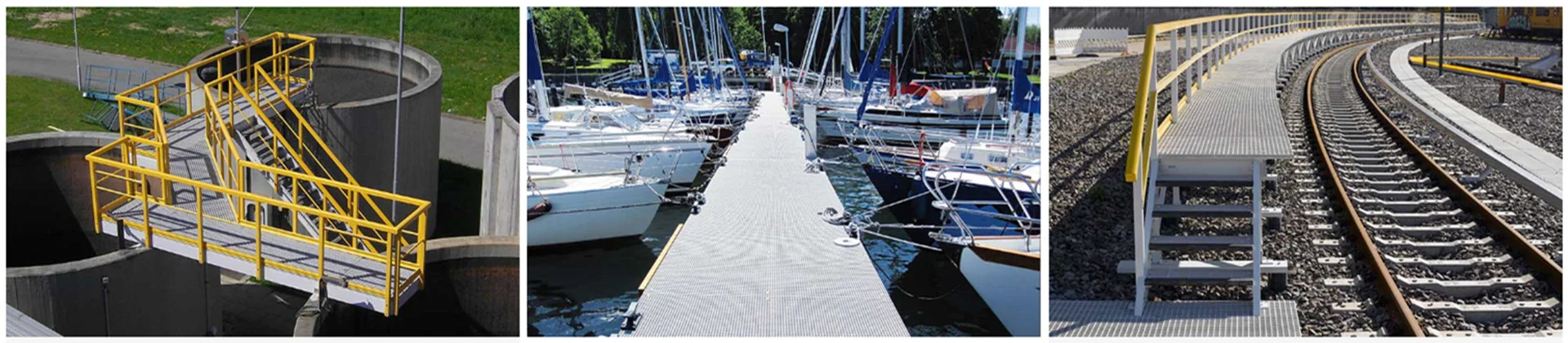
Many corrosion problems aren’t only “the pipe”—they’re the supports, platforms, brackets, and nearby structures that fail and force shutdowns. Unicomposite is an ISO certificated composites manufacturer with its own factory producing pultruded fiberglass profiles and custom composite parts, plus other composite forming options (Pulwound, SMC/BMC, hand lay-up) for custom requests. Practically, that helps industrial buyers standardize corrosion-resistant adjacent components (supports, grating, handrails, brackets, guards, fabricated frames) so the whole area lasts longer—not just the line.
If you’re sourcing the pipe itself, still procure from a qualified filament-winding pipe supplier and keep the purchase spec anchored to recognized standards such as ASTM D2996 (filament-wound RTRP) and/or AWWA C950 (fiberglass pressure pipe) as applicable.
Conclusion
A successful Filament Wound FRP/GRP Pipe project is usually boring in the best way: the RFQ is explicit, the resin/liner is confirmed in writing, joints are treated like engineered interfaces, and installation QA is documented.
If you want a high-confidence spec fast, use the “Service inputs → required outputs” table above, then demand a submittal package that ties everything back to an auditable standard basis (ASTM/AWWA) and a clear jointing procedure.
Frequently Asked Questions
Service life depends more on resin/liner selection, joint quality, and operating envelope than on the material name. When chemistry and installation QA are controlled, buyers typically choose it specifically for reduced corrosion-driven replacement cycles.
Most early failures trace back to mismatched resin/liner for the real media/temperature, poor alignment at joints, or installation shortcuts (surface prep, cure time, flange torque). That’s why written confirmation + an acceptance checklist are worth more than a lower unit price.
Yes—especially for pump starts/stops, drain/fill operations, or long runs where transients can be severe. If surge/vacuum isn’t in the design basis, you may get a pipe that “meets pressure class” but still fails under real operating conditions.
They’re common typical design assumptions for fiberglass pipe sizing, but they should be labeled as assumptions and validated for your project conditions (abrasives, aging, scaling, flow regime).
No—chemical compatibility is not universal. You must match resin/liner to media, concentration, temperature, and cleaning cycles, and require that suitability be confirmed in writing with the stated service envelope.


