 info@unicomposite.com


Introduction
Industrial access structures may look simple on drawings, but in real facilities they carry a serious operating burden. A work platform or walkway must support safe movement, equipment maintenance, drainage, cleaning, corrosion control, and long term access in areas where downtime is expensive.
Steel platforms still serve many projects well. Yet wet, chemical, coastal, and electrical environments can expose their weaknesses: rust, coating damage, repainting, heavy lifting, and conductive behavior. These issues affect lifecycle cost, maintenance planning, and worker safety.
Fiberglass work platforms and walkways give engineers and procurement teams a practical alternative for demanding industrial sites. Built with FRP grating, pultruded fiberglass profiles, handrails, stairs, clips, and support members, these systems can reduce weight, resist corrosion, improve traction, and support non conductive access design when properly specified.
This guide explains how fiberglass work platforms are used, how they compare with steel, what specifications buyers should define, and how to prepare a clear RFQ for custom FRP platform projects.
fiberglass work platformsand walkways guide
What Are Fiberglass Work Platforms?
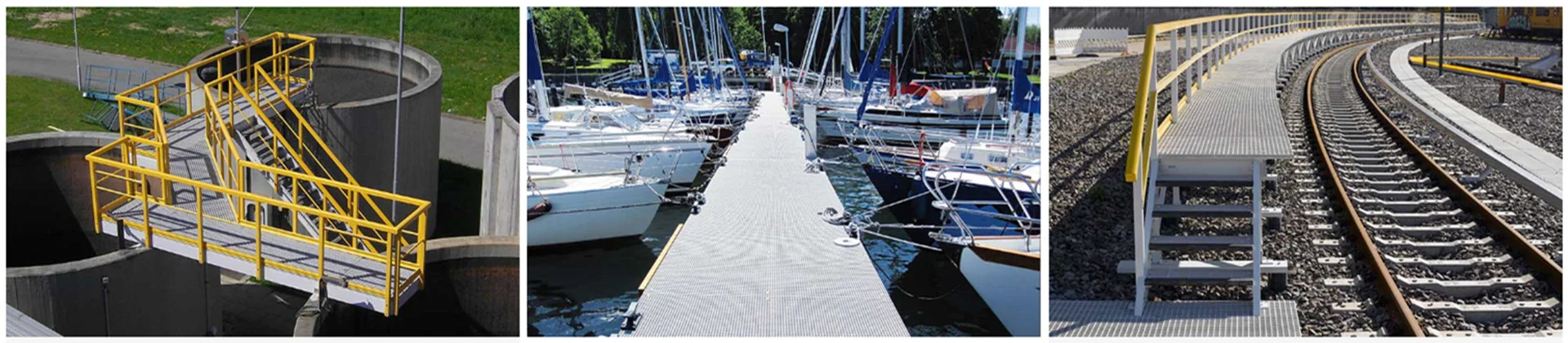
Fiberglass work platforms are industrial access systems made from fiberglass reinforced plastic, commonly called FRP or GRP. They are used to create elevated work areas, walkways, catwalks, stairs, maintenance platforms, and access decks around equipment, tanks, machinery, trenches, and process zones.
FRP combines glass fiber reinforcement with a resin matrix. The glass fiber provides strength, while the resin system protects the structure from moisture, chemicals, UV exposure, and corrosion. Final performance depends on profile geometry, resin type, fiber content, support spacing, fastener material, installation quality, and site exposure.
Main components of an FRP platform system
A complete FRP platform system usually includes more than walking panels. Engineers often combine grating, pultruded beams, handrails, stairs, ladders, clips, fasteners, toe boards, and support brackets.
| Component | Typical Function | Buyer Consideration |
|---|---|---|
| FRP grating | Walking surface with drainage and traction | Mesh size, thickness, load rating, surface texture |
| Pultruded profiles | Beams, frames, channels, angles, and supports | Span, deflection, profile size, resin system |
| FRP handrails | Fall protection and access control | Height, post spacing, toe board requirements |
| FRP stairs and treads | Safe access between levels | Tread width, nosing, angle, anti slip surface |
| Clips and fasteners | Fix panels and profiles in place | Corrosion resistance, electrical requirements, installation base |
| Toe boards | Help prevent tools or materials from falling | Required for many elevated maintenance areas |
In field installations, many performance issues come from weak connections, poor span planning, or incomplete accessories. Buyers should treat the platform as a system instead of purchasing grating alone.
How fiberglass platforms differ from steel platforms
Fiberglass platforms differ from steel platforms in four main areas: weight, corrosion behavior, electrical behavior, and maintenance requirements. FRP does not rust like steel, weighs less in many access structures, and provides non conductive performance when specified correctly.
Steel remains useful for severe impact zones, very high concentrated loads, and projects where local rules or owner specifications require metal structures. FRP becomes more attractive when chemical exposure, moisture, salt air, electrical safety, or installation weight creates long term problems.
Why Choose Fiberglass Work Platforms?
FRP platforms are usually selected because the operating environment creates challenges that coated steel, wood, or aluminum may struggle to handle.
What makes fiberglass work platforms useful in corrosive environments?
Fiberglass work platforms are useful in corrosive environments because FRP does not rust like steel and can be manufactured with resin systems suited for moisture, chemicals, wastewater, salt air, and industrial cleaning exposure. Performance depends on resin selection, UV package, surface finish, fasteners, and actual site conditions.
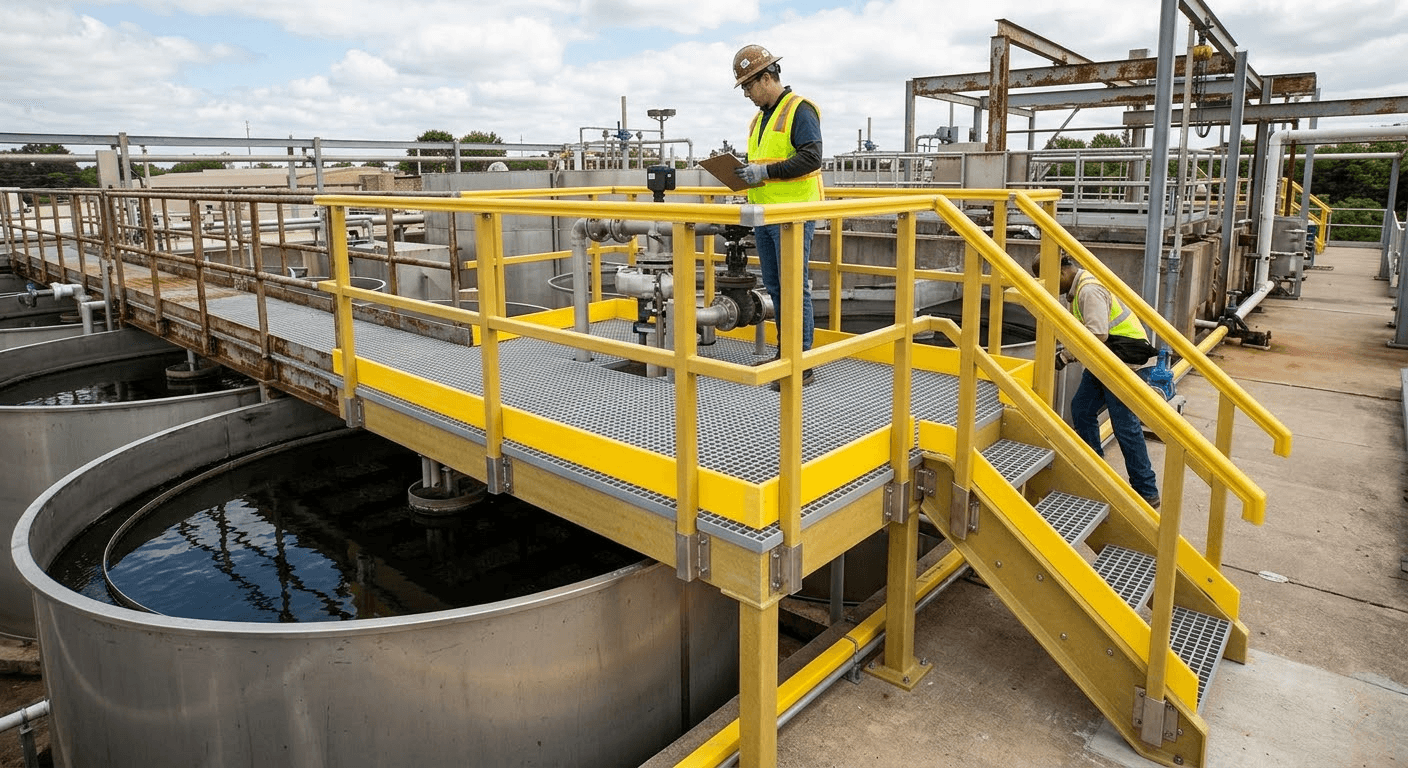
A wastewater facility, for example, may expose platforms to humidity, corrosive gases, washdown water, and biological residue. In one anonymized retrofit scenario, a facility team replaced coated steel walkways near treatment tanks with FRP grating and pultruded supports to reduce rust inspection, repainting work, and recurring coating failure around wet areas.
The specification still matters. For moderate industrial use, a general purpose resin may be suitable. For stronger chemical exposure, vinyl ester or another corrosion resistant resin may be required. Fastener material and surface finish should match the same exposure conditions.
High strength to weight ratio
Fiberglass platforms provide a strong strength to weight advantage in many industrial access applications. The source content notes weight reduction up to 75% compared with steel in certain platform structures. Actual savings depend on profile size, load requirement, span, grating type, and support design.
Lower weight can simplify installation in retrofit projects, rooftops, elevated structures, and restricted equipment areas. Smaller crews may handle many FRP panels and profiles with lighter tools, reducing dependence on heavy lifting equipment.
Non conductive and anti slip performance
FRP is non conductive when properly specified, which makes it useful around electrical equipment, utility areas, switchgear access zones, and power related maintenance platforms. It does not replace electrical engineering review, grounding plans, or site safety procedures, but it can help avoid unnecessary conductive walking surfaces.
Work platforms also need traction. FRP grating can be supplied with molded concave surfaces, grit top surfaces, or other anti slip textures. Wastewater plants may need aggressive slip resistance, while food processing areas may need a balance between traction and cleanability.
FRP Work Platforms vs Steel Platforms
Material selection should compare exposure, load, maintenance, installation, and safety requirements. The lowest purchase price rarely tells the full story.
| Factor | Fiberglass Work Platforms | Steel Platforms | Buyer Consideration |
|---|---|---|---|
| Corrosion resistance | High with suitable resin and hardware | Requires coating, galvanizing, or stainless steel | FRP is valuable in wet, chemical, and coastal sites |
| Weight | Lightweight | Heavy | FRP can reduce lifting and installation difficulty |
| Electrical behavior | Non conductive | Conductive | FRP may suit electrical access areas |
| Maintenance | Low when specified correctly | May require repainting and rust repair | Lifecycle cost should be included |
| Fabrication | Modular and custom pultruded assemblies | Welded, bolted, or fabricated metal assemblies | Steel remains familiar for heavy duty structures |
| Walking surface | Open mesh, grit top, molded, anti slip options | Plate, serrated grating, bar grating options | Surface should match drainage and cleaning needs |
| Impact resistance | Good for many access applications, design dependent | Strong in heavy impact zones | Steel may suit vehicle traffic or severe impact areas |
| Installation | Easier handling due to lower weight | May require lifting equipment | FRP can simplify retrofit work |
FRP should be specified where its advantages match the operating environment. Steel may remain the better choice for heavy vehicle impact, unusual fire requirements, extremely high concentrated loads, or sites where project rules require metal structures.
Common Applications of FRP Platforms and Walkways
FRP platforms perform best where environmental exposure and maintenance cost create real operating pressure.
Chemical plants and wastewater facilities
Chemical and wastewater sites often expose platforms to acids, alkalis, moisture, vapors, cleaning chemicals, and corrosive gases. FRP grating and pultruded profiles can provide long service life when the resin system matches the exposure.
RFQs for these sites should include chemical type, concentration, temperature, splash frequency, cleaning method, indoor or outdoor location, and ventilation conditions.
How do engineers use FRP walkways in power and utility sites?
Engineers use FRP walkways in power and utility sites to provide corrosion resistant and non conductive access around equipment, cable zones, maintenance areas, and outdoor utility structures. FRP helps reduce metal related electrical concerns while supporting lightweight installation and lower corrosion maintenance in humid or exposed environments.
A common design approach combines FRP grating with FRP handrails and pultruded support profiles. This creates a more consistent non metallic access structure and avoids mixing corrosion resistant grating with rust prone supports.
fiberglass work platformsand
Food processing, coastal sites and factories
Food processing and clean industrial spaces often require platforms that handle water, cleaning cycles, drainage, and frequent foot traffic. Surface texture should balance slip resistance with cleanability.
Offshore, port, marine, and coastal facilities expose platforms to salt air, humidity, UV, and wind. FRP platforms can reduce rust related maintenance in these conditions when the resin system, UV package, hardware, and storage method are specified correctly.
Factories and warehouses often need elevated access around tanks, machines, conveyors, loading systems, and maintenance points. Retrofit projects especially benefit from lighter components because installation teams often work around existing structures and limited lifting access.
Key Design Considerations
Good FRP platform performance depends on clear specification. The most common RFQ mistakes involve missing load data, vague chemical exposure details, and incomplete support drawings.
Load capacity, span and deflection
Buyers should define live load, point load, equipment load, pedestrian traffic, cart traffic, span, support spacing, and deflection limit. A pedestrian maintenance walkway has different requirements from a platform supporting tools, equipment, or concentrated loads.
Grating thickness and support profile size should be selected from load tables or engineering review. Long spans usually require stronger profiles or closer supports.
Grating type and surface texture
Molded FRP grating provides multi directional strength and works well in many corrosive environments. Pultruded FRP grating can provide higher load capacity in the bearing direction and may suit longer spans.
Surface texture should reflect operating risk. Grit top surfaces improve traction. Molded concave surfaces may be easier to clean in some applications. Drainage, footwear, contamination, and cleaning methods should all guide the final choice.
Resin system, fasteners and installation base
The resin system affects chemical resistance, moisture resistance, UV behavior, and temperature performance. Useful inputs include chemical type, temperature, splash or immersion risk, UV exposure, humidity, cleaning chemicals, and expected service environment.
Fasteners and clips should match the environment. Stainless steel hardware is often used for corrosion resistance. Concrete, steel framing, FRP framing, and existing equipment structures may need different anchors, brackets, and connection details.
How to Buy Fiberglass Work Platforms
A strong RFQ reduces pricing errors and prevents missing accessories. Buyers should provide enough information for the supplier to quote a full platform system.
What project details should buyers provide?
Buyers should provide platform dimensions, load requirements, span, installation base, grating type, surface texture, resin system, chemical exposure, handrail needs, stair access, drawings, quantity, packaging requirements, and target delivery schedule. These details help suppliers quote a complete fiberglass work platform system instead of isolated components.
For bulk orders, buyers should also clarify whether they need raw profiles, cut to size kits, preassembled sections, or fabricated modular platforms.
Custom fabrication and modular platform options
Fiberglass platforms can be supplied as loose grating and profiles, cut to size kits, or prefabricated modular assemblies. Modular supply can reduce site labor and improve installation consistency.
Unicomposite Technology Co., Ltd. manufactures FRP and GRP composite products in Nanjing, China, with an ISO 9001 certified facility covering 18,000 square meters. Its manufacturing capabilities include pultrusion, pulwinding, SMC and BMC compression molding, hand lay up, and vacuum infusion.
For platform projects, these capabilities can support FRP grating, pultruded support beams, handrail systems, stairs, ladders, clips, cut to size parts, and custom modular assemblies for industrial access structures.
RFQ checklist for procurement teams
The table below can be used before sending a platform inquiry:
| Question | Why It Matters |
|---|---|
| What are the platform dimensions and layout? | Defines grating quantity, support profiles, stairs, and handrails |
| What live load and point load must be supported? | Determines grating thickness, span, and support design |
| What is the installation base? | Affects anchors, brackets, clips, and base plates |
| What chemicals or cleaning agents are present? | Guides resin system and hardware selection |
| Is the platform indoors or outdoors? | Affects UV package, color stability, and surface finish |
| What surface texture is required? | Balances slip resistance, drainage, and cleanability |
| Are stairs, ladders, gates, or toe boards required? | Prevents missing safety components during installation |
| Should parts be cut to size or preassembled? | Influences packaging, labor, and installation schedule |
A qualified supplier should understand grating performance, pultruded structural profiles, resin selection, fabrication tolerances, and installation needs. A low unit price can become expensive if the platform arrives without suitable clips, wrong resin, insufficient support profiles, or unclear installation details.
Conclusion
Fiberglass work platforms and walkways offer a practical material solution for corrosive, wet, electrical, coastal, and maintenance intensive industrial environments.
Key takeaways:
FRP platforms should be specified as complete access systems, including grating, profiles, handrails, stairs, clips, fasteners, and supports.
Performance depends on resin system, profile geometry, span, load requirements, hardware, installation quality, and site exposure.
FRP can reduce corrosion maintenance, lower installation weight, and support non conductive access design in suitable applications.
Steel may still suit severe impact areas, extremely high load zones, or projects with metal structure requirements.
A detailed RFQ helps suppliers recommend the right system and avoid costly site modifications.


