 info@unicomposite.com


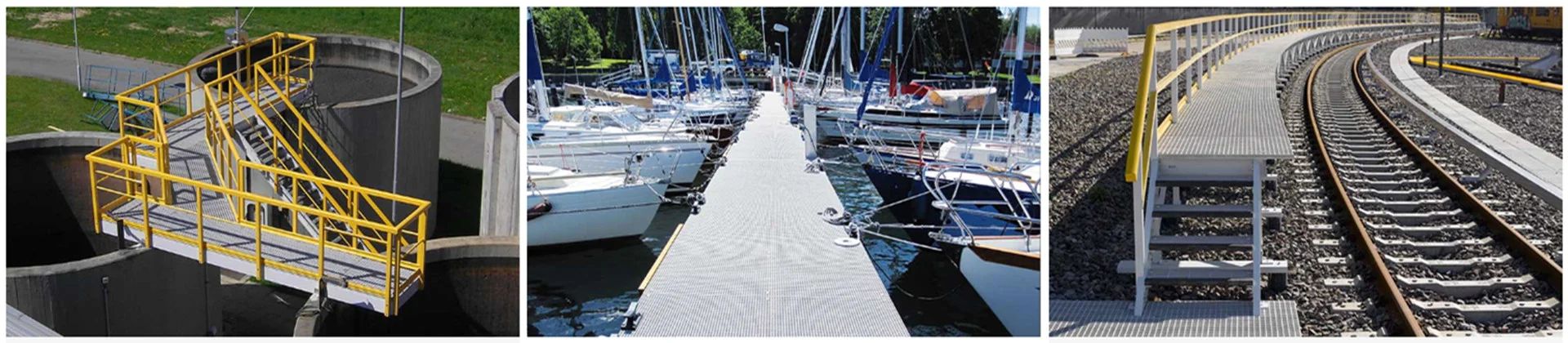
Corrosion costs the global economy an estimated $2.5 trillion annually — roughly 3.4% of global GDP, according to NACE International’s International Measures of Prevention, Application, and Economics of Corrosion Technologies Study (2016). For utility operators managing substations, water treatment facilities, and industrial walkways, a significant share of that figure traces back to one deceptively simple decision: grating material. Specify steel, and you inherit a maintenance cycle that compounds over decades. Specify GRP, and you make a different set of trade-offs — ones that increasingly favor long-term value in corrosive, electrical, and weight-sensitive environments. This article breaks down the GRP grating cover vs. steel grating comparison across the dimensions that matter most to engineers and procurement managers: material properties, total cost of ownership, and real-world specification criteria.
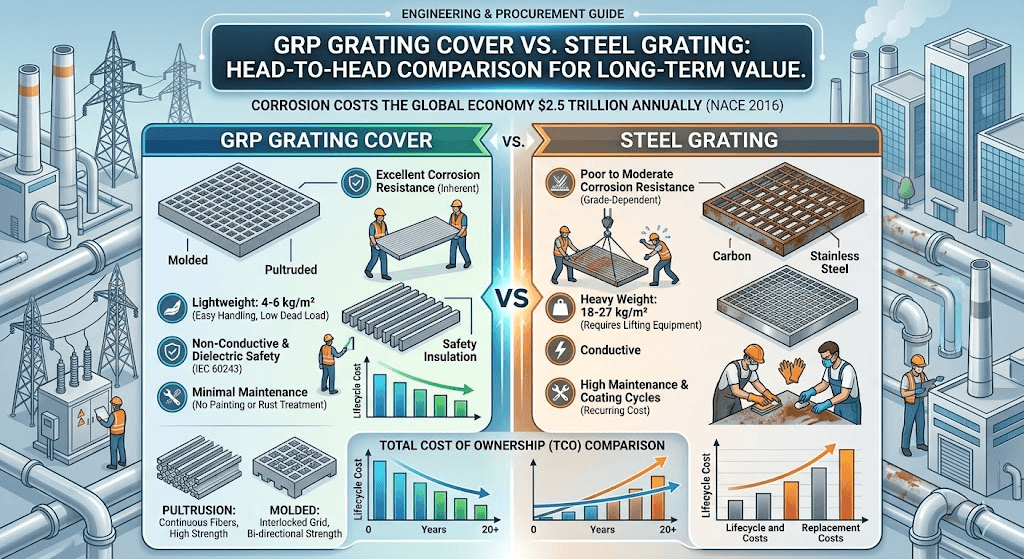
grp grating cover
What Is GRP Grating and How Is It Made?
Not all FRP grating performs the same way in service. The manufacturing process determines how a finished panel behaves under load, in chemical exposure, and over years of operational cycling — and understanding that difference is the foundation of a sound specification.
Pultrusion and Molded Manufacture Methods
GRP grating is produced through two primary methods: pultrusion and molded (open-mesh) fabrication. Pultruded grating is manufactured by pulling continuous glass fiber rovings through a resin bath and a heated die, producing profiles with highly consistent, unidirectional fiber alignment. This process delivers superior load capacity in the primary span direction and tighter dimensional tolerances — making it the preferred choice for structural walkways, cable trench covers, and applications where predictable deflection under defined load classes is a specification requirement.
Molded grating is produced by laying glass fibers in a bi-directional pattern within a mold and saturating them with resin, creating an interlocked grid. The result offers equal strength in both directions and excellent impact resistance, though typically at lower load ratings than equivalent pultruded sections. Unicomposite operates dedicated pultrusion production lines capable of producing both standard pultruded FRP profiles and fully custom-fabricated composite parts — including non-standard resin formulations and certifiable load-test documentation for project-specific engineering requirements. That manufacturing depth gives procurement teams access to engineered solutions rather than catalog-only offerings.
Key Material Properties of GRP
GRP grating covers combine a set of properties that no single metal alternative fully replicates. Glass fiber content typically runs 35–60% by weight, yielding tensile strengths in the range of 200–350 MPa per ASTM D638 (or ISO 527-4 for European specifications) — competitive with many structural steel grades on a weight-adjusted basis. GRP is inherently non-conductive, with dielectric strength values measured per IEC 60243 exceeding 20 kV/mm, which satisfies the insulation requirements of live electrical environments governed by standards such as IEC 61111 and OSHA 1910.137. Resin selection — polyester, vinyl ester, or phenolic — determines the chemical resistance class and maximum service temperature, and that choice must be matched to the site’s specific exposure conditions before anything else is specified. At roughly one-quarter the density of steel, GRP panels are manageable by two workers without mechanical lifting in most standard widths — a handling advantage that carries real installation cost implications.
GRP Grating Cover vs. Steel Grating: Head-to-Head Comparison
Selecting between GRP and steel grating requires a clear view of how each material performs across the properties that drive operational cost and safety outcomes. The table below compares GRP grating covers against carbon steel and stainless steel grating across the criteria most relevant to utility and industrial procurement decisions.
| Property | GRP Grating Cover | Carbon Steel Grating | Stainless Steel Grating |
|---|---|---|---|
| Weight (approx.) | 4–6 kg/m² | 18–25 kg/m² | 20–27 kg/m² |
| Corrosion Resistance | Excellent (inherent) | Poor (requires coating) | Good (grade-dependent) |
| Dielectric Safety | Yes (non-conductive, per IEC 60243) | No | No |
| Load Capacity | Moderate–High | High–Very High | High–Very High |
| Maintenance Requirement | Minimal | High (coating, rust treatment) | Low–Moderate |
| Typical Service Life | 25–50 years | 10–20 years (uncoated) | 20–30 years |
| Upfront Cost (relative) | Moderate–High | Low | High |
Why Weight and Corrosion Resistance Shift the Calculus for Utilities
GRP’s weight advantage is not merely a handling convenience — it carries direct structural and installation cost implications. Lighter grating reduces the dead load on support steelwork, which can allow lighter framing sections and smaller footings in new-build projects. In retrofit scenarios, where existing structures carry fixed load ratings, GRP often enables direct material replacement without triggering a structural reinforcement scope.
On corrosion resistance, the difference is fundamental rather than incremental. Carbon steel grating in coastal, chemical, or wastewater environments typically requires hot-dip galvanizing plus periodic recoating to maintain structural integrity. NACE’s 2016 study estimates that corrosion-related maintenance and premature replacement account for 25–30% of lifecycle costs in industrial infrastructure. GRP eliminates that cycle entirely — corrosion resistance is inherent to the material matrix, not applied to the surface. There is no coating to inspect, no rust to treat, and no galvanic reaction with fasteners or adjacent metals.
Where Steel Still Holds an Advantage
A credible specification decision requires acknowledging where steel genuinely outperforms GRP. In applications involving very high point loads — heavy vehicle traffic, forklift crossings, or dynamic impact from dropped equipment — steel’s superior ductility and high load-bearing capacity give it a clear edge. Elevated temperature environments above 150°C can also exceed the thermal limits of standard polyester or vinyl ester resin systems, making steel the safer specification unless phenolic or high-temperature resin systems are explicitly selected. Engineers should treat GRP as the default for corrosive, electrical, or weight-sensitive environments, and reserve steel for high-dynamic or extreme-thermal conditions where the material physics genuinely favor it.
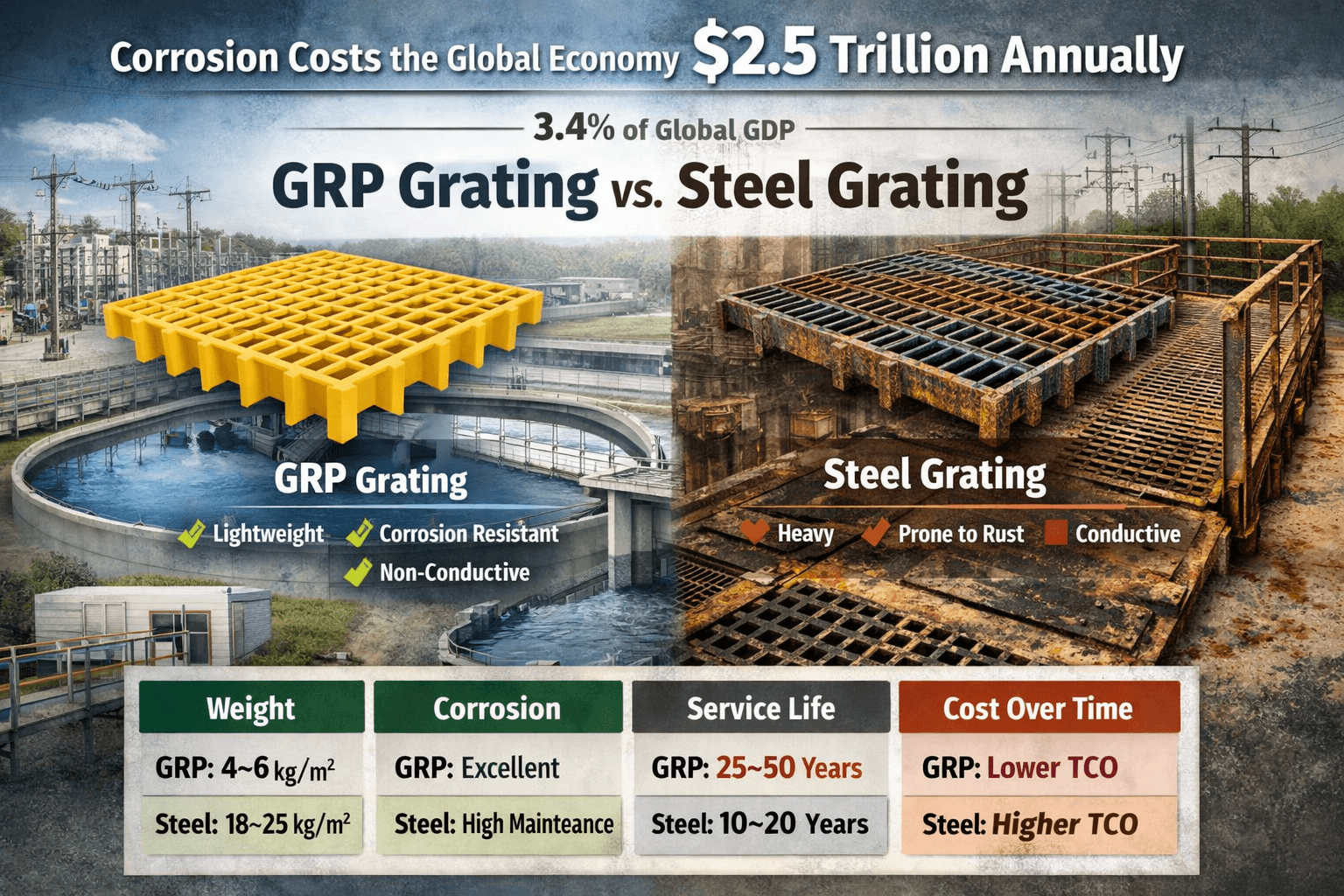
grp grating vs steel grating
Total Cost of Ownership: The Metric That Changes the Decision
Unit price comparisons rarely tell the full story. For procurement managers tasked with defending a 20-year asset decision to finance and operations stakeholders, total cost of ownership — consistent with the asset management principles outlined in ISO 55000 — is the correct evaluation framework, and it consistently favors GRP in utility-grade corrosive environments.
The figures below are illustrative estimates for comparative purposes, based on a 10 m² installed area in a moderate-corrosion industrial environment. Buyers should model these components against their own site conditions and supplier quotes.
| Cost Component | GRP (20-yr est.) | Carbon Steel (20-yr est.) | Stainless Steel (20-yr est.) |
|---|---|---|---|
| Purchase & Fabrication | $1,200 | $1,800* | $1,800 |
| Installation Labor | $300 | $1,000* | $500 |
| Maintenance / Recoating | $300 | $1,600 | $400 |
| Replacement Cost | None | $600* | Partial ~$400 |
| Estimated 20-yr Total | ~$1,800 | ~$5,000+ | ~$3,100 |
*Carbon steel figures assume full replacement at approximately year 15 in a moderate-corrosion environment, with associated re-installation labor. All figures are directional estimates for procurement modeling purposes.
Installation and Labor Savings
GRP’s weight reduction translates directly into installation efficiency. Panels that require a crane or a four-person crew to position in steel become manageable for two workers without mechanical assistance in GRP. In one coastal high-voltage substation project involving replacement of 45 m² of cable trench covers, the site team recorded installation completion 35% faster for the GRP panels compared to the original steel sections — attributed primarily to the ability to hand-carry panels across live equipment bays without overhead lifting equipment. Faster installation reduces scaffold hire duration, crane mobilization costs, and site access fees, all of which compound significantly in confined or operationally active environments.
Maintenance Cycles and Lifecycle Replacement
Carbon steel grating in a wastewater treatment environment typically shows visible corrosion within 3–5 years of hot-dip galvanizing, requiring recoating or section replacement before the decade mark. In one anonymized case from a municipal wastewater authority operating across 12 pump station sites, the transition from galvanized steel trench covers to GRP grating covers eliminated an annual maintenance spend of approximately $18,000 — with zero coating interventions recorded over eight years of post-installation service. The specifying engineer noted that the decision was initially resisted on unit-cost grounds, but cleared the authority’s internal payback threshold within six years. GRP does not rust, does not require painting, and does not delaminate under cyclic wet-dry exposure. The maintenance burden shifts from reactive and recurring to virtually zero.
Specifying GRP Grating Covers for Utility Applications
The TCO case for GRP is strong — but converting that case into a sound purchase requires defining the right product parameters for the application. Selecting the wrong load class, mesh size, or resin system can undermine performance regardless of material choice.
Load Ratings, Mesh Sizes, and Surface Options
GRP grating covers are available across a range of standard load classes. Pedestrian-rated panels (Class 1, typically rated to 1.5 kN point load) suit cable trench covers, walkways, and access platforms where foot traffic is the primary load scenario. Medium-duty ratings (Class 2–3) cover maintenance vehicle access and light equipment loading, and should be verified against project-specific deflection limits rather than assumed from catalog descriptions alone. Mesh opening sizes range from 38×38 mm to 50×50 mm for standard gratings, with close-mesh options (19×19 mm) or solid GRP covers available where debris exclusion or personnel safety regulations require finer retention. Specifiers in wastewater applications consistently find that close-mesh covers reduce debris ingress complaints more reliably than standard mesh fitted with add-on birdwire overlays — a detail that often only surfaces after the first maintenance inspection. Surface finish matters for slip resistance: grit-top coatings or concave surface profiles are specified for environments where standing water, oils, or biological growth create elevated slip risk.
Compliance, Standards, and Certifications to Request
Utility-grade GRP grating should be specified against recognized standards. BS EN 13706 (European standard for pultruded FRP composites) and ASTM E84 (surface burning characteristics) are the most commonly referenced in international procurement. For electrical environments, request documentation of dielectric test results per IEC 60243, and confirm the resin system’s surface resistivity classification — anti-static (surface resistivity < 10⁶ Ω) or fully insulating — matched to the site’s hazardous area classification.
Resin system selection deserves explicit attention in the specification document. The table below provides a concise comparison of the three primary resin options across the properties most relevant to utility procurement:
| Resin System | Max. Service Temp. | Chemical Resistance Class | Fire Performance | Typical Application |
|---|---|---|---|---|
| Polyester | ~90°C | Moderate (acids, some alkalis) | Standard | General industrial, low-chemical exposure |
| Vinyl Ester | ~110°C | High (acids, alkalis, solvents) | Standard–Enhanced | Wastewater, chemical processing, marine |
| Phenolic | ~150°C+ | Moderate–High | Excellent (low smoke) | Rail, offshore, high fire-risk environments |
ISO-certified manufacturers can provide material test certificates, third-party inspection reports, and fire-class documentation on request. Always specify the resin system by name rather than accepting a generic “FRP” designation — resin choice determines chemical and thermal performance and is the single most important variable a specifier controls at the procurement stage.
Conclusion
The GRP grating cover vs. steel grating decision is rarely close when evaluated over the full asset life in corrosive, electrical, or weight-sensitive utility environments. Five takeaways to carry into your next specification:
The lifecycle cost advantage of GRP becomes clear within five to eight years of installation, driven primarily by eliminated maintenance and extended service life rather than upfront savings. Weight reduction carries structural value beyond handling convenience — lighter panels reduce support framing demands, a factor that can determine whether a retrofit project stays within structural limits. Corrosion resistance is inherent to the material matrix, not dependent on surface treatments that degrade under cyclic wet-dry exposure. Steel retains a genuine advantage in high-dynamic load and extreme-temperature applications — specify accordingly, rather than defaulting to GRP where the material physics do not support it. And finally, resin system selection and certification documentation are non-negotiable specification inputs: match the resin to the chemical and thermal environment, and request test certificates at the specification stage rather than after contract award.
[Contact Unicomposite for a custom GRP grating cover quote →]
Frequently Asked Questions
Lead times for standard pultruded GRP grating panels typically run 3–5 weeks from order confirmation. Custom fabrications — non-standard mesh sizes, special resin systems, or project-specific load-rated designs — generally require 6–10 weeks depending on tooling requirements. Procurement teams should build specification review and sample approval into the project schedule before committing to installation dates.
Yes. Pultruded FRP profiles can be cut to length on-site or supplied to project-specific dimensions from the factory. Custom load ratings require engineering review and, in some cases, third-party load testing to generate certified documentation. Buyers with non-standard span requirements or unusual load scenarios should engage the manufacturer at the design stage rather than at the purchase order stage.
Vinyl ester resin is the standard recommendation for coastal and wastewater environments due to its broad resistance to chlorides, dilute acids, and alkalis commonly present in those settings. Polyester resin is adequate for lower-chemical-exposure environments and offers a modest cost saving, but it is not recommended where continuous immersion or concentrated chemical splash is anticipated. Your supplier should provide a chemical resistance guide specific to the resin system offered.
Yes, provided the correct resin system and surface resistivity classification are specified. GRP’s inherent non-conductivity makes it the preferred material in live electrical environments, and dielectric properties should be documented per IEC 60243. For hazardous area classifications where static discharge is a concern, specify anti-static GRP with surface resistivity < 10⁶ Ω rather than standard fully insulating grades.
GRP grating is available in standard, flame-retardant, and low-smoke phenolic grades. For most outdoor utility applications, flame-retardant polyester or vinyl ester systems satisfying ASTM E84 Class 1 (Flame Spread Index ≤ 25) are sufficient. Indoor substations, cable tunnels, and rail infrastructure typically require low-smoke phenolic systems in compliance with BS 6853 or EN 45545, depending on jurisdiction. Confirm the applicable fire standard with the project’s authority having jurisdiction before specifying.


