 info@unicomposite.com


Introduction
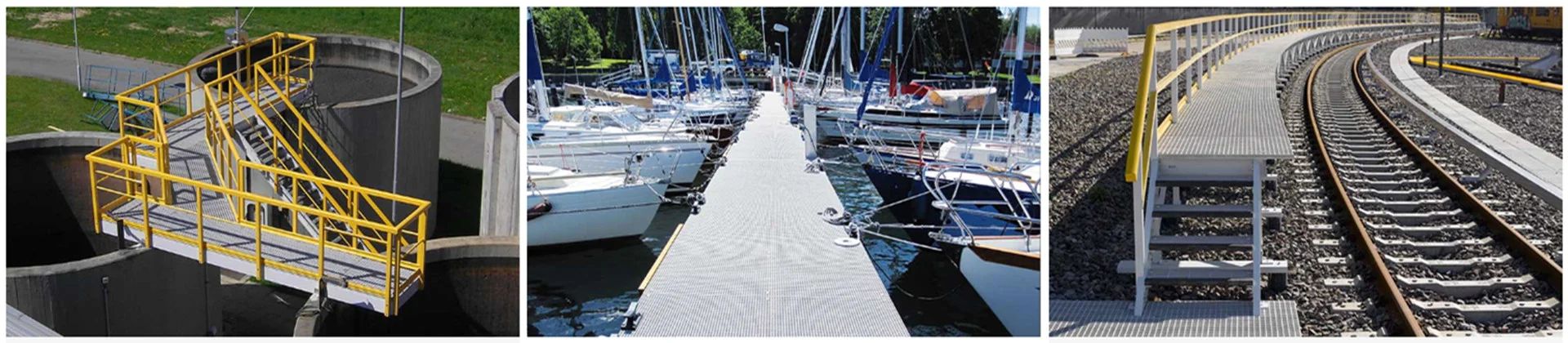
Corrosion costs global industries an estimated $2.5 trillion annually — a figure documented by NACE International’s 2016 IMPACT Study, the most comprehensive corrosion cost analysis ever conducted. A significant share of that damage starts at the platform level: walkways, trench covers, and equipment supports made from conventional steel corrode quietly, accumulate maintenance costs, and eventually fail in the environments they were designed to serve.
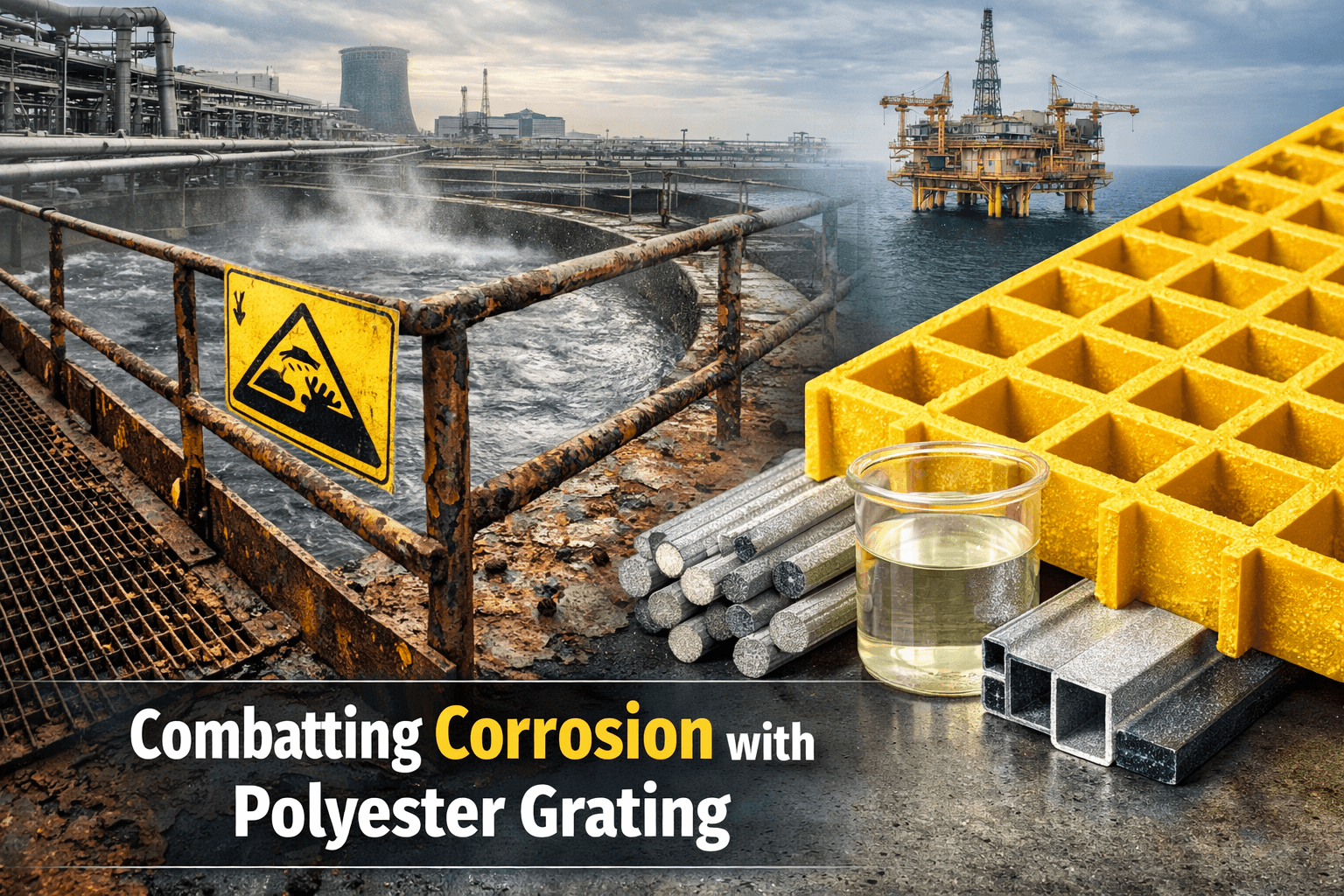
Polyester grating offers a fundamentally different answer. Made from fiberglass reinforcement embedded in a polyester resin matrix, it resists corrosion, sheds weight, and outlasts painted steel in the chemical and moisture-laden environments where steel struggles most.
This article breaks down exactly what polyester grating is, how it’s manufactured, what it can and cannot handle, and where it delivers the clearest return on investment for engineers and procurement managers specifying industrial platforms, walkways, and structural covers.
Unicomposite is an ISO-certified pultrusion manufacturer with direct factory capability producing FRP grating and profiles for customers across wastewater treatment, power utilities, agriculture, aquaculture, marine, and cooling tower construction. The technical guidance throughout this article reflects production-level knowledge of how resin selection and manufacturing method shape real-world grating performance.
polyester grating
What Is Polyester Grating?
Composition and Raw Materials
Polyester grating is a form of Fiberglass Reinforced Plastic (FRP) structural panel in which glass fiber reinforcement is combined with a polyester resin matrix to create a rigid, load-bearing grid structure. The term “polyester” refers specifically to the resin system — not the fiber.
Two polyester resin grades are commonly used in grating production. Orthophthalic polyester (ortho) is the entry-level option: cost-effective, adequate for low-chemical-exposure environments, and suitable for general industrial use. Isophthalic polyester (iso) offers improved chemical resistance, better hydrolytic stability, and longer service life in wet or mildly corrosive conditions. For most serious industrial applications, isophthalic resin is the baseline specification.
Glass fiber reinforcement is typically E-glass (electrical-grade), providing the tensile backbone of the panel. Some premium formulations use ECR-glass (corrosion-resistant), which adds resistance to acidic environments. The ratio of glass to resin — typically 25–35% glass by weight in molded grating — directly determines mechanical strength and chemical resistance ceiling.
How Polyester Grating Is Manufactured
Polyester grating is produced by two distinct methods, and the choice between them shapes nearly every performance parameter that matters during specification.
Molded grating is produced by laying fiberglass rovings in a bi-directional pattern within an open mold and infusing them with catalyzed resin. The result is a one-piece panel with equal strength in both directions, continuous resin-rich surfaces, and a wide range of mesh opening sizes. Molded panels perform well in corrosive environments because the resin completely encases the glass — there are no exposed fiber cut edges on the panel face.
Pultruded grating is produced by continuously pulling glass fiber through a resin bath and then through a heated die, creating structural bars with consistent cross-sections. These bars are then mechanically or adhesively assembled into grid panels. Pultruded grating offers higher unidirectional load capacity and longer available panel lengths, making it the preferred choice for heavy-load spans and structural decking.
The table below compares the two production methods across the specification variables that matter most at the purchasing stage:
| Parameter | Molded Polyester Grating | Pultruded Polyester Grating |
|---|---|---|
| Load orientation | Bi-directional (equal) | Unidirectional (along bearing bars) |
| Typical panel size | 1.0m × 1.2m / 1.22m × 3.66m | Up to 1.22m × 6.1m |
| Surface finish options | Gritted, concave, covered | Gritted top, smooth |
| Chemical resistance | High (full resin encapsulation) | Moderate (cut edges may expose fiber) |
| Relative cost tier | Lower | Moderate–Higher |
| Typical lead time (stock) | 1–2 weeks | 2–4 weeks |
Understanding the manufacturing difference is the first step toward choosing the right product — because the same resin in a molded panel and a pultruded panel will behave differently under load and in chemical exposure.
Key Properties of Polyester Grating
Corrosion and Chemical Resistance
Beyond the manufacturing choice, corrosion resistance is what drives most industrial polyester grating specifications. In the right environment, a properly specified FRP panel will outperform galvanized steel by decades with zero protective coating maintenance.
Isophthalic polyester grating performs reliably against dilute acids, alkalis, salt water, chlorinated water, and a wide range of organic solvents. ASTM C581 provides a standardized immersion test method for evaluating resin chemical resistance — reputable manufacturers can provide C581 compliance data for their specific resin systems. For wastewater treatment, agricultural chemical storage, and coastal utility applications, isophthalic polyester typically meets the chemical exposure brief without requiring an upgrade to vinyl ester.
There is an important ceiling, however. Concentrated oxidizing acids — including concentrated sulfuric acid, nitric acid, and chromic acid — exceed the chemical resistance of standard polyester resin. In those environments, vinyl ester or epoxy-based FRP is the correct specification. Overstating polyester’s chemical range is a common marketing failure; accurate limits are what allow procurement managers to trust a product recommendation.
Mechanical and Structural Performance
Polyester grating carries real structural loads — but the numbers depend heavily on panel depth, mesh spacing, span length, and whether the load is uniform or concentrated.
As a general reference, 25mm-depth molded grating with 38mm × 38mm mesh, supported at a 600mm span, typically carries a uniform load of 3.0–4.0 kN/m² within acceptable deflection limits (L/100 of span). Increasing panel depth to 38mm extends that capacity significantly, allowing spans up to 1.2m in standard walkway applications. Pultruded grating with deeper bearing bars can exceed these figures substantially for structural decking applications.
In field installations, engineers consistently select 38mm-depth molded grating for wastewater treatment walkways and equipment platforms because it meets deflection requirements at standard joist spacing without added steel substructure — directly reducing total installed cost, not just material cost.
Tensile strength for standard E-glass polyester grating typically ranges from 100–170 MPa (per ASTM D638), with flexural strength in the 150–210 MPa range (per ASTM D790), depending on glass content and panel type. Always request panel-specific load tables from manufacturers rather than relying on generic resin data sheets.
Additional Physical Properties
Polyester FRP grating is approximately 75–80% lighter than comparably rated steel grating. On elevated platforms, that weight reduction translates into lighter supporting structure, faster installation, and lower crane costs — savings that accumulate quickly on large-area projects.
The material is inherently non-conductive (dielectric), making it the default specification for electrical substations, switchgear rooms, and power utility catwalks where a ground fault through a conductive floor is a life-safety concern. It also does not spark on impact — relevant in fuel handling and solvent storage facilities.
Standard surface options include a gritted top surface — silicon carbide or aluminum oxide particles embedded in the resin — providing a slip-resistance coefficient typically ≥ 0.8 in wet conditions per ASTM D2047. UV-stable surface veils are available for outdoor installations where color retention and resin surface protection matter over a 20–25 year design life.
Polyester Grating vs. Alternative Materials
Knowing what polyester grating delivers as a standalone product is necessary — but the specification decision ultimately comes down to how it compares to the alternatives in the specific operating environment. The table below frames the key trade-offs across the materials engineers most commonly evaluate for industrial platform and walkway applications. Cost comparisons assume equivalent load ratings across materials.
| Property | Polyester FRP | Steel (Galvanized) | Aluminum | Vinyl Ester FRP |
|---|---|---|---|---|
| Weight (relative) | Low | High | Medium | Low |
| Corrosion resistance | High | Moderate | High (pitting risk) | Very High |
| Chemical resistance ceiling | Moderate | Low | Low | High |
| Dielectric / non-conductive | Yes | No | No | Yes |
| Maintenance requirement | Very Low | Moderate–High | Low | Very Low |
| Relative installed cost | Medium | Low–Medium | Medium–High | Medium–High |
| Typical service life* | 20–25 years | 10–15 years (coated) | 15–20 years | 25+ years |
*Service life estimates based on published manufacturer field performance data and ASTM durability study benchmarks under moderate industrial service conditions.
Steel remains the lowest upfront cost option and is appropriate where corrosion exposure is minimal and maintenance infrastructure is reliable. Aluminum suits moderate-corrosion environments but is susceptible to pitting in chloride-rich atmospheres and is not dielectric. Vinyl ester FRP is the specification upgrade from polyester when chemical exposure is aggressive — it costs more but delivers a wider chemical resistance range and longer service life in demanding conditions.
Polyester grating occupies the practical sweet spot: better corrosion performance than steel, lower cost than vinyl ester, and non-conductive where aluminum fails. For the majority of industrial walkway, platform, and trench cover applications, that profile matches exactly what the environment requires.
Where Should You Use Polyester Grating?
The comparison above establishes when polyester grating wins on the specification matrix. What follows translates that into the specific operating environments where buyers see the clearest performance and lifecycle return.
Ideal Application Environments
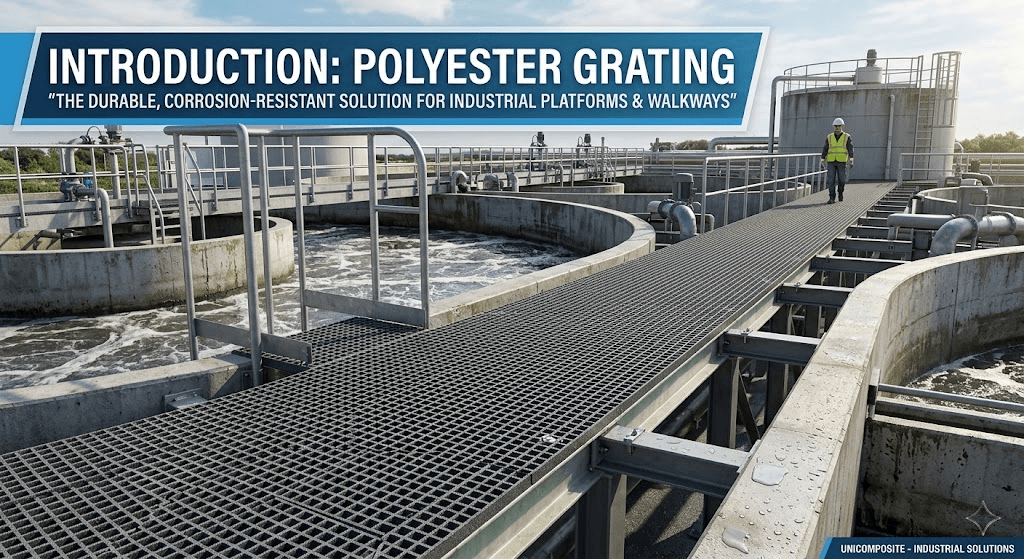
Wastewater treatment facilities are the highest-volume application. At one mid-scale municipal treatment plant, a maintenance team replaced corroded galvanized steel walkways above aeration basins with isophthalic molded polyester grating. The steel had required repainting every four years; the FRP installation has run twelve years without a surface treatment intervention. Walkways over aeration basins, dewatering platforms, and filter press access are chronically wet, exposed to H₂S off-gassing, and subject to regular foot traffic — a combination that eliminates coated steel as a viable long-term option.
Agricultural and aquaculture operations benefit from polyester grating’s resistance to fertilizers, animal waste effluent, and saline aquaculture water. Slatted flooring, drainage grating, and feed platform decking in these settings are strong candidates — particularly in humid tropical climates where steel corrosion rates are sharply accelerated.
Cooling tower construction demands materials that handle continuous moisture, biocide chemical treatment, and thermal cycling. Polyester grating is widely specified for infill support structures, fan deck walkways, and basin covers, where it eliminates the maintenance loop that steel systems generate within the first five years of service.
Chemical processing secondary containment and walkways suit polyester grating where the chemical exposure profile falls within isophthalic polyester’s documented resistance range — dilute acids, salts, and alkalis in ambient temperature service.
Coastal and marine utility structures — jetty walkways, boat landing platforms, offshore utility decks — benefit from polyester grating’s salt spray resistance and zero galvanic corrosion risk, particularly where steel pitting or aluminum chloride attack would otherwise drive frequent replacement cycles.
Where Polyester Grating Reaches Its Limits
Honest specification requires knowing where to stop recommending a material. Polyester grating is not the right choice in every corrosive environment.
Sustained service temperatures above 120°C will compromise resin integrity over time. For high-temperature process environments, phenolic FRP or high-temperature-rated vinyl ester is the appropriate alternative. Applications involving direct contact with concentrated oxidizing acids — concentrated sulfuric, nitric, or chromic acid — exceed polyester resin’s resistance capability; vinyl ester grating is the correct specification upgrade for those chemical service conditions.
Where building codes require fire retardancy performance beyond a Class 1 flame spread rating (Flame Spread Index ≤ 25 per ASTM E84), standard polyester grating may not qualify without a specific fire-retardant resin formulation. Always confirm FR rating requirements before finalizing resin specification.
Matching the resin to the actual chemical service condition — not the worst-case scenario — is how procurement managers protect both budget and long-term platform performance.
introduction polyester grating
How to Specify Polyester Grating for Your Project
Key Specification Parameters
A complete polyester grating specification covers seven variables. Treating any one of them as an afterthought creates ambiguity in the supply chain and risk in the installed product. Unicomposite’s engineering team works through this same checklist when reviewing incoming RFQs — submitting it fully populated at the inquiry stage compresses lead time and eliminates revision cycles.
- Resin grade — orthophthalic (general duty) or isophthalic (industrial/corrosive service)
- Panel type — molded or pultruded, driven by load direction and span requirements
- Panel depth and mesh opening — e.g., 25mm depth / 38×38mm mesh; set by load table analysis
- Load class — uniform load rating at the design span, with deflection limit (typically L/100)
- Surface finish — gritted (standard), concave, or covered top; smooth or gritted bottom
- Color and UV package — specify UV-stable surface veil for outdoor or high-UV environments
- Compliance requirements — OSHA walking surface standards, local fire codes, project-specific testing
Provide the operating chemical environment to your supplier in writing. A credible manufacturer will cross-reference your chemical list against published resin resistance data and flag any conflicts before production — not after installation.
Custom Fabrication and Lead Time Considerations
Standard panel sizes cover most applications, but industrial projects rarely fit cleanly into standard dimensions. Secondary fabrication — panel cutting to shape, banded or nosing edges, stair tread nosings, toe kick plates, and clip or fastener systems — is a normal part of a grating supply package and should be specified at the RFQ stage.
Pultrusion-capable manufacturers can also produce non-standard bar profiles and structural shapes that integrate with grating panels for complete platform systems, reducing the number of suppliers on a project. For stock standard panels, lead times of 1–3 weeks are typical. Custom-fabricated or custom-color orders typically run 3–6 weeks depending on order volume and factory scheduling.
Building fabrication requirements into the project timeline — not treating them as a last-mile detail — is one of the most reliable ways procurement managers protect installation schedules on platform-heavy projects.
Conclusion
Polyester grating delivers a specific and well-defined performance profile: strong corrosion resistance in mild-to-moderate chemical environments, non-conductive properties, 75–80% weight savings over steel, and a 20–25 year service life with minimal maintenance. Its value is clearest in wastewater treatment, agriculture, aquaculture, cooling towers, and coastal utility applications where steel maintenance cycles erode total cost of ownership over time.
The manufacturing method — molded for bidirectional strength and full resin encapsulation, pultruded for high-span structural loads — shapes performance as much as the resin does. Specifying the wrong panel type for the load orientation is as consequential as selecting the wrong resin for the chemical environment.
Isophthalic polyester is the baseline resin for serious industrial use. Orthophthalic suits general, low-exposure applications. Vinyl ester is the correct upgrade when concentrated acid exposure or extended chemical resistance is required — and knowing where that line sits is what separates a reliable specification from a costly one.
A complete specification covers resin grade, panel type, depth, mesh size, load class, surface finish, and compliance requirements. Submitting that information at RFQ stage drives better pricing, shorter lead times, and fewer change orders on site.
[Contact Unicomposite for a custom polyester grating specification and quote →]
Frequently Asked Questions
Polyester resin offers solid corrosion resistance in mild-to-moderate chemical environments at a lower cost point. Vinyl ester resin provides a wider chemical resistance range — particularly against concentrated acids and oxidizing chemicals — and longer service life in aggressive conditions. For most wastewater, agricultural, and coastal utility applications, isophthalic polyester is adequate; vinyl ester is the specification upgrade when the chemical brief exceeds polyester’s documented resistance range.
Standard molded polyester grating is designed for pedestrian and light equipment loads. Heavy vehicle or forklift loads typically require pultruded grating with deep bearing bars, engineered panel-to-support spacing, and a load analysis specific to the vehicle weight and wheelbase. Always request a manufacturer load table and have a structural engineer confirm support spacing before specifying for vehicular traffic.
Key documentation to request includes ISO 9001 manufacturing quality certification, ASTM C581 chemical resistance test data for the resin system, and ASTM E84 flame spread rating if fire retardancy is a project requirement (Class 1 = Flame Spread Index ≤ 25). Panel-specific load tables tested to recognized standards and material test certificates (MTC) per production batch are standard practice for B2B procurement relationships.
FRP grating panels are secured using manufacturer-supplied clip systems — typically M-clips or saddle clips — that fasten to the supporting structure without drilling through the panel face. This preserves the corrosion-resistant resin surface at every connection point. Panels can be field-cut using carbide-tipped saw blades; cut edges should be sealed with catalyzed resin to maintain corrosion resistance at the cut face.
A silicon carbide gritted top surface is the standard specification for wet walkway applications, providing a slip-resistance coefficient typically ≥ 0.8 in wet conditions per ASTM D2047. For environments where debris accumulation in the grit surface is a hygiene concern — food processing or pharmaceutical facilities, for example — a covered or solid-top panel with a profiled surface is worth evaluating as an alternative.


