 info@unicomposite.com


Introduction
Corrosion costs industrial facilities an estimated 3.4% of GDP in developed economies, according to the NACE/AMPP International Measures of Prevention, Application, and Economics of Corrosion Technologies (IMPACT) study — and in chemically aggressive or high-humidity environments, grating and flooring systems are among the first assets to degrade. For engineers and procurement managers specifying walkway, platform, and trench cover materials, the gap between upfront cost and total cost of ownership is where most decisions go wrong.
This article delivers a direct, criteria-by-criteria comparison of anti-slip FRP grating and steel grating. You’ll find clear guidance on where each material wins, where it falls short, and how to match the right choice to your operating environment.
Unicomposite, an ISO-certified pultrusion manufacturer with production lines serving power utilities, wastewater treatment, agriculture, marine, and industrial construction sectors, has compiled this comparison based on real-world application data and engineering feedback across these verticals.
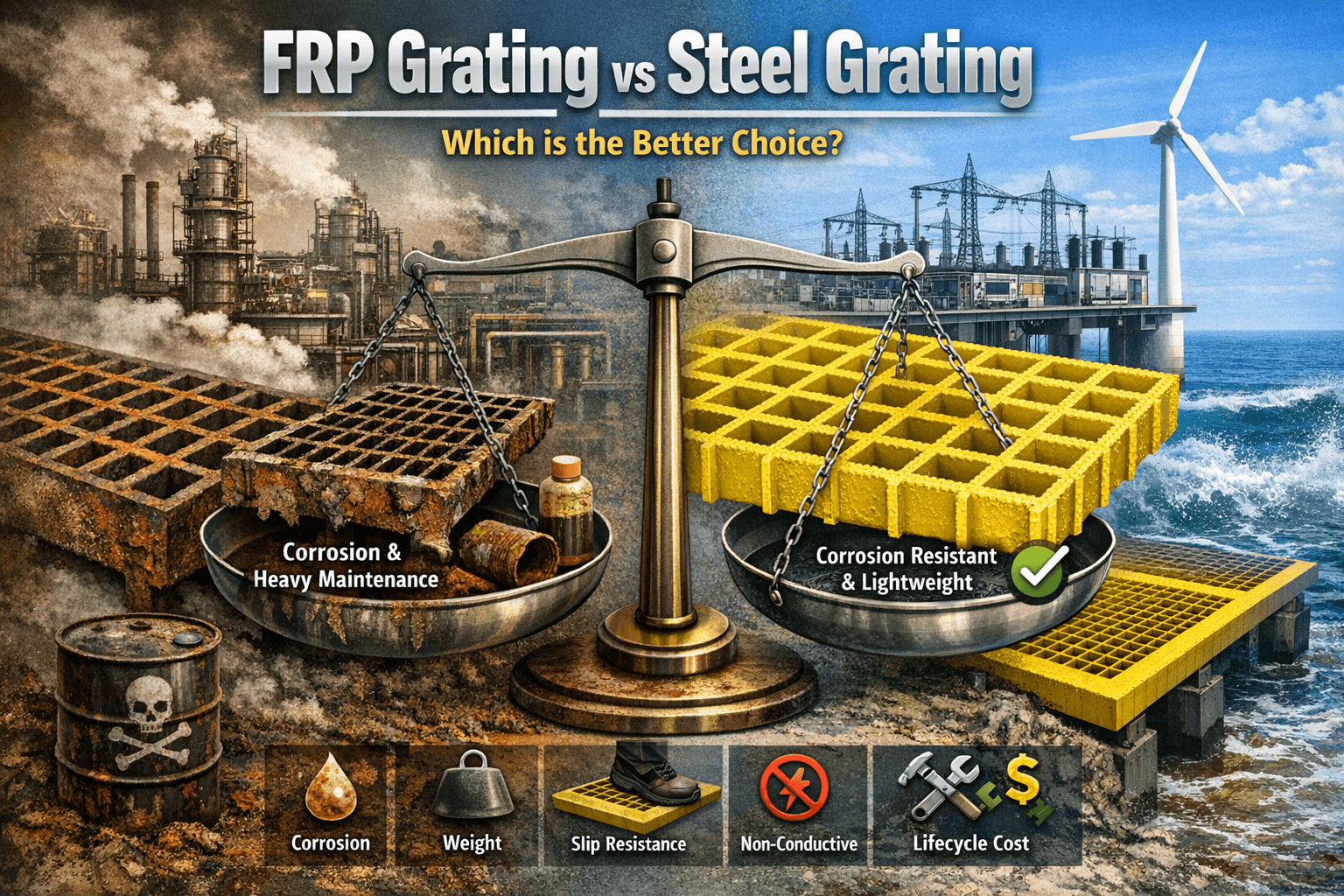
frp grating vs steel gratingpng
What Is Anti-Slip FRP Grating?
How It’s Made: The Pultrusion and Molding Process
FRP grating is produced through two primary methods: molded (hand lay-up) and pultruded. Molded FRP grating is manufactured by layering fiberglass rovings and resin in a mold, producing a bi-directional panel with uniform strength in both axes — well suited for general platform and walkway use.
Pultruded FRP grating is formed by pulling continuous fiberglass strands through a resin bath and a heated die, yielding higher unidirectional strength and tighter dimensional tolerances. Anti-slip surface performance is achieved through three main methods: broadcast grit coating (aluminum oxide or silica applied to the top surface), concave molded surface texture, or a meniscus (raised dome) top — each offering different grip levels and cleaning characteristics.
Key Physical and Mechanical Properties
Standard molded FRP grating panels typically measure 1,220 × 3,660 mm, with bearing bar depths ranging from 25 mm to 50 mm depending on span and load requirements. Resin systems include isophthalic polyester (general industrial use), vinyl ester (enhanced chemical resistance), and phenolic (fire-rated applications). Unicomposite’s production lines run all three resin systems, with vinyl ester being the most commonly specified for chemical processing and marine applications based on customer requirements across these sectors.
Surface load capacities vary by panel thickness and support spacing, but mid-range molded panels commonly achieve 3.0–5.0 kN/m² under standard industrial loading per ASTM E985 and ISO 14122 guidance. All FRP grating products should be evaluated against relevant dimensional and load standards — including ASTM D4385 for grating performance — before final specification.
Head-to-Head: FRP vs Steel Grating Across 6 Key Criteria
Both materials have a legitimate place in industrial specification — but they perform very differently across the criteria that matter most to long-term asset management. The table below provides a direct comparison across six critical performance dimensions.
| Criteria | Anti-Slip FRP Grating | Steel Grating |
|---|---|---|
| Corrosion Resistance | Excellent — unaffected by moisture, salt, most chemicals | Poor to moderate — requires coating, prone to rust |
| Weight | ~75% lighter than equivalent steel panel | Heavy — increases structural support requirements |
| Slip Resistance | High — grit, meniscus, or concave surface standard | Moderate — serrated bar; degrades when painted or corroded |
| Dielectric Properties | Non-conductive — suitable for electrical environments | Conductive — risk in high-voltage or live equipment areas |
| Lifecycle Maintenance Cost | Very low — no repainting, no rust remediation | High — periodic blasting, coating, and replacement cycles |
| Installation Effort | Easy — lightweight panels, standard hand tools | Labor-intensive — heavier panels, often requires lifting equipment |
Corrosion Resistance and Chemical Compatibility
In wastewater treatment and chemical processing plants, engineers consistently report that galvanized or painted steel grating requires maintenance intervention within 3–7 years in wet or chemically active zones, while FRP panels in the same environments often reach 20+ years based on published service histories for vinyl ester resin systems in comparable chemical exposure conditions. The resin matrix in FRP grating fully encapsulates the glass fibers, eliminating the corrosion pathway that makes steel vulnerable.
Vinyl ester resin systems extend this advantage further — delivering resistance to acids, alkalis, chlorine, and many organic solvents at concentrations that would rapidly degrade even hot-dip galvanized steel. This corrosion immunity directly reduces lifecycle cost, a point procurement managers often underweight when comparing upfront material prices.
Weight, Load-Bearing, and Structural Performance
A standard 38 mm deep molded FRP grating panel weighs approximately 12–17 kg/m², compared to 30–45 kg/m² for a comparable steel bar grating panel. That 70–75% weight reduction has structural and logistical consequences: lighter substructure requirements, lower crane and rigging costs during installation, and significantly reduced manual handling risk for maintenance teams.
Load-bearing performance is where the comparison requires more nuance. FRP grating performs reliably under standard pedestrian and light equipment loads, and engineered pultruded panels can meet demanding structural specifications. Under concentrated point loads or heavy vehicle traffic, however, steel’s higher modulus of elasticity gives it a measurable advantage — a distinction explored in the sections below.
Dielectric and Non-Magnetic Properties
FRP grating’s non-conductive properties are not incidental — they are a primary specification driver in power generation, electrical substation, and high-voltage switchgear environments. Unlike steel, FRP grating does not conduct electricity, does not generate sparks on impact, and does not interfere with sensitive electromagnetic equipment. IEC 61936-1 and related power installation standards increasingly reference non-conductive flooring and walkway materials in live equipment zones.
For operations directors at power utilities, this single property can eliminate an entire category of arc flash and electrocution risk — making FRP grating a safety compliance tool, not just a flooring choice.
Where Anti-Slip FRP Grating Outperforms Steel
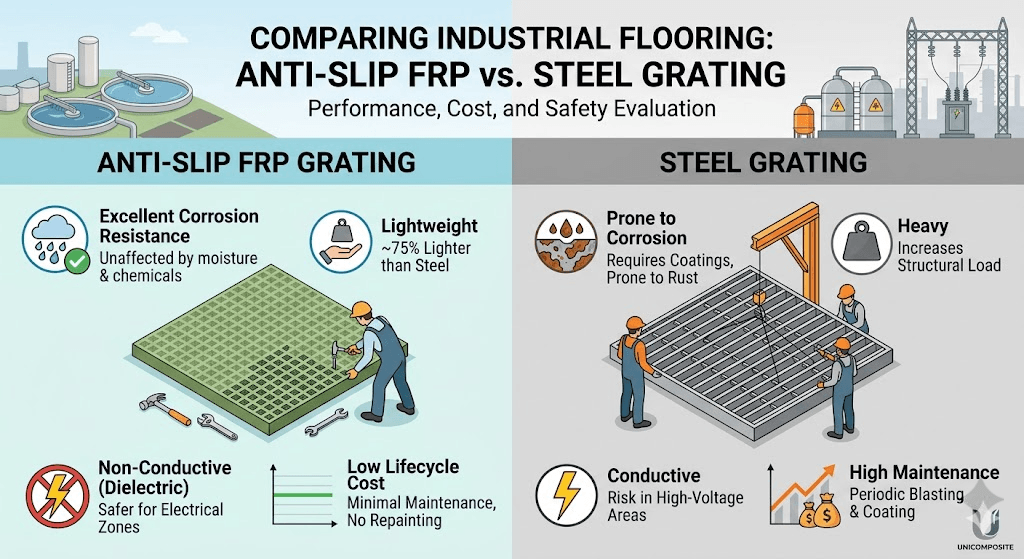
antislip frp grating
The table above signals where FRP’s advantages are most decisive — and the three environments below show what those advantages mean in practice.
Coastal, Marine, and High-Humidity Environments
An anonymized case from a Southeast Asian offshore platform illustrates the cost gap clearly. The facility replaced steel grating on its upper deck walkways with vinyl ester FRP panels after corrosion-driven replacements occurred on a 4-year cycle. The replacement specification used 38 mm deep molded vinyl ester panels at 600 mm support spacing — a configuration the maintenance team could install without lifting equipment. Over a 12-year horizon, the switch reduced grating-related material and installation labor costs by over 60%, with additional savings from eliminated production downtime during replacement shutdowns.
Salt spray, condensation, and cyclic wet-dry exposure — conditions that accelerate steel corrosion exponentially — have no meaningful effect on the FRP matrix. Coastal processing plants, marine jetties, aquaculture platforms, and offshore structures represent the strongest business case for FRP specification.
Electrical and High-Voltage Facilities
Beyond the dielectric properties covered above, anti-slip FRP grating offers a non-sparking surface that matters in environments where flammable vapors or gases may be present — refineries, gas processing units, battery storage facilities. Steel grating, when struck by dropped tools or equipment, can generate ignition-capable sparks.
Phenolic resin FRP grating adds a fire-resistance dimension, achieving Class 1 flame spread ratings per ASTM E84, making it suitable for facilities where fire code compliance governs material selection.
Agricultural and Aquaculture Operations
Chemical exposure in agricultural environments — fertilizer solutions, pesticide runoff, animal waste acids — presents a corrosion profile similar to light industrial chemical service. Steel grating in livestock housing and aquaculture tank walkways typically shows visible degradation within 2–3 seasons, and corroded surfaces present both hygiene and slip hazard concerns. Facility managers operating livestock housing report that FRP panels remain visually clean and structurally sound through 5+ years of daily washdown cycles that leave steel surfaces visibly pitted.
FRP grating’s smooth, non-porous surface (particularly in molded panels) resists bacterial adhesion and is compatible with high-pressure washdown. Lightweight panels also reduce installation and repositioning labor in facilities where layouts change seasonally.
Where Steel Grating Still Has the Edge
Not every application favors FRP. The table below maps specific use cases to the recommended material — and understanding these boundaries is just as important as knowing where FRP excels.
| Use Case | Recommended Material | Primary Reason |
|---|---|---|
| Heavy forklift and vehicle traffic areas | Steel | Higher modulus, better point load resistance |
| High-temperature process environments (>120°C) | Steel | FRP resin service temperature limits |
| Budget-constrained, short-horizon projects | Steel | Lower upfront material cost |
| Structural flooring with heavy dynamic loads | Steel | Superior impact resistance and stiffness |
Extreme Mechanical Load and Impact Scenarios
Steel’s modulus of elasticity (~200 GPa) far exceeds that of standard FRP grating (~17–45 GPa depending on construction and fiber orientation). In areas subject to repeated forklift passes, heavy pallet drops, or dynamic impact loading, steel grating deflects less and absorbs impact energy more predictably. Specifying FRP in these zones without engineered load analysis risks premature delamination or surface cracking.
For mixed-use industrial floors — vehicle lanes adjacent to pedestrian walkways — a zoned specification approach often makes sense: steel where vehicles operate, FRP where foot traffic and maintenance access are the primary load cases. That boundary is where the temperature limitation becomes the next relevant filter.
High-Temperature Environments
Standard polyester and vinyl ester FRP grating systems are typically rated to 80–120°C continuous service temperature. Phenolic resin systems extend this to approximately 150–180°C. Above these thresholds, resin degradation compromises structural integrity. Steel grating, by contrast, maintains performance at temperatures well beyond 300°C, making it the only practical choice for hot process decks, furnace platforms, and similar high-heat zones.
Initial Cost Sensitivity
On a per-square-meter basis, FRP grating typically carries a meaningful premium over standard mild steel bar grating at point of purchase. For short-duration projects, temporary structures, or applications in dry, non-corrosive environments, that upfront cost difference is unlikely to be recovered through maintenance savings. In these scenarios, galvanized steel grating remains the rational specification choice.
Conclusion
Choosing between anti-slip FRP grating and steel grating is fundamentally a lifecycle decision, not a materials catalog exercise. Five criteria anchor the specification framework:
- Corrosive or wet environment? FRP grating’s corrosion immunity delivers clear long-term cost advantage over any steel option.
- Electrical or spark-sensitive area? FRP’s dielectric and non-sparking properties make it the safer and often code-compliant choice.
- Heavy vehicle or extreme impact loads? Steel’s higher modulus makes it the structurally reliable option where point loads govern.
- High-temperature process environment? Steel handles heat that exceeds FRP resin system limits.
- Tight upfront budget, benign environment? Galvanized steel grating is a sound short-horizon choice.
For most industrial, utility, marine, and agricultural applications, the combination of corrosion immunity, lightweight handling, and low maintenance cost makes anti-slip FRP grating the stronger long-term investment.
[Contact Unicomposite for anti-slip FRP grating specifications and a custom quote →]
Frequently Asked Questions
Look for manufacturers holding ISO 9001 certification as a baseline quality management indicator. Product-level compliance with ASTM E985 (grating load performance) and ASTM E84 (flame spread, for phenolic grades) is also relevant for most industrial specifications. For electrical environments, confirm dielectric testing has been performed to applicable IEC standards.
Yes. FRP grating panels can be cut on-site using standard carbide-tipped or diamond-blade tools. For complex layouts, manufacturers like Unicomposite can supply pre-cut panels to engineering drawings, reducing installation labor and material waste. Cut edges on molded panels should be sealed with compatible resin to maintain corrosion resistance at the exposed fiber ends.
Standard panel sizes in common resin systems typically ship within 2–4 weeks from stock. Custom panel dimensions, specialized resin formulations, or large-volume project orders generally require 4–8 weeks production lead time. Buyers managing project schedules should confirm lead times during the RFQ stage rather than at order placement.
Standard FRP grating without UV stabilization will experience surface chalking and minor color fade over time, though structural properties are not significantly affected in most grades. UV-stabilized resin systems and surface veils are available for outdoor applications where appearance retention matters. For long-term outdoor installations, specifying a UV-resistant surface layer at the design stage is more cost-effective than addressing degradation after installation.
FRP grating is used in food processing applications, particularly in wet processing areas where corrosion and bacterial contamination from steel surfaces are concerns. Resin system selection is critical — isophthalic polyester and vinyl ester grades with smooth molded surfaces are the most common choices. Buyers in regulated industries should confirm that the specific resin system meets relevant FDA or EU food contact material guidelines before specification.


