 info@unicomposite.com


Introduction
Railway infrastructure operates in some of the most punishing environments imaginable. Trackside walkways, platform edges, drainage covers, and bridge decking face constant exposure to moisture, chemical contamination, mechanical impact, and — critically — live electrical systems. For decades, steel grating was the default choice. It is strong, familiar, and widely available. But familiarity has a cost: steel corrodes, conducts electricity, and demands continuous maintenance budgets that erode the economics of long-term asset ownership.
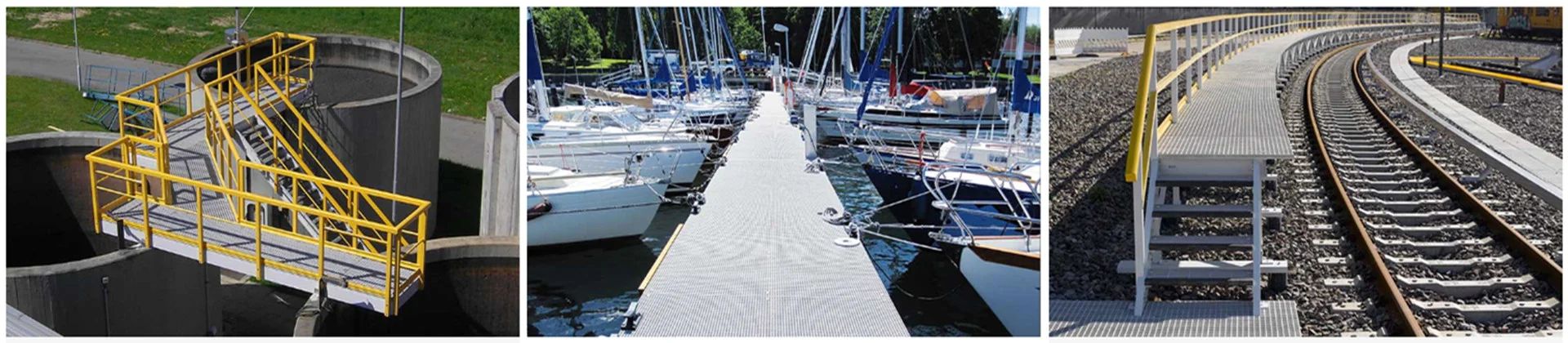
Fiberglass grating — manufactured through processes such as pultrusion and molding using fiberglass-reinforced plastic (FRP) — addresses each of these failure modes directly. For rail infrastructure buyers, specifiers, and maintenance engineers evaluating material upgrades, this guide covers what fiberglass grating actually delivers in railway environments: the safety case, the performance data, and the procurement considerations that matter.
Unicomposite, an ISO-certified pultrusion manufacturer with dedicated in-house production lines, supplies FRP grating and structural profiles to clients across power, civil, and industrial sectors — including applications where electrical safety and corrosion resistance are non-negotiable. One pattern that appears consistently in rail project enquiries: buyers unfamiliar with FRP often arrive with a steel-equivalent mindset, specifying panel dimensions and load ratings directly from their existing steel drawings without accounting for the different deflection behavior of FRP under concentrated loads. Getting specification right from the outset avoids costly redesign later — and it is one of the areas where working directly with a manufacturer’s engineering team pays for itself quickly.
fiberglass grating for railway
The Unique Demands of Railway Environments
Exposure Challenges: Moisture, Chemicals, and Heavy Loads
Railway assets are rarely in benign locations. Coastal lines face salt-laden air. Urban transit systems deal with diesel particulates, de-icing salts, and pooling groundwater. Maintenance walkways alongside active track take repeated foot traffic, tool drops, and occasional vehicle loading during possession windows.
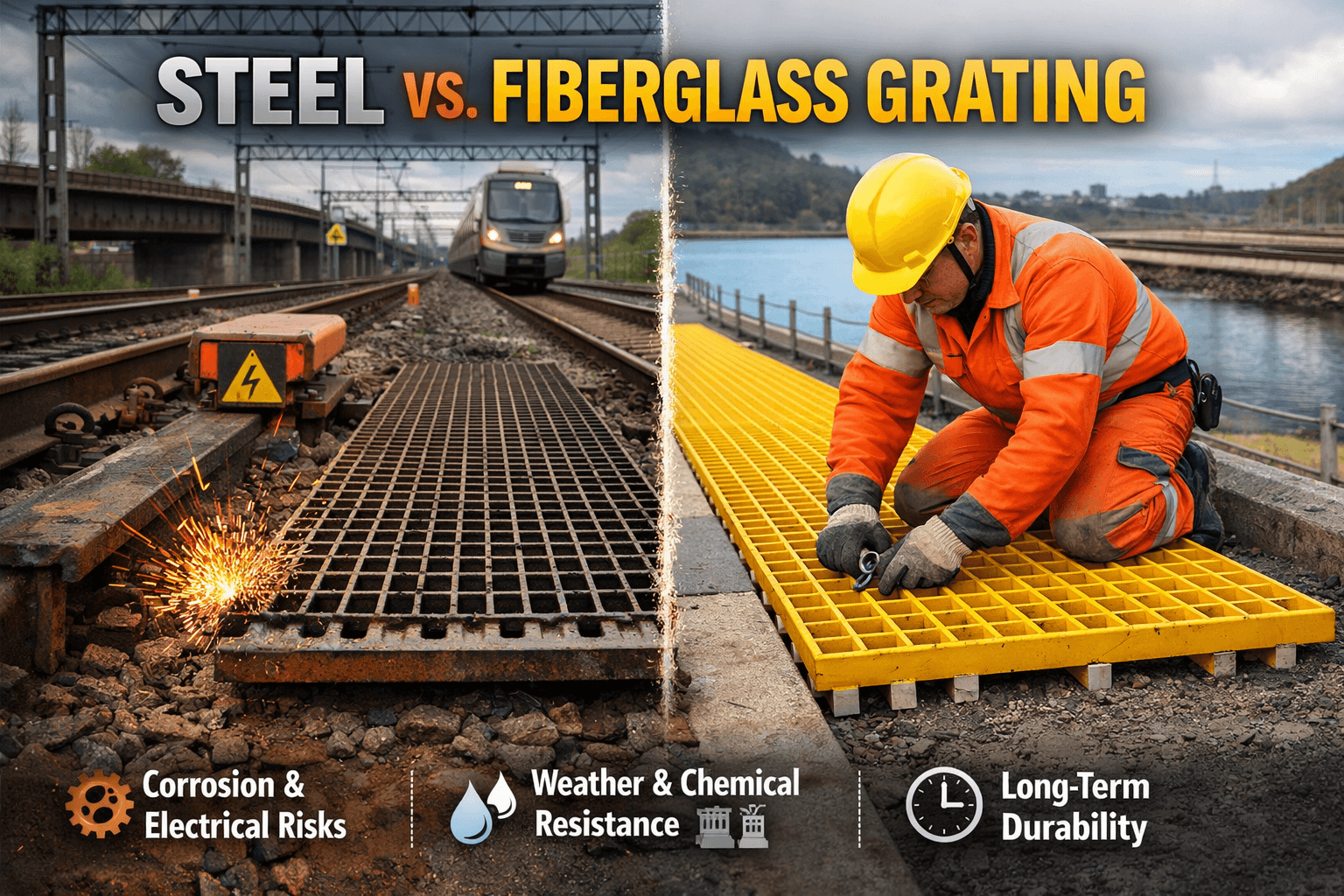
Steel grating in these conditions requires galvanizing, regular inspection, and eventual replacement — typically within 10 to 15 years in high-corrosion zones. Each replacement means track access, labor, and disposal costs on top of the material itself.
Fiberglass grating is chemically inert to the majority of substances encountered in rail environments. It does not rust, does not require surface treatment, and does not degrade from salt or mild acid contact. For infrastructure owners managing assets over 30- to 50-year horizons, this is a meaningful shift in maintenance economics.
Electrical Safety Requirements
Electrified rail networks — whether third-rail DC systems or overhead AC catenary — require that any material used near live infrastructure is electrically non-conductive. This is not a preference; in many jurisdictions it is a formal safety requirement embedded in infrastructure procurement standards.
Steel grating, by nature, is a conductor. Installing it near live rail, junction boxes, or substation access areas introduces risk for maintenance personnel. Fiberglass grating has a dielectric strength typically exceeding 100 kV/mm, making it inherently safe in these environments without additional insulating treatment. Network Rail in the UK and equivalent infrastructure managers in other markets have incorporated FRP materials into approved supplier frameworks specifically because of this property. This characteristic alone drives a significant portion of FRP adoption in electrified rail systems globally.
Key Safety Advantages of Fiberglass Grating in Rail Applications
Non-Slip Surface Performance
Trackside conditions change fast. A dry platform walkway in the morning can be wet, oily, or ice-coated by afternoon. Non-slip performance is a life-safety issue, not a comfort feature.
Fiberglass grating is available with two primary surface treatments for traction:
- Gritted surface: Aluminum oxide or silica grit bonded into the top surface, providing aggressive grip in wet or contaminated conditions.
- Meniscus surface: A concave profile molded into the top bars that channels liquid away from contact points, maintaining grip without grit wearing off over time.
In comparative testing conducted in accordance with ASTM C1028 (standard test method for determining the static coefficient of friction of ceramic tile and other like surfaces), FRP grating with gritted surfaces consistently outperforms bare steel and aluminum in wet-condition measurements. For rail operators managing platform and trackside safety obligations, this translates to measurable, documentable risk reduction.
Fire Resistance and Low Smoke Emission
In enclosed railway spaces — tunnels, underground stations, covered maintenance facilities — fire behavior of structural materials is tightly regulated. Standard polyester resin FRP grating has limited fire resistance. However, fire-retardant (FR) resin systems are available that meet demanding railway specifications.
FR-grade fiberglass grating can achieve:
- ASTM E84 Class 1 (Class A) flame spread ratings
- Low smoke density per ASTM E662 — critical in evacuation scenarios
- Compliance with BS 6853 and other national rail fire standards where specified
Specifiers working on underground or semi-enclosed rail projects should confirm the resin system with their manufacturer before ordering. The difference between a standard and FR-rated panel is not visible to the eye but is significant in a fire event.
Electrical Non-Conductivity
Fiberglass grating’s non-conductive property goes beyond preventing direct electrocution. It also eliminates the risk of stray current pathways that can form in steel structures near DC rail systems — a known cause of accelerated galvanic corrosion in adjacent metalwork and buried infrastructure.
For maintenance personnel working in substations, alongside third rails, or under overhead line equipment, FRP walkways and platforms eliminate a category of electrical risk entirely. This is a particularly compelling argument in retrofit projects where replacing steel grating in sensitive zones significantly reduces the electrical hazard assessment burden for the site.
Performance Benefits Over the Asset Lifecycle
Corrosion Resistance and Service Life
The lifecycle economics of fiberglass grating versus steel are well-documented in industrial sectors. In railway applications, the comparison is similarly favorable.
A galvanized steel grating panel in a high-humidity, salt-exposed coastal rail environment may require replacement within 10–12 years. Protective coatings help, but they degrade, chip, and require periodic reapplication. An equivalent FRP panel in the same environment routinely achieves 25 years or more of service life with no surface treatment required.
Over a 30-year asset horizon, the installed cost differential between steel and FRP often closes completely once maintenance, inspection, and replacement labor is factored in. For large-scale rail projects with hundreds or thousands of square meters of grating, this is a procurement argument worth modeling in detail before committing to a material specification.
Lightweight Construction and Easy Installation
Fiberglass grating is approximately 70–75% lighter than steel grating of equivalent load rating. For rail projects, this has two direct practical benefits.
First, panels can be handled by two workers without mechanical lifting equipment — important when access to trackside locations is constrained by working space or site safety rules. Second, during planned maintenance possessions where every minute of track access is expensive, faster panel installation and removal reduces possession time. Rail contractors working with FRP grating consistently report that replacement operations can be completed in significantly less time than equivalent steel work.
The weight advantage also reduces imposed loads on supporting steelwork and bridge decks — occasionally allowing lighter primary structure and contributing to overall project cost reduction.
Dimensional Stability and Custom Fabrication
Pultrusion — the continuous manufacturing process used for FRP structural profiles — produces consistent, tight-tolerance sections with predictable mechanical properties. Unlike cast or welded steel assemblies, pultruded fiberglass grating frames and support sections maintain their dimensions across temperature ranges without significant thermal expansion or warping.
Unicomposite’s in-house pultrusion lines allow for custom panel sizes, load-rated configurations, and color options to be produced at scale. For large rail contracts where standard panel sizes do not match existing support structures, cut-to-size panels reduce site waste and labor compared to on-site cutting of steel. Custom fabrication also enables integration of edge banding, pre-drilled fixing holes, and color-coded safety markings — details that matter on managed rail infrastructure.
Selecting the Right Fiberglass Grating for Your Railway Project
Mesh Size, Bar Profile, and Load Rating
Not all fiberglass grating specifications suit all railway applications. Key variables include:
- Mesh opening size: Smaller mesh (e.g., 38×38mm) suits pedestrian walkways where tool or heel-drop risk is a concern. Larger mesh improves drainage in trackside drainage channel covers.
- Bar height and thickness: Deeper bars carry higher loads. As a general reference, a 25mm bar height is appropriate for light pedestrian duty; 38mm or 50mm bar heights are used for maintenance vehicle crossings or high-load platform applications. Deflection under load should be calculated using the manufacturer’s published load tables for the specific span and support configuration — direct substitution of steel panel dimensions is not reliable.
- Load rating: Specify the grating to its actual use case. Over-specifying wastes cost; under-specifying creates a safety liability.
Resin System Selection
The resin matrix determines the chemical and fire performance envelope of the grating:
- Orthophthalic polyester: General-purpose, cost-effective, suitable for low-chemical-exposure locations.
- Isophthalic polyester: Better moisture and mild chemical resistance; a reasonable upgrade for most rail environments.
- Vinyl ester: High resistance to acids, alkalis, and solvents — recommended for areas near battery rooms, chemical storage, or heavy salt exposure.
- Phenolic resin: Best-in-class fire and smoke performance for tunnel and underground applications; typically specified where BS 6853 or equivalent standards apply.
Matching resin to environment is not a marginal decision. A mis-specified resin system can result in early degradation or, in fire scenarios, non-compliance with the project’s safety case.
Limitations and Considerations
Fiberglass grating is the right material for a well-defined set of conditions — but it is not universally optimal. Buyers should be aware of the following constraints:
- High point-load applications: FRP grating has lower impact resistance than steel under sharp, concentrated loads (e.g., metal tool drops from height or forklift tine contact). In areas with high point-load risk, protective measures or alternative materials may be more appropriate.
- UV exposure: Standard FRP grating can degrade in high UV environments over time without a UV-stabilized resin system or surface veil. This is easily addressed at the specification stage but must be explicitly requested.
- Upfront cost: FRP grating typically carries a higher purchase price than equivalent steel. For projects where capital budget is tightly constrained and lifecycle cost modeling is not part of the procurement process, this may be a limiting factor. The lifecycle case for FRP is strong, but it requires a total cost of ownership framing that not all procurement frameworks support.
Working with a Qualified Manufacturer
For B2B rail procurement, the manufacturer’s credentials matter as much as the product specification. Key criteria include:
- ISO certification: Confirms quality management systems are in place for consistent production.
- In-house manufacturing: Reduces supply chain risk and enables custom fabrication without third-party intermediaries.
- Engineering support: The ability to assist with load calculations, specification review, and compliance documentation.
- Bulk supply capability: Large rail projects require reliable volume and delivery scheduling.
Unicomposite holds ISO certification and operates dedicated pultrusion production lines capable of handling standard and custom FRP grating orders for rail and civil infrastructure clients. Engineering consultation is available for projects requiring specification support, load analysis, or resin system selection guidance.
Conclusion
Fiberglass grating for railway applications is not a niche substitution — it is a technically superior choice for a well-defined set of conditions: corrosive environments, electrically sensitive zones, and infrastructure where lifecycle cost matters more than upfront unit price.
The safety case is clear: non-slip surface performance, fire-rated resin systems, and inherent electrical non-conductivity reduce risk to personnel and infrastructure across the full asset life. The performance case is equally strong — 25-plus year service life, minimal maintenance demand, and lightweight handling that cuts installation time and labor cost in constrained trackside environments.
For procurement teams, infrastructure engineers, and rail contractors evaluating material specifications, fiberglass grating warrants a formal comparison against steel on total installed and lifecycle cost — not unit price alone. The analysis consistently favors FRP in environments where corrosion, electrical safety, and access constraints are present.
Ready to specify FRP grating for your next railway project? Contact Unicomposite to discuss load requirements, resin selection, custom fabrication options, and bulk supply scheduling for your application.
Frequently Asked Questions
Can fiberglass grating meet the load requirements of heavy railway maintenance applications? Yes, when correctly specified. FRP grating is available in bar heights from 25mm to 50mm and above, with load tables published by manufacturers for standard span configurations. For vehicle crossing or high-load maintenance platform applications, a 38mm or 50mm bar height with appropriate support spacing will typically meet requirements. Always verify against the manufacturer’s load deflection data for your specific span.
What fire rating should I specify for tunnel or underground station installations? For enclosed rail environments, specify a phenolic resin system or a fire-retardant vinyl ester resin capable of achieving ASTM E84 Class 1 flame spread and low smoke density per ASTM E662. For UK projects, confirm compliance with BS 6853. Discuss your project’s specific fire safety case with the manufacturer before finalizing the resin specification.
How does fiberglass grating perform near electrified third-rail or overhead line infrastructure? FRP grating is electrically non-conductive with a dielectric strength typically exceeding 100 kV/mm, making it inherently safe for installation in and around electrified rail zones. Unlike steel, it introduces no stray current pathways and requires no additional insulation treatment.
Is fiberglass grating suitable for coastal or high-salt railway environments? It is one of the strongest use cases for FRP. Fiberglass grating does not rust, requires no surface treatment, and resists salt, moisture, and mild chemical exposure without degradation. In coastal environments where steel grating typically requires replacement within 10–12 years, FRP panels routinely achieve 25 or more years of service life.
Can panels be custom-fabricated to non-standard dimensions for retrofit rail projects? Yes. Manufacturers operating in-house pultrusion lines — such as Unicomposite — can produce cut-to-size panels, custom bar profiles, and pre-drilled fixing configurations. For retrofit projects where existing support structures do not match standard panel sizes, custom fabrication reduces site waste and installation time significantly


