 info@unicomposite.com


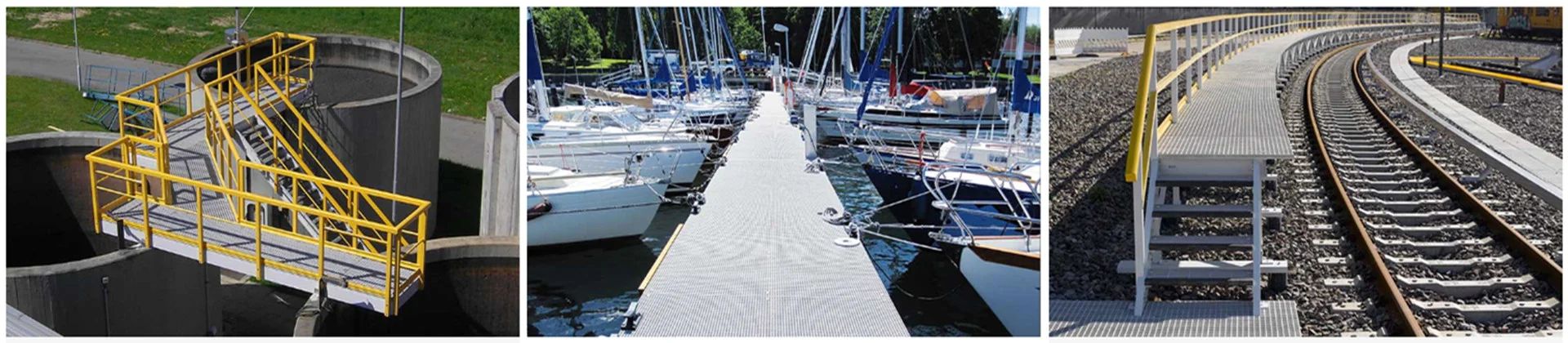
Introduction
A maintenance engineer at a mid-sized wastewater treatment plant once described the moment she realized their galvanized steel walkways had to go: “We were repainting every 18 months, and the handrails were still rusting through between cycles. We needed something that simply didn’t care about the environment it was in.”
That shift in thinking — from material tolerance to material immunity — is what drives the growing adoption of FRP grating and handrail systems across heavy industry. Built from fiberglass-reinforced plastic, these structural systems resist corrosion, carry significant loads, and outlast traditional metals in the environments where metals struggle most: wet, chemically aggressive, or electrically sensitive settings.
Unicomposite is an ISO-certified pultrusion manufacturer with dedicated production lines for FRP profiles and composite systems, serving clients across power utilities, wastewater treatment, marine construction, agriculture, and aquaculture. Their manufacturing capability spans pultrusion, pulwinding, SMC/BMC, and hand lay-up processes — making them a practical partner for bulk buyers and OEM clients who need both standard profiles and fully engineered custom solutions, exported to industrial markets worldwide.
This guide covers what FRP grating and handrail systems are, where they perform best, how to select the right specification, and what responsible installation and maintenance looks like in practice.
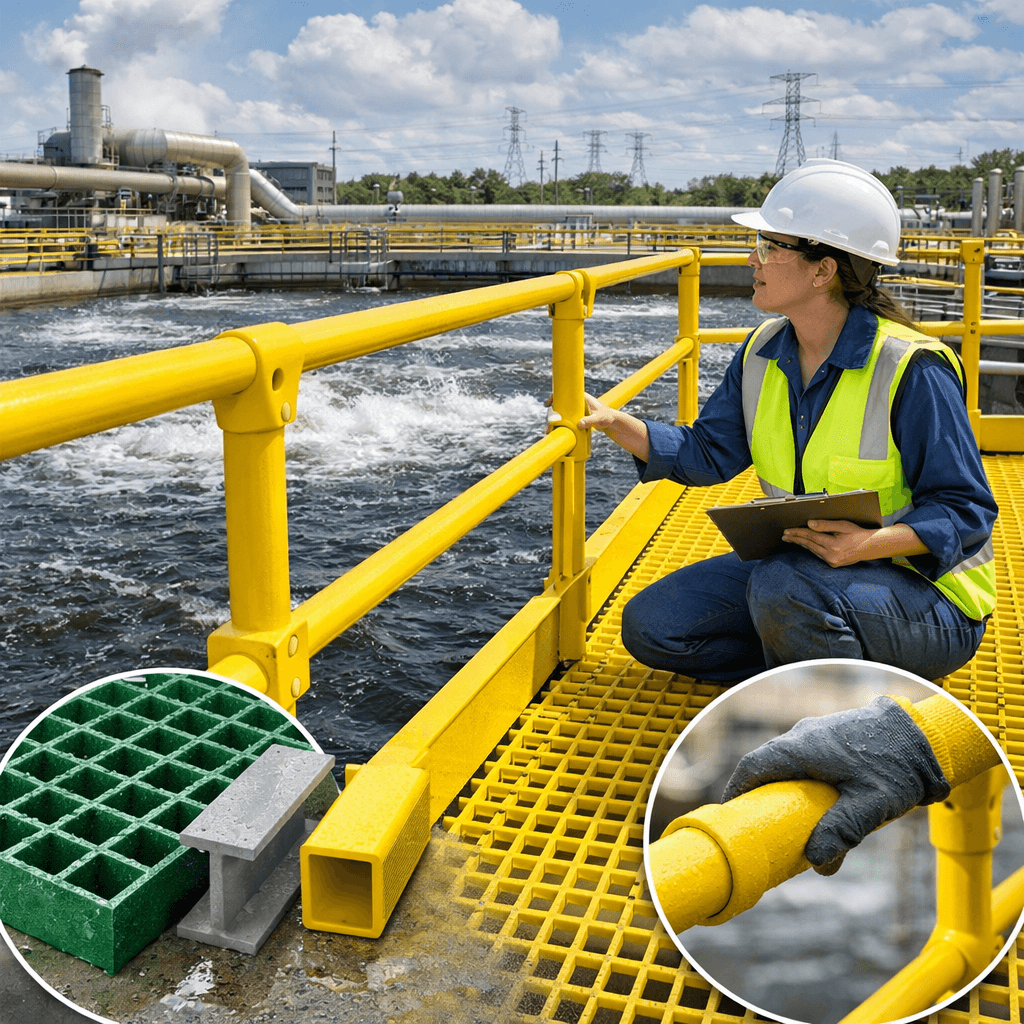
frp grating and handrail systems
What Are FRP Grating and Handrail Systems?
Composition and Manufacturing Process
Fiberglass-reinforced plastic is a composite material formed by combining continuous glass fiber reinforcement with a thermosetting resin matrix. The result is a material that is simultaneously lightweight, structurally strong, and chemically inert.
Two primary manufacturing methods are used for structural FRP products:
- Pultrusion – continuous fibers are pulled through a resin bath and a heated die, producing profiles with highly consistent mechanical properties and excellent longitudinal strength. This is the method used for most handrail components and pultruded grating bars.
- Molded (compression molding or hand lay-up) – fibers are arranged in a bi-directional pattern within a mold, producing panels with balanced strength in both directions. This method is common for molded grating.
The resin system — typically isophthalic polyester, vinyl ester, or phenolic — determines the product’s chemical resistance, fire performance, and temperature tolerance. Resin selection should be guided by chemical resistance test data referenced against ISO 175 or ASTM C581, both of which provide standardized methods for evaluating plastic resistance to chemical immersion.
Types of FRP Grating
FRP grating is available in two primary formats:
- Molded grating – manufactured as a one-piece panel with a bi-directional fiber structure. It offers equal load distribution in both directions, making it well-suited for areas with omnidirectional foot traffic or where panels may be cut to irregular shapes without losing structural integrity.
- Pultruded grating – assembled from pultruded bearing bars and crossbars, conforming to EN 13706, the European standard for pultruded FRP profiles. It offers higher load capacity per unit weight and performs particularly well in applications with heavy concentrated loads or longer spans.
Surface finishes include gritted tops for maximum slip resistance and concave (meniscus) surfaces for moderate grip with easier cleaning. Standard panel sizes are typically 1×2 m or 1×4 m, with mesh openings ranging from 25×25 mm to 50×50 mm depending on load and drainage requirements.
Types of FRP Handrail Systems
FRP handrail systems are engineered around pultruded tube and channel profiles, assembled to meet local safety codes such as OSHA 1910.23 (US) or EN ISO 14122 (Europe) and grating load standards referenced in ANSI/NAAMM MBG 531. A standard system consists of:
- Top rail – typically a round or square tube at 1,100 mm height
- Mid rail – positioned at approximately 550 mm
- Kickplate (toeboard) – a solid panel at the base to prevent tools or debris from falling
- Posts and brackets – surface-mounted or embedded, with corrosion-resistant hardware
Custom configurations — including additional rails, angled posts for sloped surfaces, or integrated cable management — are available from manufacturers offering dedicated engineering support.
Key Industrial Applications
Water and Wastewater Treatment
Wastewater treatment plants present one of the harshest environments for structural materials. Constant exposure to hydrogen sulfide, chlorine, and biological effluent accelerates corrosion in carbon steel and even stainless steel over time.
FRP grating and handrail systems have become the standard specification in this sector. Facility operators who have transitioned from galvanized steel to FRP platforms report maintenance cost reductions in the range of 25–35%, driven by the elimination of painting cycles, rust remediation, and premature structural replacement — figures consistent with lifecycle cost analyses published by the American Composites Manufacturers Association (ACMA). There are no repainting schedules, no chemical inhibitor programs, and no structural degradation from chemical splash.
Power Generation and Utilities
The dielectric (non-conductive) properties of FRP make it uniquely suited for power generation environments. Walkways and access platforms built from FRP grating around transformer bays, switchgear rooms, and substation structures eliminate the risk of accidental electrical grounding through the structure itself.
Cooling towers are a particularly high-value application. The combination of moisture, heat, and biocidal treatment chemicals creates conditions that destroy steel within years. FRP grating panels and handrails installed in cooling tower fills and basins routinely achieve service lives exceeding 20 years with minimal maintenance intervention.
Marine and Offshore Environments
Saltwater is among the most aggressive corrosion environments in structural engineering. On offshore platforms, vessels, and port infrastructure, steel demands constant painting, cathodic protection, and replacement cycles that accumulate into significant lifetime cost.
FRP grating weighs approximately 70–80% less than comparable steel panels, reducing structural load on marine decks and simplifying installation without crane support. Combined with complete immunity to salt-induced corrosion, this makes FRP the material of choice for gangways, deck grating, and stairway systems in marine settings.
Agriculture and Aquaculture
In aquaculture facilities — fish farms, hatcheries, and processing plants — floors and walkways are continuously wet, chemically treated, and subject to stringent hygiene standards. FRP grating’s open mesh design promotes drainage, its surface finish options facilitate cleaning, and its non-porous resin matrix does not harbor bacteria the way pitted or corroded metal surfaces can.
In greenhouse and livestock agriculture, ammonia and organic acids accumulate in ways that degrade conventional structures rapidly. FRP maintains dimensional stability and surface integrity under these conditions with no special treatment required.
Performance Advantages Over Traditional Materials
Corrosion and Chemical Resistance
| Property | FRP | Carbon Steel | Aluminum |
|---|---|---|---|
| Saltwater resistance | Excellent | Poor | Moderate |
| Chemical splash resistance | Excellent (resin-dependent) | Poor | Moderate |
| Maintenance requirement | Minimal | High | Moderate |
| Typical service life (aggressive env.) | 20–30 years | 5–10 years | 10–15 years |
Resin selection is the primary lever for chemical resistance. Vinyl ester resins provide superior resistance to acids, alkalis, and organic solvents, while phenolic resins are preferred where fire and smoke performance standards are stringent.
Strength-to-Weight Ratio
FRP grating typically weighs between 10–18 kg/m² depending on thickness and panel type, compared to 30–40 kg/m² for equivalent steel grating. This weight advantage translates directly into lower installation costs — smaller crews, no heavy lifting equipment, and faster turnaround on retrofit projects within operating facilities.
Despite its light weight, pultruded FRP grating can achieve load ratings exceeding 5 kN/m² for pedestrian and light equipment traffic, with engineered solutions available for heavier duty cycles.
Long Service Life and Low Maintenance
The lifecycle cost argument for FRP is compelling. While the initial purchase price of FRP grating and handrail systems is typically 20–40% higher than painted steel equivalents, the elimination of repainting, galvanizing, and early replacement delivers a net cost saving within 5–7 years in corrosive environments. No cathodic protection is needed. No rust inhibitors. No specialist coatings.
Limitations and Considerations
Specifying FRP responsibly means understanding its trade-offs alongside its strengths:
- Impact resistance – FRP is more brittle than mild steel under sharp point impact. In environments where heavy dropped objects or vehicular impact are a realistic risk, panel thickness and resin toughness should be evaluated carefully.
- UV degradation – without UV stabilizers or a protective surface veil, prolonged direct sunlight exposure can cause surface resin erosion. Specify UV-inhibited formulations for outdoor installations.
- Upfront cost – the initial material cost is higher than painted steel. The lifecycle saving argument is strong in corrosive environments, but in mild, dry indoor settings the payback period extends considerably.
- Thermal expansion – FRP expands more than steel per degree of temperature change; this must be accommodated in panel layout and fixing design.
Safety Features
FRP structural systems offer several inherent safety advantages:
- Non-slip surfaces – gritted tops provide high coefficients of friction even when wet or oil-contaminated
- Electrical non-conductivity – the base material provides a natural insulation barrier
- Fire-retardant grades – available in formulations meeting BS 476, ASTM E84, or equivalent standards
- No sharp corrosion projections – unlike rusted steel, degraded FRP does not produce hazardous jagged edges
Selecting the Right FRP Grating and Handrail System
Load and Span Requirements
The starting point for any grating specification is the design load and the clear span between supports. Deflection under load — typically limited to span/200 for industrial walkways — determines the minimum panel depth required.
As a general guide:
- Spans up to 600 mm – 25 mm depth molded grating is usually adequate for pedestrian loads
- Spans of 600–1,200 mm – 38 mm depth panels or pultruded grating should be evaluated
- Spans exceeding 1,200 mm – pultruded grating with 50 mm+ depth bars or secondary support steelwork is typically required
Always verify with manufacturer load tables or request a structural calculation for critical applications.
Chemical Exposure Assessment
Before specifying a resin system, document the chemicals, concentrations, and exposure temperatures present at the installation site. Reference chemical resistance data against ISO 175 or ASTM C581 for your specific resin formulation.
- Isophthalic polyester – general-purpose; suitable for mild chemical exposure and most outdoor environments
- Vinyl ester – recommended for strong acids, alkalis, and organic solvents; the standard choice for chemical plants and wastewater facilities
- Phenolic – required where fire and smoke toxicity standards are stringent (offshore, rail, public infrastructure)
Customization and Engineering Support
Standard panel sizes and profiles cover the majority of industrial applications. However, many projects require cut-to-size panels, non-standard mesh openings, specific colors for zone marking, or integrated handrail-to-grating connection details.
Unicomposite’s engineering team supports bulk and OEM buyers from initial profile selection through to custom fabrication and full-system supply. With production capacity across multiple forming processes and ISO-certified quality management, they are equipped to handle both high-volume standard orders and complex custom specifications — with full technical documentation available for procurement and compliance teams.
Installation and Maintenance Best Practices
Installation Guidelines
FRP grating panels are typically secured using clip systems — stainless steel or FRP clips that engage the bearing bars and attach to the support structure below. Key installation considerations include:
- Thermal expansion allowance – FRP expands at approximately 20–30 × 10⁻⁶/°C; leave clearance gaps at panel edges in environments with significant temperature variation
- Support spacing – follow manufacturer span tables strictly; do not exceed recommended clear spans
- Handrail post torque – tighten to manufacturer specifications; over-torquing can crack the FRP tube wall at the fixing point
A two-person crew can typically install 50–80 m² of standard FRP grating per day — significantly faster than equivalent steel grating requiring welding or hot-dip galvanizing after fabrication.
Safety Considerations During Installation
Cutting FRP on site generates fine fiberglass dust and resin particles that are respiratory irritants. The following precautions are mandatory:
- Use diamond-tipped or carbide cutting blades to minimize fiber fragmentation
- Wear P2/N95 respirators, safety glasses, and gloves during all cutting operations
- Seal all cut edges immediately with a compatible resin or edge sealant to prevent moisture ingress into the panel core and to encapsulate exposed fiber ends
- Work in ventilated areas or use local exhaust ventilation when cutting in enclosed spaces
Inspection and Long-Term Care
FRP systems require far less maintenance than steel, but periodic inspection remains essential practice:
- Annual visual inspection – check for impact damage, delamination, or surface crazing
- Hardware check – inspect stainless steel clips and bolts for corrosion; replace if needed
- Surface cleaning – low-pressure water wash; mild detergent for oil or biological fouling
- Structural assessment – if significant impact damage is found, evaluate whether panel replacement is warranted; FRP panels can typically be replaced individually without disturbing surrounding structure
There is no requirement for repainting, rust treatment, or galvanizing at any point in the product’s service life.
Conclusion
FRP grating and handrail systems deliver where traditional materials consistently fall short — in wet, corrosive, electrically sensitive, and chemically aggressive industrial environments. The combination of long service life, low maintenance burden, inherent safety features, and favorable lifecycle economics makes them a sound specification for engineers and procurement managers working across water treatment, power generation, marine, and agricultural sectors.
Understanding both the strengths and the real limitations of FRP — impact sensitivity, UV exposure requirements, and higher upfront cost — allows procurement teams to specify with confidence rather than assumption. In the right environment, the performance case is clear.
For organizations sourcing at scale or requiring custom fabrication, Unicomposite brings ISO-certified manufacturing capability, multi-process production expertise, and a track record of serving demanding industrial clients across global markets. Their technical team can support resin selection, load calculation review, and custom profile design from initial enquiry through to delivery.
Specifying FRP grating and handrail systems for an upcoming project? Contact Unicomposite’s engineering team for a technical consultation, chemical resistance assessment, or custom fabrication quote tailored to your application and environment.
Frequently Asked Questions
FRP typically costs 20–40% more than painted steel at the point of purchase, but eliminates repainting, galvanizing, rust remediation, and early replacement in corrosive environments. Most industrial operators in chemical, marine, or wastewater settings recover the cost premium within 5–7 years and achieve significantly lower total lifecycle cost over a 20–30 year service period.
Vinyl ester resin is the standard recommendation for environments involving strong acids, alkalis, chlorine, or organic solvents. For applications where fire performance is the primary concern — offshore platforms or public infrastructure — phenolic resin systems should be evaluated. Always cross-reference your specific chemical list against the manufacturer’s published resistance data, ideally tested to ISO 175 or ASTM C581.
Yes, FRP grating can be cut on site using diamond-tipped or carbide blades. For molded grating, cutting does not compromise panel integrity because the bi-directional fiber structure distributes load in all directions. For pultruded grating, cuts should be made between bearing bars where possible. All cut edges must be sealed with compatible resin immediately after cutting to prevent moisture ingress and to encapsulate exposed fiber ends.
Key standards include EN 13706 for pultruded FRP profiles, ANSI/NAAMM MBG 531 for metal bar grating load performance (widely applied to FRP as well), OSHA 1910.23 or EN ISO 14122 for handrail height and configuration requirements, and BS 476 or ASTM E84 for fire performance. Your manufacturer should be able to provide test certificates and compliance documentation for the specific standards relevant to your project and jurisdiction.
Unicomposite manufactures both standard pultruded profiles and fully custom FRP fabrications, including cut-to-size grating panels, custom handrail assemblies, and OEM composite parts produced via pultrusion, pulwinding, SMC/BMC, and hand lay-up processes. Bulk orders, project-specific engineering support, and custom color or surface finish requirements can all be accommodated through direct engagement with their technical and sales teams.


