 info@unicomposite.com


Introduction
Every minute a cow spends resisting a handler is a minute of lost productivity, elevated stress hormones, and increased injury risk — for both the animal and the person trying to treat it. Yet in many veterinary clinics and working ranches, the cattle handling infrastructure hasn’t been meaningfully updated in years. The alleyway is too narrow, the floor is slick, and the chute rattles loud enough to spook every animal in the pen.
A well-engineered veterinary clinic cattle chute alleyway isn’t just a convenience — it’s a clinical asset. It directly influences the quality of examination, the safety of staff, and the welfare of every animal that passes through. Poor design doesn’t just slow operations down; it drives up staff injury rates, increases animal bruising, and creates biosecurity vulnerabilities that regulatory bodies are increasingly scrutinizing.
This guide breaks down what actually works: the right layout principles, the materials that hold up under real-world conditions, and the design decisions that separate a frustrating facility from one that runs with consistency and confidence.
veterinary clinic cattle chute alleyway
Understanding the Veterinary Cattle Chute Alleyway System
Core Components and How They Work Together
A functional cattle chute alleyway system is made up of several interdependent components. The crowding tub (or forcing pen) gathers cattle and funnels them into a single-file alleyway, which leads to the squeeze chute where the animal is restrained for examination or treatment. A headgate at the front of the squeeze chute immobilizes the head for procedures like vaccinations, ear tagging, or oral dosing.
Each element affects the next. If the crowding tub is too angular, cattle balk at the entrance. If the alleyway is too wide, animals turn around. Industry guidelines — including standards outlined by the Beef Quality Assurance (BQA) program — recommend alleyway widths between 26 and 30 inches for beef cattle: wide enough for natural movement, narrow enough to prevent turning or doubling back.
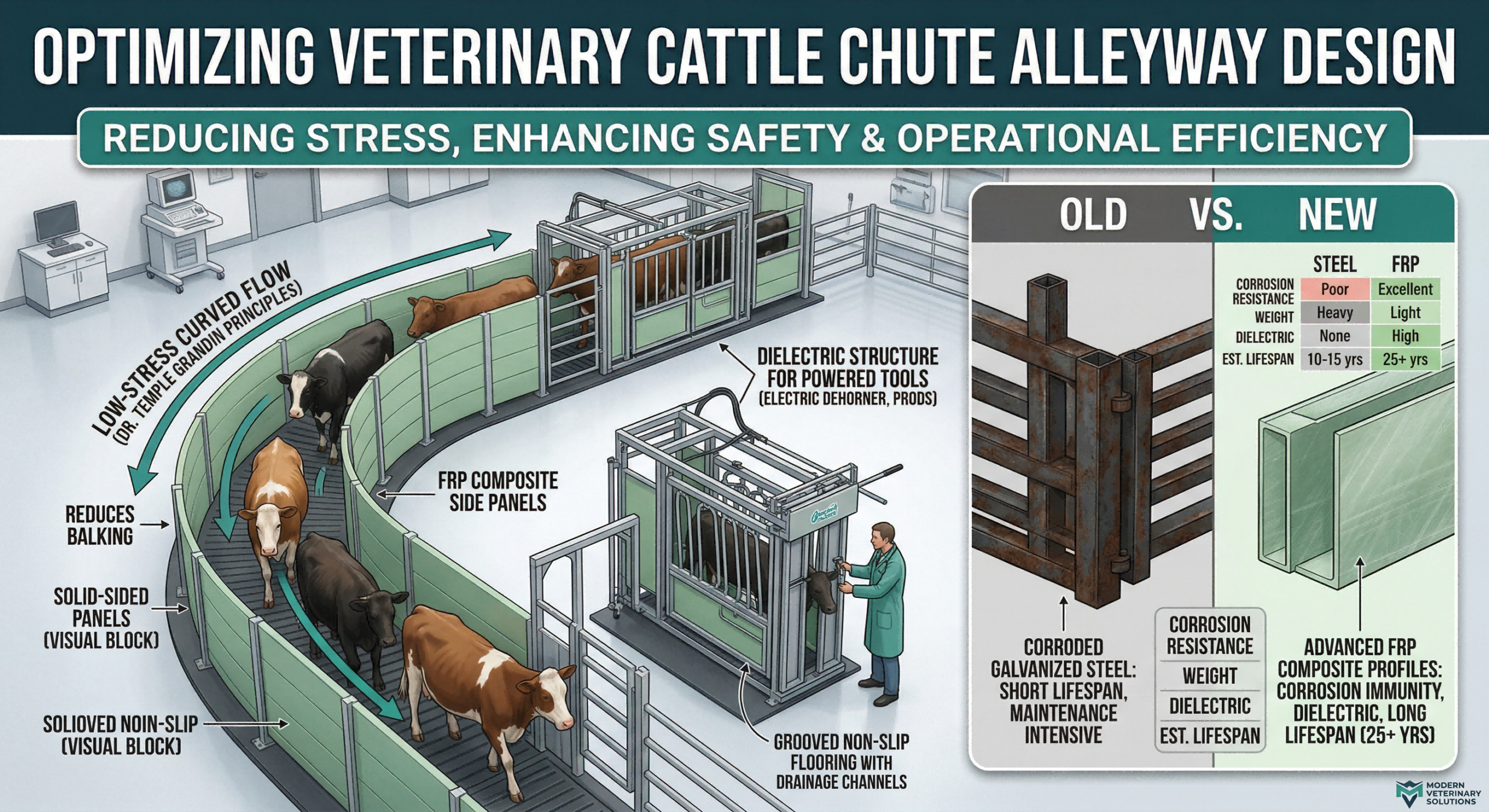
Curved alleyway designs consistently outperform straight configurations in reducing balking and handling time. Research by Dr. Temple Grandin, published through Colorado State University and widely adopted by the USDA and livestock industry, demonstrates that a curved single-file lane exploits cattle’s natural tendency to circle back toward where they came from — encouraging forward movement without the need for excessive handler pressure. Facilities that have implemented curved layouts report handling time reductions of 15–25% compared to equivalent straight-lane configurations.
Common Design Mistakes That Hurt Workflow and Animal Welfare
The most costly mistakes in cattle handling design are often invisible until you’re already losing time — and money.
- Blind corners and poor lighting: Cattle are prey animals. They hesitate at shadows and sudden visual contrasts. A dark alleyway entrance or a sharp visual break will stop animals cold, triggering the kind of prolonged resistance that leads to handler injuries.
- Inconsistent surface traction: Surfaces that are too smooth cause slipping and panic. Surfaces with aggressive textures can injure hooves. The ideal floor offers reliable grip without abrasion — a balance achievable through grooved concrete or purpose-designed composite panels.
- Undersized alleys: A bottleneck mid-alley during a busy vaccination day costs hours. Worse, it forces handlers to apply excessive pressure, elevating cortisol levels in cattle and increasing the risk of bruising and dark-cutting in beef animals — a documented economic loss that the BQA program actively works to eliminate through proper handling education.
What Makes a High-Performance Veterinary Chute Alleyway
Material Selection: Why It Matters More Than You Think
Material choice is where many facilities make a decision they later regret. The three most common structural options — steel, HDPE plastic, and FRP (fiberglass-reinforced plastic) composite profiles — each carry distinct trade-offs across the metrics that matter most in veterinary environments.
| Material | Corrosion Resistance | Weight | Dielectric | Est. Lifespan |
|---|---|---|---|---|
| Galvanized Steel | Moderate | Heavy | None | 10–15 yrs |
| HDPE Plastic | Good | Light | Moderate | 15–20 yrs |
| FRP Composite | Excellent | Light | High | 25+ yrs |
Steel remains common due to upfront cost and contractor familiarity, but in the wet, chemically aggressive environment of a veterinary clinic — where disinfectants, urine, and organic matter are constant — galvanized and painted steel corrodes faster than manufacturers’ specifications suggest under controlled conditions. Repainting cycles, structural replacement of corroded uprights, and downtime during repairs represent a hidden cost that compounds annually.
FRP pultruded profiles, manufactured through a continuous pultrusion process, address these failure points directly. Unicomposite, an ISO-certified pultrusion manufacturer with dedicated production lines for both standard and custom fiberglass composite profiles, supplies structural FRP components across agriculture, aquaculture, electricity infrastructure, and industrial construction globally. Their pultruded sections deliver high strength-to-weight ratios, full corrosion immunity, and — critically — dielectric (non-conductive) properties that reduce electrical hazard in wet handling environments. For veterinary facilities using electrical dehorning equipment, electric prods, or powered diagnostic tools, non-conductive structural panels and rails represent a meaningful and underappreciated safety upgrade.
Layout and Flow Optimization
Temple Grandin’s published guidelines on low-stress livestock handling — foundational references in both the AVMA’s animal welfare frameworks and USDA extension recommendations — establish clear principles that every facility designer should incorporate from the outset:
- Curved alleyways reduce balking and handling time. A 30-degree curve is typically sufficient to prevent animals from seeing the restraint area until they’re already committed to moving forward.
- Lighting directed from the front of the alleyway draws cattle naturally toward the source. Overhead shadows falling across the alleyway entrance are one of the most frequently overlooked causes of balking in otherwise well-designed systems.
- Solid-sided alleys eliminate visual distractions from outside the lane — moving personnel, equipment, and other animals — that interrupt forward flow.
Non-slip flooring and drainage integration are equally non-negotiable. A wet concrete floor without groove channels creates slip hazards that OSHA’s agricultural safety standards specifically flag as a leading cause of both livestock and handler injuries. Diamond-grooved patterns and composite panel flooring with integrated drainage channels both perform well in practice.
Safety Features for Both Animals and Veterinary Staff
Safety in a veterinary handling facility operates in two directions simultaneously: protecting the animal from injury during restraint, and protecting staff from kick injuries, crush incidents, and falls. According to the Bureau of Labor Statistics, livestock-related injuries account for a disproportionately high rate of lost workdays in agricultural occupations — a statistic that functional facility design directly influences.
Key design features that reduce risk on both sides:
- Squeeze chute force calibration: Excessive squeeze pressure causes bruising and, in younger animals, stress fractures. Hydraulic squeeze chutes with pressure-limiting valves allow precise, repeatable control that mechanical systems cannot match.
- Quick-release headgates: In an emergency, opening a headgate in under two seconds can contain an incident that might otherwise escalate. Staff should be able to operate releases from a protected position.
- Anti-kick panels and side-access doors: Positioned strategically along the alleyway, these allow handlers to perform injections or examinations without removing the animal from flow — reducing total handling time and contact risk.
- Non-conductive structural components: FRP panels and rails eliminate the risk of current conduction through the structure itself in powered equipment environments.
Designing for Your Specific Clinic Needs
Sizing the System to Your Cattle Volume and Species
There is no universal cattle chute alleyway. A small mixed-practice rural clinic processing 20 head per day has fundamentally different requirements from a feedlot-adjacent facility turning 200 head — and treating both as equivalent is a design error that shows up immediately in operational throughput.
“One of the most common issues we see in retrofit projects is a system that was originally specced for beef cattle being pushed to handle dairy breeds,” notes one livestock facility consultant with over 15 years of agricultural infrastructure experience. “The headgate geometry alone can be the difference between a safe restraint and a neck injury.”
Practical sizing considerations:
- Beef cattle require wider alleys and heavier-duty squeeze chute construction due to body mass and temperament variance across breeds.
- Dairy cattle, particularly Holstein breeds, are generally more habituated to human contact but require careful headgate sizing and padding to prevent neck injuries during extended restraint.
- Portable vs. permanent systems: Portable panel systems offer flexibility for clinics conducting on-farm calls. Permanent installations allow for optimized drainage, electrical integration, and reinforced anchoring — improvements that compound in value over years of daily use.
Modular systems constructed from custom composite fabrications are increasingly practical for facilities with non-standard barn dimensions. Pultruded FRP profiles can be cut, drilled, and field-assembled to fit irregular layouts without the corrosion risk that cut steel edges introduce at every modification point.
Maintenance and Long-Term Cost of Ownership
A steel system may cost less on day one. The real comparison happens at the five-year and ten-year marks.
Steel alleyway components in agricultural environments require annual inspection for rust, repainting every 3–5 years, and eventual structural replacement of corroded uprights and load-bearing rails. FRP composite components, by contrast, require only periodic cleaning and visual inspection for mechanical damage. They do not rust, splinter, or require surface treatment to maintain structural integrity.
For biosecurity compliance — a priority increasingly reinforced by state veterinary regulatory frameworks — FRP’s non-porous surface allows disinfectants to work as intended, without chemical solutions becoming trapped in corroded surface pitting or compromised paint layers.
Annual inspection checklist for any cattle chute alleyway:
- Check all connection points, welds, and fasteners for loosening or corrosion
- Inspect flooring for wear patterns, crack propagation, or chronic water pooling
- Test headgate and squeeze mechanism release times against your target response threshold
- Verify full lighting coverage, particularly at alleyway entry transitions
- Clear and inspect all drainage channels for blockage or structural compromise
Safety and Compliance Considerations
Veterinary clinic operators have both ethical and legal obligations regarding handling facility safety. OSHA’s agricultural safety standards (29 CFR 1928) apply to farm worksites and encompass livestock handling environments. Key compliance areas include:
- Maintaining walkways and working surfaces free of slip hazards
- Ensuring adequate lighting in animal handling areas
- Providing training on restraint equipment operation and emergency release procedures
The AVMA’s Guidelines for the Humane Handling of Animals also provide a professional framework that many state veterinary licensing boards reference when evaluating facility standards. Designing to these guidelines isn’t just ethically sound — it creates a defensible record of due diligence in the event of an incident.
Real-World Application: A Case Study in Clinic Efficiency
A mid-size mixed-practice veterinary clinic serving both beef and dairy producers had operated the same galvanized steel alleyway system for over 14 years. Corrosion had compromised three structural uprights, the flooring had developed chronic pooling near the headgate, and three slip-related staff incidents had occurred in a single year — two resulting in lost workdays.
The clinic undertook a phased retrofit using modular pultruded FRP structural profiles for alleyway walls and side panels, retaining the existing hydraulic squeeze chute but upgrading flooring to grooved composite panels with integrated drainage channels. The curved alleyway configuration was extended by 12 feet to reduce balking at the chute entrance, incorporating solid side panels and repositioned overhead lighting at the entry point.
Outcomes tracked over the following six months:
- Average handling time per animal reduced by approximately 20%, attributed primarily to improved animal flow through the extended curved section
- Zero slip-related staff incidents, compared to three in the prior 12-month period
- Cleaning time per session reduced by roughly 30%, driven by improved drainage and the non-porous composite panel surface
- Projected maintenance cost reduction of 60% over ten years based on elimination of steel repainting and corrosion-repair cycles
The material investment reached payback within 18 months when accounting for eliminated maintenance costs, reduced staff injury-related downtime, and improved throughput capacity.
Conclusion
A veterinary clinic cattle chute alleyway is a system, not simply a piece of equipment. When the layout respects how cattle actually move, the materials stand up to the chemical and mechanical demands of daily clinical use, and safety features protect everyone involved, the entire operation functions at a measurably higher level.
The shift toward FRP composite profiles represents the most practical materials upgrade available to facilities serious about reducing long-term total cost and improving operational resilience. With manufacturers like Unicomposite offering both standard pultruded sections and fully custom fiberglass fabrications tailored to non-standard dimensions and load requirements, the path to a modern composite handling system is accessible for new builds and retrofits alike.
Before specifying any system, audit your current alleyway dimensions, material condition, and compliance status against BQA handling guidelines and AVMA welfare standards. Then consult a composite profile specialist to identify where FRP can replace aging steel components — without compromise on strength, safety, or service life.
Frequently Asked Questions
Pultruded FRP profiles in agricultural environments typically deliver a service life of 25 years or more, compared to 10–15 years for galvanized steel under equivalent exposure to moisture, disinfectants, and organic matter. FRP requires no repainting or rust treatment, significantly reducing lifetime maintenance expenditure.
Yes. Pultrusion manufacturers like Unicomposite produce both standard profile sections and fully custom fiberglass fabrications to specified dimensions, load ratings, and surface finishes. This makes FRP particularly well-suited to retrofitting existing facilities where standard panel sizes don’t align with existing infrastructure.
Facilities should design to OSHA agricultural workplace safety standards (29 CFR 1928), AVMA animal welfare handling guidelines, and Beef Quality Assurance (BQA) low-stress handling protocols. These frameworks collectively address flooring safety, lighting, restraint equipment operation, and staff training requirements.
For most facilities processing more than 10–15 head per session, yes. Research consistently supports curved single-file lanes reducing handling time and animal stress compared to straight configurations. The design investment is typically recovered within the first year through improved throughput and reduced handler fatigue.
FRP composite surfaces are non-porous and compatible with standard agricultural disinfectants, making them easier to sanitize effectively than corroded or pitted steel. A pressure wash followed by an approved disinfectant application, with particular attention to drainage channel clearance, is the standard protocol recommended by most state veterinary extension programs.


