 info@unicomposite.com


Introduction
GRP rod stakes with sharp ends are often chosen when standard materials start creating avoidable problems in the field. Buyers may begin with timber because it is familiar, or steel because it feels strong, but repeated exposure to wet soil, chemicals, or utility environments quickly changes the cost equation. A stake that rusts, rots, or becomes difficult to install does not just raise replacement costs. It also adds labor, slows crews down, and creates inconsistency across large jobs.
For industrial buyers, the real value of GRP rod stakes with sharp ends is not just material substitution. It is better long-term performance in applications where durability, corrosion resistance, and electrical insulation matter. In my experience with composite product selection for outdoor projects, the biggest mistake buyers make is focusing only on unit price. Once a project involves hundreds or thousands of stakes, service life and installation efficiency usually matter more than saving a small amount on the initial order.
That is why many B2B buyers now look more closely at fiberglass-reinforced composite options. An experienced manufacturer can help match the rod diameter, resin system, and tip design to actual field conditions instead of offering a one-size-fits-all product. Unicomposite, for example, is an ISO certificated pultrusion manufacturer with its own factory in China producing FRP profiles and custom composite parts for sectors such as electricity, landscaping, wastewater treatment, cooling tower construction, agriculture, aquaculture, and marine use. That kind of production background is valuable when a buyer needs both standard profiles and custom support for volume orders.
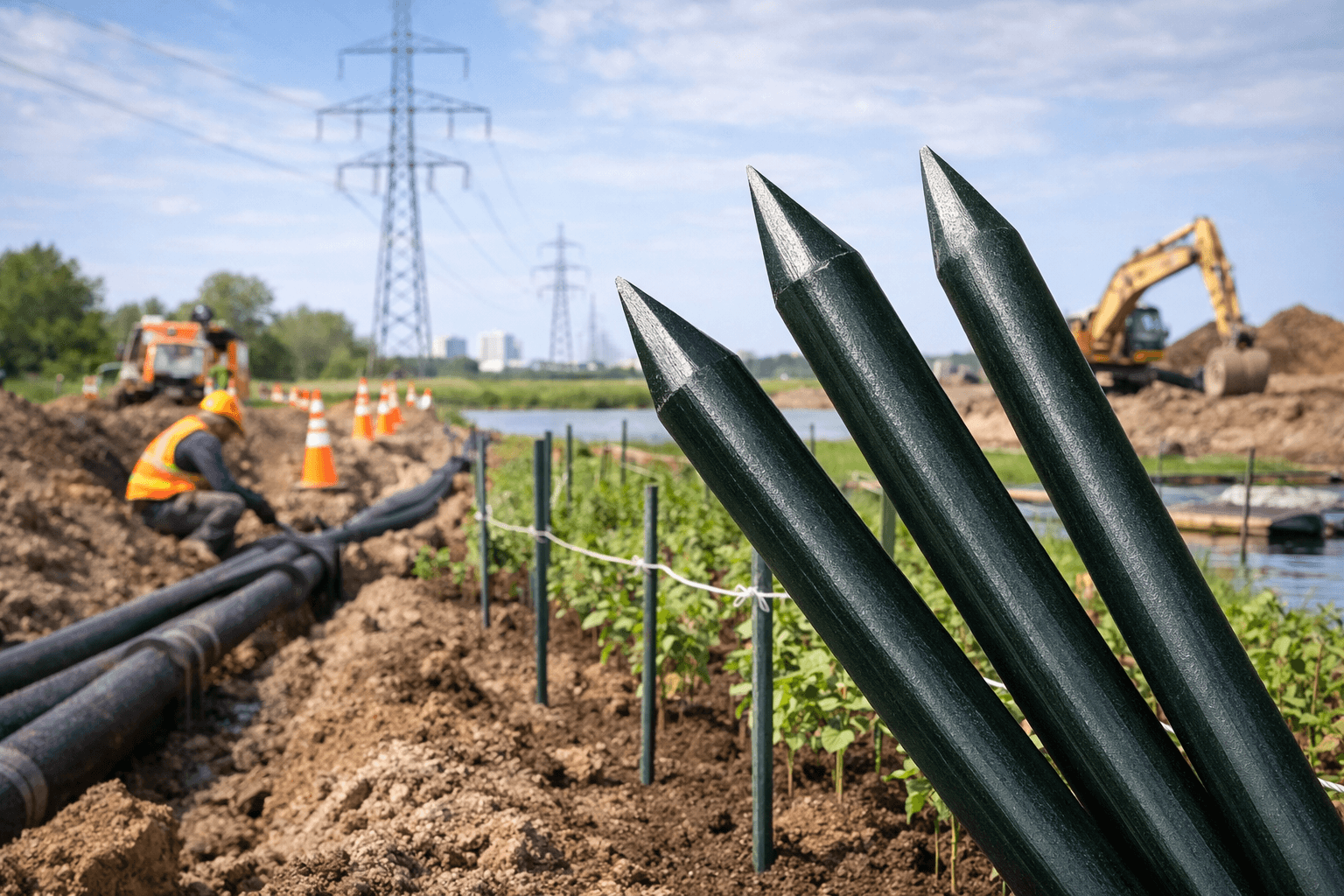
grp rod stakes with sharp ends
Why GRP Rod Stakes with Sharp Ends Are Used in Demanding Environments
Material advantages over steel, wood, and plastic
GRP, or glass reinforced plastic, is widely used because it solves several common performance issues at once. Unlike steel, it does not rust. Unlike wood, it does not absorb water and degrade in the same way over time. Unlike lower-grade plastics, it can deliver a better balance of stiffness, strength, and weather resistance for industrial use.
For buyers comparing options, the main advantages usually include:
- Corrosion resistance in wet, salty, or chemically exposed environments
- Non-conductive performance for utility-adjacent applications
- Low maintenance compared with timber or untreated metal
- Long outdoor service life with the right resin and UV protection
- Consistent dimensional quality when made through a controlled process
One of the most useful ways to think about GRP is in lifecycle terms. In many industrial settings, replacing failed stakes costs far more than the product itself. Labor, transport, downtime, and rework often become the real expense. Industry buyers frequently find that a more durable composite stake reduces total ownership cost, even when the upfront price is higher.
From a technical standpoint, resin choice also matters. Polyester, vinyl ester, and other resin systems offer different levels of chemical resistance, UV stability, and environmental durability. That is why an experienced supplier should ask where the product will be used before recommending a specification. A stake for coastal infrastructure is not necessarily the same as one for nursery support or civil layout work.
How sharp ends improve installation efficiency
The sharp end is one of the most practical features of the product. It directly affects how quickly crews can install the stake and how reliably it enters the ground. On small jobs, that may seem minor. On large projects, it can have a measurable impact on labor efficiency.
A sharp-ended design helps with:
- Faster ground penetration
- Lower insertion effort
- More consistent placement
- Less installation time across repetitive tasks
This matters especially in compacted soil, mixed terrain, or long runs where workers install large quantities in sequence. In real-world use, blunt or poorly finished ends often create more resistance, force misalignment, or cause unnecessary handling time. Buyers do not always ask about tip geometry at the start, but they usually notice its importance once installation begins.
A practical rule is simple: if the product will be installed repeatedly in field conditions, the point design should be treated as a performance feature, not a cosmetic detail. A well-made sharp end supports productivity, while an inconsistent one can reduce the benefit of the material itself.
Common B2B Applications for GRP Rod Stakes
Utility, infrastructure, and construction marking
GRP rod stakes with sharp ends are widely used in utility and civil environments where non-metallic performance is an advantage. Contractors and infrastructure teams often need stakes for temporary marking, route identification, boundary control, or site layout. In these cases, conductivity and corrosion can make metal a less attractive choice.
Common uses include:
- Underground cable and pipeline route marking
- Temporary construction boundary lines
- Survey and alignment reference points
- Roadside infrastructure work
- Utility corridor and substation support applications
An anonymized example illustrates the appeal. A contractor working in a wet, coastal utility zone may start with steel stakes because they seem durable. After repeated corrosion, difficult removal, and replacement cycles, the team shifts to GRP for better longevity and safer use near electrical assets. The material cost per unit may increase, but the overall project becomes easier to manage.
For buyers in this segment, reliability matters more than novelty. They want a stake that can be installed quickly, stay visible or functional for the required period, and avoid premature failure in harsh outdoor conditions.
Agriculture, landscaping, and aquaculture support
GRP stakes are also a strong fit for high-moisture and outdoor agricultural environments. Farms, nurseries, landscaping contractors, and aquaculture operations often need products that can handle weather, irrigation, chemicals, and repeated exposure without rotting or rusting.
Typical applications include:
- Plant and sapling support
- Nursery row marking
- Vineyard layout systems
- Boundary and zone identification
- Erosion control planning
- Aquaculture and marine-adjacent support structures
In these settings, wood may decay and steel may corrode, especially where the stakes remain in place over long periods. Composite alternatives often provide better service life and lower maintenance. One common lesson from the field is that materials that look inexpensive at purchase can become costly once seasonal replacement becomes routine.
This is where GRP performs well for bulk buyers. It offers a more stable replacement cycle, especially in environments where moisture and handling conditions are hard on conventional materials.
What Buyers Should Evaluate Before Purchasing
Rod diameter, length, resin system, and surface finish
The most effective way to buy GRP rod stakes with sharp ends is to match the product specification to the application. Not every project needs the same rod diameter, length, flexibility, or resin chemistry.
Key evaluation points include:
- Diameter: affects stiffness, impact resistance, and handling
- Length: determines penetration depth and above-ground visibility
- Resin system: influences corrosion resistance, UV performance, and durability
- Surface finish: can affect grip and abrasion behavior
- Flexibility profile: matters where movement or repeated contact is expected
A buyer working in soft agricultural soil may need something different from a contractor installing stakes in compacted roadside ground. Similarly, long-term outdoor exposure requires more attention to UV performance than temporary indoor or short-term site use.
A simple pre-purchase checklist can reduce failure risk:
- What soil or ground condition will the stake enter?
- Is the stake for support, marking, or light structural positioning?
- Does the application require dielectric performance?
- Will the product face chemicals, salt, or constant moisture?
- How much UV exposure will it receive?
- Is a standard profile sufficient, or is customization needed?
These questions help buyers avoid under-specification, which is one of the most common causes of poor field performance.
Volume, customization, and manufacturing support
For B2B purchasing, product quality and supplier capability go together. A good stake design is only valuable if the manufacturer can produce it consistently across the full order quantity. This is especially important for OEM buyers, distributors, utilities, and contractors working on repeat projects.
Manufacturing support may include:
- Custom diameters and lengths
- Special resin recommendations
- Modified point geometry
- Packaging for export or site delivery
- Repeatable tolerances across production runs
This is an area where production depth can become a real advantage. Unicomposite supports standard pultruded fiberglass profiles and custom fiberglass fabrication, along with other forming processes such as Pulwound, SMC/BMC, and hand lay-up according to custom request. For buyers, that means more flexibility when the application goes beyond a standard stock rod.
Instead of forcing a standard item into a non-standard job, a supplier with broader composite capability can help tailor the product more effectively. That support is often what separates a smooth bulk order from an expensive trial-and-error process.
How to Choose a Reliable GRP Stake Supplier
Signs of manufacturing quality and consistency
A reliable supplier should be able to explain not just what it sells, but how it manufactures the product and controls quality. This matters because field performance often depends on consistency in diameter, resin distribution, finish, and point formation.
Strong supplier indicators include:
- ISO certification
- In-house production capability
- Clear technical communication
- Experience serving industrial sectors
- Sampling before full production
- Stable dimensional and finish consistency
From a procurement standpoint, consistency often matters more than a slightly lower quote. One uneven batch can slow installation, trigger complaints, and increase waste. That is why buyers should look for signs that the supplier understands repeatability, not just price competition.
A quality-minded supplier usually sounds different in conversation. Instead of immediately pushing a catalog item, the supplier asks about environment, installation method, expected service life, and order volume. That is often a good sign that the product recommendation is being built around performance, not just availability.
Questions to ask before placing a bulk order
Before committing to a large order, buyers should take a due-diligence approach. Even a short technical review can prevent mismatches between the product and the intended use.
Useful supplier questions include:
- Which resin system is best for this environment?
- What tolerances can you maintain on diameter and length?
- How is UV resistance addressed for long-term outdoor use?
- Can the sharp end be customized for different ground conditions?
- What are the minimum order quantities for custom parts?
- Are samples available for field testing?
- How is the product packed for bulk shipment?
These questions do more than gather information. They also show whether the supplier has enough application knowledge to support the project properly.
Why testing and fit-for-use checks build trust
Not every GRP rod stake with sharp ends is suitable for every application. That is important to say clearly. Ground density, expected load, exposure conditions, and handling requirements all influence the right design.
That is why samples and field testing are smart before a full-scale purchase. A short validation step can confirm whether the point design installs cleanly, whether the stiffness is appropriate, and whether the product performs as expected in the real environment. Buyers who test first usually reduce risk, improve ordering accuracy, and build more confidence in the final specification.
Conclusion
GRP rod stakes with sharp ends are a practical solution for buyers who need more than a low-cost stake that works only in mild conditions. They offer corrosion resistance, dielectric performance, and longer service life in sectors such as utilities, infrastructure, agriculture, landscaping, and aquaculture.
The strongest buying results usually come from matching the product to the job. Diameter, resin system, length, and point design all matter, especially in bulk industrial applications. Supplier capability matters too, because consistent production and technical support help turn a product order into a dependable solution.
For buyers planning a bulk purchase, the best next step is to define the field conditions clearly, compare specification options, and discuss customization or testing with an experienced composite manufacturer. That process leads to better-fit GRP rod stakes with sharp ends and fewer issues after installation.
Frequently Asked Questions
They can be a better choice when corrosion resistance or non-conductive performance is important. Steel may still suit some heavy-duty applications, but GRP is often preferred in wet, chemical, or utility-adjacent environments.
Yes. Many manufacturers can adjust diameter, length, resin system, and tip design to fit the application. This is especially useful for OEM buyers and contractors with repeat project requirements.
Service life depends on resin choice, UV exposure, ground conditions, and how the product is used. In many demanding environments, they last longer than wood and require less maintenance than untreated metal.
Yes. They are commonly used for plant support, layout marking, and boundary definition in outdoor environments. Their resistance to moisture and corrosion makes them attractive for these sectors.
Yes. Sampling allows the buyer to check installation behavior, stiffness, finish quality, and overall fit for the intended use. It is one of the simplest ways to reduce purchasing risk.


