 info@unicomposite.com


Introduction
Material problems in industrial projects rarely start with design alone. More often, they start when a component is placed in an environment that slowly breaks it down. Moisture, chemicals, UV exposure, and electrical risk can all shorten the useful life of traditional materials. That is why FRP rod continues to gain attention in sectors such as utilities, agriculture, marine systems, wastewater treatment, and OEM manufacturing.
For procurement teams, engineers, and bulk buyers, the value of FRP rod goes beyond knowing what it is made of. The bigger question is how it performs in demanding service conditions, which specifications matter most, and how to choose a supplier that can support consistent quality at scale. This article covers those practical concerns, with a focus on lifecycle value rather than upfront price alone.
A good example of the kind of supplier many industrial buyers look for is Unicomposite, an ISO-certificated pultrusion manufacturer with its own factory in China. With experience in standard pultruded fiberglass profiles, custom fiberglass fabrication, and other composite forming methods such as Pulwound, SMC/BMC, and hand lay-up, the company reflects the type of process depth buyers often want when sourcing both standard and custom solutions.
FRP rod
What Is an FRP Rod and How Is It Made?
What FRP Rod Means in Industrial Use
FRP rod is a solid composite rod made from fiberglass reinforcement embedded in a polymer resin matrix. In industrial applications, it is commonly selected when a project needs corrosion resistance, electrical insulation, lower weight, and reliable dimensional consistency.
Compared with steel, aluminum, or wood, FRP rod offers a different balance of properties. It does not rust like carbon steel, it is non-conductive, and it can perform well in wet or chemically exposed environments. According to AMPP, the global cost of corrosion exceeds $2.5 trillion annually, which helps explain why corrosion-resistant composites are gaining wider use in infrastructure and industrial systems.
It is also important not to confuse FRP rod with other fiberglass products. A rod is solid. A tube is hollow. A profile may be an angle, channel, or flat bar. FRP rebar is designed specifically for concrete reinforcement. For buyers, that distinction matters because the end-use requirements, load expectations, and production tolerances are often different.
How the Manufacturing Process Affects Performance
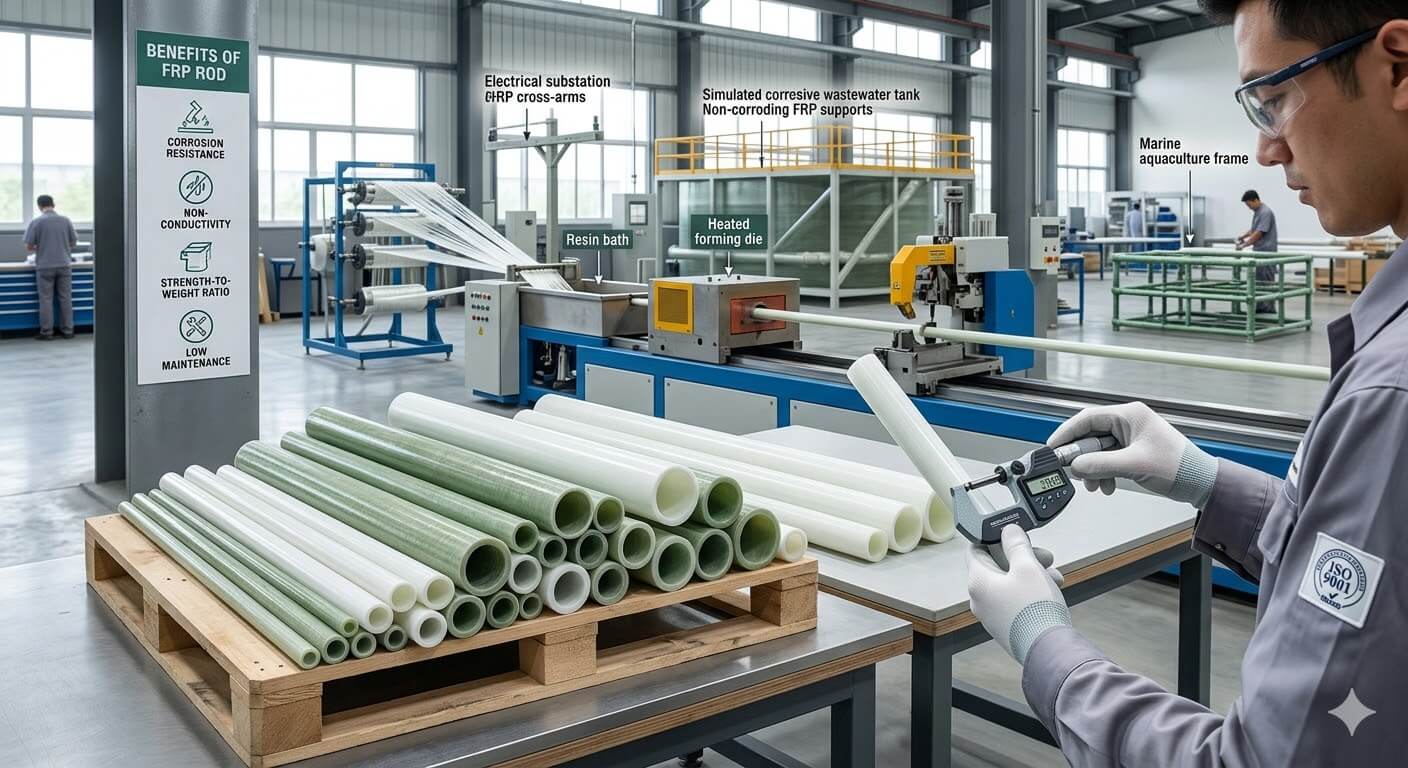
Most standard FRP rods are made using pultrusion, a continuous manufacturing process in which aligned glass fibers are pulled through resin and then through a heated die that shapes and cures the part. This process is widely used because it supports high consistency for straight, continuous profiles.
That consistency matters in real buying situations. When reviewing composite components for industrial applications, one issue comes up repeatedly: two rods may look almost identical in a catalog, yet behave differently in the field because fiber alignment, resin control, and cure consistency were not equally well managed during production. That is one of the first details experienced buyers learn to ask about.
Manufacturing choices affect more than appearance. They influence:
- Mechanical strength and stiffness
- Dimensional tolerance and straightness
- Surface finish
- Long-term resistance to moisture, chemicals, and UV exposure
Suppliers with additional capabilities such as Pulwound, SMC/BMC, or hand lay-up can also be valuable when standard pultruded rod is only one part of a broader assembly. For custom projects, that flexibility can simplify development and reduce sourcing complexity.
Why FRP Rod Is Used Across Industries
Electrical and Utility Applications
FRP rod is widely used in electrical and utility settings because of its dielectric properties. In applications near energized equipment or outdoor infrastructure, non-conductive materials can help reduce electrical risk while also resisting weather-related degradation.
This matters in practical terms. In substation structures, distribution supports, or insulating assemblies, buyers are often looking for a material that can handle exposure without introducing corrosion problems or conductivity concerns. The U.S. Department of Energy has also highlighted the enormous economic burden of corrosion across infrastructure systems, making corrosion-resistant non-metallic components increasingly relevant in utility planning.
A common buyer concern in this sector is service predictability. A component that needs less maintenance and performs reliably outdoors can be worth far more than a lower-cost alternative that requires frequent inspection or replacement.
Agriculture, Marine, and Wastewater Environments
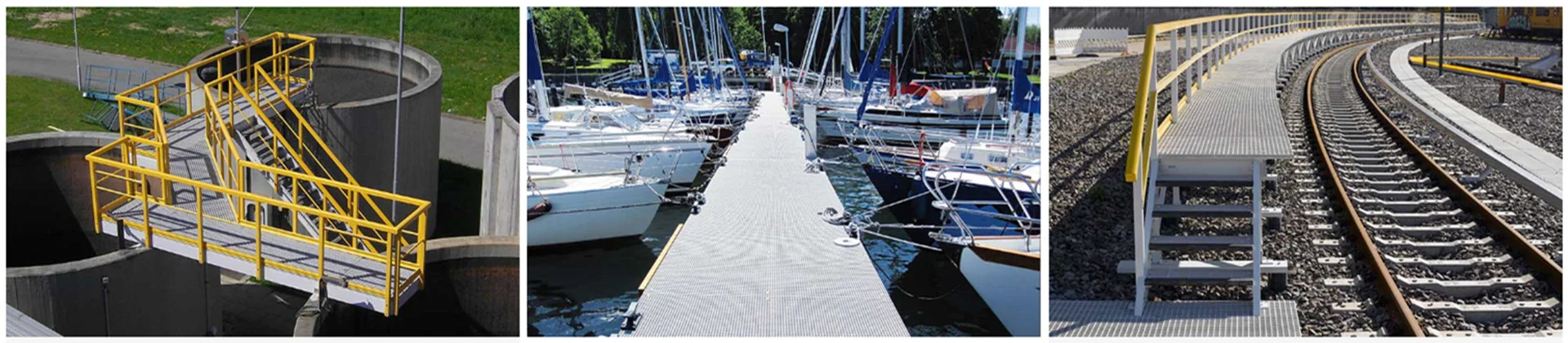
Agriculture, aquaculture, marine, and wastewater systems expose materials to moisture, chemicals, salts, and biological activity. These are the kinds of environments where FRP rod often outperforms traditional options over the long term.
The value is not only durability. It is reduced maintenance. A fiberglass composite rod used in a humid or corrosive setting may eliminate the need for repeated coating, repainting, or replacement that metal components often require. Industry groups such as the American Composites Manufacturers Association have long cited corrosion resistance as one of the main drivers behind composite adoption in industrial infrastructure.
Consider an anonymized example. A buyer responsible for support elements in a wet-process installation originally used coated steel for secondary structural parts. The material met the initial budget but required repeated maintenance after corrosion appeared in service. When those parts were redesigned using a fiberglass-based alternative, replacement frequency dropped and maintenance planning became easier. The material itself was not the whole solution, but choosing a product better suited to the environment improved lifecycle performance.
OEM and Custom Composite Applications
For OEM buyers, FRP rod is often chosen as part of a larger engineered solution. It may be specified for its strength-to-weight ratio, electrical insulation, non-magnetic behavior, or compatibility with custom fabrication.
This is where supplier support becomes especially important. Standard rod can solve many needs, but OEM programs often require:
- Custom diameters or lengths
- Specific resin systems
- Machining or fabricated secondary operations
- Surface treatments or UV-resistant veils
- Tight dimensional consistency across repeat production
Manufacturers like Unicomposite, which combine in-house factory production with both standard pultruded profiles and custom fiberglass fabrication, illustrate the type of support structure many B2B buyers prefer. The benefit is not just access to product. It is access to engineering discussion early enough to avoid design mismatches later.
Key Benefits of FRP Rod Compared with Traditional Materials
Corrosion Resistance and Service Life
Corrosion resistance is still the most recognized reason buyers shift from steel or wood to FRP rod. In harsh environments, the long-term maintenance burden of traditional materials often outweighs their lower purchase price.
AMPP’s corrosion-cost data provides useful context here, but the buying decision becomes clearer at the site level. If a component sits in wastewater vapor, salt-laden air, or fertilizer-heavy conditions, the cost question changes from “What is the cheapest material?” to “Which material will still be performing after years of exposure?”
That lifecycle view is one of the most important mindset shifts in industrial sourcing. In many cases, protecting a corrosion-prone material for years ends up costing more than selecting a corrosion-resistant one from the start.
Strength-to-Weight and Handling Advantages
FRP rod is significantly lighter than many metal alternatives, which can simplify transportation, field handling, and installation. That does not mean it replaces every metal rod in every high-load application, but it does make sense in many industrial settings where ease of handling has real operational value.
For project teams, lighter material can support:
- Faster installation
- Easier on-site movement
- Reduced handling fatigue
- Lower transport burdens for bulk orders
In practice, this benefit is often underestimated during the quotation stage. Once installation crews or assembly teams begin working with the material, the difference becomes more obvious. A lighter component that still meets the performance target can improve workflow before the product is even in long-term service.
Electrical and Thermal Performance
FRP rod also offers non-conductive and low thermal conductivity characteristics that can be valuable in safety-sensitive applications. In environments where electrical insulation matters, metal is often the wrong starting point.
The key, however, is proper specification. Not every FRP rod is the same, and buyers should avoid choosing one based only on a general description like “strong” or “lightweight.” Performance depends on the relationship between resin type, fiber content, application temperature, electrical needs, and environmental exposure.
That is why experienced materials teams typically compare total application requirements rather than single property claims. The best material decision is rarely based on one advantage alone.
How to Choose the Right FRP Rod for Your Application
Define Load, Environment, and Compliance Requirements
The first step in selecting FRP rod is defining the actual service conditions. Buyers should begin with three core questions:
- What mechanical load will the rod carry?
- What environmental exposure will it face?
- What standards, safety expectations, or compliance requirements apply?
These answers shape the entire buying process. UV exposure may call for added surface protection. Chemical contact may require a more suitable resin system. Electrical applications may demand stronger dielectric performance. A rod that works in landscaping may not be suitable in a corrosive wastewater or utility environment.
A good rule is to avoid selecting by appearance or basic size alone. Industrial performance comes from matching the composite design to the real operating conditions.
Evaluate Material and Manufacturing Specifications
Once the application is defined, the next step is technical review. Buyers should ask about:
- Resin system selection
- Glass fiber content and alignment
- Diameter tolerance and straightness
- Surface finish and veil options
- UV resistance
- Batch-to-batch consistency
For example, polyester, vinyl ester, and epoxy systems can each offer different balances of cost, corrosion resistance, and mechanical performance. In highly aggressive environments, resin choice can have a major impact on service life. This is one of the areas where more detailed supplier discussion can prevent expensive redesign later.
It is also worth asking how the rod is produced and how quality is controlled. A reliable pultrusion line with documented process control usually produces more consistent results than a less disciplined setup, especially for larger production runs.
Assess Supplier Capabilities Before Ordering
A supplier should do more than provide a price sheet. For industrial buyers, the better question is whether the supplier can support the full sourcing process from technical review to repeat production.
A practical vendor checklist includes:
- In-house manufacturing capability
- Experience with both standard and custom composite parts
- Prototyping or drawing review support
- Quality documentation and inspection processes
- Capacity for stable lead times and bulk supply
- Clear communication on MOQ, tooling, and secondary fabrication
This is where manufacturing credibility matters. Unicomposite’s positioning as an ISO-certificated manufacturer with its own factory, pultrusion production lines, and experience serving sectors such as electricity, landscaping, cooling tower construction, aquaculture, and wastewater treatment is the kind of information buyers often use to assess whether a supplier can support more than a basic catalog order.
Validate Before Full-Scale Purchase
Trust in a supplier should be backed by verification. Before moving into high-volume procurement, buyers should confirm that the proposed FRP rod meets the application’s mechanical, environmental, and dimensional requirements.
That validation may include:
- Sample review or prototyping
- Load-related testing
- Environmental exposure checks
- Dimensional inspection records
- Quality certificates and production documentation
This step is especially important when replacing metal components or moving into a custom design. A supplier that welcomes this process usually inspires more confidence than one that relies only on broad product claims.
Common Buyer Questions About Customization and Supply
Standard vs. Custom FRP Rod
Standard FRP rod is often the best fit when dimensions and performance needs are straightforward. It can reduce cost, shorten lead times, and simplify sourcing for common applications.
Custom rod becomes more valuable when the project requires unusual sizes, special resin chemistry, added UV resistance, machining, or integration into a fabricated composite assembly. In those situations, customization is not about making the product more complex. It is about making the final solution more dependable.
Lead Times, MOQs, and Engineering Support
For B2B buyers, commercial details matter just as much as technical ones. Lead times, minimum order quantities, sample policies, and drawing support often determine whether a supplier fits the project.
The most effective sourcing conversations usually happen before specifications are fully locked. Early engineering input can help align material selection, production feasibility, tooling needs, and delivery expectations. That is especially useful when a supplier can support both standard profiles and custom fabrication from the same manufacturing base.
Conclusion
FRP rod continues to prove its value in industrial applications where corrosion resistance, dielectric performance, low maintenance, and design flexibility matter more than relying on conventional materials out of habit. For many buyers, the strongest case for FRP is not its novelty. It is its ability to reduce lifecycle problems in environments that are hard on steel, aluminum, or wood.
The smartest buying decisions come from evaluating the full picture: load requirements, environmental exposure, manufacturing quality, and supplier support. Buyers that take this approach are better positioned to choose a rod that performs reliably in service, not just one that looks acceptable on a quote sheet. If you are sourcing in volume or planning a custom application, working with an experienced composite manufacturer can help turn a material option into a durable, repeatable solution.
Frequently Asked Questions
FRP rod is commonly used in utility, marine, agriculture, wastewater, and OEM applications where corrosion resistance, electrical insulation, and low weight are important. It is often selected for supports, spacers, structural components, and custom composite assemblies.
Not in every respect. Steel is usually stronger in absolute terms for many heavy-load applications, but FRP rod can offer a better strength-to-weight balance and much better corrosion resistance in the right environment. The correct comparison depends on the load, exposure conditions, and service life expectations.
Yes. Many manufacturers offer custom diameters, lengths, resin systems, surface finishes, and secondary fabrication. Customization is especially useful when the rod must meet specific environmental, electrical, or assembly requirements.
A reliable supplier should be able to explain its manufacturing process, provide quality documentation, support sample or prototype review, and discuss custom requirements clearly. In-house production capability and experience across multiple industrial sectors are also strong indicators.
In many corrosive or high-moisture environments, it can. FRP rod often requires less surface protection and fewer replacements than materials that rust, rot, or degrade quickly. That can improve lifecycle value even if the initial purchase price is higher than some traditional options.


