 info@unicomposite.com


Introduction
Choosing the right cable support system is rarely a simple material decision. For industrial buyers, EPC contractors, and OEM teams, the real question is how a system will perform after years of exposure to moisture, chemicals, UV, and electrical risk. A low upfront price can lose its appeal quickly if the ladder corrodes, becomes difficult to maintain, or creates installation headaches.
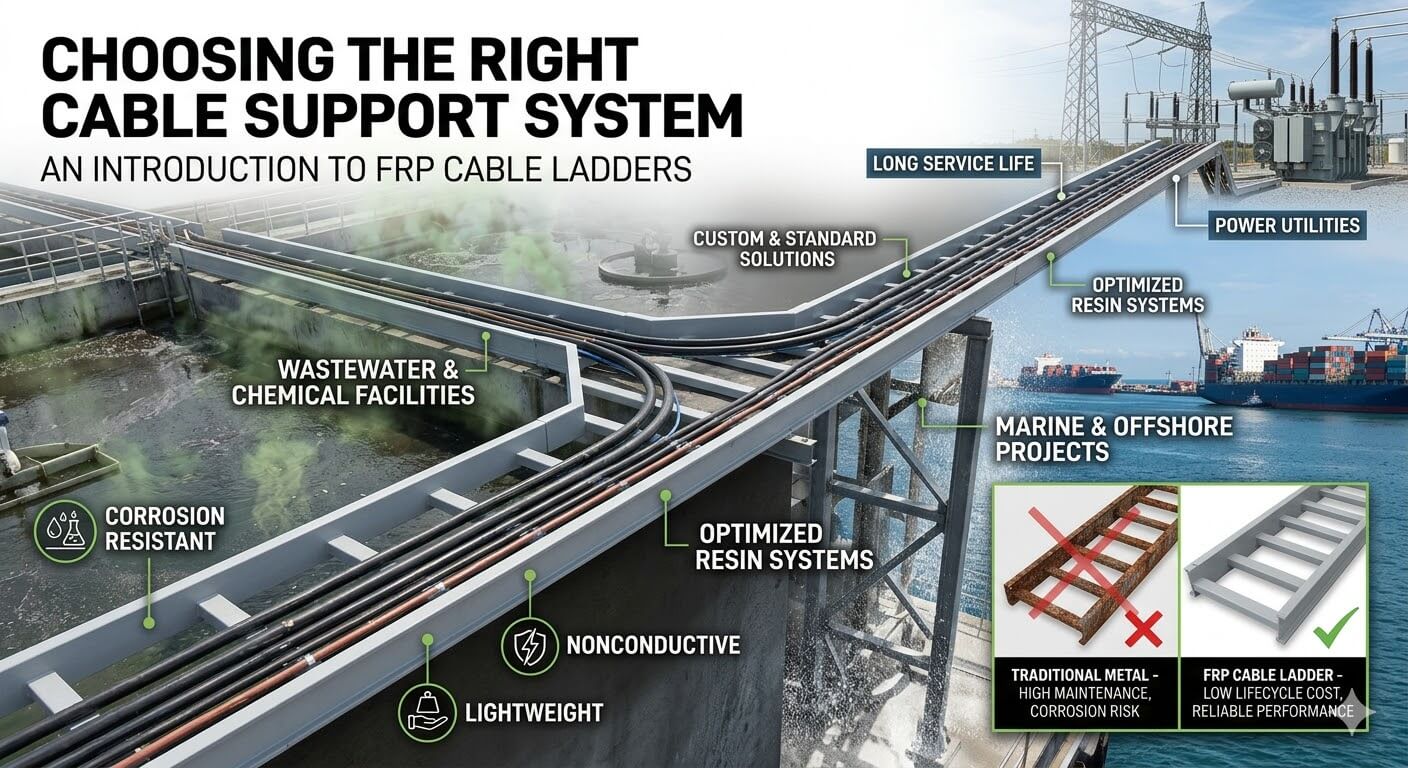
That is where the FRP cable ladder has become a serious option. FRP, or fiberglass reinforced plastic, is valued for corrosion resistance, low weight, and nonconductive performance. Those properties make it especially relevant in power utilities, wastewater plants, marine projects, and other demanding environments where long service life matters more than short-term savings.
From a manufacturing perspective, one lesson comes up again and again: buyers get better outcomes when they specify the ladder around the application, not just the catalog size. Resin choice, span, fittings, and service conditions all affect long-term performance. Unicomposite, an ISO-certificated pultrusion manufacturer with its own factory in China, works across standard pultruded fiberglass profiles and custom composite parts for sectors including electricity, wastewater treatment, marine, agriculture, and cooling tower construction. That type of in-house production experience is useful because it shifts the discussion from “FRP vs. metal” to “Which FRP solution fits the job best?”
frp cable ladder
Why FRP Cable Ladder Is Gaining Attention in Industrial Projects
Corrosion Resistance Supports Lower Lifecycle Cost
Corrosion is not a minor maintenance issue. NACE’s global corrosion study has estimated that corrosion costs the world economy about 3.4% of global GDP, which helps explain why industrial owners now look harder at total lifecycle cost, not only purchase price.
For cable management, corrosion affects more than appearance. It can shorten service life, increase inspection frequency, and create replacement costs in places where shutdowns are expensive. An FRP cable ladder does not rust like carbon steel, which is why it is often selected for wastewater facilities, chemical plants, cooling towers, and coastal installations.
A practical example is a treatment facility where humidity, chemical fumes, and washdown conditions stay constant. In that environment, a metal ladder may require coatings, regular inspection, and eventual replacement. FRP changes that equation by offering a material that is inherently more resistant to corrosive attack.
Dielectric Properties Add Safety Value
Another reason FRP attracts attention is its nonconductive nature. In substations, utility corridors, and telecom infrastructure, buyers may want a cable support system that helps reduce conductivity-related risk.
Engineering guides from major cable-management suppliers regularly identify FRP as a preferred option where dielectric performance matters. That makes the material relevant for projects where safety and electrical isolation influence specification decisions alongside strength and durability.
In practice, this matters most when project teams are balancing several risks at once. A support system that can handle structural demands while also offering electrical insulation gives designers more flexibility in harsh or sensitive environments.
Lower Weight Can Simplify Installation
Weight influences shipping, handling, labor, and installation speed. FRP systems are often significantly lighter than steel alternatives, with some designs weighing up to 70–75% less than steel, depending on profile geometry and loading requirements.
That lighter weight offers clear field advantages:
- Easier handling during transport and staging
- Reduced lifting demands for installation crews
- Faster work in elevated or restricted-access areas
- Less need for heavy equipment during retrofits
On one anonymized retrofit project, a contractor replaced a corroded support system in a tight plant area where access was limited and outage time was costly. The move to FRP did not solve every challenge, but the reduced handling weight made installation more manageable and helped the team stay on schedule.
FRP Cable Ladder vs Steel
How to Evaluate the Right FRP Cable Ladder for Your Application
Start with Load and Span Requirements
One of the most common buying mistakes is comparing ladder width and price before reviewing the real load case. A ladder may look suitable in a product sheet but still underperform if cable weight, support spacing, or future capacity is underestimated.
A better specification process starts with four questions:
- What is the total current and future cable load?
- What span distance will the ladder cover between supports?
- Will the system face wind, vibration, impact, or heavy outdoor exposure?
- Are there special fittings, cutouts, or routing constraints?
This is where engineering support matters. From experience reviewing composite applications, underestimating span is one of the quickest ways to turn a good material choice into a poor system outcome. Buyers who confirm loading early usually avoid later redesigns, site modifications, and field delays.
Match the Resin System to the Environment
Not all FRP performs the same way. Resin selection affects chemical resistance, UV durability, flame-retardant behavior, and long-term weathering. Two ladders with similar dimensions may perform very differently if one uses the wrong resin system for the environment.
For example:
- Outdoor utility installations may need stronger UV resistance
- Wastewater and chemical facilities may prioritize chemical durability
- Indoor industrial projects may require attention to flame and smoke performance
- Marine environments may demand a more robust combination of moisture and salt resistance
This is one reason experienced manufacturers add value beyond supply alone. Unicomposite supports pultrusion-based standard profiles as well as custom fiberglass fabrication, which can help buyers align profile design and resin choice with the service conditions instead of treating FRP as a one-size-fits-all material.
Know When Standard Profiles Are Enough
Standard ladder systems can be the right fit when the application is repeatable and the layout is straightforward. They can shorten lead times and simplify purchasing for common industrial designs.
That said, custom fabrication often becomes necessary when the project includes:
- Nonstandard widths or rung spacing
- Unusual support spacing
- Special brackets or connectors
- Integration with other FRP structural components
- Site-specific fire, chemical, or dimensional requirements
An anonymized OEM example shows why this matters. A buyer originally planned around a standard ladder size, but the installation later revealed routing conflicts and bracket limitations. Adjusting the design during production, rather than on-site, helped prevent costly field modifications. It is a good reminder that custom work is not always about complexity for its own sake; sometimes it is the most efficient path.
FRP Cable Ladder vs Traditional Materials
FRP vs Steel
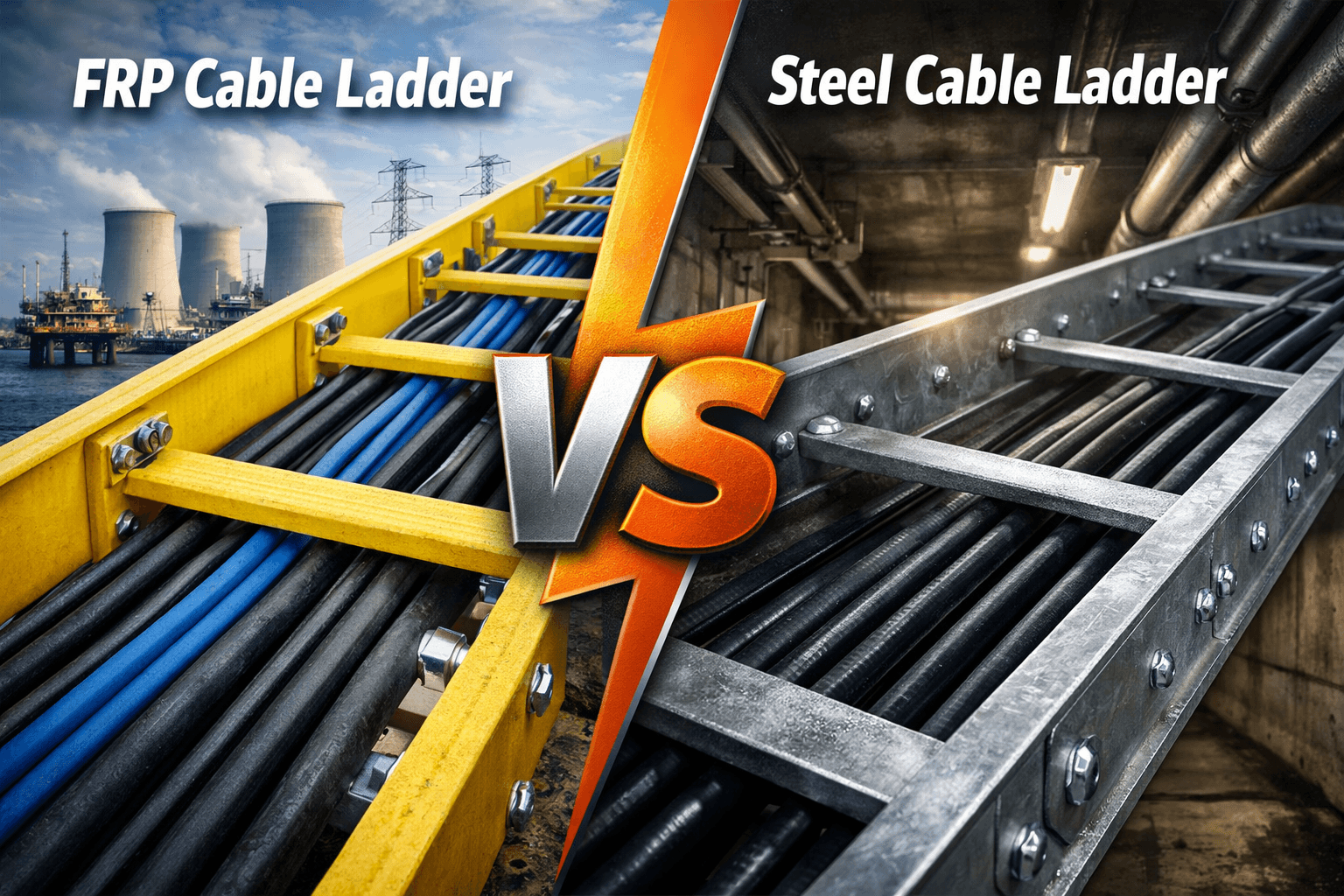
Steel remains a familiar choice because it is widely available, mechanically strong, and well understood by contractors. In some heavy-load or legacy-specification projects, it may still be the preferred material.
The drawback is maintenance. In corrosive environments, steel often depends on coatings and inspections to maintain performance. Once coatings degrade, repairs and replacement can add up quickly.
FRP often delivers stronger value when the priority is:
- Corrosion resistance
- Low maintenance
- Easier handling
- Electrical insulation
- Long service life in harsh conditions
A balanced comparison is important. FRP is not automatically the right answer for every project, but in aggressive environments it often wins on lifecycle economics rather than raw purchase price.
FRP vs Aluminum
Aluminum is also lighter than steel and performs well in many outdoor applications. That makes it a common alternative in cable support discussions. However, it remains conductive, which can limit its suitability in some electrical installations.
FRP generally makes more sense when buyers want:
- Dielectric performance
- Better resistance in chemically aggressive settings
- Minimal maintenance in wet or marine conditions
- More freedom for pultruded custom shapes
Aluminum may still work well where moderate corrosion resistance is enough and electrical conductivity is not a concern. The right decision usually comes from reviewing service conditions, maintenance expectations, and installation needs together rather than selecting purely on base material cost.
What Buyers Should Verify Before Ordering
Certifications, Quality Control, and Supplier Capability
A cable ladder system is only as dependable as the process behind it. For bulk orders and engineered applications, buyers should verify more than the product dimensions.
Useful questions to ask include:
- Is the manufacturer ISO certificated?
- Are resin systems and reinforcement materials documented?
- What dimensional tolerances are controlled during production?
- Is mechanical testing available for the ladder design?
- Can the supplier support fabrication, fittings, and assembly details?
- Is there traceability for large or repeat orders?
This is where supplier background becomes part of procurement risk management. Unicomposite’s in-house pultrusion capability, custom fabrication support, and experience across multiple industrial sectors can be relevant for buyers who want both production capacity and technical input rather than a simple resale transaction.
Support Services Can Affect Project Success
The best supplier relationship often includes more than product delivery. Buyers usually benefit when the manufacturer can assist with design review, standard-versus-custom recommendations, packaging requirements, and communication during production.
A manufacturer-side insight worth noting: one recurring issue is buyers finalizing ladder size before confirming cable fill, fittings, and support spacing. That can create avoidable revisions later. Early coordination between procurement, engineering, and the manufacturer tends to reduce friction and improve project execution.
Where FRP Cable Ladder Delivers the Most Value
Power Utilities and Electrical Infrastructure
FRP is well suited to substations, cable trenches, and utility upgrades where dielectric properties and weather resistance are important. In those environments, long service life and electrical insulation can be just as valuable as mechanical performance.
Wastewater, Marine, and Chemical Facilities
These environments are among the strongest use cases for FRP because corrosion is often a daily operating reality. A properly specified FRP cable ladder can reduce maintenance pressure and extend replacement intervals where metallic systems are more vulnerable.
Agriculture, Aquaculture, and Heavy Civil Projects
Outdoor exposure, moisture, and the need for low-maintenance materials make FRP attractive in these sectors as well. Whether the goal is durability around water or reduced upkeep in remote installations, FRP can offer a practical long-term advantage.
Conclusion
The right cable ladder decision depends on more than strength or price. Environment, load, resin choice, installation demands, and supplier capability all shape whether the system will perform over time. For many industrial projects, the FRP cable ladder stands out because it combines corrosion resistance, low weight, dielectric performance, and long-term value in one solution.
Buyers usually get the best results when they review actual service conditions early, compare lifecycle cost instead of upfront price alone, and work with a manufacturer that understands both standard profiles and custom requirements. With experience in pultruded fiberglass profiles, custom fabrication, and composite manufacturing for sectors such as electricity, wastewater, marine, agriculture, and OEM applications, Unicomposite reflects the kind of supplier profile many B2B buyers look for when planning large-volume or engineered orders.
The next step is to review your project specifications, confirm load and span conditions, and consult an experienced composite manufacturer before finalizing a bulk purchase.
Frequently Asked Questions
FRP cable ladders are nonconductive, corrosion-resistant, and much lighter than steel. Steel may offer familiarity and high strength, but FRP often delivers better long-term value in corrosive or electrically sensitive environments.
Yes, it can be a strong choice for outdoor use, especially when the resin system is selected for UV and weather exposure. The key is matching the product design to the actual environment rather than assuming all FRP grades perform the same way.
Yes. Manufacturers can often provide custom widths, fittings, bracket designs, and related composite parts when standard products do not fit the layout. This is especially useful for OEM projects, retrofits, or complex routing conditions.
Buyers should review load requirements, span distances, resin type, quality-control procedures, and the supplier’s fabrication capability. It is also wise to confirm whether the manufacturer can support drawings, fittings, and application-specific recommendations.
Power utilities, wastewater treatment, marine infrastructure, chemical processing, agriculture, and aquaculture are among the strongest fit sectors. These environments often value FRP because it resists corrosion and reduces maintenance over time.


