 info@unicomposite.com


Introduction
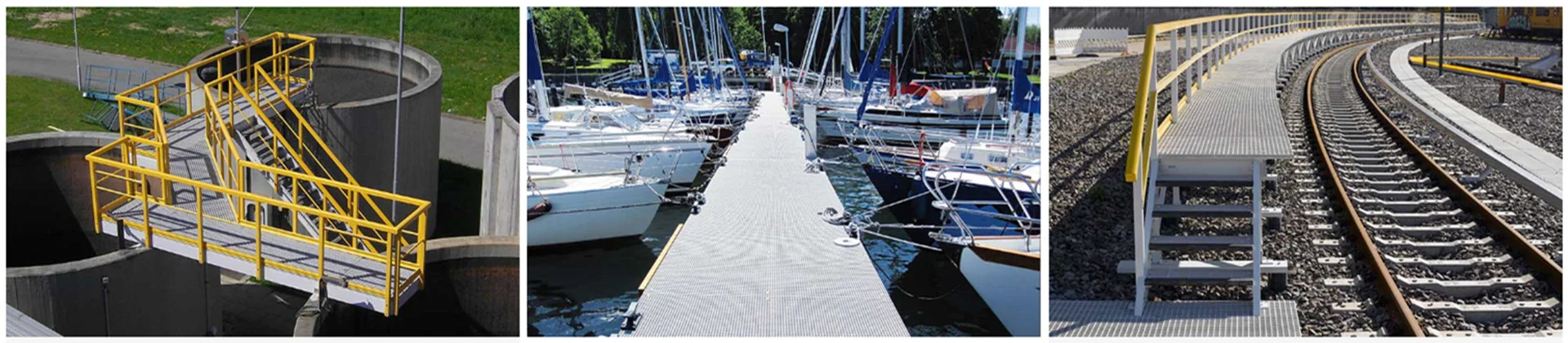
When industrial buyers compare chamber materials, the real decision is rarely about purchase price alone. It is about how the chamber will perform after years of exposure to moisture, chemicals, UV, electrical risk, and repeated maintenance access. That is why FRP chambers have become a practical option for utilities, wastewater systems, telecom infrastructure, agriculture, and OEM projects that need durability without excessive weight or upkeep.
FRP, or fiberglass-reinforced plastic, gives buyers a combination that is hard to ignore: corrosion resistance, strong dielectric performance, lower handling weight, and a service profile that often reduces maintenance pressure over time. Those advantages matter even more when the installation is remote, labor is limited, or downtime is expensive.
For B2B buyers, the material is only part of the equation. Supplier capability also matters. Unicomposite, for example, is an ISO-certificated pultrusion manufacturer with its own factory in China, producing standard pultruded fiberglass profiles and custom composite parts for sectors including electricity, wastewater treatment, cooling towers, agriculture, aquaculture, and marine applications. In practical sourcing terms, that kind of manufacturing depth can help buyers move from “catalog fit” to “application fit.”
FRP chambers
What Are FRP Chambers and Where Are They Used?
Core structure and material characteristics
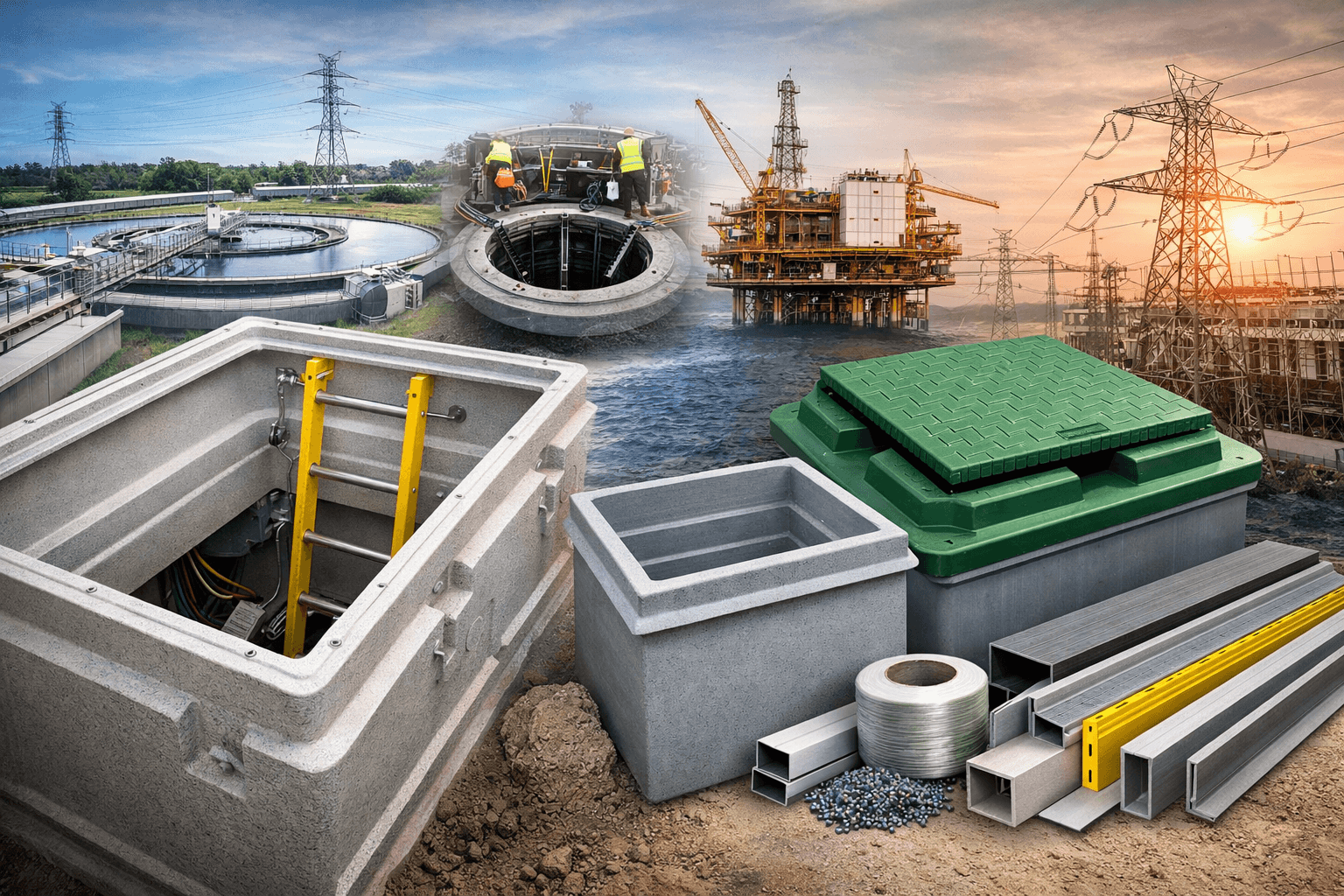
FRP chambers are composite enclosures or access structures made with glass fiber reinforcement and a resin matrix. The purpose of that combination is straightforward: the glass fibers contribute strength, while the resin system helps protect the structure from moisture, chemicals, and environmental wear. Industry manufacturers commonly position FRP around key performance traits such as corrosion resistance, chemical resistance, and reduced dependence on heavy equipment during installation.
For buyers, the most useful properties are usually these:
- Corrosion resistance for wet, coastal, or chemically exposed environments
- High strength-to-weight ratio for easier transport and handling
- Dielectric performance for electrical and utility settings
- Weather resistance for outdoor service
- Lower routine maintenance compared with rust-prone materials
In field terms, this matters because chambers often fail slowly before they fail visibly. A steel unit may need coating attention. A concrete unit may be durable but difficult to move and vulnerable to cracking or joint issues in some installations. FRP is attractive because it can reduce those operational frictions when properly specified.
Common industrial and commercial applications
FRP chambers are used anywhere buyers need a durable enclosure or access point in a harsh or electrically sensitive environment. Common sectors include:
- Power and utility infrastructure
- Wastewater treatment and drainage
- Telecom and underground access
- Agriculture and aquaculture
- Marine and landscaping projects
A realistic project example looks like this: a buyer replacing legacy access chambers near a corrosive process area usually notices the installation difference first. The crew spends less time coordinating lifting equipment, and the maintenance team spends less time worrying about rust progression later. That kind of first-hand project feedback is one reason composites keep gaining attention in infrastructure work.
Why Many Industrial Buyers Choose FRP Chambers Over Traditional Materials
Performance advantages over concrete, steel, and standard plastics
Compared with concrete, FRP chambers are much lighter, which can simplify transport, reduce lifting requirements, and make placement easier in tight or remote sites. Compared with steel, FRP has a major advantage in environments where corrosion drives maintenance cost. Compared with standard plastics, FRP is often better suited for industrial duty because the reinforcement improves structural performance and dimensional stability.
The corrosion issue is not minor. AMPP’s corrosion research traces the global cost of corrosion to roughly US$2.5 trillion, and the IMPACT study notes that better corrosion-management practices could reduce a meaningful share of those losses.
For a buyer, the takeaway is practical rather than academic: selecting a corrosion-resistant chamber at the design stage is often cheaper than managing deterioration after commissioning.
Long-term value and lifecycle cost
The strongest case for FRP chambers usually appears in lifecycle cost, not in a one-line quote comparison. Buyers should look beyond unit price and ask:
- How much labor is needed to install it?
- What maintenance will it need after three, five, or ten years?
- How difficult is replacement if it fails early?
- What is the cost of downtime if access is lost?
In many projects, FRP wins because it reduces handling effort upfront and lowers maintenance exposure later. That does not mean it is the perfect answer for every application. It means the business case improves when corrosion, electrical insulation, or installation efficiency are major factors.
How to Evaluate FRP Chambers for Your Application
Load requirements, environment, and compliance needs
A good chamber decision starts with a precise application review. Buyers should confirm:
- Expected load conditions
- Traffic exposure
- Chemical or salt contact
- UV exposure
- Moisture conditions
- Electrical insulation needs
- Dimensional and connection requirements
This is also where expertise matters. Resin choice, wall thickness, reinforcement design, and fabrication method should reflect the real environment, not a generic description. For example, a chamber near electrical infrastructure may prioritize dielectric performance, while a chamber in a wastewater setting may put chemical resistance first.
One trustworthy rule is worth stating clearly: FRP performance depends on correct specification and installation. A composite chamber should not be treated as a one-size-fits-all substitute for every steel or concrete unit.
Standard vs. custom FRP chamber design
Standard chambers can work well when dimensions and service conditions are predictable. Custom chambers make more sense when the site has unusual geometry, demanding loads, special cutouts, or integration requirements that would otherwise force field modification.
That is where supplier versatility matters. Unicomposite supports standard pultruded fiberglass profiles as well as custom fiberglass fabrication, with additional forming options such as Pulwound, SMC/BMC, and hand lay-up for project-specific requests. For B2B buyers, that flexibility can reduce installation compromises and lower the risk of ordering a chamber that fits the drawing but not the real jobsite.
What to Ask a Supplier Before You Buy
Manufacturing quality and technical support
Before ordering in volume, buyers should ask direct questions:
- Is the manufacturer ISO certificated?
- Does it own and control its factory production?
- What testing or quality checks are used?
- Can it support design review or customization?
- What documentation comes with the order?
These questions do more than screen suppliers. They help reduce buyer risk. A factory-controlled manufacturer with technical support is often better positioned to maintain consistency, manage revisions, and support repeat orders.
Lead times, customization, and after-sales support
A strong supplier should also be able to explain:
- Minimum order quantities
- Sample or prototype options
- Revision handling
- Packaging and export readiness
- Installation guidance and material documentation
One useful procurement lesson from composite sourcing is this: the way a supplier handles design changes often reveals more than the original quote does. Responsive engineering support can prevent delays, especially in custom chamber programs.
Installation and Maintenance Considerations
Best practices for handling and installation
Lighter weight is one of the most practical benefits of FRP. Manufacturers in the pultruded FRP market routinely emphasize reduced dependence on specialized labor and heavy equipment as part of the value proposition.
On site, good practice still matters:
- Protect the chamber during transport
- Prepare a stable base
- Verify alignment and support
- Plan seals and connections carefully
- Check that load assumptions match the installation
From experience, many installation issues blamed on material are actually specification or support issues. A well-chosen FRP chamber usually performs best when the installation details are treated with the same care as the material selection.
Maintenance expectations over time
FRP chambers are often chosen because buyers want fewer corrosion-related interventions. That expectation is reasonable, but inspections still matter. Teams should periodically review surface condition, joints, deformation, and signs of overload.
A balanced message builds trust: FRP can reduce maintenance burden, but long-term performance still depends on matching the chamber design to the service environment and verifying supplier documentation before installation.
Conclusion
FRP chambers are gaining ground because they solve several persistent industrial problems at once: corrosion exposure, electrical sensitivity, installation difficulty, and long-term maintenance burden. For B2B buyers, the best decision comes from evaluating lifecycle value, not just initial cost.
The most reliable buying process starts with application data, continues through careful supplier review, and ends with a chamber design that matches the real service environment. Buyers that need bulk supply, engineering input, or custom composite fabrication should work with a manufacturer that can support both standard and tailored solutions with clear technical documentation.
If your project depends on long service life, corrosion resistance, and efficient installation, the next step is to review your specifications with a qualified FRP manufacturer and confirm whether a standard or custom chamber approach will deliver the best result.
Frequently Asked Questions
They can be, especially when weight, corrosion resistance, and installation speed are important. Concrete may still suit some heavy-duty applications, but FRP is often easier to handle and maintain in corrosive or electrically sensitive environments.
Service life depends on the resin system, design, environment, and installation quality. In well-specified applications, FRP chambers are often selected because they can deliver long-term performance with less corrosion-related maintenance.
Yes. Many B2B buyers request custom dimensions, cutouts, reinforcement, or connection features. Suppliers with in-house pultrusion and multiple composite forming options are usually better equipped to support those requirements.
Confirm load requirements, environmental exposure, dimensions, documentation, quality controls, lead times, and the supplier’s customization capability. It is also wise to ask how revisions and technical support are handled after quotation.
They are often chosen for utility and electrical infrastructure because FRP materials can offer strong dielectric properties. Buyers should still verify that the specific design and material system meet the project’s electrical and structural requirements.


