 info@unicomposite.com


Introduction
For industrial and civil buyers, bridge decking is not just a surface layer. It affects load distribution, installation planning, maintenance frequency, and the long-term cost of keeping a structure in service. That matters even more in corrosive, wet, or electrically sensitive environments, where the wrong deck material can raise repair costs and shorten service life.
The buying conversation has also changed. Instead of asking only whether concrete or steel is familiar, many project teams now compare conventional materials with FRP composite systems based on lifecycle performance. FHWA’s composite bridge deck program described the target product as lightweight, corrosion resistant, modular, easy to install, repairable, and designed to require little maintenance in service.
From what buyers typically discover in rehabilitation work, the real pressure point is rarely the panel alone. It is the combination of dead load, corrosion exposure, shutdown time, and supplier capability. That is where material choice becomes a strategic procurement decision rather than a simple line-item purchase.
bridge decking
What Bridge Decking Does and Why Material Choice Matters
Core functions of bridge decking in civil and industrial projects
A bridge deck must transfer loads safely to the supporting structure, provide a durable traffic or access surface, and maintain serviceability under weather, moisture, and operational wear. In practice, that means buyers are balancing structural demands with slip resistance, surface durability, inspection access, and the realities of future maintenance.
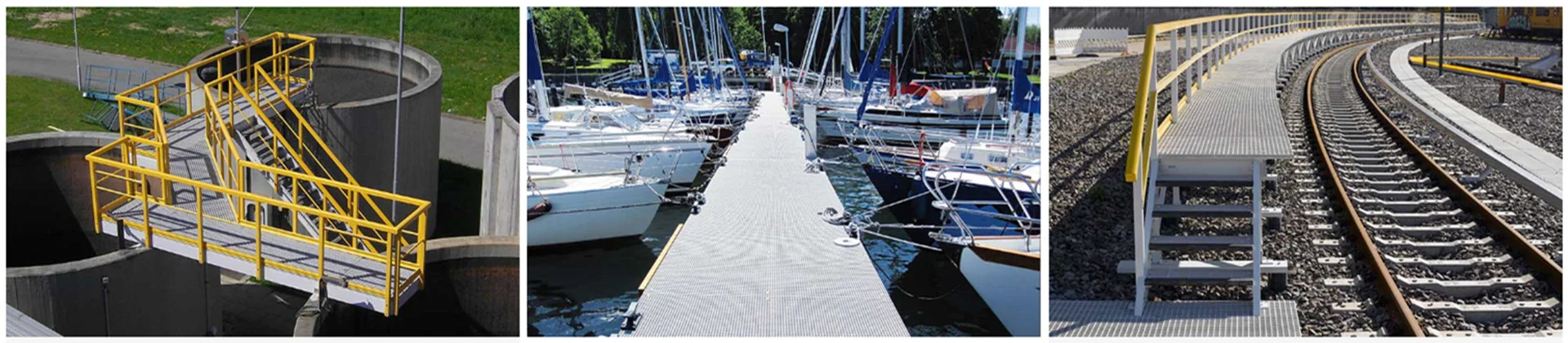
This applies across more than highway bridges. Buyers may be specifying decking for pedestrian crossings, utility walkways, service platforms, trench covers, marine access structures, or retrofit jobs where preserving existing supports is critical. FHWA notes that FRP composite bridge technologies are being pursued in part because lightweight, corrosion-resistant systems can help address bridge rehabilitation and new construction needs.
Common bridge decking materials and their trade-offs
Most projects compare four broad material paths:
- Concrete: familiar and stiff, but heavy
- Steel: strong and proven, but vulnerable to corrosion without protection
- Timber: useful in some applications, but often less durable in aggressive environments
- FRP composites: lighter and corrosion resistant, but dependent on good design, detailing, and supplier quality
The key is not to treat one option as universally best. A low initial material price can be offset by higher installation demands, coating systems, heavier support requirements, or more frequent maintenance. FHWA’s final composite bridge decking report also notes that while a tested composite system showed many desirable attributes, its initial material cost was higher than some conventional alternatives.
Why FRP Bridge Decking Is Getting More Attention
Performance advantages in corrosive and high-moisture environments
FRP decking is gaining ground because it addresses a familiar infrastructure problem: deterioration driven by moisture, chemicals, and corrosion. FHWA states that lightweight composite bridge decks are attractive for new construction because of their corrosion resistance, and its composite deck research describes these systems as capable of long service life with little maintenance.
That makes composite decks especially relevant in places such as:
- wastewater treatment facilities
- marine and coastal crossings
- cooling tower structures
- agriculture and aquaculture facilities
- utility environments where dielectric performance matters
In these settings, buyers often care less about lowest first cost and more about avoiding repeated maintenance cycles, corrosion-related shutdowns, and hard-to-schedule replacements.
Lightweight design and installation efficiency
Weight is often the deciding factor in retrofit work. A lighter deck can reduce added dead load on aging supports, simplify logistics, and make installation easier on constrained sites. FHWA says accelerated bridge construction methods can reduce onsite construction time substantially, and in some cases bridges can be replaced within 48 to 72 hours, which helps explain the appeal of lighter, prefabricated systems.
An anonymized example is common in older industrial crossings: the owner wants to replace a deteriorated deck, but strengthening the entire support system would push the project over budget. In that situation, a pultruded composite deck may stay on the shortlist because it lowers dead load and may reduce lifting and installation complexity. The lesson is practical: material selection is often really about solving several project constraints at once.
How B2B Buyers Evaluate Bridge Decking Options
Key specification criteria before procurement
Before comparing quotes, buyers should align on the performance requirements. At minimum, that review should cover:
- design loads and span assumptions
- serviceability limits such as deflection and vibration
- slip resistance and surface finish
- UV, moisture, and chemical exposure
- connection details and support conditions
- fire behavior or special safety requirements
- fabrication tolerances and field-fit expectations
FHWA’s composite bridge deck program explicitly tied the work to meeting AASHTO service requirements, which is the right framework for specification work: define the application first, then confirm the deck system is suitable for it.
Total cost of ownership versus upfront purchase price
Procurement teams often improve outcomes when they compare full ownership cost rather than only square-foot price. A more durable system may justify a higher purchase price if it reduces:
- maintenance labor
- protective coating needs
- downtime during repair
- future structural strengthening
- replacement frequency
This is especially relevant for owners with multiple facilities or exposed assets. One better decision standard is to ask which material best protects uptime, not just which material is cheapest to buy.
Manufacturing, Customization, and Supply Considerations
Why production method affects bridge decking quality
Composite performance does not begin at the job site. It starts with manufacturing control. Pultrusion is a continuous process that can produce consistent fiberglass-reinforced profiles with repeatable geometry and fiber alignment. For decking buyers, that consistency matters because fit-up, fastening, and dimensional stability affect both installation quality and structural reliability.
This is also where supplier evaluation becomes important. A manufacturer that can explain process control, tolerances, fabrication steps, and quality checks is usually more valuable than one offering a generic product sheet. For B2B projects, especially bulk orders, repeatability is often just as important as raw material properties.
Where custom fabrication adds value
Many projects need more than a standard panel. Cut-to-fit sections, anti-slip surfaces, embedded features, custom assemblies, and project-specific connections can all affect installation success. That is why engineering support and fabrication capability deserve a place in supplier qualification.
In that context, Unicomposite’s profile is relevant as a credibility signal rather than a sales pitch. The company describes itself as an ISO-certificated pultrusion manufacturer with in-house production for standard pultruded fiberglass profiles, custom fiberglass fabrication, and other composite forming methods. For buyers, those capabilities matter because they suggest a supplier can support both standardized production and custom configurations when application requirements are not purely off the shelf.
Design and Safety Considerations Buyers Should Not Skip
Verify project loads, codes, and detailing assumptions
No article can replace project-specific engineering. Final deck selection should be validated against actual site conditions, support geometry, design loads, and applicable codes or owner standards. FHWA notes that bridge design practice is tied to LRFD methods, and service-life planning is increasingly formalized through AASHTO service-life design guidance.
For buyers, that means asking early:
- Who is verifying the load assumptions?
- Are the connection details proven for this use case?
- Does the surface meet the slip and wear requirements?
- How will thermal movement, drainage, and edge detailing be handled?
- What testing or reference projects support the proposed system?
Trust comes from clear limits, not overclaims
A trustworthy supplier should be comfortable saying when additional engineering review is required. That is especially important for rehabilitation work, where existing supports, field tolerances, and operational constraints can change the design path. Buyers should view technical transparency as a strength, not a weakness.
Practical Applications for Bridge Decking Across Industries
Heavy civil, utility, and municipal infrastructure
Composite decking can fit pedestrian bridges, utility access structures, maintenance walkways, and selected rehabilitation projects where reducing dead load is valuable. FHWA’s preservation work also reinforces a broader lesson for owners: bridge decks are major maintenance drivers, and deterioration mechanisms such as chloride-related damage shape lifecycle strategy.
Agriculture, marine, and OEM environments
Outside public infrastructure, bridge decking often supports operations rather than traffic volume. Marine facilities want corrosion resistance. Agriculture and aquaculture sites value washdown durability. OEM buyers may need lightweight composite deck sections integrated into broader equipment or platform systems.
An anonymized use case illustrates the point: a coastal facility replacing corroded access decking may prioritize lighter components, low maintenance, and custom fit around existing steelwork. In that case, the most useful supplier is not simply the one selling panels, but the one that can help align material form, fabrication, and field installation with the actual operating environment.
Common Mistakes to Avoid When Selecting Bridge Decking
Focusing only on initial cost
A cheaper deck is not automatically a lower-cost project. If it requires more structural support, more maintenance, or more downtime, the savings may disappear quickly.
Overlooking engineering support and supplier capability
Before placing an order, buyers should ask:
- What design references or testing data support the system?
- What fabrication tolerances are typical?
- Can the supplier handle custom details accurately?
- What lead times apply for standard and custom parts?
- How does the supplier manage quality consistency across production runs?
Those questions usually reveal whether the supplier is truly solution-oriented.
Conclusion
The right bridge decking choice depends on service environment, structural demands, installation constraints, and long-term maintenance strategy. Traditional materials remain appropriate in many projects, but FRP composites deserve serious consideration where corrosion resistance, lower weight, and reduced maintenance can improve lifecycle value.
For B2B buyers, the strongest decisions come from combining engineering review with a realistic view of ownership cost. A supplier with in-house pultrusion experience, fabrication control, and customization support, such as Unicomposite, can be especially useful when the application calls for more than a standard panel. The next step is straightforward: define the operating environment clearly, confirm the performance requirements, and compare deck options on total project value rather than initial price alone.
Frequently Asked Questions
What makes FRP bridge decking attractive for industrial buyers?
FRP decking is attractive when corrosion, moisture, chemicals, or dead-load limits are major concerns. Buyers often choose it to reduce maintenance exposure and simplify installation in difficult environments.
Is FRP bridge decking always cheaper than concrete or steel?
Usually not on initial material price alone. Its value is more often seen in lower maintenance needs, lighter weight, and potential lifecycle savings over time.
Can bridge decking be customized for nonstandard projects?
Yes. Many suppliers can provide cut-to-fit panels, special surface finishes, and custom fabrication features. That matters for retrofit jobs, OEM systems, and structures with unusual support layouts.
What should buyers verify before specifying a bridge decking system?
They should confirm design loads, support conditions, connection details, surface requirements, environmental exposure, and relevant code or owner-standard expectations. Project-specific engineering review is essential before final selection.
How should a supplier be evaluated for composite bridge decking?
Look at manufacturing control, technical support, fabrication accuracy, quality systems, and experience with custom requirements. A capable supplier should be able to discuss both material performance and practical installation considerations.


