 info@unicomposite.com


Introduction
An FRP cable tray usually enters the conversation when a project team is tired of replacing metal in places where metal simply does not last. In corrosive plants, coastal installations, wastewater systems, and electrically sensitive environments, the tray is not just a support structure. It becomes part of the site’s reliability strategy.
From a buyer’s perspective, the real question is not “What does this tray cost today?” It is “How will this tray perform after years of chemical exposure, moisture, UV, and maintenance pressure?” That is where fiberglass reinforced plastic starts to stand out. It offers corrosion resistance, dielectric properties, lower weight, and a longer-service-life mindset that fits industrial operations focused on total cost of ownership.
In practice, material choice also affects installation and future maintenance. A common pattern in industrial retrofits is that the original tray was selected mainly on upfront price, while the replacement is chosen based on what the site learned the hard way: repeated coating repairs, rust, shutdown planning, or safety concerns around degradation. That experience is one reason many specifiers now evaluate FRP earlier in the design stage.
Supplier capability matters too. For example, Unicomposite is an ISO certificated professional pultrusion manufacturer with its own factory in China, producing standard pultruded fiberglass profiles and custom composite parts for sectors such as electricity, landscaping, wastewater treatment, cooling towers, agriculture, aquaculture, and marine applications. For B2B buyers, that kind of manufacturing depth can be valuable when standard products are not enough and engineering input is needed.
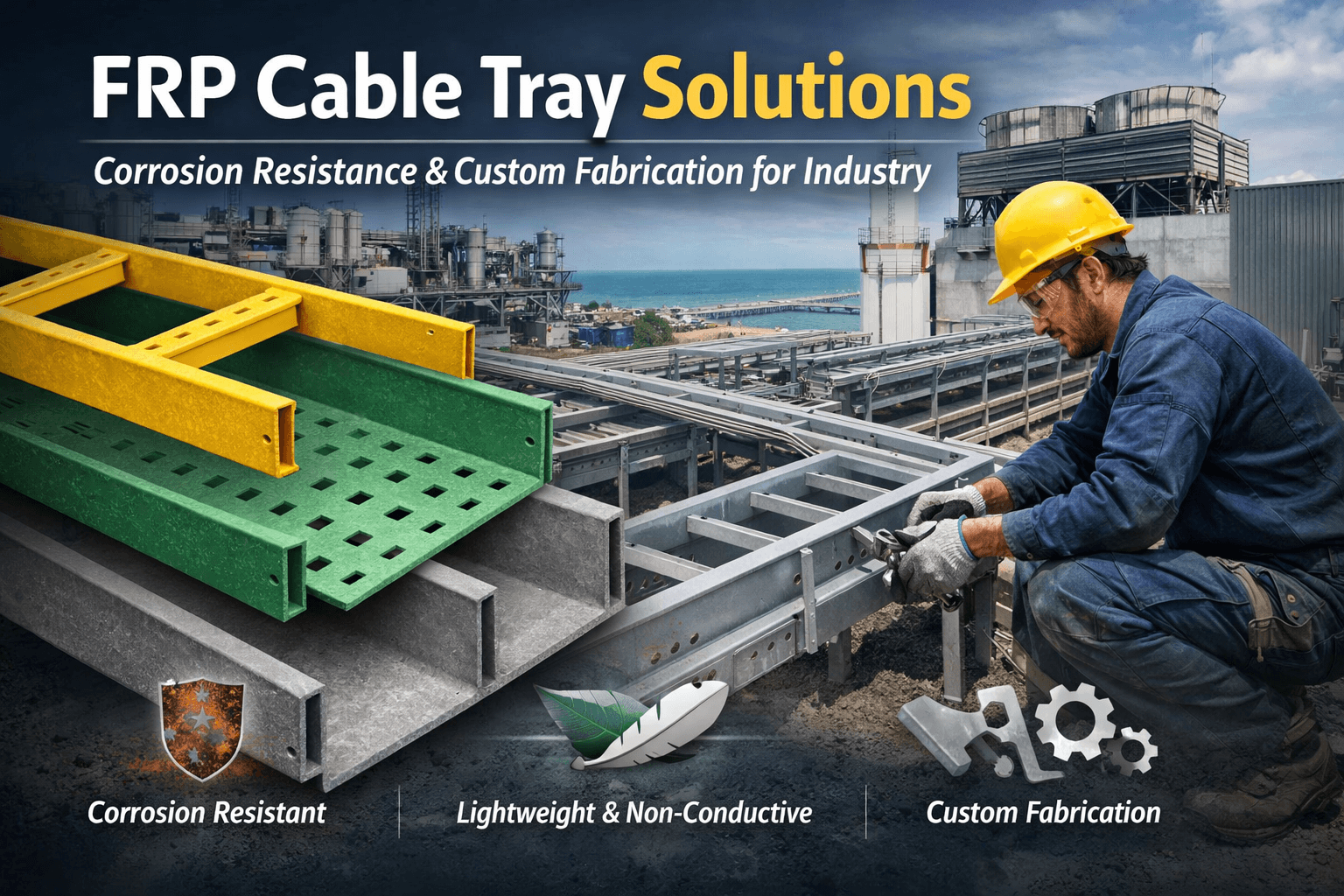
frp cable tray
Why FRP Cable Tray Is Gaining Attention in Industrial Projects
Material properties that solve common cable management problems
Fiberglass reinforced plastic combines glass fibers with a resin matrix to create a structural material designed for demanding service conditions. In cable tray systems, that translates into practical performance benefits rather than marketing language.
The biggest advantage is corrosion resistance. In wet, chemical, or salt-laden environments, metal trays can become a maintenance issue long before the cables themselves reach end of life. FRP helps reduce that risk by resisting rust and many forms of environmental attack that quickly affect conventional materials.
It also offers dielectric performance. Because FRP is non-conductive, it is often considered in substations, utility projects, and industrial plants where electrical isolation is an important design factor. That property can support safer system planning when combined with proper engineering review.
Weight is another major factor. Compared with many steel systems, FRP trays are easier to handle, easier to move into difficult access areas, and often less labor-intensive during installation. On larger jobs, small handling advantages can add up quickly across crews and schedules.
A widely cited benchmark from the corrosion engineering field is that corrosion costs the global economy trillions of dollars every year. While that figure covers far more than cable management, it explains why industrial buyers increasingly look at non-metallic systems when evaluating lifecycle risk.
Where traditional steel or aluminum trays fall short
Metal trays are still common, but their performance depends heavily on the environment. In controlled indoor settings, they may be perfectly acceptable. In wastewater treatment, fertilizer processing, marine structures, pulp and paper, or chemical plants, the limitations become more obvious.
The weakness is not only visible rust. It is the maintenance cycle that follows: inspections, coating touch-ups, replacement planning, and the labor required to keep the system serviceable. Once a site starts budgeting for repeated intervention, the cheaper material often stops being the cheaper choice.
That is why experienced buyers compare lifecycle cost, not just purchase price. A tray that lasts longer with less maintenance can deliver a better financial result, especially where shutdown windows are limited and replacement work is disruptive.
How to Evaluate the Right FRP Cable Tray for Your Application
Load requirements, span, and support design
Not every FRP cable tray is interchangeable. One of the most common specification mistakes is assuming that tray width alone determines suitability. In reality, buyers need to review cable load, span length, side rail design, support spacing, and future fill allowance.
Those details affect deflection and long-term structural performance. A tray that is undersized for the actual load may look fine during installation but perform poorly once the system is fully populated or expanded later. For industrial and utility projects, that risk should be addressed before purchase, not after installation.
A useful rule from project engineers is simple: always review the manufacturer’s load tables and installation guidance before approving a tray system. That means asking for engineering data tied to real support spans and expected service conditions.
Where applications are complex, supplier guidance becomes important. Manufacturers with experience in pultrusion and composite design can often help determine whether a standard tray is sufficient or whether a modified profile, reinforced section, or custom layout is the better fit.
Environmental and regulatory considerations
Environment often drives the final decision more than price. Before selecting a tray, buyers should map out the real conditions the product will face:
- Chemical splash or vapor exposure
- High humidity or standing water
- UV exposure outdoors
- Salt spray in coastal or marine settings
- Temperature swings
- Fire-retardant requirements
- Smoke or flame performance expectations
This is also where resin selection matters. Different resin systems are chosen for different performance priorities, whether that is chemical resistance, UV durability, or flame-retardant behavior. A good specification should reflect actual operating conditions rather than generic assumptions.
From an expertise standpoint, it also helps to align with relevant project criteria and test expectations. Depending on the job, that may include ASTM-based material evaluation, NEMA-related cable tray expectations, customer engineering standards, or local code requirements. The key point is that tray selection should match the project specification, not bypass it.
Manufacturers serving sectors such as electricity, wastewater treatment, cooling towers, and marine applications usually have a clearer view of how environment affects material choice. That experience can make early-stage specification more accurate.
Standard profiles versus custom fabrication
Standard trays are often the right starting point. They simplify procurement, support faster quoting, and work well when project loads and layouts are straightforward. For many facilities, a standard pultruded solution is enough.
Custom fabrication becomes more valuable when the project includes unusual spans, special fittings, integration with other composite structures, or application-specific dimensions. In those cases, customization can reduce field modification and improve installation efficiency.
This is where manufacturing breadth matters. Unicomposite, for instance, supports not only standard pultruded fiberglass profiles and custom fiberglass fabrication, but also other forming methods such as Pulwound, SMC/BMC, and hand lay-up based on project requirements. For OEMs, utilities, and contractors buying in bulk, that broader capability can improve fit, consistency, and responsiveness.
Key Benefits B2B Buyers Should Look For in an FRP Cable Tray Supplier
Manufacturing consistency and quality control
The tray is only as reliable as the process used to make it. Industrial buyers need confidence that dimensions, material properties, and quality will remain consistent from batch to batch, especially on large orders or phased projects.
This is where ISO-based quality systems and controlled production matter. A supplier with documented manufacturing procedures, stable production lines, and traceable material practices is better positioned to deliver repeatable product quality. That is particularly important for customers who cannot afford mismatch between shipments or inconsistent accessory fit.
Buyers should also expect clear documentation. Product data sheets, load information, resin details, and realistic performance claims all help establish trust. If the supplier cannot explain how the tray is made or what performance basis supports the recommendation, that is a warning sign.
Engineering support and application guidance
A good supplier does more than send a quotation. It helps the buyer make a technically sound decision.
One common example is support spacing. A contractor may choose a tray based on dimensions and price, only to learn later that the actual installation conditions require closer supports or a different profile. That leads to rework, extra material, and schedule pressure. Early engineering review can prevent that kind of mistake.
For utilities, OEMs, and industrial project teams, engineering support may include resin selection, accessory coordination, custom fitting design, or guidance on installation practices. Even brief pre-order consultation can reduce risk significantly.
Scalability for bulk and custom orders
B2B procurement rarely ends with one shipment. Many buyers need repeatability across projects, bulk delivery, phased supply, or custom dimensions that fit a standard platform.
A supplier with its own factory and multiple composite forming capabilities is usually better equipped to support these needs than one relying only on external sourcing. Production visibility improves scheduling, consistency, and communication when requirements change.
Unicomposite’s in-house production model and experience across pultrusion and other composite forming methods make it relevant for buyers that need both standardization and flexibility. That combination is often valuable in industrial sectors where every project is similar, but never identical.
Best Practices for Selecting and Using FRP Cable Tray
Ask the right questions before requesting a quote
A strong RFQ improves both pricing accuracy and technical fit. Before contacting suppliers, buyers should prepare answers to a few essential questions:
- What cable load will the tray carry now and later?
- What span will exist between supports?
- What environmental conditions will the system face?
- Is flame-retardant or chemical-resistant performance required?
- What fittings, supports, covers, and accessories are needed?
- Are there project standards, client specifications, or approval requirements?
- What quantity, delivery schedule, and customization level are expected?
This information helps suppliers recommend the right tray faster and reduces the risk of mismatched quotes.
Avoid common specification mistakes
A frequent mistake is treating all fiberglass systems as equivalent. In reality, resin choice, structural design, UV stability, manufacturing quality, and accessory compatibility all affect performance.
Another common mistake is looking only at upfront cost. In corrosive environments, the wrong tray may trigger maintenance labor, unplanned replacement, or field modification that wipes out any initial savings.
A typical retrofit lesson goes like this: the site first installs a lower-cost tray suited to mild conditions, then replaces it years later when corrosion or maintenance becomes unacceptable in the real environment. The second time, the buying team usually asks better questions about lifecycle performance, not just line-item price.
Installation and lifecycle planning
Even the right tray can underperform if installation is poor. Support placement, fitting alignment, fastening methods, and handling practices all influence long-term results.
Project teams should confirm installation instructions before work begins and make sure field crews understand support intervals and accessory requirements. Just as important, they should plan for inspection and maintenance expectations over the tray’s service life.
The real value of FRP cable tray often shows up after commissioning. Less corrosion-related intervention, fewer replacement cycles, and better durability in aggressive environments can make a measurable difference over time.
Safety and compliance considerations
No tray should be specified on material reputation alone. Final selection should always be checked against project-specific structural, fire, chemical, and electrical requirements, along with applicable codes and customer standards.
That matters for trust. FRP can be an excellent solution, but it is not a shortcut around engineering review. Buyers should validate the design with qualified technical personnel and confirm that the selected product matches both the operating environment and the project documentation.
Conclusion
An FRP cable tray is often the smarter option where corrosion, electrical sensitivity, and maintenance exposure make metal systems harder to justify. The strongest buying decisions come from matching material performance to real operating conditions, not from comparing product prices in isolation.
For B2B buyers, the evaluation should include more than tray dimensions. Manufacturing consistency, engineering support, resin selection, customization capability, and lifecycle cost all shape whether the system will perform as expected years from now.
When projects involve bulk purchasing, harsh service environments, or non-standard requirements, working with an experienced composite manufacturer can reduce risk and improve long-term value. If your team is reviewing options now, the best next step is to define the application clearly and request guidance based on load, environment, and project specifications.
Frequently Asked Questions
Not always. Steel may still be suitable for dry, controlled environments with limited corrosion risk. FRP is usually more attractive when the project involves chemicals, moisture, salt exposure, or a need for dielectric performance.
Service life depends on load, environment, resin selection, installation quality, and maintenance practices. In harsh environments, FRP is often chosen because it can reduce deterioration and maintenance compared with metal alternatives.
Yes. Many manufacturers offer custom widths, fittings, support solutions, and fabrication options. This is especially useful for OEMs, utilities, and projects with non-standard layouts or performance requirements.
At minimum, buyers should share load requirements, span distance, environment, quantity, fitting needs, and any fire or chemical resistance requirements. The more complete the information, the more accurate the recommendation and quotation will be.
It should be reviewed just like any other critical support system. Buyers should confirm load tables, support spacing, environmental suitability, and compliance with project specifications before final approval.


