 info@unicomposite.com


Introduction
Selecting the right FRP dowel bar is not a simple material swap. For contractors, specifiers, and procurement teams, it directly affects joint performance, installation efficiency, maintenance cycles, and long-term project cost.
That matters most in environments where steel dowels are vulnerable. When moisture, chlorides, chemicals, or stray current are part of the operating conditions, corrosion can turn a small embedded component into a major maintenance problem. An FRP dowel bar is often considered because it offers corrosion resistance, dielectric performance, and lower handling weight, but those advantages only pay off when the bar is matched to the application, not chosen as a generic substitute.
Buyers also need confidence in the source. Unicomposite, for example, is an ISO-certificated pultrusion manufacturer with its own factory producing FRP profiles and custom composite parts in China. Its experience across electricity, wastewater treatment, cooling tower construction, marine, agriculture, and related industrial sectors reflects the kind of manufacturing depth B2B buyers often look for when they need bulk supply, customization, or engineering support rather than a simple catalog item.
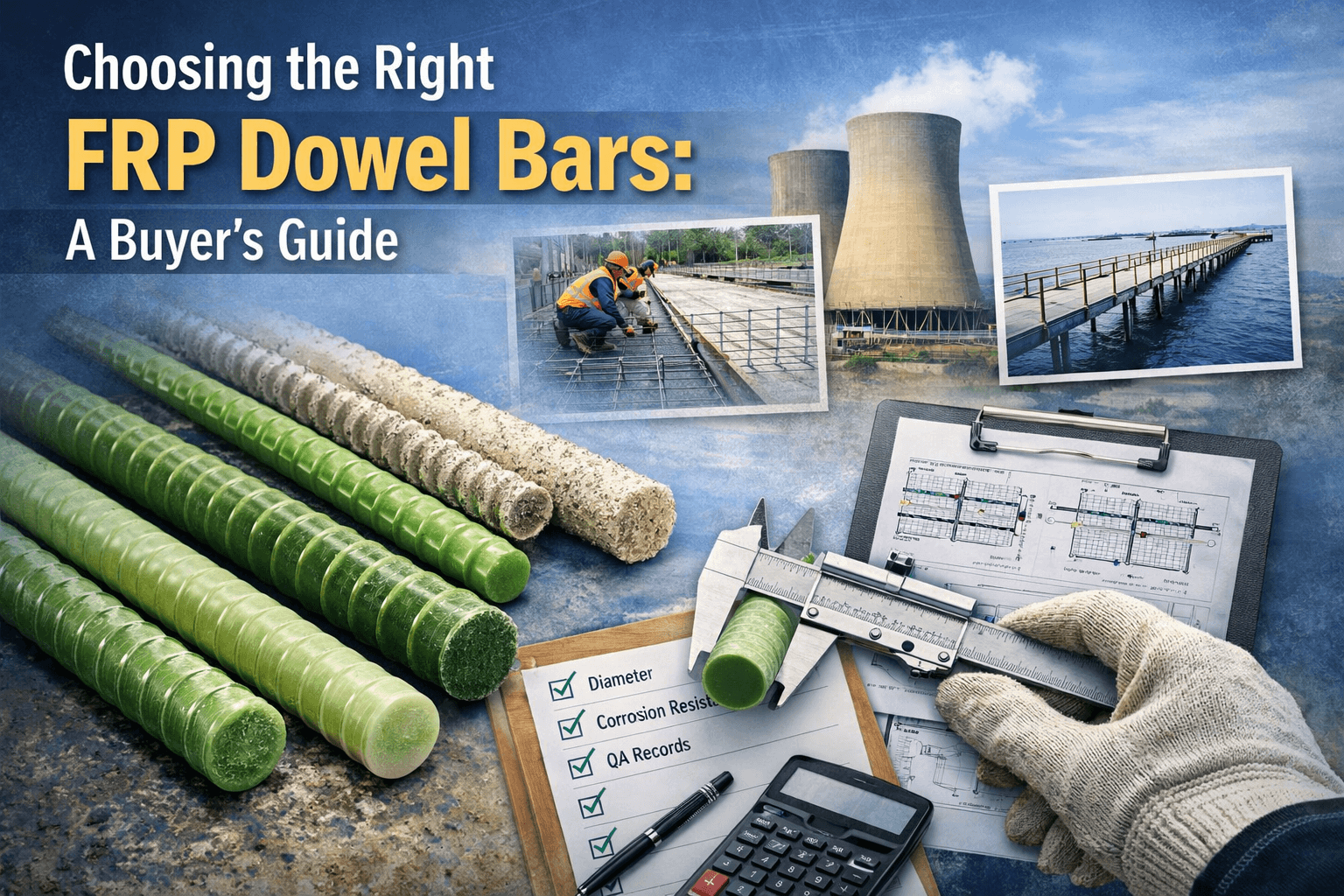
frp dowel bar
Why FRP Dowel Bar Selection Matters
The wrong choice creates long-term joint problems
A dowel bar is designed to transfer load across a concrete joint while still allowing controlled horizontal movement. When the specification is wrong, the joint may lose that balance.
Typical consequences include:
- Poor load transfer between slab panels
- Joint spalling and edge cracking
- Excessive restraint at the joint
- Moisture entry and accelerated maintenance
- Early repair costs that outweigh initial material savings
One practical lesson that comes up repeatedly in industrial paving and civil work is this: buyers who focus only on “replacing steel with composite” often overlook the details that actually govern performance. A bar may resist corrosion well, but if its dimensions, stiffness, or surface behavior do not align with the joint design, the concrete system can still suffer.
Experienced site teams usually notice the difference quickly. When the right bar is specified, placement is smoother and alignment checks tend to be more predictable. When the wrong product is chosen, the warning signs show up earlier, often as installation questions, movement concerns, or uneven joint behavior after service begins.
Where FRP dowel bars make the most sense
FRP dowel bars are commonly selected in projects where corrosion resistance and durability carry more weight than the lowest upfront material cost.
Common use cases include:
- Pavements exposed to deicing salts
- Wastewater and chemical-processing slabs
- Marine-adjacent or coastal infrastructure
- Utility and power-sector projects
- Heavy-use industrial yards with aggressive exposure conditions
In those environments, steel can become the maintenance trigger. FRP is attractive because it removes the rust mechanism from the equation and can support longer service life when the rest of the design is handled correctly.
Key Criteria for Choosing the Right FRP Dowel Bar
Match diameter, length, and spacing to the design
The first buying decision should be about fit, not price.
An FRP dowel bar should be evaluated based on:
- Slab thickness
- Joint width
- Anticipated loading
- Bar spacing
- Concrete design details
- Intended load-transfer performance
If the bar is undersized, load transfer may be inadequate. If it is oversized or poorly spaced, the project may absorb unnecessary cost or create movement-related issues. That is why experienced buyers review the dowel bar as part of the full joint system rather than as a stand-alone component.
A useful purchasing habit is to confirm three things together before placing an order: the slab geometry, the design load, and the joint movement requirement. When one of those is ignored, the risk of a mismatch goes up sharply.
Evaluate the material properties that matter in service
FRP does not behave like steel, so the evaluation criteria need to reflect composite performance rather than metal assumptions.
Key properties to review include:
- Corrosion resistance
- Shear performance
- Flexural behavior
- Modulus characteristics
- Thermal stability
- Dielectric and non-magnetic properties
For many B2B buyers, corrosion resistance is the headline benefit, but it should not be the only one reviewed. The real question is how the bar will perform under repeated loading, environmental exposure, and the movement demands of the slab.
This is also where supplier expertise matters. In pultruded composites, fiber alignment, resin selection, and process consistency all influence performance. A manufacturer with established production control is often better positioned to explain how the product will behave in service, not just provide a basic sales sheet.
Surface finish affects movement and bond
Surface condition is one of the most overlooked selection factors.
The dowel bar has to transfer load while allowing the joint to open and close as designed. If the bond behavior is wrong, the slab may not move properly. That can create restraint stress, reduce performance, and shorten service life.
Procurement and engineering teams should ask:
- Is the bar smooth, coated, or textured?
- Is debonding required on one side of the joint?
- Has the finish been selected for joint movement, not just embedment?
This is where experienced supplier input can save time and money. A low-cost bar that looks acceptable on paper may create avoidable field issues if its surface behavior is not suited to the joint design.
FRP Dowel Bar vs. Steel: What Buyers Should Compare
Corrosion resistance and lifecycle value
The strongest case for an FRP dowel bar is usually lifecycle performance in corrosive environments.
Steel can perform well in many applications, but once chlorides, moisture, or chemicals begin attacking embedded metal, deterioration can spread into the surrounding concrete. FRP avoids that corrosion pathway. For infrastructure owners and industrial buyers, that may translate into fewer repairs, less downtime, and a longer service interval.
That is why the better comparison is not just piece price. Buyers should compare:
- Initial procurement cost
- Installation handling
- Maintenance exposure
- Risk of premature replacement
- Total service-life value
Teams with field experience often reach the same conclusion: when the environment is aggressive, the cheapest upfront option is rarely the safest long-term choice.
Weight and installation efficiency
FRP bars are lighter than steel, and that can produce practical jobsite benefits.
Potential advantages include:
- Easier transport and staging
- Faster handling during repetitive placement
- Reduced worker fatigue
- Better control during alignment and installation
On large pours, those gains can be noticeable. Crews spend less effort moving material and more attention on correct placement. That may not appear as a line item in every procurement review, but it influences labor flow, installation pace, and the likelihood of field frustration.
Electrical and magnetic performance
In some sectors, corrosion resistance is only part of the reason to choose FRP.
Because FRP is non-conductive and non-magnetic, it can be useful in:
- Power and utility projects
- Electrified infrastructure
- Rail-related work
- Facilities sensitive to electrical interference
That is one reason buyers often prefer a supplier with broader composite experience. Unicomposite’s work across electricity, wastewater treatment, marine, agriculture, aquaculture, and custom composite fabrication suggests the kind of cross-industry familiarity that can help when the application involves more than a standard commodity requirement.
How to Evaluate an FRP Dowel Bar Supplier
Review manufacturing method and process control
Not every composite product is made with the same level of consistency.
For recurring B2B orders, buyers should ask about:
- Pultrusion process control
- Resin system selection
- Fiber orientation and content
- Dimensional tolerances
- Inspection frequency
- Batch-to-batch consistency
Pultrusion is often preferred for continuous profiles because it supports repeatability at scale. That matters when the job requires large volumes, predictable dimensions, and stable product quality from one shipment to the next.
An ISO-certificated manufacturer can offer additional confidence here because documented quality systems help support traceability, inspection discipline, and repeatable output.
Look for engineering support and customization
Many projects do not fit a stock-only purchasing model.
The right supplier should be able to support:
- Custom diameters or lengths
- Project-specific tolerances
- Technical datasheets
- Sampling before scale-up
- Packaging for bulk shipment
- Collaborative engineering discussion
That is particularly important for OEM buyers, infrastructure contractors, and industrial procurement teams that need more than a standard part number. Unicomposite’s capabilities in pultrusion, Pulwound, SMC/BMC, and hand lay-up for custom requests illustrate the kind of flexibility that can matter when a standard profile is not enough.
Verify documentation and supply reliability
Trust is built through documentation, not claims alone.
Before approving a supplier, request:
- ISO certification details
- Product datasheets
- Resin and material specifications
- Dimensional tolerance information
- QA or inspection records
- Lead-time commitments
- Export and logistics support, if relevant
A strong supplier should be ready with this information. If the answers are vague or delayed, that is often a signal that the order carries more risk than it first appears.
Common Buyer Mistakes to Avoid
Buying on price alone
Low initial pricing can hide expensive downstream problems.
Those problems may include:
- Inconsistent dimensions
- Limited technical support
- Poor process control
- Greater risk of rework or early maintenance
For bulk orders, one specification error can erase the apparent savings of a low quote.
Treating FRP as a direct steel substitute
An FRP dowel bar should not be selected as a one-for-one replacement without review.
Composite materials have different structural behavior, bond characteristics, and service advantages. The design assumptions must be checked, especially when a project team is updating an older steel-based specification.
Ignoring the service environment
Environmental conditions should shape selection from the start.
A dry interior slab and a chloride-exposed pavement are not asking the same thing from the dowel bar. Chemical exposure, moisture, temperature variation, and electrical conditions should all be part of the buying discussion before the bulk order is approved.
Practical Buying Checklist for FRP Dowel Bars
Questions to answer before ordering
Before placing a volume order, confirm the following:
- What loads will the slab carry?
- What is the expected exposure environment?
- What dimensions and tolerances are required?
- How should the joint move in service?
- What documentation supports the product?
- Can the supplier support repeat volume reliably?
What to request from the manufacturer
Ask the supplier for:
- A technical datasheet
- Sample pieces, if needed
- Resin and material details
- QA and inspection documentation
- Lead times
- Customization options
- Shipping and packaging details
This step is where trust becomes practical. A supplier who can answer clearly and document thoroughly is usually easier to work with before, during, and after delivery.
Conclusion
Choosing the right FRP dowel bar means matching the product to the joint design, service environment, and long-term performance target, not simply replacing steel with a corrosion-resistant alternative. Buyers who take a broader view tend to make better decisions because they evaluate sizing, material behavior, surface condition, documentation, and supplier capability together.
For B2B purchasers, the strongest results usually come from working with a manufacturer that combines production consistency with technical support. When bulk supply, custom fabrication, or application-specific guidance is part of the project, a qualified composite manufacturer can help reduce risk before the order is placed and improve confidence in the final specification.
Frequently Asked Questions
The main advantage is corrosion resistance. In aggressive environments such as chloride exposure, wastewater facilities, or marine-adjacent structures, FRP helps eliminate the rust-related deterioration that can shorten the service life of steel dowels.
Yes. Many manufacturers can provide custom lengths, diameters, tolerances, and packaging for bulk orders. Buyers should confirm these options early, especially when the project requires engineering support or non-standard dimensions.
They can be, provided the product is selected based on the slab design, expected loading, and service environment. The key is to verify that the material properties and dimensions match the performance demands of the application.
Buyers should request technical datasheets, QA records, resin information, dimensional tolerances, and lead times. It is also wise to ask about pultrusion process control, customization capability, and recurring supply reliability.
In many projects, yes. Lighter bars are easier to move, stage, and place, which can reduce worker fatigue and improve handling efficiency, particularly on large pours or repetitive joint installations.


