 info@unicomposite.com


Introduction
An FRP ramp is not just an access product. For many industrial buyers, it is a way to cut recurring maintenance, reduce slip risk, and improve reliability in environments where steel, aluminum, or wood can become a long-term burden. Wet process areas, coastal facilities, chemical exposure zones, and utility sites all put heavy demands on walking surfaces, and OSHA requires those surfaces to be kept free of hazards such as corrosion, leaks, spills, snow, and ice while also supporting their intended loads.
That makes material choice more strategic than it first appears. Buyers evaluating an FRP ramp are usually asking three practical questions: Will it last in this environment? Will it help us keep people safe? Will it lower our total ownership cost over time? Those are exactly the questions this article answers.
Manufacturing depth also matters. Unicomposite, for example, is an ISO certificated pultrusion manufacturer with its own factory producing standard and custom FRP composite parts in China. With experience in pultrusion, pulwound, SMC/BMC, and hand lay-up products for sectors such as electricity, wastewater treatment, cooling towers, marine, and agriculture, the company reflects the kind of supplier capability many B2B buyers look for when they need more than a catalog item.
FRP ramp
Why Businesses Choose an FRP Ramp
Performance advantages over traditional materials
The strongest argument for an FRP ramp is lifecycle performance. Corrosion is not a niche problem. AMPP estimates the global cost of corrosion at about $2.5 trillion, or 3.4% of global GDP, which helps explain why industrial owners increasingly prioritize corrosion-resistant materials in exposed service.
Compared with steel, FRP avoids the familiar cycle of rust treatment, coating repair, and surface degradation. Compared with wood, it is less vulnerable to rot, swelling, and inconsistent traction. Compared with aluminum, it often offers a better fit where electrical insulation and chemical resistance matter.
In buyer conversations, one pattern comes up again and again: the lowest upfront quote often stops looking cheap after a few seasons of maintenance. That is especially true for ramps near salt air, standing water, or aggressive cleaning chemicals.
Safety and compliance benefits
Safety is a major reason to specify FRP. A properly designed FRP ramp can include slip-resistant surfaces, stable structural profiles, and accessories such as handrails or edge protection. Those features matter in industrial environments where water, oils, or residue can quickly turn ordinary walking surfaces into a hazard.
OSHA’s walking-working surface rule does not prescribe FRP specifically, but it does require employers to provide safe access and maintain surfaces free of hazards, including corrosion. For buyers, that means choosing a ramp material that supports safer operation in real site conditions, not only in ideal showroom conditions.
How an FRP Ramp Is Manufactured and Customized
Pultrusion and why it matters
Many structural FRP ramp components are produced by pultrusion, a continuous manufacturing process in which reinforcing fibers are pulled through resin and then through a heated die to create a constant cross-sectional profile. CompositesWorld describes pultrusion as a core composite manufacturing method valued for producing repeatable structural shapes.
For a procurement team, that repeatability matters. It supports tighter consistency across multiple units, better dimensional control, and smoother scale-up when a project expands from one site to several. Resin selection also matters because it influences chemical resistance, fire performance, and process fit; CompositesWorld notes that resin formulation is an important factor in optimizing pultruded profiles for their intended use.
This is where a manufacturer with in-house production adds value. Unicomposite’s combination of pultrusion capability and custom fabrication support is relevant for buyers who need both standard profiles and application-specific ramp assemblies.
Custom fabrication options
A successful FRP ramp is usually specified around the job, not chosen by appearance alone. Key variables include:
- Design load and traffic type
- Span, slope, and support spacing
- Resin system for chemical or UV exposure
- Slip-resistant surface finish
- Handrails, curbs, and connection details
- Fire or electrical performance requirements
An anonymized example is common in wastewater work: a plant needs to replace a steel service ramp that has become slippery and corrosion-prone. The replacement must hold its load, resist splash exposure, and reduce maintenance shutdowns. In that case, the right answer is not simply “use fiberglass.” It is to match the profile, resin, surface texture, and fabrication details to the actual service environment.
Where an FRP Ramp Delivers the Most Value
Industrial and infrastructure use cases
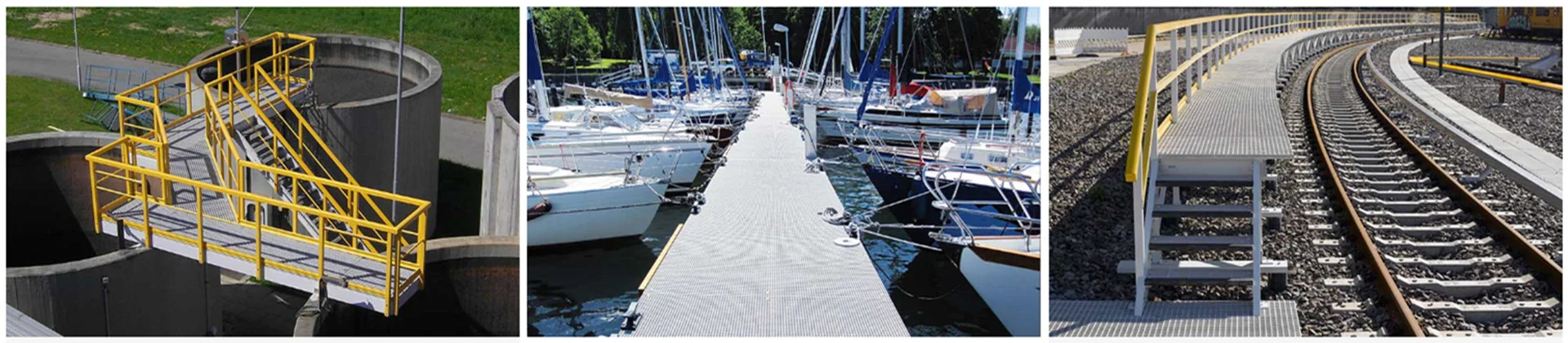
An FRP ramp tends to deliver the greatest value where corrosion, moisture, or electrical risk are constant concerns. Common applications include:
- Wastewater and water treatment plants
- Power utilities and substations
- Cooling tower structures
- Marine and dockside facilities
- Agriculture and aquaculture operations
- Heavy civil and industrial access systems
These are all environments where a low-maintenance, corrosion-resistant ramp can reduce interruptions and improve site durability. Buyers in these sectors are usually less interested in cosmetic finish than in years of dependable service.
OEM and bulk procurement considerations
For OEMs and large project buyers, repeatability is often as important as raw material performance. They need predictable lead times, engineering support, and quality assurance across volume orders. A supplier with multiple composite forming capabilities can be especially useful when the project also includes related structural parts, fabricated fittings, or custom assemblies.
That is why experienced buyers often ask not only, “What is the unit price?” but also, “Can this supplier help us standardize and support this system across future projects?”
How to Evaluate the Right FRP Ramp Supplier
Technical questions to ask before ordering
Before approving a supplier, buyers should verify:
- What resin system is specified, and for which environment?
- What load rating and deflection criteria apply?
- What surface finish is used for slip resistance?
- What are the UV, chemical, and temperature limits?
- What tolerances and fabrication controls are in place?
- What testing or compliance documents can be provided?
These questions improve both expertise and trust because they force the discussion toward real operating conditions.
Signs of a reliable manufacturing partner
A dependable supplier usually offers ISO-backed quality systems, factory production capability, prototyping or drawing support, and experience serving demanding industries. Trust also improves when the supplier is transparent about what must be confirmed before manufacture, including loads, environment, fixing details, and installation conditions.
The strongest partners do not oversell FRP as a universal answer. They explain where it performs well and where project-specific review is still required.
Cost, Lifespan, and Return on Investment
Upfront price versus lifecycle value
An FRP ramp may cost more upfront than a basic steel or timber alternative, but the comparison should be made across service life, not just purchase day. When corrosion, repainting, repairs, and replacement outages are factored in, lifecycle economics often shift in favor of composites. That broader corrosion-cost reality is exactly why industry groups continue to emphasize prevention and material selection.
Common mistakes that increase total cost
The most expensive mistakes are usually specification errors:
- Choosing by price alone
- Underestimating load requirements
- Ignoring environmental exposure
- Treating all FRP formulations as identical
- Skipping documentation review before approval
A better process is simple: define the service environment first, then match the ramp design and supplier capability to that reality.
Conclusion
A well-specified FRP ramp can be a smart long-term investment for industrial buyers who need corrosion resistance, dependable traction, and lower maintenance in harsh environments. The material’s real value comes from matching the design to site conditions and partnering with a manufacturer that can support engineering review, repeatable production, and custom fabrication where needed.
For buyers comparing access solutions, the best next step is to review loads, exposure, safety requirements, and installation details early. That makes it easier to decide whether a standard design will work or whether a custom FRP ramp will deliver better long-term value.
Frequently Asked Questions
In many corrosive or wet environments, yes. FRP is often chosen because it resists corrosion better than steel and can reduce ongoing coating and repair work.
Yes. Many manufacturers can adjust dimensions, structural profiles, surface finishes, handrails, and connection details to fit project requirements and repeat those specs across volume production.
They should confirm design loads, slope, support conditions, chemical exposure, UV exposure, slip-resistance needs, and available testing or quality documentation.
It can. Pultrusion is valued because it produces consistent structural profiles, which helps with repeatability, fit, and scalable production for multi-site or OEM orders.
Not at the purchase stage. Its advantage is usually lifecycle value, especially where corrosion, moisture, or frequent maintenance would make traditional materials more expensive over time.


