 info@unicomposite.com


Introduction
A fence stake rarely gets attention during project planning, but it becomes expensive when it bends, rots, rusts, or forces crews back to the site for replacement. For agricultural boundaries, utility sites, coastal facilities, industrial perimeters, and OEM assemblies, stake material affects more than the purchase order. It affects installation speed, long-term maintenance, safety, and total project cost.
Buyers usually compare three options: wood, steel, and fiberglass. Each can work, but each serves a different environment. This guide helps engineers, procurement managers, and operations teams compare fiberglass fence stakes with wood and steel using practical B2B criteria: corrosion resistance, handling, dielectric behavior, customization, maintenance, and RFQ preparation.
Unicomposite manufactures FRP and GRP composite products through processes including pultrusion, pulwinding, SMC and BMC molding, hand lay-up, and vacuum infusion. For fence stakes, pultrusion matters most because it produces consistent profiles for bulk orders, including rods, tubes, square stakes, flat profiles, and custom sections.
fiberglass fence stakes
What Is a Fiberglass Fence Stake?
A fiberglass fence stake is a composite stake made from glass fiber reinforcement and a resin matrix. The glass fiber provides strength, while the resin protects the reinforcement, holds the shape, and supports resistance to moisture, UV exposure, salts, and selected chemicals depending on the resin system.
Most FRP fence stakes used in repeatable industrial or agricultural supply are pultruded. During pultrusion, continuous fibers pass through resin and a heated die to form a fixed cross-section. That process helps maintain dimensional consistency, which matters when buyers need thousands of stakes with the same length, color, hole pattern, or packaging requirement.
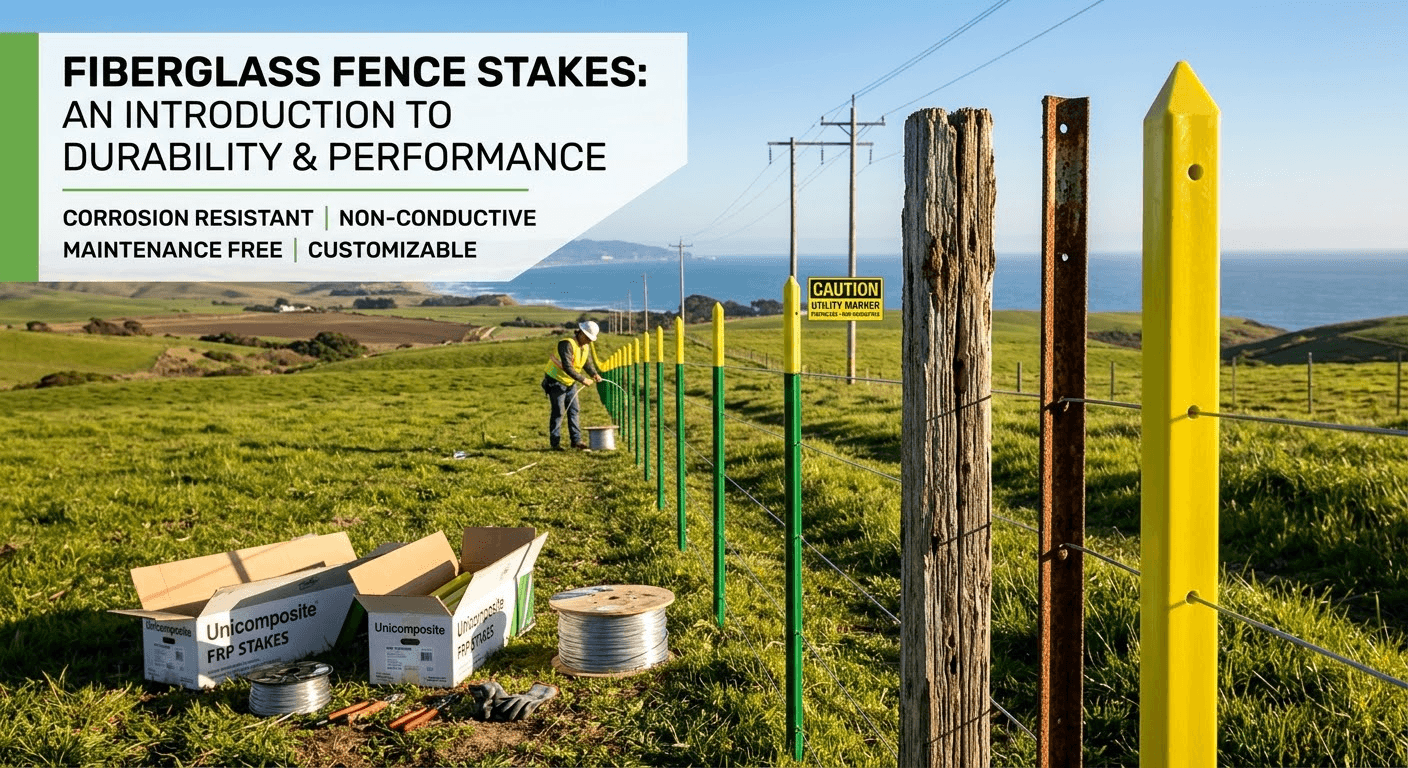
Common options include round rods, square profiles, tubes, flat stakes, pointed tips, drilled holes, reflective tape, and custom colors. Buyers may use them for fencing, boundary marking, plant support, utility zones, temporary site control, snow or road marking, and corrosion-prone outdoor installations.
How does a pultruded FRP stake work?
A pultruded FRP stake uses continuous glass fibers for mechanical strength and resin for shape, durability, and environmental protection. This structure creates a lightweight, non-corrosive profile that can be manufactured in consistent lengths and cross-sections for bulk fencing, marking, and support applications.
In field installations, engineers usually evaluate more than strength. They also check stiffness, flexibility, UV exposure, installation damage, hole quality, surface finish, and whether the stake can handle repeated wetting, sunlight, or chemical contact.
For procurement teams, pultrusion also supports repeatability. A standard die can produce large quantities with stable dimensions, while secondary processing can add holes, tips, cuts, labels, or packaging formats.
Fiberglass Fence Stakes vs Wood and Steel
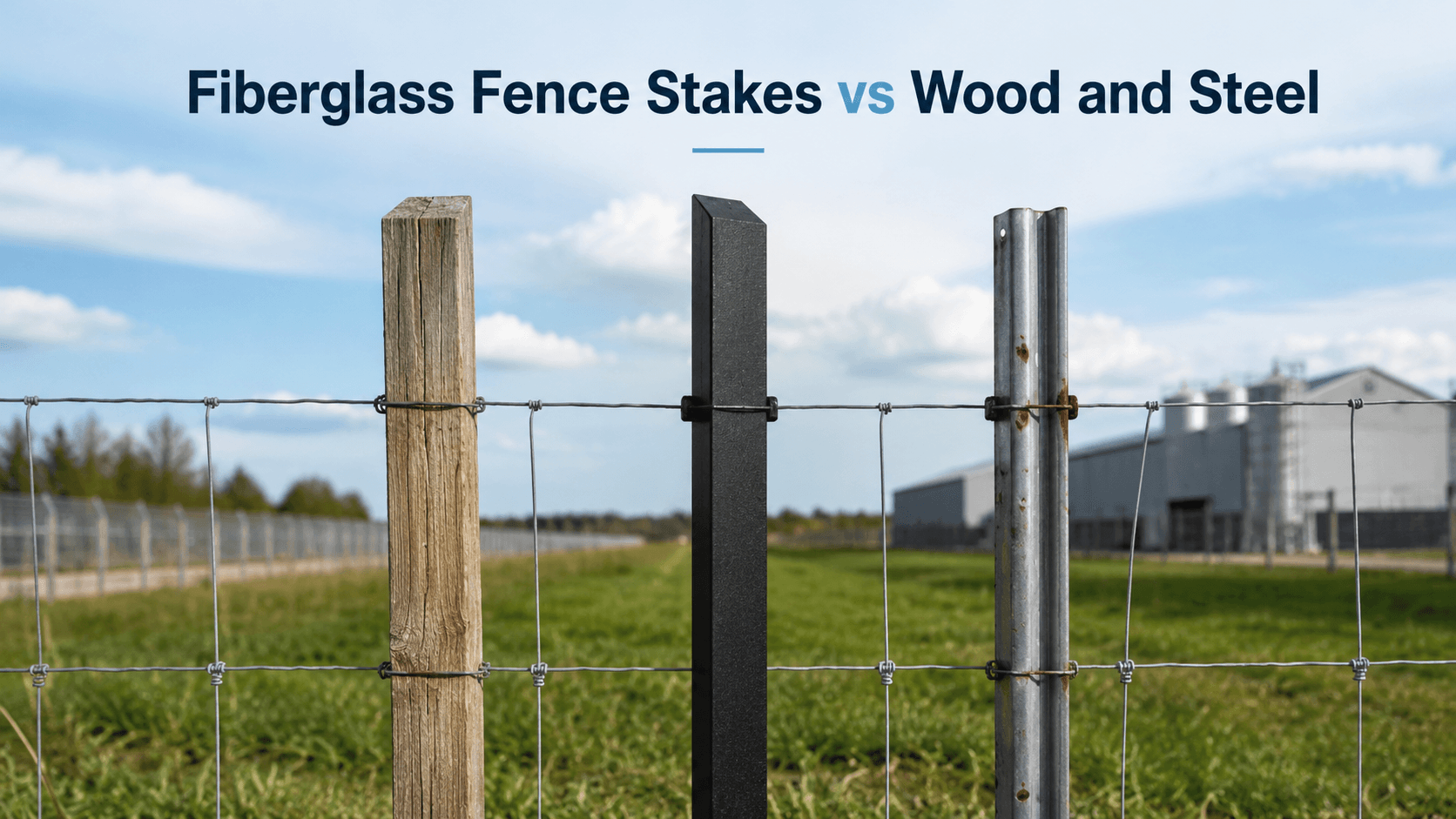
Material choice starts with the operating environment. Wood, steel, and fiberglass all have valid roles, but they fail in different ways. Wood can rot, split, or warp. Steel can corrode, conduct electricity, and add handling weight. Fiberglass can cost more upfront, but it often reduces maintenance in wet, corrosive, or electrically sensitive locations.
The table below compares the main material trade-offs for B2B fence stake selection:
| Factor | Fiberglass Fence Stake | Wood Stake | Steel Stake |
|---|---|---|---|
| Moisture and corrosion behavior | Can be specified for resistance to moisture, salts, UV, and selected chemicals | Can rot, split, warp, or absorb moisture | Can rust when coating is damaged |
| Weight and handling | Lightweight for bulk transport and field movement | Usually light, but weight varies by species and moisture | Heavier, especially in long profiles |
| Electrical behavior | Non-conductive | Generally low conductivity when dry, less predictable when wet | Conductive |
| Maintenance | Low maintenance when properly specified | Replacement or treatment may be needed | Coating checks or rust control may be needed |
| Customization | Length, color, profile, holes, tips, and packaging can be customized | Limited consistency for engineered use | Customization possible, often with more fabrication steps |
| Best-fit use | Corrosive, wet, utility, agricultural, coastal, and reusable applications | Temporary or low-cost light-duty fencing | Heavy impact or high structural load conditions |
This comparison does not make one material universally superior. It shows when each material fits. Wood works for short-term, low-cost projects. Steel works when impact resistance or structural load dominates. Fiberglass works when corrosion resistance, insulation, lightweight handling, and lower maintenance matter together.
Are fiberglass fence stakes better than wood stakes?
Fiberglass fence stakes usually perform better than wood stakes in wet, coastal, chemical, or long-term outdoor environments because they resist rot, splitting, and moisture absorption. Wood can still work for temporary fencing, low-cost marking, or projects where replacement is expected and service life is less critical.
In agricultural operations, wood often looks economical at first purchase. The hidden cost appears later through replacement labor, inconsistent quality, breakage, and disposal. For long fence lines, the labor cost of repeated replacement can exceed the unit price difference.
Fiberglass stakes help buyers reduce that cycle. They are especially useful where irrigation, fertilizer, soil moisture, or seasonal weather repeatedly attack traditional materials.
Are fiberglass fence stakes better than steel stakes?
Fiberglass fence stakes are often better than steel stakes when corrosion resistance, lighter handling, and electrical insulation are priorities. Steel may be better for high-impact or heavy structural applications, so buyers should compare site conditions, load requirements, safety needs, and expected service life before selecting material.
In utility and electrical environments, conductivity can drive the decision. FRP does not conduct electricity like steel, which makes it useful near substations, cable routes, communication equipment, and controlled-access areas where insulation matters.
Steel still has a role. If a stake must resist severe impact or act as a structural post, steel may remain the safer choice. A balanced specification should match the material to the real site risk.
When Should Buyers Choose Fiberglass Fence Stakes?
Once buyers understand the material trade-offs, the next question is application fit. FRP fence stakes deliver the most value when the environment attacks wood or steel, or when crews need lightweight products for large-area installation.
For example, in a coastal agricultural boundary exposed to salt air, irrigation, and fertilizer, operations teams often prioritize FRP because rust control and wood replacement can become recurring costs. In a utility site, the same buyer may value FRP for its non-conductive behavior and easier manual handling.
The table below shows common applications and why FRP may be selected:
| Use Case | FRP Suitability | Buyer Reason |
|---|---|---|
| Agricultural fencing | High | Resists moisture, fertilizer exposure, and repeated outdoor use |
| Coastal boundary fencing | High | Performs well where salt air can shorten the life of metal components |
| Utility and electrical sites | High | Non-conductive and easier for crews to handle |
| Chemical plant boundaries | High | Can be specified with resin systems suited to selected corrosive conditions |
| Temporary construction marking | Medium | Useful when reuse matters, though low-cost temporary stakes may be enough |
| Heavy impact barriers | Case-dependent | Steel may be better when impact load is the main design factor |
Buyers should also consider visibility. High-visibility colors, reflective tape, and consistent lengths can help with site safety, snow marking, traffic areas, and controlled boundaries.
A practical rule works well: choose FRP when the project needs repeated outdoor service with less maintenance; choose wood for short-term economy; choose steel when heavy impact dominates.
How to Specify Fiberglass Fence Stakes
A strong specification saves time during quotation and prevents product mismatch. Vague RFQs such as “send price for fiberglass stakes” usually create delays because the supplier needs size, use case, quantity, processing details, and delivery information.
A pultrusion manufacturer typically reviews the application environment first. The supplier may ask whether the stake will be installed in soil, sand, gravel, snow, coastal air, chemical exposure, or near electrical equipment. Then the manufacturer can recommend a standard profile or evaluate whether a custom profile, resin system, or secondary processing step is required.
The table below lists technical details buyers should confirm before bulk purchase:
| Technical Detail | What to Confirm | Why It Matters |
|---|---|---|
| Profile size | Diameter, wall thickness, width, or custom section | Affects stiffness, flexibility, and material cost |
| Length | Standard or custom cut length | Controls installation depth and visible height |
| Resin system | Polyester, vinyl ester, epoxy, or project-specific option | Influences environmental resistance |
| UV package | Outdoor exposure requirement | Supports long-term color and surface performance |
| Hole tolerance | Hole diameter, spacing, and position | Helps fit wires, ties, clips, or hardware |
| Surface finish | Smooth, textured, colored, or reflective | Affects handling and visibility |
| Tip style | Flat, pointed, capped, or drilled | Affects installation method |
| Packaging | Bundle size, pallet format, cartons, labels | Supports warehousing, resale, and job-site handling |
What information should buyers prepare before requesting a quote?
Buyers should prepare stake length, profile size, quantity, color, application environment, installation method, packaging requirement, destination, and any drawings or samples. Clear information helps the manufacturer confirm feasibility, recommend standard or custom options, and provide a more accurate bulk quotation.
If the stake needs holes, pointed ends, reflective tape, or special labeling, include those details early. Secondary processing affects cost and lead time.
For critical projects, buyers should also request samples, dimensional tolerances, material data sheets, and quality documentation. ISO 9001 process control, batch traceability, inspection records, or agreed sample approval can reduce purchasing risk before a full container or project order.
fiberglass fence stakes vs wood and steel
Cost, Maintenance, and Total Project Value
Unit price matters, but B2B buyers should also calculate total installed cost. Fence stake cost includes purchase price, freight, installation labor, replacement frequency, maintenance, downtime, and disposal.
Wood often has the lowest initial price. Steel can provide high strength, but it may add coating, corrosion, freight, and handling costs. Fiberglass can cost more upfront, yet it may reduce replacement and maintenance costs when the site is wet, corrosive, electrically sensitive, or difficult to access.
The table below gives procurement teams a simple cost review framework:
| Cost Question | Why It Matters |
|---|---|
| How long must the fence line remain in service? | Longer service life favors durable materials |
| How wet, salty, or corrosive is the site? | Harsh environments increase wood and steel maintenance risk |
| How often will crews need to replace damaged stakes? | Labor can exceed unit price in large projects |
| Will stakes be moved or reused? | Lightweight FRP can improve handling efficiency |
| Are safety or electrical concerns present? | Non-conductive materials may reduce site risk |
In field use, replacement labor often changes the calculation. A low-cost stake may become expensive if crews must return every season to replace failed sections. That matters for farms, remote utility areas, industrial boundaries, and long roadside or perimeter installations.
For importers and distributors, packaging also affects cost. Pallet configuration, bundle count, carton labeling, and container loading can influence warehouse efficiency and resale readiness.
Custom Pultruded Fence Stakes from Unicomposite
After buyers decide that FRP fits the application, supplier capability becomes the next filter. The right supplier should support profile selection, material recommendation, secondary processing, quality control, packaging, and export coordination.
Unicomposite is a China-based FRP and GRP composite manufacturer with ISO 9001 certification and an 18,000-square-meter production facility. Its manufacturing capabilities include pultrusion, pulwinding, SMC and BMC molding, hand lay-up, and vacuum infusion. For fiberglass fence stakes, pultrusion supports consistent profile production for standard and custom bulk orders.
Buyers can request options such as custom length, custom color, round or square profiles, drilled holes, pointed tips, reflective tape, UV-resistant systems, and distributor-ready packaging.
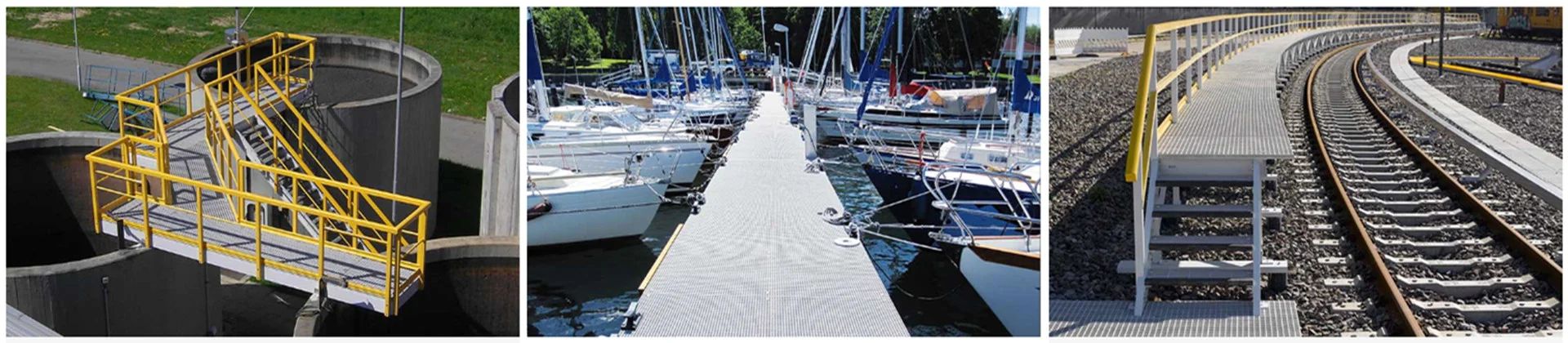
Unicomposite also manufactures related FRP products such as rods, tubes, structural profiles, grating, handrails, cable trays, ladders, rebar, road markers, tent poles, tool handles, and custom composite components. This can help buyers consolidate related FRP sourcing when a project requires more than one product type.
How can buyers decide whether they need a standard or custom FRP stake?
Buyers can choose standard FRP stakes when the application uses common lengths, simple installation, and normal outdoor exposure. Custom FRP stakes are better when the project needs special geometry, color, holes, tips, resin requirements, packaging, or integration with fence hardware.
A standard round rod may work for general boundary marking. A square or flat custom profile may work better when the stake must align with clips, wire, mesh, brackets, or OEM assemblies.
The best approach is to share the application first. A qualified manufacturer can then recommend whether a standard product is enough or whether customization will reduce installation work and long-term risk.
Requesting a Quote for Fiberglass Fence Stakes
A clear RFQ helps both buyers and suppliers move faster. Before contacting a manufacturer, buyers should define the product, the environment, and the commercial requirement.
Include length, diameter or profile size, quantity, color, resin expectation, installation environment, surface features, hole pattern, tip style, packaging method, delivery destination, and target timeline. If drawings, photos, or samples exist, include them with the first inquiry.
For engineering teams, define unusual conditions such as strong wind, repeated bending, livestock pressure, chemical exposure, coastal salt, snow, or electrical proximity. For procurement teams, separate required features from optional features so the supplier can quote a practical solution.
Use this decision framework:
- Choose fiberglass fence stakes when corrosion resistance, electrical insulation, lightweight handling, and reduced maintenance are priorities.
- Choose wood for short-term, light-duty, low-cost use where replacement is acceptable.
- Choose steel when heavy impact resistance or high structural load is the main requirement.
- Request samples, tolerances, material details, quality documents, and packaging confirmation before bulk purchase.
- Work with a manufacturer that can support standard supply, custom pultrusion, secondary processing, and export logistics.


