 info@unicomposite.com


Introduction
Outdoor rods face sunlight, salt, fertilizers, temperature cycling, wind, impact, and repeated clamping. These forces can expose weaknesses that remain invisible during warehouse inspection.
A hollow fiberglass rod for outdoor use can provide long service when its resin, reinforcement, geometry, surface system, and connections match the environment. This guide helps engineers and procurement teams define those requirements, compare alternatives, and request evidence that supports a reliable purchasing decision.
Why Hollow Fiberglass Rod Performs Well Outdoors
Fiberglass reinforced polymer combines glass reinforcement with a cured thermoset resin. The glass carries much of the load, while the resin binds the reinforcement, transfers stress, and protects it from moisture and chemicals.
hollow fiberglass rod
Corrosion Resistance in Wet and Chemical Environments
FRP does not rely on a zinc layer or paint system to prevent rust. This gives it an advantage around salt spray, wastewater, fertilizers, and many industrial chemicals. Resin choice still matters because concentration and temperature affect chemical resistance.
ASTM D570 covers water absorption testing for plastics, including laminated rod and tube forms. ASTM notes that finished-product testing can also support product-uniformity control, making it more useful than generic resin data alone.
How Does Hollow Fiberglass Rod Handle UV Exposure?
Hollow fiberglass rod can handle long-term sunlight when the laminate includes UV inhibitors, stable pigmentation, a resin-rich surface, and an appropriate veil or coating. Poor protection may lead to fading, chalking, roughness, and exposed fibers. UV testing should compare retained properties and appearance after a defined exposure cycle.
ASTM G154 provides controlled fluorescent UV, moisture, and heat exposure procedures. The standard also warns that the apparatus alone does not establish an exact outdoor lifespan or reproduce saltwater, pollution, and biological attack.
Thermal Stability and Weather Cycling
Pultruded glass-fiber profiles usually expand less than aluminum and many plastics. Exel Composites reports typical coefficients of thermal expansion around 9 to 11 × 10⁻⁶/K for polyester fiberglass profiles, while the precise value depends on resin and reinforcement architecture.
Buyers should also confirm the operating-temperature range and retained properties at temperature. A room-temperature tensile figure cannot describe creep, impact, or long-duration loading during hot outdoor service.
Structural Design Factors That Affect Service Life
Environmental resistance creates the foundation. Geometry and reinforcement determine whether the rod can carry its loads without excessive deflection, crushing, or splitting.
Wall Thickness, Diameter, and Load Capacity
Outside diameter alone is incomplete. Engineers should define inside diameter, wall thickness, unsupported length, load direction, connection details, and acceptable deflection.
For example, a 25 mm outside-diameter tube with a 2 mm wall has a second moment of area of about 9,628 mm⁴. Increasing the wall to 4 mm raises it to about 15,075 mm⁴, approximately 57 percent higher. Visually similar rods can therefore have very different bending stiffness.
Why Does Fiber Orientation Matter Outdoors?
Longitudinal fibers carry most axial tension and bending loads. Transverse mat, stitched reinforcement, or wound fibers improve hoop strength, splitting resistance, impact tolerance, and performance around holes or clamps. Pulwinding is useful when a tube must resist torsion or multidirectional stress as well as lengthwise loading.
Unicomposite uses pultrusion for constant-section profiles and pulwinding when greater transverse strength and stiffness are needed. Process choice should follow the load path, connection design, and handling conditions.
Surface Finish and Moisture Protection
A resin-rich outer layer and surfacing veil help cover reinforcement and support weather resistance. Strongwell specifies UV inhibitors in several polyester and vinyl ester structural-profile series and varies resin systems for general or harsher corrosive environments.
Production samples should be checked for dry fibers, cracks, resin-starved areas, waviness, deep scratches, and exposed reinforcement. Cut ends and drilled holes may require sealing where water or chemicals can enter the hollow section.
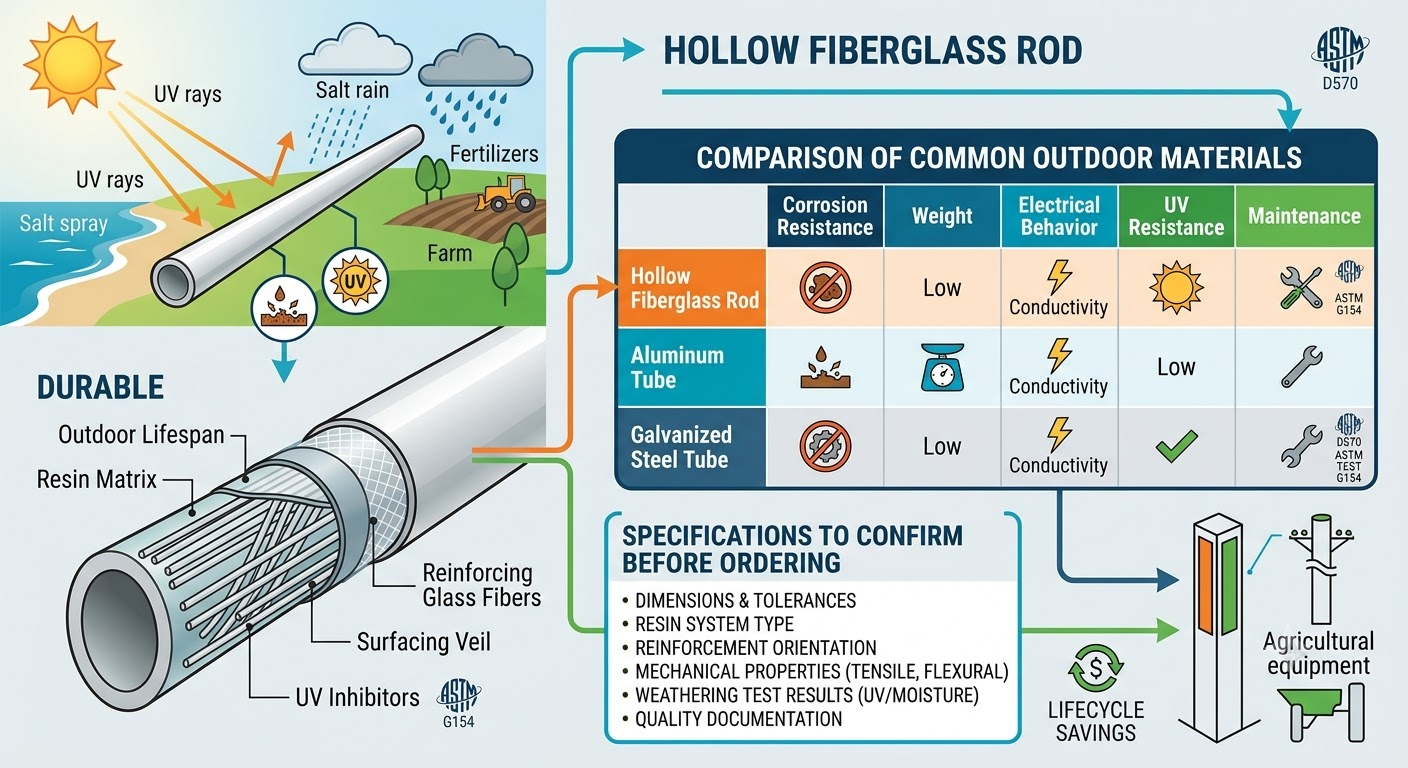
Hollow Fiberglass Rod vs Common Outdoor Materials
The table below compares common options under typical outdoor conditions. Final selection depends on grade, coating, geometry, and design load.
| Material | Corrosion Behavior | Weight | Electrical Behavior | Outdoor Limitation | Typical Maintenance |
|---|---|---|---|---|---|
| Hollow fiberglass rod | Resists rust without metallic coating | Low | Low conductivity | Needs suitable UV and resin system | Inspection and local repair |
| Aluminum tube | Oxide layer offers some protection | Low | Conductive | Galvanic and chemical attack can occur | Cleaning and connection checks |
| Galvanized steel tube | Relies on zinc coating | High | Conductive | Cut edges and coating damage may rust | Coating repair |
| PVC pipe | Resists many wet environments | Very low | Low conductivity | Lower stiffness and temperature capability | Deformation checks |
Fiberglass suits utility supports, coastal installations, agricultural equipment, markers, and OEM assemblies where corrosion resistance, electrical isolation, and handling weight matter together. Steel can remain preferable where high modulus, concentrated loads, or elevated-temperature performance dominate.
Specifications Buyers Should Confirm Before Ordering
A purchase specification should connect each requirement with evidence. Terms such as “heavy duty” or “weather resistant” leave too much room for interpretation.
| Specification | What to Confirm | Why It Matters Outdoors | Evidence to Request |
|---|---|---|---|
| Dimensions | OD, ID, wall, length, straightness, tolerances | Controls fit and stiffness | Approved drawing and inspection report |
| Resin system | Type and additives | Affects chemicals, heat, moisture, and cost | Resin designation and compatibility data |
| Reinforcement | Glass content, orientation, veil, wound layers | Controls directional properties | Laminate description and test report |
| Mechanical properties | Tensile, flexural, modulus, bearing, impact | Supports calculations | Finished-profile or representative coupon data |
| Weathering | UV cycle, moisture cycle, retained properties | Indicates comparative durability | Method, cycle, lamp type, and results |
| Quality control | Batch ID, dimensions, visual criteria | Reduces lot variation | Traceability and release records |
Which Resin System Is Best for Outdoor Use?
Polyester suits many cost-sensitive general outdoor applications. Vinyl ester is commonly selected for stronger chemical resistance and harsher wet environments. Epoxy may support demanding mechanical, bonding, or electrical requirements. Selection depends on exposure, temperature, fire requirements, expected life, manufacturing process, and verified results.
ASTM D638 produces tensile data for plastics, though ASTM cautions that specimen preparation, loading rate, and environment influence results. For continuous high-modulus fiber composites, ASTM points users toward ASTM D3039/D3039M. ASTM D790 covers flexural testing and notes that depth, temperature, atmosphere, and strain rate affect results.
hollow fiberglass rod for outdoor use
Testing and Quality Documentation
Buyers should ask whether each value comes from a resin casting, machined coupon, representative laminate, or finished hollow profile. The report should identify conditioning, specimen orientation, test speed, temperature, failure mode, and sample size.
For repeat production, an approved first article plus dimensional and visual records provides a stronger baseline than a catalog sheet alone. Strongwell describes first-article testing for each EXTREN production run as part of its quality approach.
Outdoor Applications and Selection Guidance
Utilities may use hollow FRP profiles for marker posts, insulating supports, cross-arm components, tool shafts, and nonconductive assemblies. These applications require application-specific dielectric verification because contamination, moisture, wall thickness, and hardware can affect performance.
Agricultural, landscaping, aquaculture, and marine projects add fertilizer, salt, wet soil, impact, and repeated handling. Thicker walls, reinforced ends, or wound layers may be justified where workers drive, clamp, or reposition rods frequently.
Unicomposite supplies FRP products for utilities, infrastructure, agriculture, and marine-related environments, including rods, profiles, cross arms, and garden supports. Custom work may include length control, color, machining, inserts, bonding, and end fittings.
Installation Practices That Extend Outdoor Service Life
Carbide or diamond tooling, stable workholding, dust extraction, and controlled feed help reduce splintering and heat damage during cutting and drilling. Operators should inspect edges for loose fibers, cracks, discoloration, and delamination before assembly. Strongwell also recommends rigid support during cutting and sealing cut surfaces when required.
Wide washers, shaped saddles, bonded inserts, or internal sleeves can spread bearing and clamp loads. Holes placed too close to an end increase splitting risk, especially when the laminate contains limited transverse reinforcement.
Field inspection should record chalking, exposed fibers, impact damage, loose hardware, coating wear, and water entry. Installation photographs create a useful comparison point for later inspections.
Procurement and Total Cost Considerations
Lifecycle cost gives buyers a clearer comparison than unit price. The example below is illustrative and uses disclosed assumptions for one installed component over 15 years.
| Cost Element | Galvanized Steel | Hollow FRP |
|---|---|---|
| Purchase | $30 | $55 |
| Initial handling and installation | $20 | $15 |
| Coating repair at year 5 | $15 | $0 |
| Replacement at year 10 | $50 | $0 |
| Inspection and minor repair | $10 | $5 |
| 15-year total | $125 | $75 |
Under these assumptions, FRP costs 40 percent less. A real model should include shipping, access equipment, shutdowns, labor rates, corrosion severity, residual value, and replacement intervals.
Supplier qualification should cover process control, material traceability, dimensional capability, machining trials, approved samples, packaging, capacity, and lead time. Data should identify the exact profile family and test conditions.
Conclusion
A durable hollow fiberglass rod for outdoor use depends on aligned design and purchasing decisions:
- Match the resin and surface system to UV, moisture, chemicals, and temperature.
- Specify both diameters, wall thickness, reinforcement orientation, loads, and deflection limits.
- Request finished-profile data, weathering details, drawings, and traceable inspection records.
- Protect machined areas and distribute clamp, bolt, and bearing loads.
- Compare installed lifecycle cost across the intended service period.
[Contact Unicomposite to discuss a custom hollow fiberglass rod specification →]


