 info@unicomposite.com


Introduction
A low unit price becomes expensive when solid fiberglass rods arrive with drifting diameters, incomplete curing, exposed fibers, or machined features that miss the drawing. These defects can interrupt assembly, increase inspection work, and shorten service life.
This guide shows you how to compare solid fiberglass rods manufacturers by application fit, production control, test evidence, total cost, and delivery reliability.
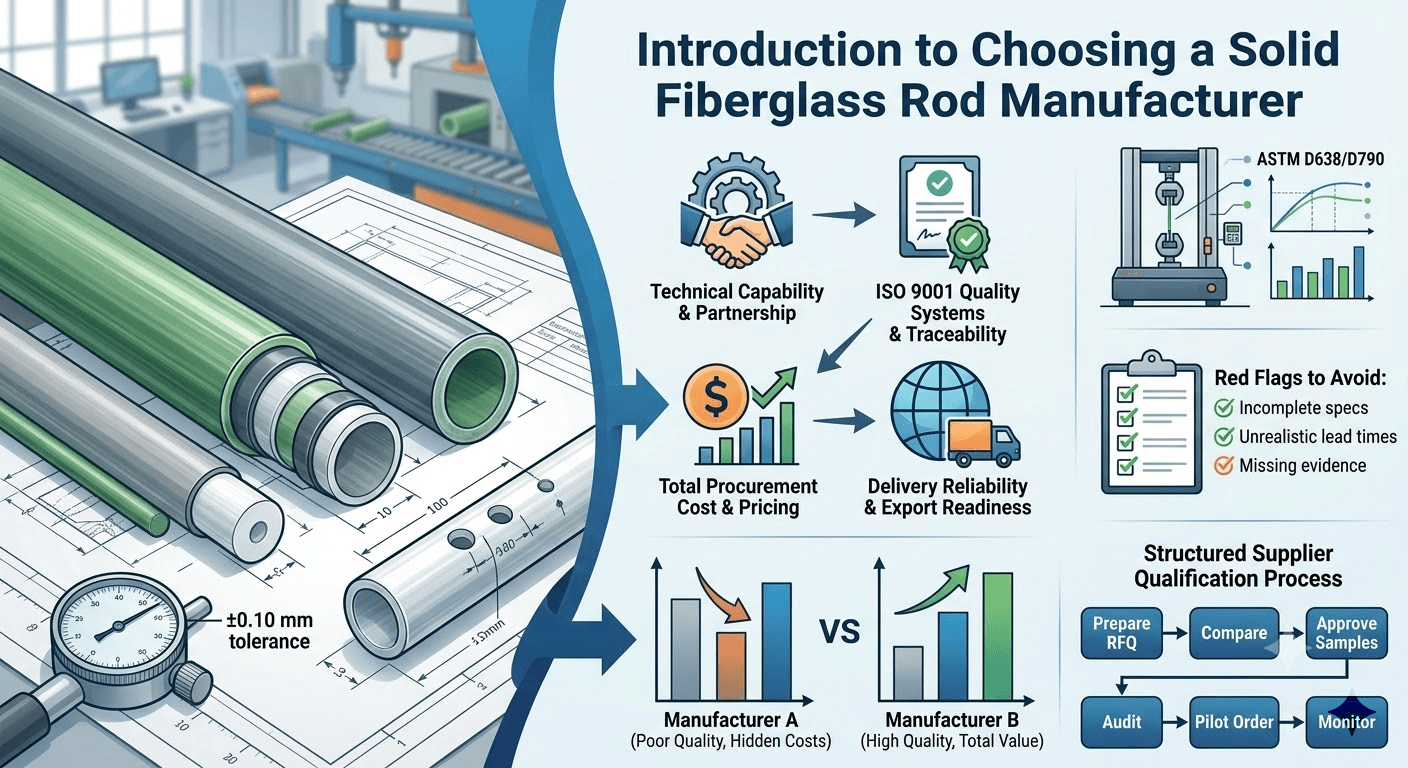
introduction to choosing a solidfiberglass rod manufacturer
Define Your Application and Performance Requirements
Begin with operating conditions. A manufacturer cannot select the correct resin, reinforcement, surface treatment, or tolerance until you define how the rod will be loaded and where it will operate.
What Specifications Should You Define Before Contacting Manufacturers?
Define diameter, cut length, tolerances, resin system, reinforcement content, tensile and flexural requirements, service temperature, moisture or chemical exposure, dielectric needs, machining, finish, packaging, and expected life. This lets every supplier quote the same scope and reveals substitutions before production.
ASTM D638 produces tensile data for material control and specification, while ASTM D790 covers flexural properties through three point loading. Results can vary with specimen preparation, conditioning, temperature, and test rate, so compare reports only when test conditions are equivalent.
ASTM D570 measures water absorption in plastics, including finished rod and tube products. ASTM D2584 can help estimate resin content in glass reinforced systems through ignition loss, subject to the method’s limitations.
| Application | Key Requirement | Evidence to Request | Main Risk |
|---|---|---|---|
| Electrical insulation | Dielectric and moisture stability | ASTM D149 and D570 data | Assuming all FRP grades perform equally |
| Chemical processing | Resistance to named chemicals | Resin compatibility data | Accepting a general corrosion claim |
| Outdoor structures | UV and moisture durability | Weathering cycle and surface system | Fiber bloom or surface erosion |
| Agricultural supports | Flexibility and safe handling | Flexural target and smooth finish | Splinters or inconsistent stiffness |
| Machined OEM parts | Repeatable geometry | Drawing and first article report | Assembly failure from dimensional drift |
ASTM D149 covers dielectric strength testing of solid electrical insulating materials under specified conditions.
An OEM might specify a 10.00 mm diameter with a tolerance of ±0.10 mm and hole positions within ±0.25 mm. These values are illustrative. Your load and assembly process should determine the final limits.
Clear acceptance criteria create a reliable basis for supplier comparison.
Evaluate Manufacturing Processes and Technical Capability
Next, examine how the factory controls fiber placement, resin wet out, curing, pulling, and cutting. Pultrusion is a continuous process for constant cross section profiles and is widely used for automated, high volume composite production.
Review reinforcement tension, resin mixing, die temperature, pulling speed, and cure stability. Look for dry fibers, resin rich areas, cracks, voids, warping, uneven color, eccentricity, and breakout at cut or drilled edges.
How Do Pultrusion and Pulwinding Differ?
Pultrusion mainly places continuous reinforcement along the profile length, supporting efficient production and strong axial performance. Pulwinding adds angled or circumferential reinforcement, which may improve transverse or torsional behavior when the rod faces multidirectional loading.
| Process | Main Strength | Typical Output | What to Verify |
|---|---|---|---|
| Pultrusion | Continuous axial reinforcement | Rods, tubes, beams | Die control and batch consistency |
| Pulwinding | Added angled reinforcement | Specialized rods and tubes | Winding angle and test evidence |
| Compression molding | Repeatable complex shapes | SMC and BMC parts | Tool condition and flash control |
| Hand lay up | Flexible tooling | Panels and custom structures | Operator and laminate records |
| Vacuum infusion | Controlled resin flow | Panels and shells | Vacuum and resin flow records |
Confirm whether cutting, drilling, grinding, threading, coating, and end finishing are completed in house. Outsourced steps create additional risks for dimensions, lot identity, and delivery.
Unicomposite reports an ISO 9001 certified, 18,000 square meter facility using pultrusion, pulwinding, molding, hand lay up, and vacuum infusion for standard and customized FRP products.
Manufacturing capability matters when it connects directly to your drawing and load case.
Verify Quality Systems and Material Traceability
A capable production line still needs documented quality control. ISO 9001 defines requirements for establishing, maintaining, and improving a quality management system. Certification supports process confidence, though it does not prove that a specific rod batch meets your specification.
Which Test Reports Should a Manufacturer Provide?
Request dimensional records, mechanical test reports, resin and glass documentation, reinforcement content results, batch identification, certificates of analysis, and required electrical or environmental data. Reports should identify the material system, specimen preparation, method, date, laboratory, and production lot.
Traceability should connect resin and glass lots to the production date, line record, inspection report, finished lot, packing list, and order. For a new custom rod, inspect every drawing dimension on first article samples and check the start, middle, and end of the pilot run.
This evidence supports repeat orders, corrective action, and warranty investigation.

solid fiberglass rods manufacturers
Assess Customization and Engineering Support
A strong supplier converts functional needs into a manufacturable specification. Ask whether it can adjust diameter, length, resin, pigment, reinforcement, surface finish, machining, and packaging without losing process stability.
Good engineering support includes drawing review, tolerance analysis, test alignment, sample planning, and revision control. Warning signs include vague answers, silent substitutions, missing drawing revisions, and reluctance to define acceptance limits.
Consider an illustrative OEM qualification scenario. A buyer requires 10.00 ±0.10 mm rods with drilled holes positioned within ±0.25 mm. The supplier produces 10 first article samples, records every critical dimension, checks cut end quality, and confirms the resin batch before a 500 piece pilot order.
Engineering support should remove ambiguity before volume production.
Compare Pricing, Capacity, and Total Procurement Cost
After technical screening, compare tooling, samples, machining, inspection, packaging, freight, duties, rework, stoppages, and replacement risk.
In an illustrative 10,000 piece order, Supplier A quotes $1.00 per rod and creates $3,000 in sorting and rework, totaling $13,000. Supplier B quotes $1.15 with verified inspection and no rework, totaling $11,500.
| Evaluation Category | Weight | Evidence Required |
|---|---|---|
| Technical capability | 25% | Equipment and engineering review |
| Quality and traceability | 25% | QMS certificate and lot records |
| Price and total cost | 15% | Full quotation and logistics assumptions |
| Delivery reliability | 15% | Capacity plan and shipment history |
| Engineering support | 10% | Drawing feedback and change control |
| Documentation | 10% | Complete RFQ and export records |
Verify capacity through available lines, tooling, shifts, maintenance, and raw material supply. A monthly output claim has little value when the required die or resin is unavailable during your delivery window.
A weighted scorecard reveals the lowest controlled cost.
Review Delivery Reliability and Export Readiness
Separate tooling, sample approval, production, inspection, booking, and transit when reviewing lead time.
Long rods need suitable supports, protected ends, abrasion barriers, readable labels, and packaging compatible with unloading equipment. A three meter bundle usually requires more support than a one meter bundle to control handling deformation.
For export orders, confirm the commercial invoice, packing list, certificate of origin when required, test reports, shipping marks, HS code support, and destination specific packaging rules.
Delivery discipline protects the value created during production and inspection.
Identify Red Flags Before Placing a Bulk Order
Compare the quotation, drawing, material declaration, test report, sample label, and production schedule for matching details.
How Can You Spot an Unreliable Manufacturer?
Watch for incomplete specifications, changing quotations, missing test evidence, unrealistic lead times, unclear production ownership, unexplained substitutions, and resistance to sample inspection. Repeated inconsistencies across technical and commercial documents justify deeper verification.
Challenge terms such as high strength, corrosion resistant, and maintenance free. Ask for the property, test method, specimen direction, conditioning, temperature, exposure duration, and acceptance limit.
ASTM G154 provides procedures for controlled UV and moisture exposure, yet it does not define one universal cycle or predict every field environment. Weathering claims should identify the actual cycle and measured property retention.
Use registration checks, live video audits, traceability records, and third party inspection when factory capability remains unclear.
Run a Structured Supplier Qualification Process
Use a controlled approval sequence:
- Prepare the RFQ: Include drawings, tolerances, resin, tests, quantities, packaging, and destination.
- Compare responses: Record assumptions, exceptions, and alternatives before reviewing price.
- Approve samples: Inspect appearance, dimensions, machining, material identity, and packaging.
- Audit the factory: Review equipment, process records, calibration, traceability, and laboratory capability.
- Place a pilot order: Validate consistency, documentation, packaging, and delivery.
- Monitor performance: Track defects, on time delivery, corrective actions, and batch consistency.
Before approval, obtain a signed drawing, material declaration, inspection plan, approved sample, test evidence, packaging specification, lead time, and change notification procedure.
This process creates an auditable supplier decision.
Conclusion
Choosing solid fiberglass rods manufacturers starts with a measurable application specification. Connect material claims to test methods, inspect production and traceability controls, compare total procurement cost, and validate performance through first articles and pilot production.
A qualified supplier should provide consistent manufacturing, transparent records, engineering support, controlled secondary processing, and reliable export delivery.
[Contact Unicomposite to discuss your solid fiberglass rod specifications →]


